Listen to this Post
Introduction:
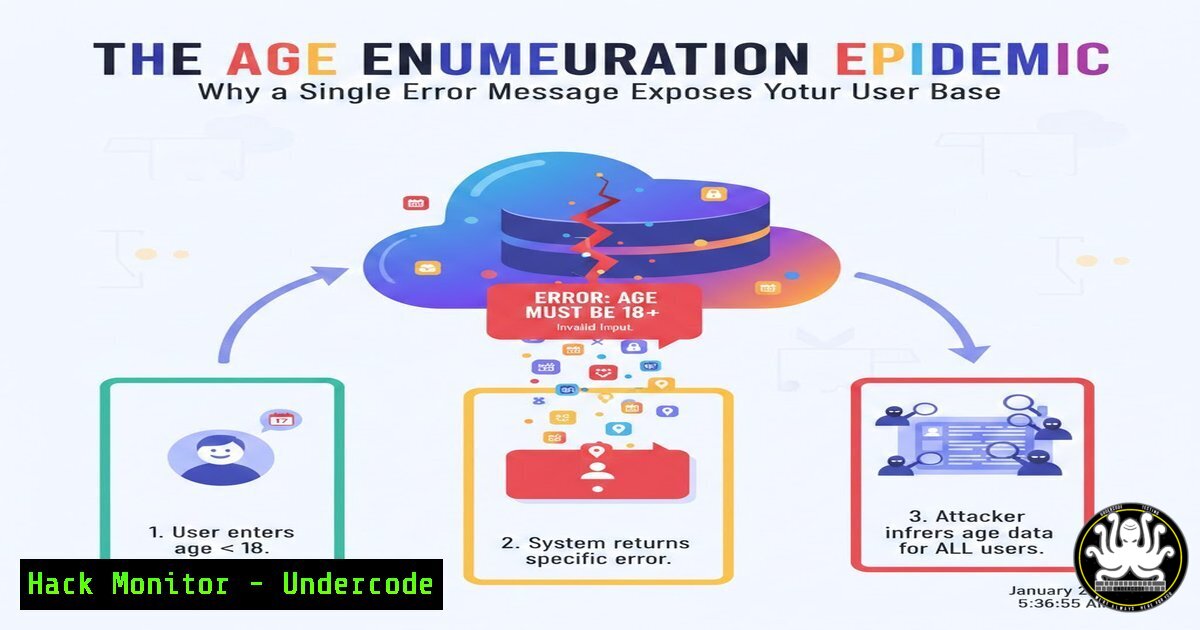
A seemingly trivial error message revealing a user’s age is far more than a comedic disclosure; it represents a critical class of Information Disclosure vulnerability that attackers leverage for sophisticated profiling and targeted attacks. In an era of data privacy regulations like GDPR and CCPA, such leaks transform minor bugs into severe compliance violations and entry points for credential stuffing, social engineering, and account takeover campaigns. This article deconstructs the age enumeration vulnerability, moving beyond the meme to explore its exploitation, impact, and definitive remediation.
Learning Objectives:
- Understand how improper error handling leads to user enumeration and data leakage.
- Learn to manually and automatically test for information disclosure vulnerabilities in web applications.
- Implement secure coding practices and server configurations to neutralize enumeration attacks across common tech stacks.
You Should Know:
1. The Anatomy of an Age Enumeration Vulnerability
This vulnerability typically occurs during processes like account registration, password reset, or profile updates. When an application checks for age restrictions (e.g., “Users must be 13+”), it may return distinct error messages for “age too young” versus “user not found.” This allows an attacker to infer valid user data.
Step‑by‑step guide explaining what this does and how to use it.
Step 1: Reconnaissance. Identify input points related to user age: sign-up forms, birthday fields in account settings, or age-gated content access.
Step 2: Manual Testing.
Scenario A: Registration. Submit a birth date like 2005-05-05. If the response is “You must be at least 18 years old,” you’ve confirmed an age check.
Scenario B: “Forgot Password” Flow. Enter a known email with a birth date. Then, enter the same email with a wildly different birth date. If the error changes from “Incorrect date of birth” to “Email not found,” you can enumerate registered users.
Step 3: Automation with cURL/Burp Suite. Use tools to systematize the attack.
Linux/Mac (cURL):
 Test for differential responses
curl -X POST https://target.com/api/check-age -H "Content-Type: application/json" -d '{"email":"[email protected]", "dob":"2010-01-01"}'
 Observe response, then test with a non-existent email
curl -X POST https://target.com/api/check-age -H "Content-Type: application/json" -d '{"email":"[email protected]", "dob":"2010-01-01"}'
Windows (PowerShell): Use `Invoke-RestMethod` with similar JSON payloads.
Burp Suite: Use Intruder to cycle through a list of emails with a fixed young DOB, then grep-extract for differentiating error messages.
2. From Enumeration to Exploitation: Building Attack Chains
A standalone age leak might be rated “Low” or “Informational,” but its real danger lies in chaining. Leaked age data enriches attacker profiles for precise social engineering.
Step‑by‑step guide explaining what this does and how to use it.
Step 1: Data Correlation. Combine enumerated age data with other leaks (e.g., username from login page errors) to build a profile: {email: [email protected], age: 17, known_platform: "TargetApp"}.
Step 2: Crafting Targeted Phishing. An attacker can craft a convincing phishing email: “As you are 17, your account requires parental consent. Click here to verify…” The inclusion of the correct age drastically increases credibility.
Step 3: Password Spraying. Knowing the user’s birth year (e.g., 2005) allows attackers to generate potential passwords: Spring2005!, Victor2005, Jan2005@. Use a tool like `Hydra` or a custom Python script for targeted spraying.
- Secure Error Handling: The First Line of Defense
The core fix is to implement generic error messages that do not disclose the reason for failure for any user-related operation.
Step‑by‑step guide explaining what this does and how to use it.
Backend Code Examples:
Node.js/Express:
// INSECURE
if (user.age < 18) { return res.status(400).json({ error: "You must be 18 or older." }); }
if (!user) { return res.status(404).json({ error: "User not found." }); }

// SECURE - Generic Response
app.post('/validate', async (req, res) => {
const { email, dob } = req.body;
const user = await User.findOne({ email });
// Consolidated, generic error
if (!user || calculateAge(dob) < 18) {
return res.status(400).json({ error: "Validation failed. Please check your information or contact support." });
}
// Success logic...
});
Python/Django: Use a single validation function that raises a generic ValidationError("Invalid input.").
Logging: Detailed errors (for debugging) must be written to secured server logs, never returned to the client.
4. Implementing Rate Limiting and Monitoring
Prevent automated enumeration by limiting request rates and monitoring for suspicious patterns.
Step‑by‑step guide explaining what this does and how to use it.
Step 1: Implement Application-Level Rate Limiting.
Using Nginx (`nginx.conf`):
http {
limit_req_zone $binary_remote_addr zone=one:10m rate=10r/m;

server {
location /api/check-age {
limit_req zone=one burst=5 nodelay;
proxy_pass http://your_backend;
}
}
}
Using Cloudflare WAF: Create a rate limiting rule for the specific endpoint path.
Step 2: Set Up Alerting. Use your monitoring stack (e.g., Elastic SIEM, Splunk) to trigger alerts on patterns like >100 POST requests to /api/check-age from a single IP in 2 minutes.
5. Advanced Mitigation: Cryptographic Age Verification
For high-sensitivity applications, move beyond simple date submission.
Step‑by‑step guide explaining what this does and how to use it.
Concept: Use a zero-knowledge proof or trusted third-party verification service where the user proves they are over a threshold age without revealing their actual birth date.
Implementation Consideration: This is complex. A practical intermediate step is to hash the date of birth with a user-specific salt before sending it to the backend for comparison, preventing trivial observation of the raw DOB in transit. However, the backend comparison logic must still avoid differential responses.
What Undercode Say:
Key Takeaway 1: Never underestimate “informational” vulnerabilities. In isolation, they may seem trivial, but in the hands of a skilled attacker, they become critical pivot points in a kill chain, directly enabling more severe attacks like credential stuffing and sophisticated phishing.
Key Takeaway 2: Security is a continuum of context. What might be a low-severity issue on a public blog comment system becomes a high-severity, compliance-breaking flaw in a healthcare portal or a social media platform used by minors. Risk must be assessed based on the application’s data and user base.
The meme highlights a pervasive developer mindset: functional feedback over security. The joke resonates because professionals constantly battle to elevate the perceived risk of such flaws. The shift-left movement demands that secure error handling be a non-negotiable requirement in the first code review, not an afterthought post-disclosure. As AI-powered scraping and automation become cheaper, the cost of exploiting these “small” leaks plummets, making their remediation an urgent priority.
Prediction:
Within the next 2-3 years, automated bug bounty and penetration testing tools will integrate advanced NLP to specifically hunt for and chain these subtle information disclosure flaws, dramatically increasing their exploitability and thus their market value in underground forums. Simultaneously, regulatory bodies will begin issuing fines specifically for enumeration vulnerabilities under the “failure to implement appropriate technical measures” clauses of privacy laws, forcing a top-down mandate for generic error handling across all industries. The “funny” P1 will become a costly P0.
▶️ Related Video (78% Match):
🎯Let’s Practice For Free:
IT/Security Reporter URL:
Reported By: Md Nawshad – Hackers Feeds
Extra Hub: Undercode MoN
Basic Verification: Pass ✅


