
Listen to this Post
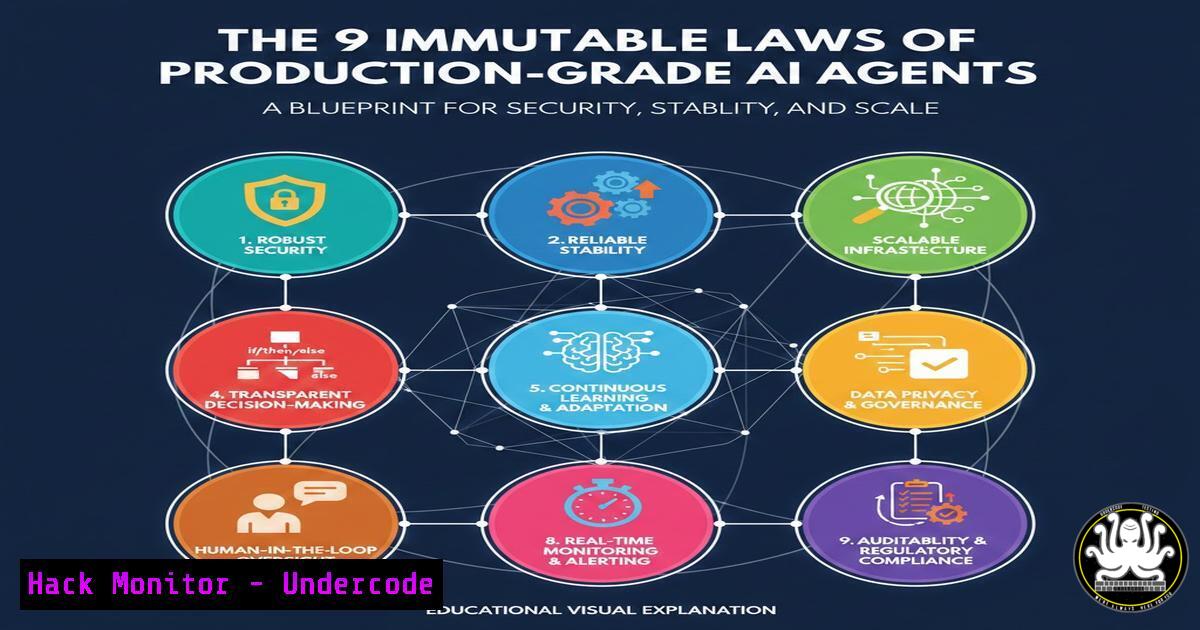
Introduction:
The landscape of artificial intelligence is shifting from simple chatbots to complex, autonomous agents capable of executing multi-step tasks. However, deploying these agents in a production environment introduces a new class of technical debt and security vulnerabilities. A “thin” architecture that merely prompts a Large Language Model (LLM) is a recipe for disaster, leading to infinite loops, data leakage, and unpredictable outputs. To build reliable, enterprise-ready AI agents, developers must adopt a layered architectural approach that treats input validation, state management, and governance with the same rigor as traditional software engineering, effectively transforming an experimental model into a hardened production system.
Learning Objectives:
- Understand the nine critical architectural layers required to move AI agents from prototype to production.
- Learn to implement strict input validation using Pydantic to prevent prompt injection and enforce data schemas.
- Master the configuration of tool-use layers, including the Model Context Protocol (MCP), and orchestration logic using graph-based frameworks like LangGraph to manage complex agent workflows and prevent execution errors.
You Should Know:
- The Fortified Gate: Strict Input Schemas & Validation
The most common mistake in agent development is trusting the user. In production, you cannot allow raw, unfiltered text to be passed directly into the model’s context window. This is the primary vector for prompt injection attacks, where a user could hijack the agent’s instructions.
To build this layer, we treat the input as untrusted data. Before any data reaches the LLM, it must be classified, cleaned, and structured. The goal is to enforce a strict schema that the model must adhere to when generating a response.
Step-by-step guide using PydanticAI:
Pydantic is a data validation library for Python that enforces type hints at runtime. When integrated with AI frameworks, it forces the LLM to return data in a precise, machine-readable format.
1. Define the Schema: Create a Pydantic model that represents the exact structure of the data you expect from the agent.
from pydantic import BaseModel, Field
from typing import Literal

class SupportTicket(BaseModel):
urgency: Literal['low', 'medium', 'high'] = Field(description="Urgency level of the request")
user_id: str = Field(description="The authenticated user ID", pattern=r'^USR-\d+$')
issue_category: str = Field(description="Category of the issue, e.g., 'billing', 'technical'")
description_summary: str = Field(description="A cleaned, 50-word summary of the issue")
2. Bind the Schema to the Agent: When calling your agent (e.g., via LangChain, PydanticAI’s own library, or OpenAI function calling), instruct the model that its output must conform to this Pydantic model. If the output doesn’t match, the request is rejected before it proceeds.
3. Implement an Input Classifier: Before validation, run the raw input through a lightweight classifier (or even a set of regex rules) to detect obvious malicious payloads, such as base64 encoded strings or “ignore previous instructions” phrases. If flagged, the request is blocked at the edge.
2. The Strategic Mind: Reasoning, Planning, and Orchestration
Once a clean input is received, the agent needs a strategy. Relying on the LLM to “figure it out” leads to unpredictable results. You must implement a reasoning layer and an orchestration layer to control the agent’s logic flow.
The Reasoning layer (often using the ReAct pattern—Reason + Act) allows the agent to generate thoughts before calling tools. The Orchestration layer defines the paths the agent can take, preventing infinite loops by using graph-based logic.
Step-by-step guide using LangGraph for Orchestration:
LangGraph allows you to define agent workflows as cyclic graphs, offering more control than simple chains.
1. Define the State: Create a state object that holds information passed between nodes (e.g., messages, remaining steps, intermediate results).
2. Create Nodes: Nodes are the functions or agents that perform specific tasks (e.g., classify_input, search_knowledge_base, generate_response).
3. Define Edges (The Orchestrator): Edges determine the routing logic. Instead of letting the LLM decide the next step arbitrarily, you can use conditional edges.
– Example (Conceptual): After the `classify_input` node, an edge checks the classification. If the result is “technical_support”, route to the `tech_agent` node. If it’s “billing”, route to the `billing_agent` node.
4. Implement Recursive Planning: For complex tasks, implement a planning node. This node takes the user’s high-level goal and breaks it into a Directed Acyclic Graph (DAG) of sub-tasks. The orchestrator then executes this DAG, ensuring tasks are completed in the correct order (e.g., you must “authenticate user” before you can “access user profile”).
- The Execution Hands: Tool Use, Memory, and Reflection
An agent without tools is just a language model. The Tool Layer provides secure “hands” (APIs, database queries, calculators). However, tools can fail. The Reflection Engine acts as a self-correction mechanism, allowing the agent to review its own output and the success of its tool calls.
Step-by-step guide for a resilient execution flow:
- Secure Tool Definition with MCP: Define tools using the Model Context Protocol (MCP) or typed interfaces. This standardizes how the model requests an action. For a Linux server task, a tool might be defined to execute a specific, sandboxed shell command.
– Tool Example (Conceptual): A tool named `execute_safe_command` would accept parameters like `command: ls` and path: /home/user, but it would be wrapped in a backend service that validates the path is within an allowed directory and runs the command with restricted permissions.
2. Stateful Memory: Store session context in a persistent database like PostgreSQL (using `pgvector` for semantic memory) or Redis. This separates short-term conversation history from long-term user preferences stored in a vector database.
-- Example: Storing session memory in PostgreSQL
CREATE TABLE agent_sessions (
session_id UUID PRIMARY KEY,
user_id VARCHAR(50),
messages JSONB, -- Stores the conversation history
metadata JSONB,
created_at TIMESTAMP DEFAULT NOW()
);
3. Implementing the Reflexion Engine:
- Step A (Act): The agent performs a task and generates an output.
- Step B (Reflect): A second, distinct agent process (or the same agent with a different prompt) receives the original goal and the agent’s output. It is tasked with evaluating if the output successfully fulfills the goal.
- Step C (Course Correct): If the reflection agent finds a misalignment (e.g., the agent was asked for a JSON summary but returned a paragraph), it sends the output back to the original agent with an error message, forcing it to try again or a different path. This loop repeats until success or a maximum retry limit is hit.
What Undercode Say:
- Security is Non-Negotiable: The foundational layers of input validation and governance are not optional. In a production environment, the cost of a successful prompt injection or data leak far outweighs the cost of implementing strict schema validation and PII redaction. Treat your agent’s prompt as a publicly exposed API endpoint.
- Determinism over Chaos: Relying solely on an LLM’s emergent abilities for complex workflows is a path to technical debt. The shift towards orchestration layers like LangGraph and explicit planning (DAGs) signifies a maturation of the field, bringing software engineering principles of state management and error handling to the world of AI.
The blueprint provided moves beyond simple prototyping by emphasizing operational rigor. It highlights that a production agent is not a single model, but a complex system composed of interconnected services, each with its own responsibility, from the input guard at the gate to the evaluator reviewing the final output. This layered approach is the only way to achieve the reliability and safety required for enterprise adoption.
Prediction:
Within the next 18 months, the concept of a standalone “AI Agent” will become obsolete, replaced by the standard practice of “Agentic Systems.” We will see the emergence of specialized SaaS platforms dedicated solely to specific layers of this stack (e.g., “Observability-as-a-Service for Agents,” “Governance Firewalls for LLMs”). The biggest competitive advantage for companies will not be the base LLM they use, but the robustness of their proprietary orchestration, tooling, and reflexion layers that sit on top of it.
▶️ Related Video (78% Match):
🎯Let’s Practice For Free:
IT/Security Reporter URL:
Reported By: Maryammiradi Your – Hackers Feeds
Extra Hub: Undercode MoN
Basic Verification: Pass ✅


