Listen to this Post
Introduction:
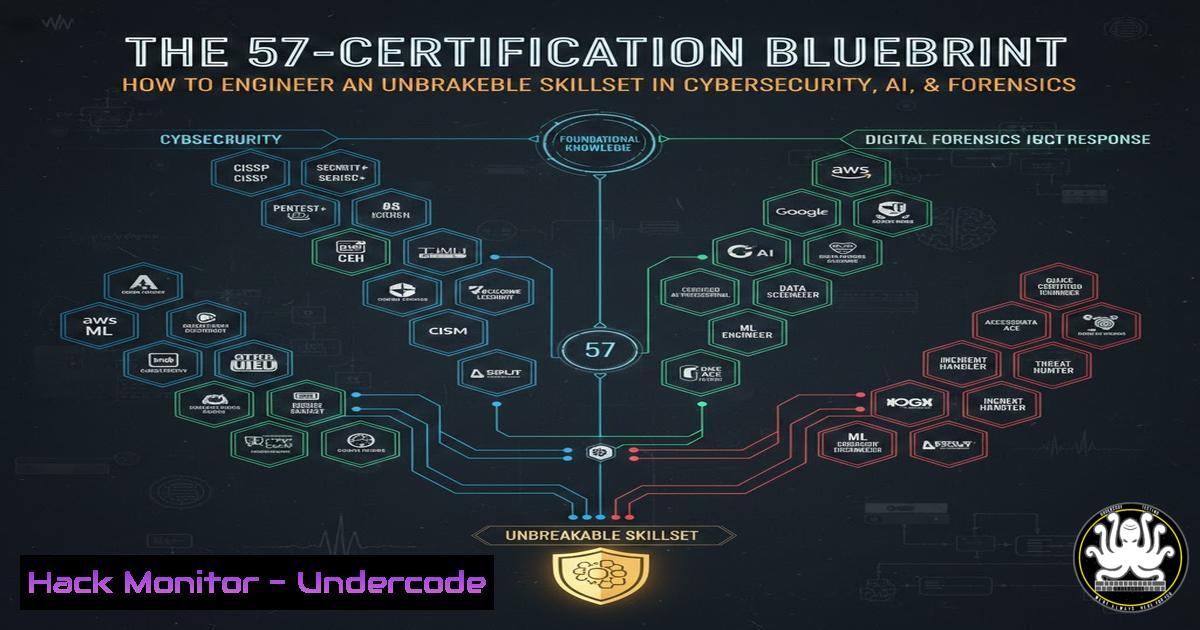
In an era where digital threats evolve faster than traditional defenses, the industry’s demand has shifted from generalists to hyper-specialized, multi-disciplinary engineers. The modern security expert is no longer just a firewall administrator but a hybrid professional capable of merging artificial intelligence with forensic investigation, and hardware development with cloud hardening. By examining a blueprint of 57 certifications across Cybersecurity, Forensics, AI Engineering, and Electronics Development, we can reverse-engineer the exact technical roadmap required to dominate the modern threat landscape.
Learning Objectives:
- Understand how to architect a multi-domain learning path that combines offensive security, defensive AI, and hardware exploitation.
- Identify the specific Linux, Windows, and embedded system commands necessary for real-world forensic acquisition and penetration testing.
- Learn to configure cloud environments and API gateways to withstand AI-powered cyber attacks.
You Should Know:
- The Forensic Acquisition Triage: Linux & Windows Command-Line Essentials
To replicate the forensic expertise implied by a multi-certification background, one must master the art of dead-box analysis and live response. In Linux, the foundation begins with using `dd` for bit-for-bit imaging:sudo dd if=/dev/sda of=/mnt/evidence/disk_image.dd bs=4096 conv=noerror,sync. For memory acquisition on a live Windows system, tools like DumpIt or the built-in `tasklist` and `netstat` commands provide a snapshot of running processes and network connections. A critical step is verifying image integrity using `sha256sum disk_image.dd` to maintain the chain of custody. This ensures that the digital evidence is forensically sound and admissible, mirroring the rigorous standards found in advanced forensic certifications. -
AI-Driven Threat Hunting: Configuring Machine Learning for Log Analysis
Moving into the AI engineering domain, the objective is to configure a machine learning pipeline that identifies anomalies. Using Python and the `scikit-learn` library, one can implement an Isolation Forest algorithm on system logs. First, convert Windows Event Logs (.evtx) to a CSV format using `python-evtx` scripts. Then, execute a basic model:from sklearn.ensemble import IsolationForest import pandas as pd data = pd.read_csv('security_logs.csv') model = IsolationForest(contamination=0.05) data['anomaly'] = model.fit_predict(data.select_dtypes(include=['number']))This script labels outliers—potential zero-day exploits—that traditional signature-based tools miss. The configuration of the API feeding these logs into the model requires securing the data stream with TLS 1.3 and OAuth2 tokens to prevent data poisoning.
-
Hardening the Cloud: Securing APIs Against AI Abuse
Cloud hardening, a core component of modern IT security, requires strict API gateway policies. Using AWS CLI, one can configure a Web Application Firewall (WAF) to mitigate AI-driven brute-force attacks. The command `aws wafv2 create-web-acl –name AIMitigationACL –scope REGIONAL –default-action Allow={} –rules file://waf-rules.json` applies rate-based rules. Insidewaf-rules.json, define a rule to block IPs exceeding 100 requests per minute, a common pattern for credential stuffing bots. Additionally, enforce bucket policies to prevent public exposure:aws s3api put-public-access-block --bucket critical-data-bucket --public-access-block-configuration BlockPublicAcls=true,IgnorePublicAcls=true. -
Vulnerability Exploitation & Mitigation: The Penetration Testing Toolkit
Understanding exploitation is key to building better defenses. Using Metasploit on a Kali Linux machine, a professional can simulate an attack on a vulnerable SMB service. The command `msfconsole -q` opens the console, followed by `use exploit/windows/smb/ms17_010_eternalblue` to target the EternalBlue vulnerability. After setting the payload (set payload windows/x64/meterpreter/reverse_tcp) and RHOSTS, the exploitation begins. Mitigation, however, lies in rapid patch management and using Windows Defender Firewall with Advanced Security to block port 445. The command `New-NetFirewallRule -DisplayName “Block SMB” -Direction Inbound -LocalPort 445 -Protocol TCP -Action Block` in PowerShell effectively neutralizes the attack vector. -
Embedded Systems and Electronics: Securing the IoT Periphery
Electronics development and hardware security often overlap in the Internet of Things (IoT) domain. Using the Arduino IDE and a simple ESP32 microcontroller, one can simulate a secure data transmission protocol. The code snippet involves initializing WiFi with encrypted credentials stored in flash memory (ESP8266WiFi.h). To harden the device, one must disable JTAG debugging interfaces post-deployment via firmware updates. In a Linux environment, checking for open serial ports with `ls /dev/tty` and analyzing UART communication with `minicom -D /dev/ttyUSB0` allows a security researcher to audit the hardware for backdoor access points. -
Comprehensive Network Defense: Linux Firewalls and Windows Auditing
A holistic security posture involves constant auditing. On a Linux server, implement `iptables` to create a stateful firewall:sudo iptables -A INPUT -m state --state ESTABLISHED,RELATED -j ACCEPT. For Windows, use the Security Compliance Toolkit to apply baseline policies viaLGPO.exe /t c:\baseline\GptTmpl.inf. Regular auditing is automated via `auditpol` commands to set success and failure logging for all account logon events, ensuring that no lateral movement goes unnoticed. The combination of these configurations ensures a hardened network that aligns with CIS Benchmarks.
What Undercode Say:
- The era of the isolated expert is over. The synthesis of AI, Forensics, and Hardware security is not just a collection of certifications but a necessary evolution to combat threats that exist at the intersection of code and physics.
- Practical command-line fluency remains the bedrock of cyber resilience. No matter how sophisticated the AI tool, the ability to manually acquire a disk image, block a port, or analyze a packet trace with `tcpdump` is the ultimate fail-safe when automated systems are compromised.
- The roadmap to 57 certifications is less about the quantity and more about the vertical integration of knowledge—from the silicon of an embedded chip to the abstract logic of a machine learning model. True mastery lies in defending the entire stack.
Prediction:
In the next three to five years, we will witness the rise of the “Full-Stack Defender”—a professional who moves fluidly between writing Python scripts for AI detection, soldering hardware implants for security testing, and responding to cloud incidents. As quantum computing and AI-generated malware become mainstream, the demand for this multidisciplinary engineer will skyrocket. The future of cybersecurity will belong not to those who simply accumulate certifications, but to those who use them to build bridges between disparate domains, creating a unified, intelligent, and adaptive defense mechanism. The blueprint outlined by a 57-certification profile is a preview of the standard requirements for CISO roles by 2030.
▶️ Related Video (80% Match):
🎯Let’s Practice For Free:
IT/Security Reporter URL:
Reported By: Mshastryacmorg Wonderful – Hackers Feeds
Extra Hub: Undercode MoN
Basic Verification: Pass ✅


