Listen to this Post
Introduction:
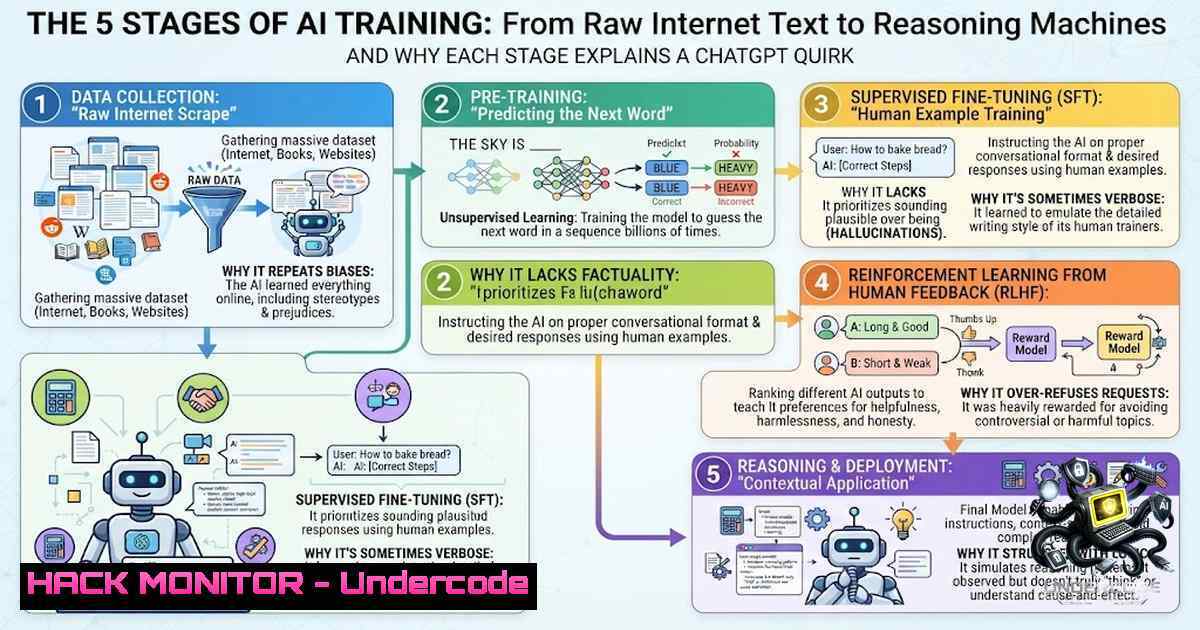
Most people believe that training an AI model like ChatGPT is a single, monolithic process – feed it data, press “train,” and out pops a genius. The reality is far more nuanced. AI training is not one step; it’s five distinct stages, each responsible for a different behavior you’ve observed, from hallucinations to refusal to answer reasonable requests. Understanding these stages is crucial not just for AI developers but for cybersecurity professionals, IT architects, and security engineers who must secure, audit, and harden these increasingly ubiquitous systems.
Learning Objectives:
- Understand the five-stage pipeline of modern Large Language Model (LLM) training and how each stage impacts model behavior.
- Identify security vulnerabilities and attack surfaces introduced at each stage of the AI training lifecycle.
- Learn practical Linux, Windows, and cloud security commands to audit, monitor, and harden AI training infrastructure.
You Should Know:
- Stage 1: Data Collection & Preprocessing – The Foundation of (In)Security
The journey begins with hoovering up vast amounts of internet text – CommonCrawl, WebText, The Pile, and others. This stage is where the model learns the statistical patterns of human language, but it’s also where the first seeds of security vulnerabilities are sown. Data poisoning, where an adversary injects malicious or biased data into the training corpus, can have catastrophic consequences. A poisoned model might generate harmful content, leak sensitive information, or fail catastrophically when presented with specific triggers.
Step‑by‑step guide: Auditing Your Training Data Pipeline
- Verify Data Provenance: Ensure your data sources are trusted and verifiable.
– Linux Command: Use `wget` with checksum verification.
wget https://example.com/dataset.tar.gz
sha256sum dataset.tar.gz  Compare against known good hash
– Windows PowerShell:
Get-FileHash dataset.tar.gz -Algorithm SHA256
- Scan for Malicious Content: Implement content filtering and anomaly detection.
– Linux: Use `grep` and `awk` to scan for known malicious patterns or adversarial triggers.
grep -r "malicious_pattern" /path/to/dataset/
- Implement Data Version Control: Use tools like DVC (Data Version Control) to track changes and enable rollbacks.
– Command: `dvc add dataset/ && git add dataset.dvc`
4. Enforce Access Controls: Restrict who can modify the training data.
– Linux: Use `chmod` and `setfacl` to set strict permissions.
chmod -R 750 /path/to/dataset/
setfacl -m u:data_engineer:rwx /path/to/dataset/
- Stage 2: Pre-training – The “Next Token Prediction” Black Box
This is the computationally expensive phase where the model learns to predict the next token in a sequence. The model ingests billions of parameters and learns general language understanding. However, this stage is a black box; it’s nearly impossible to know exactly what the model has learned or where it learned it. This opacity creates significant security challenges for auditing and compliance.
Step‑by‑step guide: Monitoring Pre-training Infrastructure
- Monitor Resource Usage: Track GPU utilization, memory, and network I/O to detect anomalies that might indicate a compromise or inefficiency.
– Linux: Use `nvidia-smi` for GPU monitoring.
watch -1 1 nvidia-smi
– Linux: Use `htop` for CPU and memory.
htop
- Log All Activities: Implement comprehensive logging of all training jobs and system access.
– Linux: Configure `auditd` to monitor critical directories and processes.
auditctl -w /path/to/training/scripts -p wa -k training_scripts
- Network Segmentation: Isolate training infrastructure from production networks to prevent lateral movement in case of a breach.
– Cloud (AWS): Use Security Groups and Network ACLs to restrict traffic.
– Linux (iptables):
iptables -A INPUT -s 10.0.0.0/8 -j ACCEPT  Allow internal traffic only
iptables -A INPUT -j DROP
- Stage 3: Supervised Fine-Tuning (SFT) – Teaching the Model to Follow Instructions
After pre-training, the model knows language but doesn’t know how to follow instructions. SFT uses human-annotated data (prompts and ideal responses) to teach the model to be a helpful assistant. This stage is where the model learns to refuse harmful requests (safety alignment) but also where “jailbreak” vulnerabilities are introduced. Adversaries can craft prompts that bypass these safety filters.
Step‑by‑step guide: Hardening Against Prompt Injection
- Input Sanitization: Implement strict input validation and sanitization on all user prompts.
– Python (Example):
import re
def sanitize_prompt(prompt):
 Remove potential injection patterns
prompt = re.sub(r'<.?>', '', prompt)  Remove HTML tags
prompt = re.sub(r'[;|&$]', '', prompt)  Remove shell metacharacters
return prompt
2. Rate Limiting: Prevent brute-force jailbreak attempts.
- Linux (using
fail2ban):Configure fail2ban to monitor API logs and ban IPs with excessive failed requests
- Implement a Web Application Firewall (WAF): Use a WAF to filter malicious prompts.
– Cloud (AWS WAF): Create rules to block common prompt injection patterns.
- Conduct Regular Red-Teaming: Simulate adversarial attacks on your model to identify weaknesses.
– Tools: Use frameworks like `PyRIT` (Microsoft) or `Garak` to automatically generate adversarial prompts.
- Stage 4: Reinforcement Learning from Human Feedback (RLHF) – Aligning with Human Values
RLHF is the secret sauce that makes models like ChatGPT feel “smart” and “helpful.” A reward model is trained to predict human preferences, and the base model is fine-tuned using reinforcement learning to maximize this reward. This stage is responsible for many of the model’s “quirks”: why it’s overly verbose, why it refuses some reasonable requests, and why the “fast” version feels dumber. From a security perspective, RLHF can introduce new biases and make the model more susceptible to adversarial manipulation of the reward signal.
Step‑by‑step guide: Auditing RLHF for Bias and Security
- Analyze Reward Model Behavior: Examine the reward model for biases.
– Python: Use `SHAP` or `LIME` to explain the reward model’s decisions.
import shap
explainer = shap.TreeExplainer(reward_model)
shap_values = explainer.shap_values(X)
- Monitor for Reward Hacking: Detect if the model is exploiting the reward function.
– Logging: Log reward scores and generated responses to identify anomalies.
- Diverse Human Feedback: Ensure your human feedback dataset is diverse and representative to mitigate bias.
-
Implement Continuous Evaluation: Regularly evaluate the model’s safety and alignment using benchmark datasets (e.g., ToxiGen, BBQ).
-
Stage 5: Deployment & Continuous Monitoring – The Live Fire Exercise
The final stage is deploying the model to production and monitoring its performance in the wild. This is where the rubber meets the road, and where many security issues become apparent. Model drift, data leakage, and adversarial attacks in real-time are all concerns.
Step‑by‑step guide: Securing Your AI Deployment
1. Implement API Security:
- Use API Keys and OAuth 2.0: Authenticate all requests.
- Rate Limiting: Implement per-user and global rate limits.
- Input Validation: Validate all inputs against a strict schema.
2. Monitor for Data Leakage:
- Logging: Log all inputs and outputs (sanitized of PII) for audit purposes.
- DLP (Data Loss Prevention): Implement DLP tools to detect sensitive data in model outputs.
3. Set Up Continuous Monitoring:
- Linux (Prometheus & Grafana): Monitor model latency, error rates, and resource usage.
prometheus.yml
scrape_configs:</li>
<li>job_name: 'ai_model'
static_configs:</li>
<li>targets: ['localhost:8000']
- Implement a Kill Switch: Have a mechanism to immediately shut down the model if it starts exhibiting harmful behavior.
-
Regular Security Audits: Conduct regular penetration testing and vulnerability assessments on your AI infrastructure.
What Undercode Say:
- Key Takeaway 1: AI training is a complex, multi-stage pipeline, not a monolithic process. Each stage introduces unique security challenges that must be addressed proactively.
- Key Takeaway 2: The “quirks” of modern LLMs – hallucinations, refusals, and inconsistencies – are not bugs but emergent properties of specific training stages. Understanding these stages is the first step to controlling and securing them.
Analysis:
The five-stage model of AI training provides a critical framework for cybersecurity professionals. Data collection is the supply chain, pre-training is the core build, SFT is the safety layer, RLHF is the alignment layer, and deployment is the operational environment. Each stage is a potential attack surface. Data poisoning, prompt injection, reward hacking, and model theft are just a few of the threats that must be mitigated. The industry is moving towards “Secure AI” practices, including adversarial training, differential privacy, and homomorphic encryption, but these are still nascent. The most effective defense today is a combination of robust infrastructure security, continuous monitoring, and a deep understanding of the AI lifecycle. The future of AI security will depend on building security into the training pipeline from the ground up, not as an afterthought.
Prediction:
- +1 The increasing sophistication of AI training pipelines will lead to the development of new security tools and practices, creating a booming market for AI security specialists.
- +1 Open-source frameworks for secure AI training will emerge, democratizing access to safe and aligned AI models.
- -1 The complexity of AI training will make it increasingly difficult for smaller organizations to secure their models, leading to a concentration of AI power in the hands of a few large tech companies.
- -1 We will see a significant increase in AI-specific cyberattacks, including large-scale data poisoning campaigns and sophisticated jailbreak techniques that bypass current safety measures.
- +1 Regulatory bodies will step in, mandating security audits and transparency requirements for AI training, which will drive the adoption of best practices.
▶️ Related Video (58% Match):
🎯Let’s Practice For Free:
🎓 Live Courses & Certifications:
Join Undercode Academy for Verified Certifications
🚀 Request a Custom Project:
Secure, high-velocity infrastructure and disruptive technological engineering. Contact our engineering team for high-tier development and proprietary systems:
[email protected]
💎 Smart Architecture | 🛡️ Secure by Design | ⭐ Trusted by Thousands
IT/Security Reporter URL:
Reported By: Ivan Ovcharov – Hackers Feeds
Extra Hub: Undercode MoN
Basic Verification: Pass ✅


