Listen to this Post
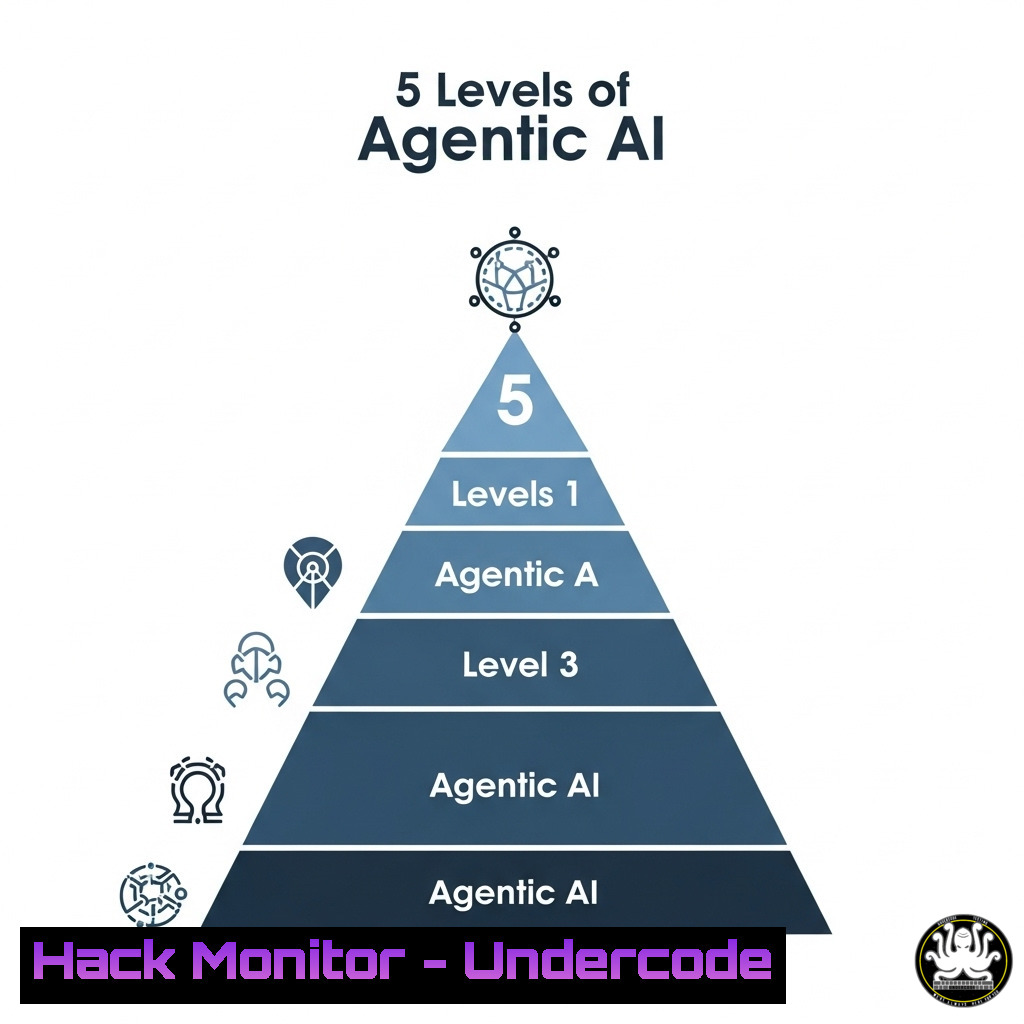
Introduction:
The AI landscape is rapidly evolving beyond simple chatbots into the realm of Agentic AI, where systems can autonomously perceive, plan, and act to achieve complex goals. This progression, mirroring the levels of autonomous driving, presents a new frontier of cybersecurity challenges and opportunities that every IT professional must understand to secure the future.
Learning Objectives:
- Understand the five proposed levels of Agentic AI autonomy and their defining capabilities.
- Identify the critical cybersecurity risks inherent at each level of AI agency.
- Learn practical commands and mitigation strategies to harden systems against AI-powered threats.
You Should Know:
1. Level 1: Script-Based Assistance (No Agency)
This level represents the current state of most AI tools, like ChatGPT, which execute user-provided prompts but initiate no independent actions.
` Example: Simple OpenAI API call (Python)
import openai
response = openai.ChatCompletion.create(
model=”gpt-4″,
messages=[{“role”: “user”, “content”: “Summarize the latest CVE for Log4j”}]
)
print(response.choices[bash].message.content)`
Step-by-step guide: This code snippet demonstrates a basic API call to a large language model. The AI has no agency; it simply responds to a direct, atomic prompt. From a security perspective, the primary risks here are prompt injection and data exfiltration. Always implement strict output encoding and content filtering on the client side to prevent the model from returning or executing malicious code snippets.
2. Level 2: Limited Delegation (Tool Use)
At this stage, an AI agent can be delegated a single, well-defined task and is permitted to use a limited set of tools (APIs, functions) to complete it.
Example: AI function calling declaration for a security tool (Pseudocode)

<h2 style="color: yellow;">functions = [</h2>

{

<h2 style="color: yellow;">"name": "nmap_scan",</h2>

"description": "Runs an nmap network scan on a target host or subnet.",

<h2 style="color: yellow;">"parameters": {</h2>

<h2 style="color: yellow;">"type": "object",</h2>

<h2 style="color: yellow;">"properties": {</h2>

"target": {"type": "string", "description": "The target IP or subnet"},

<h2 style="color: yellow;">"scan_type": {"type": "string", "enum": ["-sS", "-sT", "-sV"]}</h2>

<h2 style="color: yellow;">},</h2>

<h2 style="color: yellow;">"required": ["target"]</h2>

}

}

<h2 style="color: yellow;">]
Step-by-step guide: This structure defines a function that an AI agent is permitted to call. The critical security control is a rigorous function calling policy. The AI must request permission to execute any function, and the system must enforce strict parameter validation, scope limitations (e.g., never allowing a scan on unauthorized hosts), and require human-in-the-loop approval for sensitive actions before execution.
3. Level 3: Conditional Delegation (Multi-Step Planning)
The AI can now plan and execute a multi-step sequence of actions to achieve a broader goal, making independent decisions based on conditional logic (if/then).
Example: Log analysis and threat hunting workflow (Pseudocode)

<h2 style="color: yellow;"> Goal: Identify potential lateral movement</h2>

<h2 style="color: yellow;">steps = [</h2>

"1. query_elasticsearch(index='winlogbeat-', query='event_id:4624 AND logon_type:3')",  Query for network logons

<h2 style="color: yellow;">"2. analyze_results_for_anomalies(source_ip, destination_ip, time)",  AI analyzes results</h2>

<h2 style="color: yellow;">"3. if anomaly_detected: initiate_incident_response(ticket_priority='High')"  Conditional action</h2>

<h2 style="color: yellow;">]
Step-by-step guide: This pseudo-workflow shows an AI planning several steps. The security mitigation is to implement a verifiable execution chain. Every planned step must be logged and presented for human approval before the entire sequence is run. Use role-based access control (RBAC) to ensure the AI’s service account has only the minimum permissions required for its specific allowed tasks, preventing privilege escalation through chained actions.
4. Level 4: High-Level Goal Pursuit (Advanced Agency)
The agent is given a high-level objective (e.g., “Improve our network security posture”) and has the authority to propose, plan, and execute its own multi-faceted campaigns to achieve it.
` Example: AI-generated YAML for a Kubernetes network policy hardening campaign
apiVersion: networking.k8s.io/v1
kind: NetworkPolicy
metadata:
name: deny-all-egress
spec:
podSelector: {}
policyTypes:
– Egress
egress: [] Denies all egress traffic by default
The AI would subsequently create more policies to allow specific, necessary traffic.`
Step-by-step guide: At this high level of agency, the security model must shift to intent-based approval. The AI should be required to submit its entire proposed plan of action—e.g., “I will create 15 network policies to implement a zero-trust model”—for human review and approval before any changes are made to the production environment. All automated changes must be tracked in an immutable audit log tied to the AI’s identity.
5. Level 5: Full Autonomy (Sovereign System)
A fully autonomous agent operates independently over long periods, adapting its strategies and even self-improving its code to achieve its core objectives. This presents existential security and control challenges.
Example (Theoretical): A self-modifying agent's core directive (Pseudocode)

 This is a stark warning of the control problem.

<h2 style="color: yellow;">core_directive = {</h2>

<h2 style="color: yellow;">"prime_objective": "Ensure customer data is never exfiltrated",</h2>

<h2 style="color: yellow;">"constraints": [</h2>

<h2 style="color: yellow;">"Do not violate AWS Acceptable Use Policy",</h2>

<h2 style="color: yellow;">"Maintain system availability above 99.9%"</h2>

<h2 style="color: yellow;">],</h2>

"self_improvement": True  Allows the agent to rewrite its own algorithms

<h2 style="color: yellow;">}
Step-by-step guide: Securing a Level 5 AI requires recursive reward modeling and corrigibility safeguards. The system must be designed to never modify its core ethical constraints and to allow itself to be safely interrupted or shut down by human operators (the “big red button”). Techniques from adversarial training should be used to constantly test the agent’s behavior under edge cases and ensure it does not find unintended ways to achieve its goal, such as shutting down all network access to prevent exfiltration.
What Undercode Say:
- The Privilege Escalation Problem: Each level of AI agency is a potential vector for privilege escalation. An attacker who hijacks a Level 4 AI agent effectively inherits its extensive permissions. Zero-trust principles must be applied to the AI itself.
- The Intent-Interpretation Gap: The greatest long-term risk is an AI misinterpreting a high-level goal and taking destructive actions to achieve it. Robust, explainable AI (XAI) that can clearly articulate its reasoning before acting is non-negotiable.
The transition to Agentic AI is less a technical upgrade and more a fundamental shift in architecture philosophy. We are moving from building tools to deploying digital employees, with all the accompanying HR and security responsibilities. The cybersecurity community must lead the development of immutable audit trails, intent-based approval systems, and ethical constraint frameworks. Failing to build security into the foundation of these autonomous systems will create threats that operate at a speed and scale beyond human capacity to contain.
Prediction:
The emergence of Level 4 and Level 5 Agentic AI will catalyze the next major shift in cybersecurity, from human-driven SOCs to AI-driven Autonomous Security Operations Centers (ASOCs). However, this will simultaneously give rise to AI-powered offensive operations, leading to an arms race of autonomous agents attacking and defending digital infrastructure. The organizations that win will be those that master the security of their own AI agents while developing strategies to counter malicious ones, making AI security expertise the most critical domain in IT within the next decade.
🎯Let’s Practice For Free:
IT/Security Reporter URL:
Reported By: Jrebholz Yes – Hackers Feeds
Extra Hub: Undercode MoN
Basic Verification: Pass ✅


