Listen to this Post
Introduction:
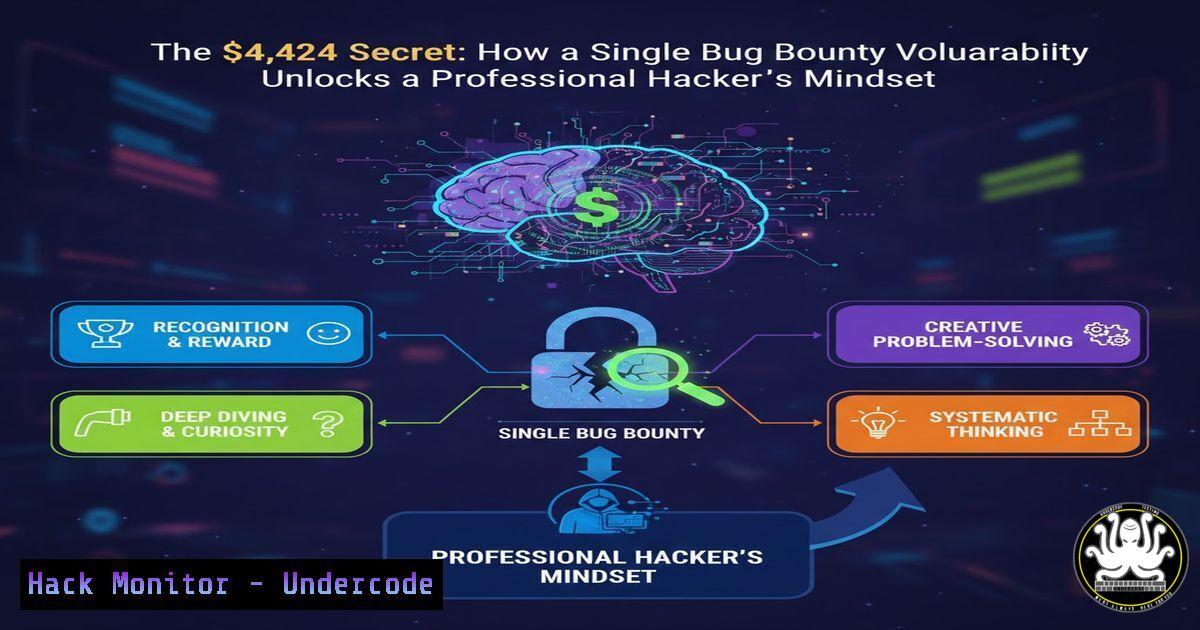
The public celebration of a significant bug bounty reward, such as the 3500 CHF ($4,424) prize highlighted in a recent social media post, often glosses over the rigorous technical process and strategic methodology that led to the discovery. Behind every successful bounty lies a systematic approach to reconnaissance, vulnerability identification, and proof-of-concept development that transforms random testing into a repeatable, high-yield security research discipline. This article deconstructs the essential technical workflows that bridge the gap between enthusiastic hacking and professional-grade vulnerability discovery.
Learning Objectives:
- Understand and implement a professional bug hunter’s reconnaissance and attack surface enumeration toolkit.
- Learn to methodically test for and validate common high-impact web vulnerabilities.
- Master the process of crafting a compelling, actionable bug bounty report that ensures clear reproduction and swift triage.
You Should Know:
1. Professional Reconnaissance: Beyond Basic Subdomain Enumeration
The initial phase of a successful bounty hunt involves mapping the target’s digital estate far beyond its obvious domains. This requires automated enumeration paired with intelligent filtering.
Step‑by‑step guide explaining what this does and how to use it.
Step 1: Passive Enumeration. Use tools like amass, subfinder, and `assetfinder` to gather subdomains from public sources and certificate transparency logs.
 Example command sequence for passive enum
subfinder -d target.com -silent | tee subdomains.txt
amass enum -passive -d target.com -o amass_passive.txt
cat subdomains.txt amass_passive.txt | sort -u > all_subs.txt
Step 2: Active Resolution & Probing. Resolve all discovered subdomains to filter out dead hosts and then probe for alive web servers and open ports.
 Resolve and find live hosts
cat all_subs.txt | httprobe -prefer-https | tee live_hosts.txt
 Parallel port scanning on alive hosts (focused on web ports)
cat live_hosts.txt | naabu -top-ports 1000 -o naabu_results.txt
Step 3: Technology Fingerprinting & Parameter Discovery. Use `httpx` to gather technologies (JS frameworks, servers, CMS) and waybackurls/gau to unearth historical URLs and parameters for testing.
cat live_hosts.txt | httpx -title -tech-detect -status-code -o tech_stack.json
cat live_hosts.txt | waybackurls | grep "?" | sort -u > params.txt
- Vulnerability Discovery: Automating the Hunt for Critical Flaws
With a mapped attack surface, the next step is targeted vulnerability testing, focusing on business logic errors and common OWASP Top 10 issues.
Step‑by‑step guide explaining what this does and how to use it.
Step 1: Identify Injection Points. From your params.txt, categorize targets for SQLi, XSS, and Command Injection. Use tools like `ffuf` for fuzzing.
 Fuzz for SQL Injection
ffuf -w /path/to/sqli-payloads.txt -u "https://target.com/api/user?id=FUZZ" -mr "error in your SQL syntax" -t 50
Step 2: Test for Access Control Bugs (IDOR & Broken Auth). Automate the testing of object references by manipulating numeric IDs, UUIDs, or JWT tokens. A simple Python script can iterate through a range.
import requests
for id in range(1000, 1100):
resp = requests.get(f'https://api.target.com/v1/user/{id}', cookies={'session': 'your_valid_cookie'})
if resp.status_code == 200 and 'admin' in resp.text:
print(f'Potential IDOR at /user/{id}')
Step 3: Leverage Nuclei for Pattern-Based Scanning. Use the curated template database of `nuclei` to run thousands of known vulnerability checks against your live_hosts.txt.
nuclei -l live_hosts.txt -t /nuclei-templates/ -severity critical,high -o nuclei_findings.txt
- The Art of the Proof of Concept (PoC): From Detection to Demonstration
Finding a potential flaw is only 10% of the work. A clear, standalone PoC is what justifies the bounty.
Step‑by‑step guide explaining what this does and how to use it.
Step 1: Isolate the Vulnerability. Remove any external dependencies from your testing environment. Can you reproduce it in a fresh, private browser session with minimal steps?
Step 2: Craft a Self-Contained Demo. For a stored XSS, this might be a simple HTML file that, when opened by an admin, triggers a callback to your server. For an API flaw, provide a complete `curl` command.
 Example PoC curl command for a Broken Access Control
curl -H "Authorization: Bearer eyJ0eXAi..." https://api.target.com/admin/delete_user/751
 This command, with a low-privilege user's token, successfully deletes another user.
Step 3: Document Impact. Clearly articulate the business risk: “This IDOR allows any authenticated user to view and modify the financial records of any other user, leading to data breach and fraud.”
4. Report Crafting: The Bridge to Your Bounty
A poorly written report can delay or nullify a valid finding. Structure is key.
Step‑by‑step guide explaining what this does and how to use it.
Step 1: Use a Clear Template. Include: (Brief flaw description), Target & Endpoint, Severity/CVSS Score, Step-by-Step Reproduction (numbered list), Proof of Concept (screenshots/video/commands), Impact Analysis, Remediation Suggestions.
Step 2: Be Concise and Technical. Avoid narrative. Security teams need to reproduce the issue in under 5 minutes. Every step must be unambiguous.
Step 3: Follow Platform Guidelines. Adhere strictly to the specific bounty program’s scope, rules, and reporting channels. Submitting out-of-scope issues harms credibility.
5. Toolchain Hardening: Securing Your Own Hacking Environment
As a security researcher, you are a target. Hardening your own system is non-negotiable.
Step‑by‑step guide explaining what this does and how to use it.
Step 1: Isolate Research Activities. Use virtual machines (VMware, VirtualBox) or dedicated cloud instances for testing. Snapshots allow quick recovery from misconfigurations.
Step 2: Secure Communications. Use a VPN and consider tools like `proxychains` for routing traffic. Never use personal accounts or identifiers during testing.
 Route all tool traffic through a local proxy (like Burp) or VPN
proxychains nmap -sT target.com
Step 3: Manage Data Securely. Encrypt your findings and tool outputs. Use `gpg` for file encryption.
 Encrypt a directory containing your research notes
tar czf research.tar.gz ./findings/ && gpg -c research.tar.gz
What Undercode Say:
- Methodology Over Luck: The consistent factor in high-value bounty earnings is not luck but a disciplined, documented, and repeatable process that covers reconnaissance, analysis, exploitation, and reporting in equal measure.
- The Currency is Clarity: The technical vulnerability is the key, but the clear, concise, and irrefutable proof of concept is the only thing that unlocks the bounty payment. Your report is your final and most important exploit.
The showcased bounty achievement is a direct product of applied systematic research, not chance. It underscores a maturation in the infosec landscape where platforms reward not just the flaw, but the professional delivery of its context and impact. This elevates bug hunting from a hobbyist activity to a supplementary cybersecurity career path, demanding skills in tool development, technical writing, and ethical execution. The researcher’s celebration is valid—it marks a milestone in their transition from a hacker to a security engineer.
Prediction:
The increasing professionalization and substantial monetary rewards in bug bounty programs will accelerate two key trends. First, we will see a surge in AI-assisted vulnerability discovery, where researchers leverage custom-trained models to analyze code diff and deployment configurations for anomalous patterns that hint at flaws, vastly increasing the scale of analysis. Second, corporate attack surface management (ASM) platforms will begin to integrate “white-hat simulation” modules directly, using the very same methodologies outlined here to proactively identify and patch vulnerabilities before they appear on a bounty board, effectively crowdsourcing their internal security posture. The line between external researcher and internal security team will continue to blur.
▶️ Related Video (80% Match):
🎯Let’s Practice For Free:
IT/Security Reporter URL:
Reported By: Dhananjay Kumar – Hackers Feeds
Extra Hub: Undercode MoN
Basic Verification: Pass ✅


