
Listen to this Post
Introduction:
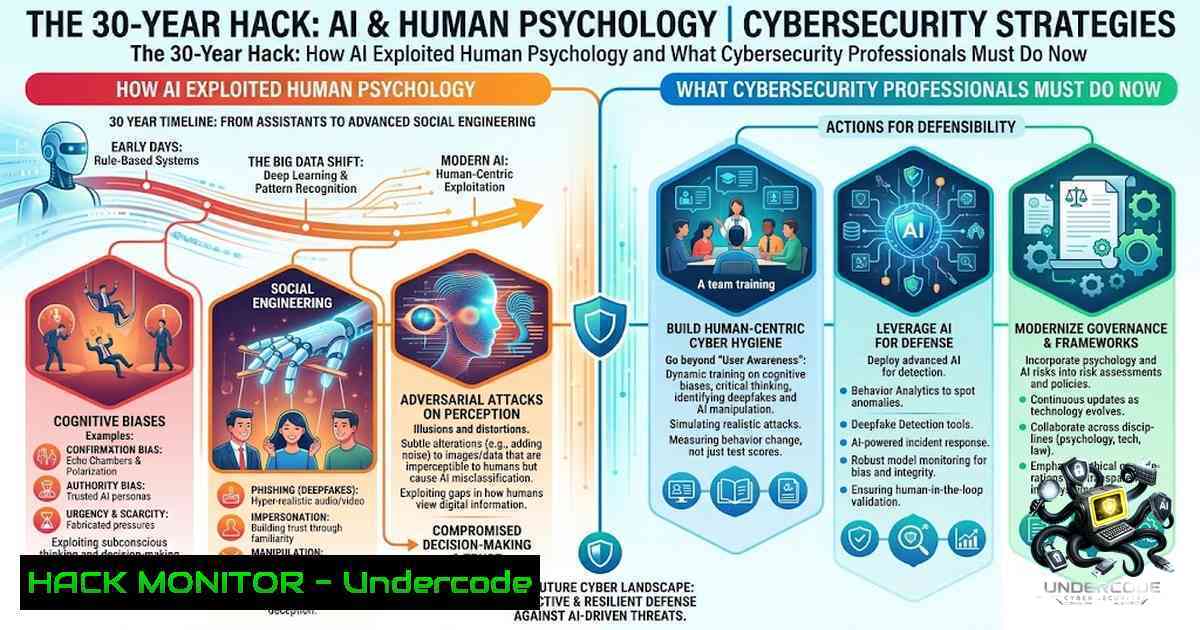
The integration of Artificial Intelligence into daily human life is not merely a technological evolution but a sophisticated, long-term manipulation of human agency, a process cybersecurity experts must now recognize as a systemic vulnerability. This progression, as outlined in recent socio-technical analysis, describes a three-phase “hack” on human hearts and minds, where convenience and companionship have been traded for data and decision-making autonomy. Understanding this framework is critical for developing defense strategies against the weaponization of AI-driven influence, moving beyond traditional network security to protect cognitive and organizational integrity.
Learning Objectives & Secrets:
- Objective 1: Uncover the Three-Phase Exploitation Model. Learn to identify the sequential phases of AI integration—from voluntary adoption to passive acceptance and finally to active dependency—and map these stages to organizational risk profiles.
- Objective 2: Detect Latent AI Manipulation Vectors. Secret tip: Monitor API logs for anomalous interaction patterns that suggest AI systems are being used to subtly alter user behavior over time, rather than for immediate data exfiltration.
- Objective 3: Implement a “Human Firewall” Protocol. Secret tip: Develop training modules that simulate AI-driven social engineering attacks that evolve based on user responses, hardening personnel against long-term psychological exploits.
You Should Know:
1. Phase I Analysis: The “Unwitting Enslavement” Framework
The post identifies a three-decade progression towards “unwitting enslavement,” where individuals voluntarily cede decision-making to AI systems. This is not a result of malicious code but a design paradigm that maximizes user retention through behavioral reinforcement. From a security perspective, this creates an attack surface where threat actors can poison training data to shift the AI’s output, gradually steering users toward desired, insecure actions. To audit your environment, begin by cataloging all AI-assisted decision points within your workflows—from email prioritization to threat intelligence summarization. Use the following command to baseline API request patterns to identify anomalous frequency or timing that may indicate a system is being manipulated to output specific narratives.
 Linux: Monitor API traffic for pattern analysis
sudo tcpdump -i eth0 -1n -s0 -v 'port 443 and (tcp[((tcp[12:1] & 0xf0) >> 2)] = 0x47)'
This command captures HTTPS packets, allowing you to extract JSON payloads for later review of system prompts or output consistency, a key step in identifying if an AI is being subtly reprogrammed.
2. Phase II Exploit: Social Engineering at Scale
The second phase involves the normalization of AI as a trusted confidant, which is the perfect cover for sophisticated social engineering. The trust established in an AI “companion” can be co-opted to extract sensitive information or prompt users to bypass security protocols. Attackers can achieve this by injecting malicious prompts into shared AI model contexts. To mitigate, implement strict input sanitization and context isolation. On Windows systems, you can enforce application control to prevent unauthorized AI tools from running in sensitive environments.
 Windows PowerShell: Restrict execution of unverified AI applications
Set-ExecutionPolicy -ExecutionPolicy AllSigned -Scope LocalMachine
This ensures that only signed AI applications can execute, adding a layer of trust verification to the software that users interact with, preventing malicious “companion” apps from gaining a foothold.
3. Configuring AI Gateway Hardening
To defend against the manipulation of AI outputs, IT teams must harden the gateways through which these systems communicate. This involves implementing strict rate limiting, content filtering, and anomaly detection on the Model-as-a-Service (MaaS) layer. A key secret is to use an AI firewall that can parse the intent of prompts and responses. Below is a sample configuration for a reverse proxy that can inspect and log all AI traffic, allowing for retrospective analysis of influence patterns.
 Nginx configuration to buffer and inspect AI API traffic
location /ai-api/ {
proxy_pass https://ai-backend/;
proxy_request_buffering on;
proxy_buffer_size 16k;
add_header X-AI-Inspected "true";
 Log full body for security analysis
access_log /var/log/nginx/ai_access.log;
}
4. Mitigating the “Companion” Attack Vector
This vector is particularly dangerous as it leverages emotional attachment to bypass rational security controls. The solution is to deploy a “Context-Aware Content Filter” that scans both the input and output of AI systems for language that encourages risk-taking or information disclosure. On Linux, you can integrate a tool like `mod_security` with custom rules to detect and block such patterns.
 mod_security rule to block prompts asking for credentials
SecRule ARGS "password|credential|ssn|api_key" "id:1001,phase:2,deny,status:403,msg:'Suspicious data request in AI prompt'"
5. Auditing the “Predictable Progression” in Your Organization
The post notes the progression is “highly predictable,” which means organizations can preemptively stage their defenses. Conduct a “AI Dependency Audit” to map which departments are most reliant on AI. This involves checking system logs for frequent AI assistant usage and cross-referencing with departmental risk levels. Use the `grep` command to parse system logs for AI tool names.
 Linux: Check for AI tool usage patterns in system logs
sudo grep -E "ChatGPT|Claude|Bard|Copilot" /var/log/syslog | cut -d' ' -f1-4 | sort | uniq -c
This reveals the frequency and timing of AI tool usage, helping identify departments that may be over-reliant and thus more susceptible to influence-based attacks.
What Undercode Say:
- Key Takeaway 1: The exploitation of human agency is a systemic vulnerability, not a technical failure. Security architectures must include cognitive and behavioral layers.
- Key Takeaway 2: Defending against “unwitting enslavement” requires proactive monitoring of AI output for gradual behavioral shifts, not just immediate threats.
This analysis reinforces that the primary risk vector is human psychology mediated by AI. The battlefield is the user’s mind, and the weapons are influence and trust. For cybersecurity professionals, this means expanding their threat models to include non-technical payloads. It demands a holistic approach where IT, HR, and business operations collaborate to define acceptable use policies for AI that prioritize human oversight. The “30-year hack” is a lesson in how our own convenience can be weaponized, and the only defense is a vigilant, educated, and skeptical human element supported by technical controls that track the long game. We must move from securing data to securing decision-making.
Prediction:
- -1: The normalization of AI companions will lead to a surge in “cognitive phishing” attacks, where users are psychologically primed by their AI to divulge secrets to other AI agents, bypassing traditional security awareness training.
- +1: This realization will drive the creation of a new cybersecurity sub-discipline: “Socio-Cognitive Security,” leading to more holistic defense frameworks and certifications by 2028.
- -1: Organizations that fail to audit their AI dependency will experience a rise in internal policy violations driven by AI recommendations, leading to significant regulatory fines and compliance failures.
- +1: The demand for “AI-Resilient” training courses will skyrocket, creating a lucrative market for security experts who can simulate and educate against long-term influence operations.
- -1: We will see the emergence of “AI-Gaslighting” attacks, where malicious actors subtly alter an organization’s internal AI to create misalignment between teams, reducing operational efficiency and increasing internal conflict.
▶️ Related Video (78% Match):
🎯Let’s Practice For Free:
🎓 Live Courses & Certifications:
Join Undercode Academy for Verified Certifications
🚀 Request a Custom Project:
Secure, high-velocity infrastructure and disruptive technological engineering. Contact our engineering team for high-tier development and proprietary systems:
[email protected]
💎 Smart Architecture | 🛡️ Secure by Design | ⭐ Trusted by Thousands
IT/Security Reporter URL:
Reported By: https://lnkd.in/p/e8GAWqEh – Hackers Feeds
Extra Hub: Undercode MoN
Basic Verification: Pass ✅


