Listen to this Post
Introduction:
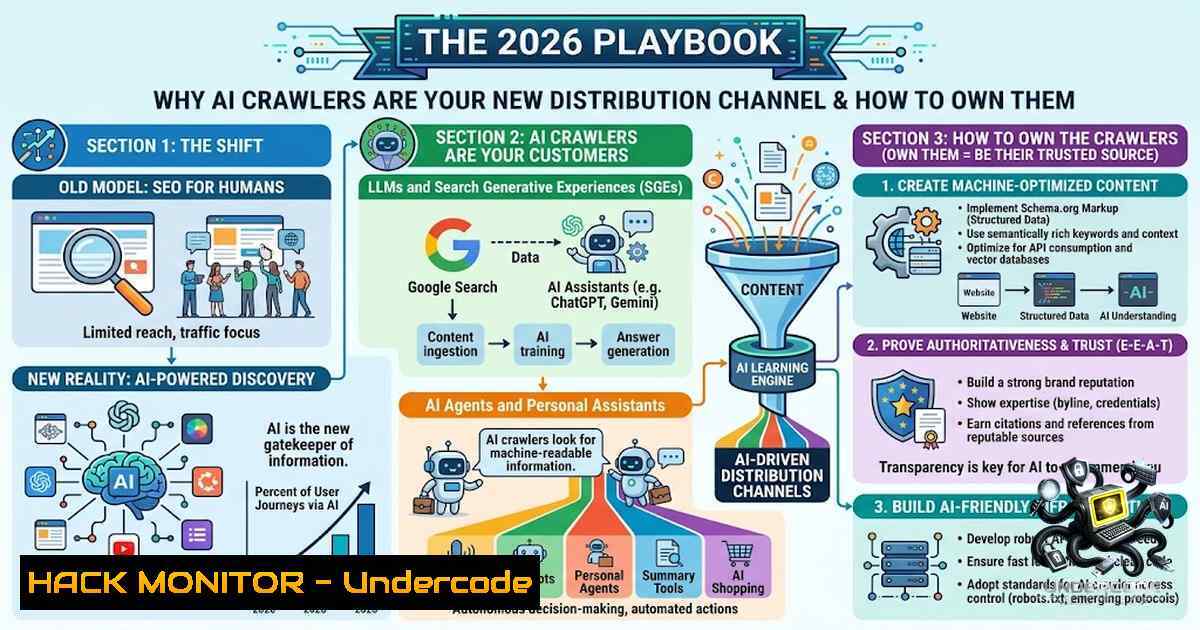
The landscape of startup distribution has fundamentally shifted. In 2026, the standard advice of “build it and they will come” is not just outdated—it’s financially dangerous. Founders who achieve significant early revenue spend a staggering 60–80% of their pre-launch time on distribution, not product development, with SEO and content marketing generating over $10 million in attributed revenue compared to paid ads. Simultaneously, a new, powerful channel has emerged: AI crawlers. With these bots now accounting for a massive portion of web traffic and referral traffic from LLMs like ChatGPT growing by over 66% year-over-year, being the source that AI quotes is becoming a primary driver of growth. This article provides a technical blueprint for mastering distribution in the AI era, combining classic growth strategies with advanced log analysis and security hardening to ensure your content is not only found by humans but is also the primary source for the AI engines that will recommend you.
Learning Objectives:
- Master the 80/20 distribution framework for pre-launch and post-launch phases.
- Learn to identify, analyze, and optimize for major AI crawlers (GPTBot, ClaudeBot, etc.) using server log analysis.
- Implement advanced `robots.txt` strategies and Linux commands to manage AI bot access and prioritize content indexing.
- Understand the cybersecurity implications of AI bot traffic and how to secure your infrastructure against automated threats.
- The 80/20 Rule of Distribution in the AI Era
The core principle of modern startup growth is that distribution is the product. The data is clear: in an analysis of 1,162 startups, SEO and content marketing crushed paid ads, generating $10.3 million and $8 million respectively. This is because organic channels compound over time, while paid ads stop the moment you stop spending. As Tibo Louis-Lucas, founder of the bootstrapped SaaS studio TMAKER (which crossed $1M a month), puts it: “SEO is the most durable distribution channel for a bootstrapped SaaS startup, even as LLMs reshape search”.
The pre-launch phase is critical. The winning formula is an 80/20 split: 80% of your time on distribution and 20% on the product. This involves building an email list before launch, having 50-100 real customer conversations, and owning one niche community. Post-launch, the ratio shifts to 60% distribution, 30% product, and 10% on community and partnerships.
However, 2026 introduces a “2026 twist”: AI crawlers now hit sites more than humans do. This means your content strategy must be optimized for two audiences: human readers and AI algorithms that summarize and cite information. Being the source that ChatGPT quotes is becoming its own powerful, organic channel.
- Identifying AI Crawlers: A Technical Guide with Linux Commands
Before you can optimize for AI crawlers, you need to know they exist and what they are doing on your site. Raw bot volume is the first-order question, but the more important one is: “Where are they going?”. A bot that hits your blog 4,200 times a day but never reaches your pricing page is not a well-informed AI advocate for your product.
You can identify these bots by analyzing your server access logs. Here are the primary AI crawlers and their user-agent strings:
- Googlebot: `Mozilla/5.0 (compatible; Googlebot/2.1; +http://www.google.com/bot.html)`
– GPTBot (OpenAI): `Mozilla/5.0 AppleWebKit/537.36 (KHTML, like Gecko; compatible; GPTBot/1.0; +https://openai.com/gptbot)`
– ClaudeBot (Anthropic): `Mozilla/5.0 (compatible; ClaudeBot/1.0; +https://anthropic.com/claudebot)`
– PerplexityBot: `Mozilla/5.0 (compatible; PerplexityBot/1.0; +https://perplexity.ai/perplexitybot)`
– OAI-SearchBot: `Mozilla/5.0 (compatible; OAI-SearchBot/1.0; +https://openai.com/searchbot)`To analyze these logs on a Linux server, you can use basic command-line tools. For example, to count the number of requests from GPTBot, use:
grep "GPTBot" /var/log/nginx/access.log | wc -l
To see which URLs GPTBot is crawling most frequently:
grep "GPTBot" /var/log/nginx/access.log | awk '{print $7}' | sort | uniq -c | sort -1r | head -20
These commands give you raw data. The real value comes from funnel analysis. For instance, you can filter logs for `GPTBot` and extract paths:
grep "GPTBot" /var/log/nginx/access.log | awk '{print $7}' | sed 's/\/[^\/]$//' | sort | uniq -c
This shows you which top-level directories (e.g., /blog/, /pricing/, /docs/) the bot is visiting, revealing gaps in your AI visibility.
3. Advanced `robots.txt` Strategies for AI Bot Governance
Not all AI bots are the same, and they should not be treated equally. They fall into two main categories: Training Bots (e.g., GPTBot) that crawl to improve their models, and Search Bots (e.g., OAI-SearchBot, Claude-SearchBot) that crawl to index and provide real-time answers. A fundamental strategic choice is whether to allow or block these bots. Blocking `OAI-SearchBot` in your `robots.txt` file could cause your site to disappear from ChatGPT Search results. Blocking `GPTBot` means refusing to be used for training.
Here is a sample `robots.txt` file that allows search bots but restricts training bots from certain sections:
User-agent: OAI-SearchBot
Allow: /

User-agent: Claude-SearchBot
Allow: /

User-agent: GPTBot
Disallow: /internal/
Disallow: /admin/
Disallow: /draft/

User-agent: ClaudeBot
Disallow: /internal/
Disallow: /admin/

Sitemap: https://www.yourdomain.com/sitemap.xml
This configuration ensures that AI search engines can find your critical content (like product pages and blog posts) to answer user queries, while protecting sensitive or unfinished areas of your site from being used for model training. As of May 2026, Googlebot holds approximately 27% of global AI crawler traffic, GPTBot around 10%, and ClaudeBot has surged from 9% to 20%. Regularly updating your `robots.txt` based on these shifting dynamics is a key operational task.
4. Optimizing Content for AI Citation
Getting crawled is only half the battle. To be cited, your content must be structured for AI comprehension. A study of over 21,000 ChatGPT citations found that the top 10 domains take 46% of all citations in a topic, and the top 30 take 67%. This concentration means there are effectively only ~30 “seats” at the citation table for any given topic.
To claim one of these seats, you need to structure your content to be easily parsed. AI models prefer clear, hierarchical data. This means using proper HTML heading tags (<h1>, <h2>, <h3>) to create a logical outline, using bullet points and numbered lists for step-by-step instructions, and implementing structured data (Schema.org markup) to explicitly define entities like products, reviews, and FAQs.
Furthermore, a “user fetch” (real-time answers) now accounts for 56.9% of all crawler activity, driven almost entirely by ChatGPT. This means your content needs to directly answer specific questions. Creating comprehensive, long-form content that answers a wide range of related queries (e.g., “What is X?”, “How to use X?”, “X vs Y”) increases the likelihood that an AI will fetch and cite your page.
5. Cybersecurity Implications of AI Bot Traffic
The rise of AI crawlers is not just a marketing concern; it is a significant cybersecurity issue. Automated traffic is growing eight times faster than human traffic, with AI-driven traffic up 187% from January to December 2025. This massive increase in bot activity can lead to several threats:
- DDoS and Resource Exhaustion: Aggressive crawlers can overwhelm your server, leading to downtime and increased hosting costs.
- Data Scraping: Malicious bots may scrape proprietary content, pricing, or user data for competitive intelligence or to train their own models without permission.
- Web Application Attacks: Automated bots can be used to probe for vulnerabilities, perform brute-force attacks, or exploit known vulnerabilities in your web application.
To mitigate these risks, implement a multi-layered security approach. Use a Web Application Firewall (WAF) to filter and block malicious traffic. Regularly monitor your server logs for unusual patterns, such as a sudden spike in requests from a single IP range or a high number of 404 errors from a bot probing for hidden directories. You can use tools like `fail2ban` to automatically block IPs that exhibit malicious behavior. For example, to ban an IP that makes more than 200 requests in 60 seconds, you can configure `fail2ban` with a custom jail for your web server logs.
6. Securing Your Infrastructure: A Practical Guide
For developers and system administrators, here is a step-by-step guide to hardening your server against AI bot-related threats:
Step 1: Log Analysis and Monitoring
- Linux: Set up a daily cron job to analyze your access logs. Use `grep` and `awk` to generate reports on bot traffic. For example, to get a summary of bot requests by user-agent:
awk -F'"' '{print $6}' /var/log/nginx/access.log | sort | uniq -c | sort -1r | head -20This command extracts the user-agent string from each log entry, counts the occurrences, and displays the top 20 most common agents.
- Windows (IIS): Use PowerShell to parse IIS logs. You can filter by the `cs(User-Agent)` field to identify bot traffic. For example:
Get-Content C:\inetpub\logs\LogFiles\W3SVC1\u_ex.log | Select-String "GPTBot" | Measure-Object
Step 2: Rate Limiting
- Implement rate limiting on your web server or CDN. For Nginx, you can use the `limit_req` module. Add the following to your configuration to limit requests to 10 per second per IP:
limit_req_zone $binary_remote_addr zone=mylimit:10m rate=10r/s;
server {
location / {
limit_req zone=mylimit burst=20 nodelay;
... rest of your config
}
}
Step 3: Implement a WAF and Bot Management
- Use a cloud-based WAF (e.g., Cloudflare, AWS WAF) that provides bot management features. These services can automatically distinguish between good bots (Googlebot, GPTBot) and bad bots, and block the latter.
Step 4: Harden Your `robots.txt`
- Regularly review and update your `robots.txt` file to ensure it reflects your current strategy. As seen with the new Google-Agent crawler, new bots are constantly emerging. Staying informed is crucial.
What Undercode Say:
- Distribution is the Product: Treating distribution as an afterthought is a fatal error. The most successful founders in 2026 are those who build their audience and distribution channels in parallel with their product, recognizing that attention is the most valuable currency.
- AI is a New Distribution Channel: The rise of AI crawlers and LLM-based search is not a future trend; it is the present reality. By actively managing how AI bots interact with your site through `robots.txt` and log analysis, you can turn AI referrals into a significant and growing source of traffic and revenue, with platforms like ChatGPT showing 66.7% growth year-over-year.
Prediction:
- +1: The democratization of AI will enable solo founders and small teams to compete with larger corporations by creating highly specialized, AI-optimized content that captures niche markets, leading to a new wave of “micro-SaaS” success stories.
- +1: AI citation will become a standard Key Performance Indicator (KPI) for marketing teams, alongside traditional metrics like organic traffic and conversion rates, with tools emerging to track and optimize for this metric.
- -1: The concentration of AI citations among a few top domains will create a “citation oligopoly,” making it exponentially harder for new entrants to gain visibility, potentially stifling innovation and leading to a more static web.
- -1: The rapid growth of AI bot traffic will lead to a corresponding increase in sophisticated cyberattacks, forcing startups to allocate significant resources to security and bot management, diverting funds from product development and growth.
- -1: The shift of 56.9% of crawler activity to “user fetch” means content is consumed by AI, not humans. This could decimate traditional ad-based revenue models for content creators who rely on human page views, forcing a fundamental shift in how online content is monetized.
▶️ Related Video (76% Match):
🎯Let’s Practice For Free:
🎓 Live Courses & Certifications:
Join Undercode Academy for Verified Certifications
🚀 Request a Custom Project:
Secure, high-velocity infrastructure and disruptive technological engineering. Contact our engineering team for high-tier development and proprietary systems:
[email protected]
💎 Smart Architecture | 🛡️ Secure by Design | ⭐ Trusted by Thousands
IT/Security Reporter URL:
Reported By: Eddybogomolov Most – Hackers Feeds
Extra Hub: Undercode MoN
Basic Verification: Pass ✅


