Listen to this Post
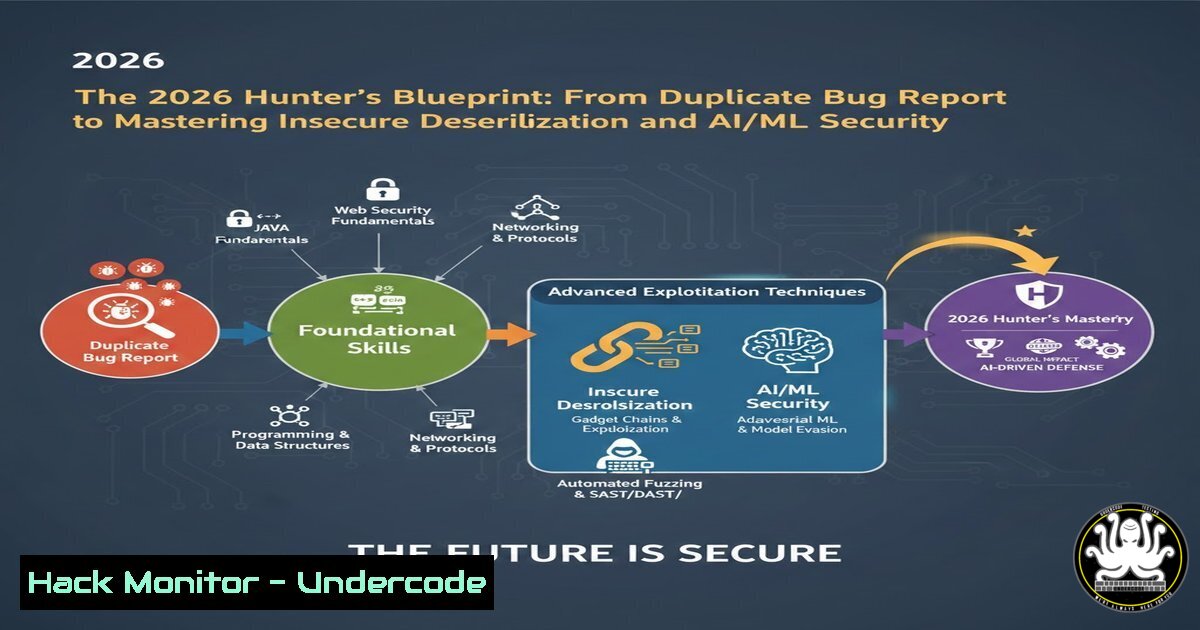
Introduction:
The discovery of an insecure deserialization vulnerability leading to Remote Code Execution (RCE) marks a critical milestone for any security researcher, even when marked as a duplicate. This incident underscores the persistent threat posed by improper data handling in applications, a vector increasingly relevant in the expanding attack surface of AI/ML systems. Mastering the identification and exploitation of such flaws is foundational to modern offensive security and responsible disclosure practices.
Learning Objectives:
- Understand the mechanics and critical impact of insecure deserialization vulnerabilities.
- Learn practical methodologies for hunting and validating deserialization bugs in modern applications.
- Develop a roadmap for transitioning bug bounty skills into the specialized domain of AI/ML security.
You Should Know:
1. The Anatomy of an Insecure Deserialization Vulnerability
Insecure deserialization occurs when untrusted data is used to reconstruct serialized objects, leading to malicious code execution, privilege escalation, or denial-of-service. Serialization converts objects into a storable/transmittable format (like JSON, YAML, or binary protocols), and deserialization reverses this process. The core flaw is a lack of validation, allowing attackers to manipulate serialized data to execute arbitrary code during the deserialization process.
Step‑by‑step guide explaining what this does and how to use it.
1. Reconnaissance: Identify endpoints accepting serialized data. Look for parameters, cookies, or file uploads with patterns like `rO0` (Java base64), `O:` (PHP serialized object), or structured JSON/XML with type indicators.
2. Tool Setup: Use interception proxies (Burp Suite, OWASP ZAP) and dedicated tools. For Java, `ysoserial` is essential; for Python, `python-deserialization-scanner` or dirty-json.
3. Payload Generation: Determine the application’s language and libraries. For a hypothetical Java app using Apache Commons Collections, a proof-of-concept (PoC) payload can be generated:
 Generate a payload that executes 'id' on the target system
java -jar ysoserial.jar CommonsCollections5 'id' > payload.bin
 Encode for HTTP transmission
base64 -w0 payload.bin
4. Testing & Exploitation: Send the encoded payload via the vulnerable parameter. Monitor for delayed responses, out-of-band interactions (using tools like burpcollaborator.net), or direct command execution.
5. Mitigation Verification: The primary fix is to avoid deserializing untrusted data. If unavoidable, implement integrity checks (digital signatures), use safe serialization formats (pure JSON without parsers like ObjectMapper.enableDefaultTyping()), and enforce strict type constraints.
- Crafting a Winning Bug Report: Beyond the Duplicate
A “duplicate” report is not a failure but validation of your methodology. A professional report accelerates triage and demonstrates impact.
Step‑by‑step guide explaining what this does and how to use it.
1. Clear and concise. Example: “Insecure Deserialization in /api/v1/import leading to Remote Code Execution.”
2. Summary: A brief overview of the vulnerability, component, and potential impact.
3. Technical Details:
Vulnerable Endpoint: POST https://target.com/api/v1/data/import`serialized_data`
<h2 style="color: yellow;"> Parameter:
Steps to Reproduce: A numbered list. Include exact requests. Example:
POST /api/v1/data/import HTTP/1.1
Host: target.com
Content-Type: application/x-www-form-urlencoded

serialized_data=rO0ABX... [Base64 Payload]
Proof of Concept: Screenshot of command output (e.g., `id` or whoami) or DNS/interaction log.
4. Impact Analysis: Detail the worst-case scenario: “An unauthenticated attacker can achieve remote code execution with the privileges of the application server, leading to full system compromise.”
5. Remediation Suggestions: Provide actionable fixes, such as recommending the use of JSON with a safe parser or implementing a whitelist for allowed classes.
- From General Web Apps to AI/ML Attack Surfaces
The post highlights a pivot towards AI/ML security. These systems introduce unique vectors like model poisoning, adversarial examples, and exploitation of serialization in ML pipelines (e.g., pickle files).
Step‑by‑step guide explaining what this does and how to use it.
1. Identify Targets: AI/ML endpoints—model upload/download, prediction APIs, data processing pipelines.
2. Attack Pickle Files: Python’s `pickle` module is inherently insecure. A malicious pickle file can execute code upon loading.
 Example of a malicious pickle payload creation (for authorized testing only)
import pickle
import os
class Exploit(object):
def <strong>reduce</strong>(self):
return (os.system, ('whoami',))
payload = pickle.dumps(Exploit())
with open('malicious_model.pkl', 'wb') as f:
f.write(payload)
3. Test ML Inference APIs: Fuzz input data with malicious payloads. Use tools like `ffuf` or `wfuzz` to test for command injection in backend processing scripts.
ffuf -w command_payloads.txt -u "https://target.ai/api/predict?input=FUZZ" -mr "root"
4. Mitigation: For ML, use safer alternatives to `pickle` like `joblib` with security checks or `h5py` for model weights. Validate and sanitize all inference input rigorously.
4. Building Your Proactive Hunting Lab
Reactive testing isn’t enough. Build a lab to practice on known vulnerable targets.
Step‑by‑step guide explaining what this does and how to use it.
1. Set Up a Local Environment: Use Docker to run deliberately vulnerable apps.
 Run a Java deserialization lab
docker run -p 8080:8080 webgoat/goatandwolf
 Run an ML security lab
docker pull advmlsec/lab:pickle-rick
2. Practice with Platforms: Engage with dedicated platforms:
PentesterLab: Exercises on Java deserialization.
HackTheBox: Machines like “Pickle Rick” or “Serialization” challenges.
TryHackMe: Rooms on “Insecure Deserialization.”
- Automate Recon: Write simple scripts to scan for potential endpoints.
import requests
from bs4 import BeautifulSoup
Basic crawl to find API endpoints (pseudo-code)
Use requests to crawl and grep for patterns like /api/, /import, /export
5. Hardening Defenses: A Sysadmin’s Checklist
While hunters find flaws, defenders must harden systems.
Step‑by‑step guide explaining what this does and how to use it.
1. Application Layer:
Java: Use `SerializationFilter` (JEP 290) to set global filters. Validate `ObjectInputStream` with a strict whitelist.
Python: Replace `pickle` with `json` or use `pickle` with a restricted `Unpickler` class.
PHP: Avoid `unserialize()` on user input. Use json_decode().
2. Network Layer: Implement Web Application Firewalls (WAF) with rules to detect serialized object patterns. Use IDS/IPS signatures for known exploit payloads.
3. System & Cloud:
Least Privilege: Run application servers with minimal permissions (non-root users).
Container Hardening: In Docker, run as non-root, use read-only filesystems where possible.
FROM openjdk:11-jre-slim
USER 1000:1000  Run as non-root
Cloud Security: Use IAM roles with least privilege for AWS/Azure/GCP services running the app.
What Undercode Say:
- A duplicate bug bounty report is a credential, not a rejection. It validates that your independent research aligns with professional findings, proving your skills are market-ready.
- The frontier of application security is rapidly expanding into AI/ML systems, where traditional vulnerabilities like insecure deserialization manifest in new, high-impact contexts (e.g., compromised training pipelines). Researchers must adapt their toolkits to target serialized models and inference APIs.
Analysis: This researcher’s journey highlights a critical evolution in cybersecurity. The initial success with a classic OWASP Top 10 vulnerability (insecure deserialization) provides the foundational expertise required to tackle the complex, emerging threats in AI. The pivot towards AI/ML security is prescient; as organizations race to integrate machine learning, they often overlook basic security hygiene, making these systems prime targets. The true takeaway is the methodological discipline: systematic vulnerability identification, clear proof-of-concept development, professional reporting, and continuous learning towards new attack surfaces. This cycle turns isolated bug hunting into a sustainable career trajectory in advanced security research.
Prediction:
Insecure deserialization will remain a prevalent critical flaw, especially as it becomes a primary entry point for attacking AI/ML infrastructure. By 2027-2028, we will see a significant rise in CVEs related to the unsafe deserialization of machine learning models (e.g., in PyTorch or TensorFlow serving), leading to large-scale poisoning attacks or supply chain compromises. Bug bounty programs will increasingly list AI components as in-scope, and researchers who have mastered both traditional web app flaws and AI security fundamentals will be at the forefront of uncovering these next-generation vulnerabilities. This will force a paradigm shift in DevOps towards “Secured MLOps,” integrating security scanners specifically for model files and inference endpoints into CI/CD pipelines.
▶️ Related Video (78% Match):
🎯Let’s Practice For Free:
IT/Security Reporter URL:
Reported By: Ananthanrayananr2004 Bugbounty – Hackers Feeds
Extra Hub: Undercode MoN
Basic Verification: Pass ✅


