Listen to this Post
Introduction:
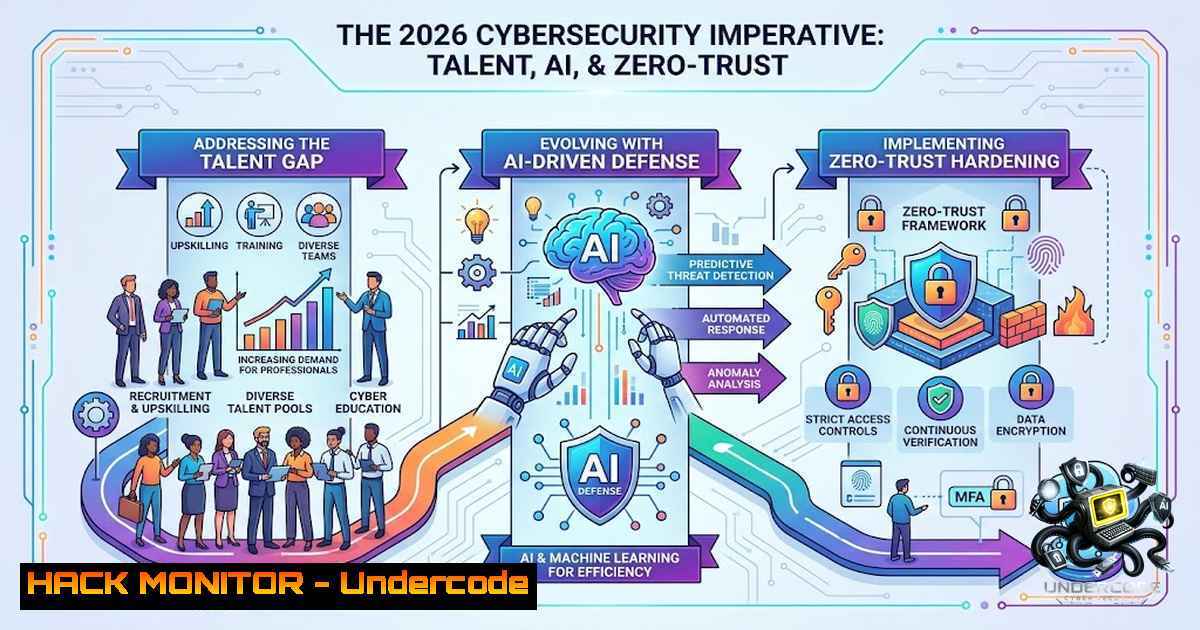
The cybersecurity landscape in 2026 is defined by a paradox: demand for skilled professionals has never been higher, yet the very nature of those skills is evolving faster than traditional training can keep up. With 83% of cybersecurity roles now requiring hands-on experience and 60% of “must-have” skills non-existent just three years ago, organizations face a dual challenge of talent acquisition and technological adaptation. Simultaneously, the rise of AI-assisted attacks has compelled bodies like CERT-In to mandate 12-hour patching for internet-facing flaws, fundamentally altering defense timelines. This article bridges the gap between recruitment needs and technical reality, providing a comprehensive guide to the skills, commands, and configurations defining modern cyber defense.
Learning Objectives:
- Master system hardening techniques across Linux and Windows environments using industry-standard benchmarks.
- Implement API security controls and multi-cloud hardening strategies to protect modern, distributed architectures.
- Understand and apply AI-driven threat detection and vulnerability prioritization frameworks in response to accelerated attack timelines.
You Should Know:
1. System Hardening: The Foundation of Cyber Resilience
System hardening remains the bedrock of cybersecurity, yet it is often undermined by “configuration drift”—the gradual accumulation of services, firewall exceptions, and access rules that expand the attack surface over time. A practical hardening approach focuses on reducing unnecessary exposure while maintaining operational stability.
Step-by-Step Guide for Linux Server Hardening:
Begin by auditing your current environment to understand what services are running and which ports are exposed:
 List all running services
systemctl list-units --type=service --state=running

Check listening ports and associated processes
ss -tulpen
This initial reconnaissance is critical because hardening decisions must align with the server’s actual role—a database server has different requirements than a public web server. Next, remove unnecessary services that often persist from default installations:
 Disable and stop legacy services (e.g., CUPS, Avahi)
sudo systemctl disable --1ow cups
sudo systemctl disable --1ow avahi-daemon
Secure SSH, the primary administrative access point, by disabling root login and enforcing key-based authentication:
 Edit /etc/ssh/sshd_config
PermitRootLogin no
PasswordAuthentication no
PubkeyAuthentication yes

Restart SSH service
sudo systemctl restart sshd
Finally, keep systems updated to patch known vulnerabilities:
 Ubuntu/Debian
sudo apt update && sudo apt upgrade -y

RHEL/CentOS/Fedora
sudo dnf update -y
For Windows environments, automated toolkits provide a structured approach aligned with CIS Controls v8 and Microsoft Security Baselines. The `windows-security-hardening` PowerShell suite offers a turnkey solution:
 Clone the repository
git clone https://github.com/phillza/windows-security-hardening
cd windows-security-hardening

<ol>
<li>Audit current state (non-destructive, no admin required)
powershell -ExecutionPolicy Bypass -File scripts\validate_security_hardening.ps1</p></li>
<li><p>Generate a human-readable report
powershell -ExecutionPolicy Bypass -File scripts\generate_security_report.ps1</p></li>
<li><p>Apply hardening (requires admin)
.\scripts\run_hardening_as_admin.bat</p></li>
<li><p>Collect a baseline for drift detection
powershell -ExecutionPolicy Bypass -File scripts\collect_security_baseline.ps1
The toolkit includes drift detection with three tiers—quick hash (~2s), standard JSON diff (~10s), and deep validation (~60s)—allowing continuous monitoring of security posture.
- API Security: Protecting the Connective Tissue of Modern Applications
APIs in 2026 don’t just exchange data; they control money, access, identity, and core business logic. One vulnerable API can lead to data theft, transaction manipulation, or service disruption. The NIST Special Publication 800-228-upd1 provides comprehensive guidelines for API protection, emphasizing risk identification across the API lifecycle and the implementation of layered controls.
Step-by-Step Guide for API Security Hardening:
Authentication and Authorization: Implement strong, granular controls. Prefer short-lived OAuth bearer tokens over static API keys, scope every credential to the minimum required, and validate JWTs strictly (pin the algorithm, verify signature, check claims).
Input Validation and Rate Limiting: Block malicious payloads through rigorous input validation and protect against abuse with rate limiting. Consider deploying an API gateway that enforces these policies consistently.
Encryption and Monitoring: Encrypt all traffic with TLS and implement real-time blocking of attacks. Continuous API discovery and security testing ensure that shadow APIs don’t become entry points for attackers.
- Multi-Cloud Hardening: Unifying Security Across AWS, Azure, and GCP
Multi-cloud environments multiply risk not because individual clouds are insecure, but because the seams between them are. Attackers exploit the weakest cloud—usually the one your team knows least well. A unified strategy standardizes controls above the provider level.
Step-by-Step Guide for Multi-Cloud Security:
Unified Identity: Federate all three clouds to a single identity provider (IdP) with enforced MFA. Map cloud roles to groups in that IdP rather than creating native users in each cloud.
Policy-as-Code: Express security rules (e.g., “no storage bucket may be public”) once and enforce them against AWS S3, Azure Blob Storage, and GCP Cloud Storage alike. Infrastructure-as-code scanning becomes the natural backbone of a multi-cloud program.
Consistent Encryption: Standardize on encryption at rest with customer-managed keys, TLS-only access, and public access blocked at the account or subscription level. Codify these as policy-as-code checks.
Prioritized Findings: Consolidate findings from all clouds into a single queue prioritized by exploitability and blast radius. This is where AI-assisted triage excels—ranking a publicly exposed GCP database above a theoretical AWS finding.
- Vulnerability Management in the Age of AI-Assisted Attacks
AI is fundamentally altering the vulnerability landscape. CERT-In warns that “AI-assisted cyber exploitation reduces the time required for adversaries to identify, weaponize, and exploit vulnerabilities”. In response, organizations must adopt continuous, risk-based vulnerability and patch management practices.
Step-by-Step Guide for Modern Vulnerability Management:
Prioritize Based on Exploitability: Move beyond static CVSS scores. Use frameworks like CISA’s Known Exploited Vulnerabilities (KEV) catalog to prioritize patches based on real-world exploitation.
Accelerate Patching Timelines: CERT-In recommends patching critical vulnerabilities in internet-exposed systems within 12 hours where feasible. Critical externally exposed vulnerabilities should be remediated within 1 day.
Automate Scanning: Use tools like Nuclei for fast, template-based vulnerability scanning:
 Basic nuclei scan
nuclei -u https://example.com -t cves/

Scan with multiple template categories
nuclei -u https://example.com -t cves/ -t misconfiguration/ -t exposures/
Adopt a Zero Trust Approach: Enforce continuous verification and least-privilege access. Implement defense-in-depth with layered controls across infrastructure. Assume breach and prepare for rapid detection, containment, and recovery.
- AI in Cybersecurity: From Threat Detection to Autonomous Response
AI is not just a threat vector; it’s a powerful defensive tool. AI-driven frameworks leverage machine learning and generative AI to enhance threat detection, automate incident response, improve anomaly detection, and bolster zero-day exploit prevention. In cloud environments, ML and deep learning models monitor network traffic, application logs, and user behaviors to detect zero-day attacks, insider threats, and polymorphic malware early.
Practical Implementation:
AI Attack Surface Detection: Tools like `detect-ai-features.ps1` (Windows) can identify AI-related vulnerabilities. LLM-driven agents like `s0-cli` can find security vulnerabilities and “vibe-code” problems (stub authentication, hallucinated imports, dummy crypto, prompt-injection sinks) in any repository.
Real-time Threat Scoring: Implement ML-based threat scoring systems that provide risk scores and OWASP-mapped reports. These systems can block known-bad input before it reaches the LLM and proactively discover vulnerabilities.
Autonomous Cyber Threat Mitigation: Explore frameworks that leverage generative AI and reinforcement learning for autonomous threat mitigation. These systems can dramatically reduce response times and improve security posture.
What Undercode Say:
- The Skills Gap is Real and Growing: With 60% of required cybersecurity skills emerging in just the last three years, traditional hiring and training models are obsolete. Organizations must prioritize hands-on experience and cross-domain expertise.
- Automation and AI are Non-1egotiable: From system hardening to vulnerability prioritization, automation is essential to keep pace with AI-assisted attacks. Policy-as-code and AI-driven triage are no longer optional—they are survival mechanisms.
The convergence of talent shortages, AI-driven threats, and complex multi-cloud environments demands a holistic approach. System hardening provides the foundation; API and cloud security protect the architecture; AI-driven tools and accelerated patch management address the speed of modern attacks. Organizations that invest in these areas—and the skilled professionals who can implement them—will be best positioned to defend against the evolving threat landscape.
Prediction:
- +1 The demand for cybersecurity professionals with hands-on AI and cloud security skills will continue to outpace supply, driving significant salary growth and creating new specialized roles.
- -1 Organizations that fail to adopt AI-driven defense mechanisms and accelerated patch management will face increasingly severe breaches as attack timelines collapse.
- +1 Policy-as-code and infrastructure-as-code scanning will become standard practice, reducing misconfigurations—a leading cause of cloud breaches.
- -1 The complexity of multi-cloud environments will continue to be a primary attack vector, with attackers exploiting the weakest link in fragmented security postures.
- +1 AI-powered security tools will evolve to provide autonomous threat mitigation, significantly reducing mean time to detect and respond (MTTD and MTTR).
▶️ Related Video (82% Match):
🎯Let’s Practice For Free:
🎓 Live Courses & Certifications:
Join Undercode Academy for Verified Certifications
🚀 Request a Custom Project:
Secure, high-velocity infrastructure and disruptive technological engineering. Contact our engineering team for high-tier development and proprietary systems:
[email protected]
💎 Smart Architecture | 🛡️ Secure by Design | ⭐ Trusted by Thousands
IT/Security Reporter URL:
Reported By: Prathamesh Jadhav – Hackers Feeds
Extra Hub: Undercode MoN
Basic Verification: Pass ✅


