Listen to this Post
Introduction:
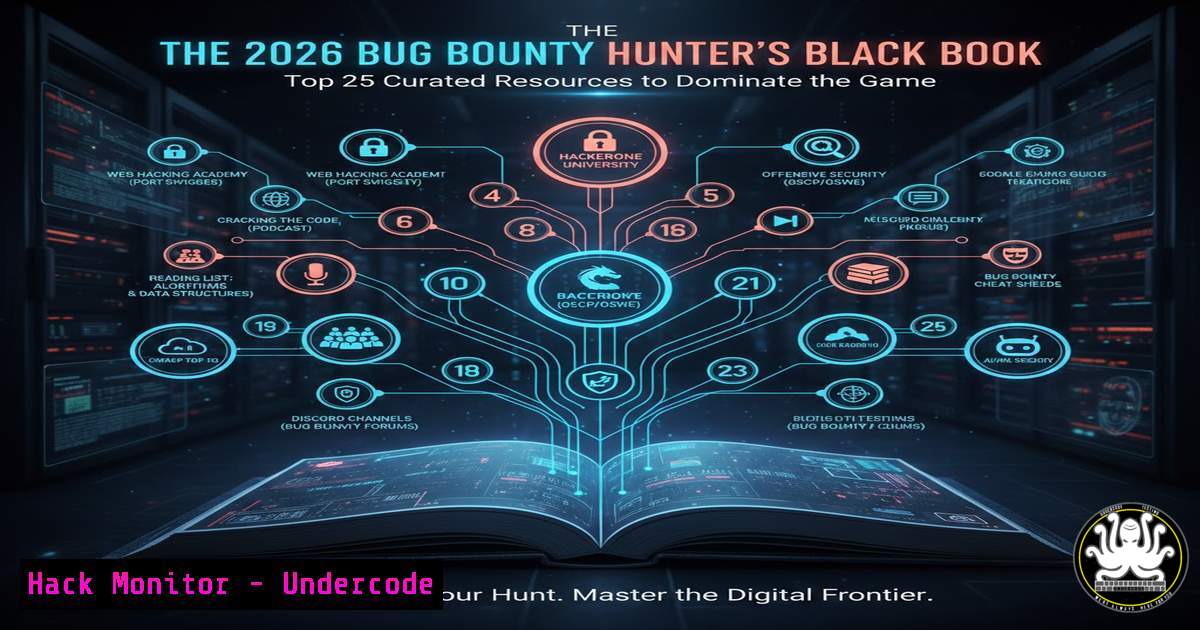
The bug bounty landscape is a deluge of tools, platforms, and content, making it challenging for security researchers to find high-signal information. Harley Kimball, a lead at HackerOne, analyzes thousands of items monthly and has distilled the top 1% into a curated PDF guide for 2026. This article extracts and expands upon the core technical categories from such a resource, providing actionable steps to integrate these assets into your security research workflow.
Learning Objectives:
- Identify and navigate the premier bug bounty platforms and private programs for maximum yield.
- Deploy and configure essential open-source reconnaissance and vulnerability assessment tools.
- Develop a learning pipeline from top security researchers and curated technical content.
You Should Know:
- Navigating the Top Bug Bounty Platforms (VDPs & Private Programs)
A strategic researcher must be on the right platforms. The curated list certainly highlights giants like HackerOne, Bugcrowd, and OpenBugBounty, but the key is understanding their nuances. Private, invite-only programs often offer higher rewards and less competition. Your profile on public platforms is your resume; detailed, high-quality reports increase chances of private invitations.
Step‑by‑step guide explaining what this does and how to use it.
1. Profile Crafting: On HackerOne/Bugcrowd, complete your profile with a link to your blog/write-ups. Showcase your methodology.
2. Initial Triage: Start with public programs. Use platform-specific search to find targets matching your skills (e.g., `scope:.android.app` for mobile).
3. Report Quality: Your first 5-10 reports are critical. Follow the platform’s template precisely, provide clear impact, and include reproducible PoC code or videos.
4. Private Invite Hunt: After establishing a reputation, network on platform-specific chat (e.g., Bugcrowd’s Slack) and express interest in specific program types.
2. The Reconnaissance Toolstack: From Surface to Depth
Recon is the bedrock of bounty hunting. The PDF’s tool list likely includes staples like Amass, Subfinder, and AssetFinder for subdomain enumeration, and httpx/httprobe for filtering live hosts.
Step‑by‑step guide explaining what this does and how to use it.
1. Passive Enumeration: Use tools that aggregate data without touching the target.
 Using Amass for passive subdomain discovery
amass enum -passive -d target.com -o passive_subs.txt
 Using Subfinder
subfinder -d target.com -all -o subfinder_subs.txt
2. Resolution & Probing: Merge results and find live hosts.
cat passive_subs.txt subfinder_subs.txt | sort -u | httpx -silent -o live_targets.txt
3. Screenshot & Tech Stack: Use tools like `gowitness` for visual recon and `wappalyzer` or `webanalyze` to identify technologies.
gowitness file -f live_targets.txt --threads 10
- Automating Vulnerability Discovery with Nuclei & Custom Templates
Nuclei is the de-facto standard for fast, template-based vulnerability scanning. The curated resources will emphasize following projectdiscovery’s official templates and leading community writers.
Step‑by‑step guide explaining what this does and how to use it.
1. Installation & Update: Always use the latest version and templates.
go install -v github.com/projectdiscovery/nuclei/v3/cmd/nuclei@latest
nuclei -update-templates
2. Targeted Scanning: Run specific template classes to avoid noise.
 Scan for exposures and common web CVEs
nuclei -u https://target.com -t exposures/ -t cves/ -es info
3. Integration in Pipeline: Use nuclei with your live targets list.
cat live_targets.txt | nuclei -t ~/nuclei-templates/ -severity medium,high,critical -o nuclei_findings.txt
4. API Security Testing: Beyond the Web Interface
Modern applications are API-driven. Resources will point to tools like Postman, Burp Suite’s API scanning, and specialized tools like `kiterunner` or `ffuf` for endpoint discovery.
Step‑by‑step guide explaining what this does and how to use it.
1. Endpoint Discovery: Fuzz for API routes and parameters.
 Using ffuf to discover API endpoints
ffuf -w /path/to/wordlist/api_routes.txt -u https://target.com/api/FUZZ -mc 200,403 -t 50
2. Schema Analysis: If you have an OpenAPI/Swagger spec (often at `/v2/api-docs` or /swagger.json), analyze it for hidden parameters and test all defined endpoints.
3. Mass Assignment & BOLA Testing: Use Burp’s “Scan defined insertion points” or craft custom Python scripts to test for Broken Object Level Authorization by tampering with object IDs in POST/PUT requests.
5. Cloud & Infrastructure Misconfiguration Hunting
Programs increasingly include cloud assets (AWS, Azure, GCP). The guide will list resources for learning about S3 buckets, IAM roles, and container orchestration misconfigs.
Step‑by‑step guide explaining what this does and how to use it.
1. Passive Discovery: Use tools like `cloud_enum` (for keyword spraying) or `s3scanner` to find publicly accessible cloud storage.
python3 cloud_enum.py -k targetname -t 20
2. Active Recon (Authorized): If the program includes cloud scope, use the provider’s CLI with read-only permissions to audit configurations.
 AWS CLI example - check for public S3 buckets
aws s3api list-buckets --query "Buckets[].Name" --output text | xargs -I {} aws s3api get-bucket-acl --bucket {}
3. Kubernetes Audit: For exposed `kubelet` or API servers, tools like `kube-hunter` can identify common hardening issues.
- The Human Element: Following Top Researchers & Blogs
The “people” section of the PDF is invaluable. It points to researchers who consistently publish novel techniques on platforms like Medium, personal blogs, and YouTube.
Step‑by‑step guide explaining what this does and how to use it.
1. Aggregate Feeds: Use an RSS reader (like Feedly) or follow a curated Twitter/X list to aggregate content from researchers like @zseano, `@hacker_,` @stok, etc.
2. Deconstruct Write-ups: Don’t just read; replicate. Set up a local lab (Docker, DVWA, OWASP Juice Shop) and test the technique yourself.
3. Engage: Comment on write-ups, ask thoughtful questions. This builds your network and deepens understanding.
7. Building Your Personal Knowledge Management System
Consuming content isn’t enough. The top hunters systemize their learnings using tools like Obsidian, Notion, or a simple Git repository to create a searchable vault of commands, payloads, and target-specific notes.
Step‑by‑step guide explaining what this does and how to use it.
1. Choose Your Tool: Set up a local Obsidian vault or a private Notion workspace.
2. Structure It: Create main folders: Targets, Methodologies, Tools/Commands, Vulnerability_Proofs, Templates.
3. Automate Note-Taking: Write simple bash scripts that append new commands or one-liners to your vault with a timestamp.
 Example script to log a useful command
echo " $(date) - New Nuclei Template Scan" >> ~/kb/commands.md
echo 'nuclei -l targets.txt -t /path/to/new-cve.yaml' >> ~/kb/commands.md
What Undercode Say:
- Curated Scarcity is King: In an ocean of low-quality tutorials, a rigorously filtered list from an industry insider provides asymmetric value, dramatically reducing the time-to-competence for aspiring hunters.
- Tooling is Secondary to Methodology: The tools mentioned are meaningless without the strategic framework to deploy them. The true value of such a resource is in implicitly teaching the when and why, not just the what.
The shift towards highly curated resource lists signals a maturation phase in the bug bounty ecosystem. As the barrier to entry lowers with more public knowledge, the differentiating factor becomes efficiency and signal-to-noise ratio. This guide represents a meta-skill: the ability to let experts pre-filter the informational landscape. However, reliance on such lists carries the risk of creating homogeneous hunting patterns. The most successful researchers in 2026 will use these resources as a foundation but will spend an equal amount of time exploring off-list tools and developing novel, non-automatable techniques to find vulnerabilities that the crowd misses.
Prediction:
The widespread dissemination of elite, curated knowledge will rapidly upskill the global researcher community, leading to a short-term spike in common vulnerability findings. In response, organizations will harden their attack surface against these “commodity” attacks, pushing the economic incentive towards discovering complex, chained, and logic-based vulnerabilities. This will accelerate the integration of AI-assisted code reasoning tools into the hunter’s workflow, not to replace the researcher, but to manage the scale of application complexity and identify anomalous code paths that could lead to the next paradigm of critical bugs. The bug bounty market will bifurcate into a high-volume, lower-reward tier for automated/common flaws and a premium tier for deep, contextual security research.
▶️ Related Video (78% Match):
🎯Let’s Practice For Free:
IT/Security Reporter URL:
Reported By: Harley Kimball – Hackers Feeds
Extra Hub: Undercode MoN
Basic Verification: Pass ✅


