Listen to this Post
Introduction:
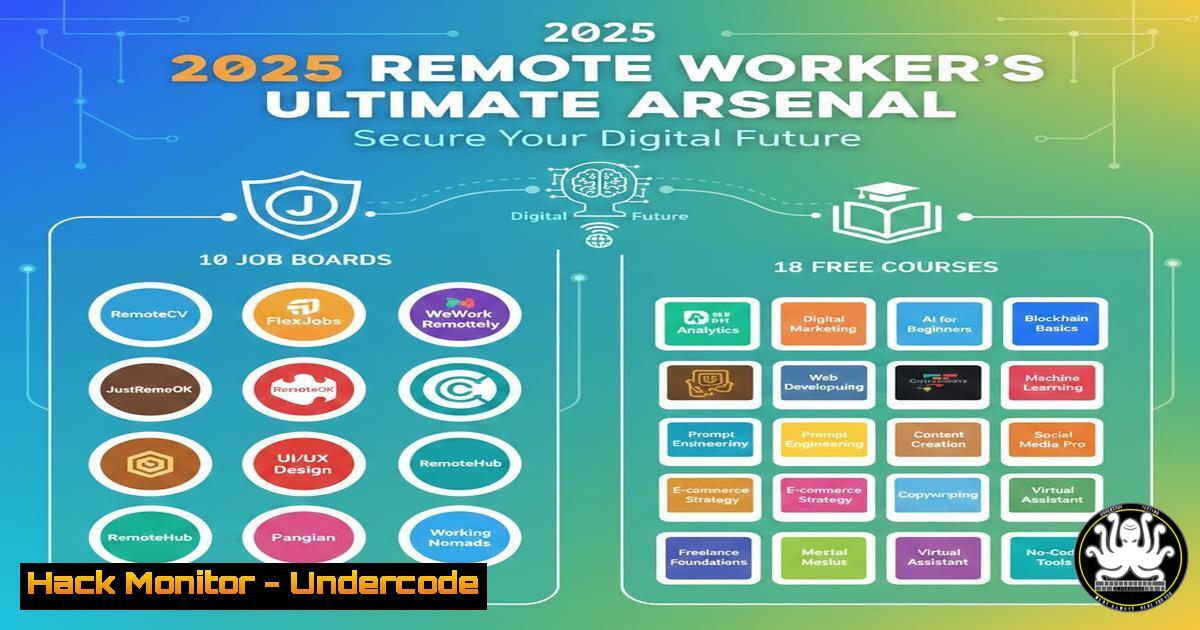
The landscape of professional work has irrevocably shifted towards remote and hybrid models, creating unparalleled opportunities for global employment. Concurrently, the rapid evolution of technology, especially in cybersecurity, AI, and cloud computing, has made continuous upskilling not just an advantage but a necessity. This guide merges the critical paths to finding a remote role with the essential, free technical training required to qualify for and excel in these in-demand positions, focusing on the practical skills that protect assets and drive innovation in a distributed world.
Learning Objectives:
- Identify and leverage specialized remote job boards to target global opportunities in the tech sector.
- Access and strategically navigate free, industry-recognized courses to build competencies in cybersecurity, AI, cloud, and data science.
- Implement foundational technical commands and security practices relevant to remote IT and development roles.
You Should Know:
- Navigating Remote Job Boards with a Security-First Mindset
The proliferation of remote work has expanded the attack surface for both companies and professionals. When using job platforms like JustRemote, Dynamite Jobs, or Wellfound, it’s crucial to practice digital operational security (OpSec). This means verifying the legitimacy of job posters, being wary of offers that seem too good to be true (a common phishing tactic), and protecting your personal data. Before applying, research the company’s security posture. A simple `whois` lookup on a company’s domain can reveal basic registration information and help confirm legitimacy.
Step-by-Step Guide:
- Bookmark Verified Sites: Use the provided list (e.g., Remotive, Himalayas) as a starting point to avoid malicious copycat sites.
- Investigate Listings: For a company you don’t recognize, open a terminal and run
whois companydomain.com. Check the registration date; very new domains can be a red flag. - Use a Dedicated Email: Create a professional email specifically for job applications to isolate potential spam or phishing attempts from your primary accounts.
- Enable 2FA: Ensure your accounts on these job platforms are secured with two-factor authentication, preferably using an authenticator app.
-
Building Your Foundation: The Non-Negotiable IT & Security Skills
The free “Google IT Support” and “Cybersecurity” courses listed are your bedrock. These courses typically cover fundamentals like networking, system administration, and threat models. For a remote professional, understanding how to secure your own home office network is step one. This includes configuring your router, using a VPN, and understanding basic firewall rules.
Step-by-Step Guide:
- Secure Your Home Router: Log into your router’s admin panel (often `192.168.1.1` or
192.168.0.1) and change the default admin password. Disable WPS and ensure WPA2/WPA3 encryption is enabled. - Basic Network Reconnaissance: On your local machine, understand your network. In Linux/Mac, open a terminal and use `ifconfig` or `ip a` to see your IP address. In Windows, use
ipconfig. Use `nmap -sn 192.168.1.0/24` (adjust subnet) to see all devices on your local network and identify unauthorized devices. - Implement a Firewall: On a Linux system, use `ufw` (Uncomplicated Firewall). Enable it with `sudo ufw enable` and set default deny policies: `sudo ufw default deny incoming` and
sudo ufw default allow outgoing.
3. Leveraging Cloud and AI for Competitive Advantage
Cloud Computing (Google Cloud, Cloud Computing course) and Generative AI are the most sought-after skills. The free courses provide theoretical and lab-based knowledge. To stand out, you must demonstrate hands-on ability. Start by creating free-tier accounts on major cloud platforms (AWS, GCP, Azure) and follow tutorials to deploy a secure web server or a serverless function.
Step-by-Step Guide:
- Deploy a Secure Web Server on AWS EC2:
– Launch an EC2 instance (Ubuntu Server) via the AWS Console.
– SSH into it: ssh -i your-key.pem ubuntu@your-ec2-public-ip.
– Update packages: sudo apt update && sudo apt upgrade -y.
– Install a web server: sudo apt install nginx -y.
– Configure the firewall (AWS Security Group & local): sudo ufw allow 'Nginx HTTP'.
– Harden SSH: edit `/etc/ssh/sshd_config` to change `PasswordAuthentication` to `no` and `PermitRootLogin` to no. Reload with sudo systemctl reload sshd.
2. Experiment with AI APIs: After taking the Prompt Engineering course, use the OpenAI API or Google’s Gemini API to build a simple CLI chatbot script in Python, ensuring you keep API keys in environment variables, not in the code.
4. Data Proficiency: The Language of Decision-Making
Roles in Data Analytics (Google), Data Science (IBM), and Visualization (Microsoft PowerBI) are highly remote-friendly. The technical skill here extends beyond analysis to securing data pipelines and outputs. Learn how to anonymize data, manage access controls, and encrypt sensitive datasets.
Step-by-Step Guide:
1. Anonymize a CSV Dataset with Python:
import pandas as pd
from hashlib import sha256
 Load data
df = pd.read_csv('sensitive_data.csv')
 Anonymize a 'user_email' column by hashing
df['user_email_anon'] = df['user_email'].apply(lambda x: sha256(x.encode()).hexdigest())
 Drop the original column
df.drop('user_email', axis=1, inplace=True)
df.to_csv('anonymized_data.csv', index=False)
2. Secure a Data Directory: On your project server, set strict permissions: `chmod -R 750 /path/to/data/project` and change ownership: chown -R username:group /path/to/data/project.
5. Full-Stack Development in a Remote-First World
The “Full Stack Developer” and “Web Dev” courses teach you how to build. For remote teams, you must also know how to collaborate securely using Git and how to write code with security in mind (e.g., preventing SQL injection, XSS).
Step-by-Step Guide:
- Secure Git Configuration: Set your Git username/email globally: `git config –global user.name “Your Name”` and
git config --global user.email "[email protected]". Use SSH keys for authentication with GitHub/GitLab instead of passwords. - Basic Code Security Scan: Use a static application security testing (SAST) tool. For a Python project, you can run `bandit -r /path/to/your/code` to scan for common security issues. Install it via pip:
pip install bandit. - Sanitize User Input (Node.js Example): Always sanitize input to prevent injection attacks.
// Using express-validator in a Node.js/Express app
const { body, validationResult } = require('express-validator');
app.post('/user',
body('email').isEmail().normalizeEmail(),
body('password').isLength({ min: 5 }),
(req, res) => {
const errors = validationResult(req);
if (!errors.isEmpty()) {
return res.status(400).json({ errors: errors.array() });
}
// Proceed with safe data
}
);
What Undercode Say:
- The Convergence is Key: Success in the remote job market is no longer just about finding the listing; it’s about possessing the verified, technical skills that these roles demand. The provided course list is a curated curriculum for the modern digital workforce.
- Security is Your Responsibility: In a remote setting, you are your own first line of IT defense. Proactively applying the cybersecurity fundamentals from these courses to your own workflow is a non-negotiable practice that will also be evident to potential employers.
Analysis: The post intelligently links opportunity with capability. The job boards represent the demand, while the courses—particularly in high-stakes areas like cybersecurity, cloud, and AI—represent the supply of skills. For a professional, this is a complete loop. Notably, the most valuable and future-proof remote roles will require this exact blend of technical depth, especially security awareness, as organizations battle threats in a decentralized environment. Merely applying for jobs is passive; aggressively consuming these free, quality resources to build demonstrable skills is the active strategy that leads to success.
Prediction:
The remote job market will increasingly bifurcate. Generic, low-skill remote roles will face saturation and automation. Conversely, roles demanding verified technical skills in cybersecurity, AI integration, and cloud infrastructure management will see exponential growth, with compensation to match. The professionals who treat the listed courses as a mandatory 2025 upskilling roadmap will not only secure remote positions but will also shape the security and architectural standards of the distributed organizations of the future. Platforms that can verify both skill acquisition (via micro-credentials from these courses) and job readiness will become the new intermediaries in the talent marketplace.
▶️ Related Video (72% Match):
🎯Let’s Practice For Free:
IT/Security Reporter URL:
Reported By: Tajber Alam – Hackers Feeds
Extra Hub: Undercode MoN
Basic Verification: Pass ✅


