Listen to this Post
Introduction:
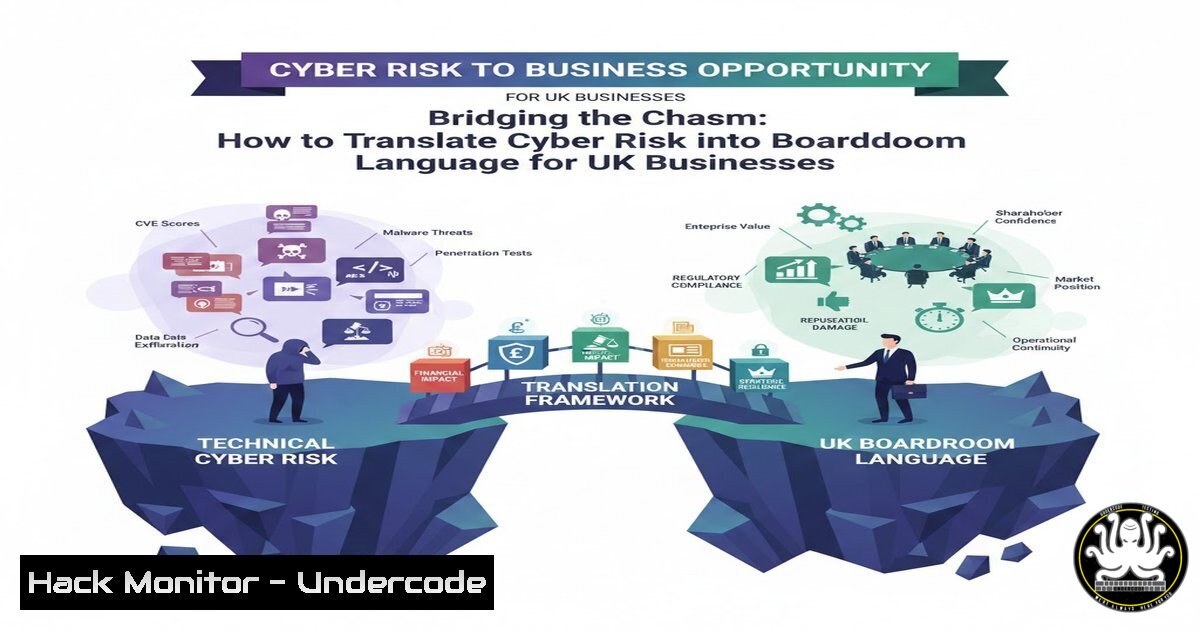
For UK boards, cyber risk reporting remains a persistent communication failure. Despite regulatory pressure from the NCSC and PRA, board packs are still saturated with technical metrics like patch rates and phishing click-throughs, which obscure the true business exposure. This article provides a strategic framework for CISOs and technology leaders to reframe cyber risk in the language of business resilience, financial impact, and operational continuity that directors inherently understand.
Learning Objectives:
- Learn to replace technical metrics with risk-based storytelling and attack path analysis that maps threats directly to business services.
- Understand how to align reporting with UK regulatory frameworks (NCSC CAF, DORA, NIS2) and present cyber risk alongside financial and operational risk.
- Develop actionable strategies to overcome the primary obstacles—culture, complexity, and confidence—in board-level cyber communication.
You Should Know:
- From Patching Percentages to Business Impact: The Art of Risk Translation
The core failure is presenting operational data as risk intelligence. A board doesn’t need to know that 95% of systems are patched; they need to understand the financial and reputational impact if a critical revenue-generating application, reliant on the unpatched 5%, is compromised.
Step‑by‑step guide:
- Identify Critical Business Services: Map your IT assets to the business services they support (e.g., e-commerce platform, customer data warehouse, manufacturing control system).
- Conduct Attack Path Mapping: Use tools like BloodHound (for Active Directory) or AttackIQ to visually trace how a common vulnerability (e.g., CVE-2024-12345) in a low-level system could lead to compromise of a critical service.
- Quantify the Impact: Frame the risk in financial terms. For example: “An exploit in our legacy payment gateway server (unpatchable due to vendor EOL) creates a path to our core transaction database. A breach here could lead to a 48-hour outage, incurring ~£250k in lost revenue, plus potential GDPR fines of up to 4% of global turnover.”
-
Framing Cyber Risk Within Regulatory & Resilience Postures
Boards are accountable for organizational resilience and regulatory exposure. Cyber reporting must explicitly connect to these mandates, moving beyond checkbox compliance.
Step‑by‑step guide:
- Map Controls to Frameworks: Align your security program to the NCSC’s Cyber Assessment Framework (CAF). Don’t just list controls; report on the CAF’s objectives: “Managing Security Risk,” “Protecting Against Cyber Attack,” “Detecting Security Events,” and “Minimising Impact.”
- Report on Systemic Risks: For “cloud concentration risk,” don’t just list AWS usage. Present an analysis: “90% of our customer data resides in a single AWS region. An outage there would halt all digital services. Our mitigation is a multi-region failover strategy, requiring a £50k investment to implement, reducing potential outage cost from £500k to £50k.”
-
Link to Specific Regulations: Instead of “we comply with NIS2,” state: “Our incident response plan and 24/7 monitoring capability, as demonstrated in last quarter’s tabletop exercise, directly satisfy NIS2 21 requirements and reduce our mandatory incident reporting time from 72 to 24 hours.”
-
Leveraging Threat Intelligence for Mid-Term Risk Reporting (AI, Quantum)
Reporting on emerging threats like AI-driven phishing or quantum computing cannot be vague. It must be contextualized within the organization’s strategic timeline.
Step‑by‑step guide:
- Analyze Threat Relevance: Use threat intelligence feeds to filter for your industry. For AI, report: “Adversaries are using LLMs to generate highly personalized phishing lures targeting our finance department. Our current email gateway has a 70% detection rate against these, highlighting the need for enhanced user simulation training.”
- Create a Quantum Readiness Roadmap: For quantum risk, the threat is to current encryption. Conduct a data inventory: “We have 15 years of archived customer data encrypted with RSA-2048. Quantum computers could break this within 5-10 years. Our plan is to initiate a migration to post-quantum cryptographic algorithms for archival data by Q4 2025, ahead of the expected NIST standards finalization.”
-
Command Example – Cryptographic Audit: On a Linux system, you can audit SSL/TLS certificates for weak algorithms:
openssl s_client -connect yourdomain.com:443 -servername yourdomain.com 2>/dev/null | openssl x509 -text -noout | grep "Signature Algorithm". This helps baseline current cryptographic posture. -
Building a Board-Level Cyber Risk Dashboard: Key Performance Indicators (KPIs) vs. Key Risk Indicators (KRIs)
Shift from technical KPIs to business-centric KRIs. A KPI measures security team activity; a KRI measures business risk exposure.
Step‑by‑step guide:
- Define KRIs: Identify 5-7 top KRIs. Examples: Financial Exposure from Critical Vulnerabilities, Third-Party Service Downtime Impact, Mean Time to Recover (MTTR) for Critical Services.
- Implement Data Aggregation: Use SIEM (e.g., Splunk, Elastic) queries and vulnerability management tools to feed KRIs. For example, a KRI for “Top Attack Path Criticality Score” can be pulled from BloodHound or Microsoft Defender for Identity.
- Visualize in Business Terms: In your dashboard, show: “KRI 1: Supply Chain Risk. Our primary logistics vendor suffered 3 security incidents last quarter, posing a High risk to our delivery timelines. Mitigation: We are implementing API-based security monitoring for all vendor connections (completion: Q3).”
5. Conducting a Board-Ready Tabletop Exercise
Move beyond hypotheticals. A well-facilitated exercise is the ultimate translation tool, making risk tangible.
Step‑by‑step guide:
- Design a Business-Focused Scenario: Base it on a real threat to a critical service. “Scenario: Ransomware has encrypted the servers hosting our online booking system. Customers cannot place orders. The attackers are demanding 50 BTC.”
- Invite Key Decision-Makers: Include not just IT, but Legal, Communications, Finance, and Operations leads.
- Facilitate for Decisions, Not Technical Solutions: Pose questions to the board role-player: “CEO, do you authorize engaging with the threat actors? What is your public messaging threshold? CFO, what is the maximum downtime we can absorb before insolvency concerns arise?”
- Report on Gaps and Investments: The output is not an incident response report, but a strategic finding: “The exercise revealed a 6-hour delay in executive decision-making, costing an estimated £150k in simulated losses. We recommend implementing a pre-authorized crisis playbook and communication charter.”
What Undercode Say:
- Culture is the Ultimate Firewall. The most significant obstacle is not complexity, but organizational culture. Cybersecurity must be re-branded from a technical cost center to a strategic enabler of business resilience. This requires persistent, narrative-driven communication from security leadership.
- Speak the Language of the Balance Sheet. To gain confidence and cut through complexity, every cyber risk must be articulated in terms of financial impact, operational downtime, reputational damage, and regulatory fines. This aligns directly with the board’s fiduciary duties.
Analysis: The LinkedIn discourse highlights a critical evolution in the CISO role—from chief technician to chief risk translator. While frameworks and tools exist, the persistent gap indicates a failure in security leadership to master business communication as thoroughly as they master technology. The regulators (PRA, NCSC) have set the expectation; the onus is now on security professionals to develop the fluency. The future CISO will be evaluated not on their ability to configure a firewall, but on their ability to convincingly articulate how that firewall protects shareholder value.
Prediction:
In the next 2-3 years, we will see a formalization of “cyber risk translation” as a core competency in MBA programs and executive certifications. Boards will increasingly recruit directors with hybrid cyber/risk governance expertise, and CISOs who fail to adapt will be relegated to operational roles, replaced by leaders who can seamlessly integrate cyber strategy with business strategy. Furthermore, AI-powered tools will emerge to automate the translation of technical telemetry into board-ready financial risk models, but the human element of storytelling and building a culture of security will remain the indispensable factor.
▶️ Related Video (80% Match):
🎯Let’s Practice For Free:
IT/Security Reporter URL:
Reported By: Colin Merrells – Hackers Feeds
Extra Hub: Undercode MoN
Basic Verification: Pass ✅


