Listen to this Post
Introduction:
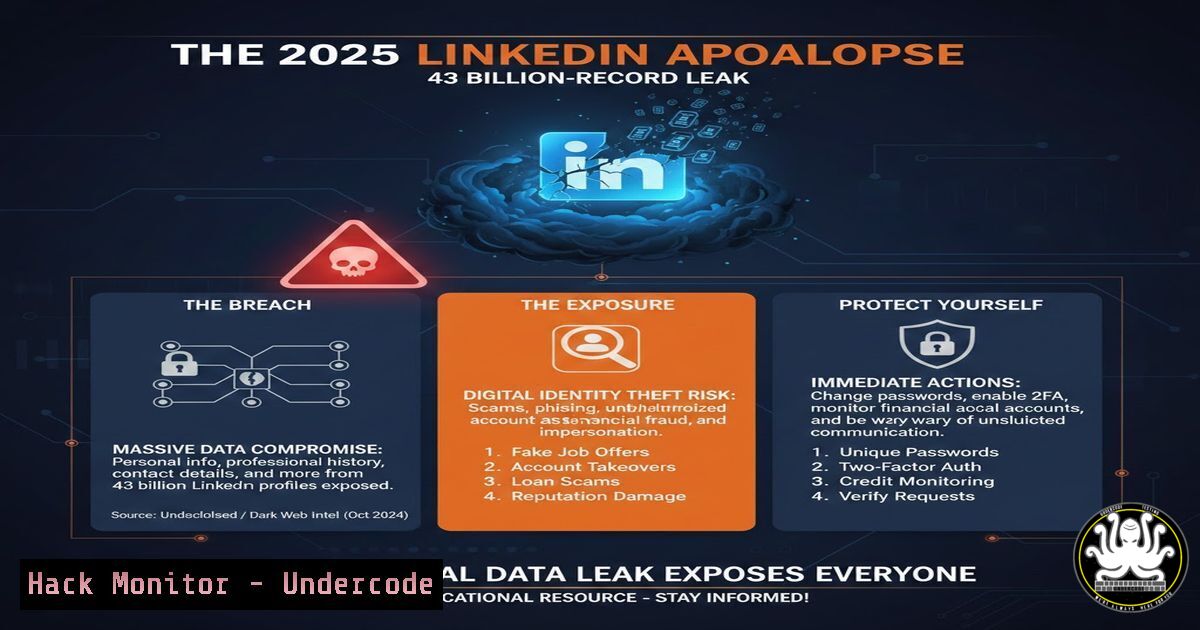
The professional networking giant LinkedIn faced a catastrophic data crisis in 2025, with a single unsecured database exposing a staggering 4.3 billion user records. This incident, far from an isolated breach, underscores systemic vulnerabilities in how platforms and third-party data brokers handle vast troves of personal information. The leaked data, including names, email addresses, job histories, and photographs, has created a perpetual threat landscape ripe for sophisticated phishing campaigns, identity theft, and targeted scams, forcing both individuals and organizations to radically reassess their digital footprint and defensive postures.
Learning Objectives:
- Understand the technical mechanisms of data scraping and third-party data exposure that led to the LinkedIn-linked breach.
- Implement immediate, actionable steps to harden personal and corporate LinkedIn profiles against data harvesting.
- Learn advanced threat-hunting techniques to identify if your data is circulating on the dark web following a mega-breach.
You Should Know:
- How Your Data Was Stolen: The Anatomy of Data Scraping and Leaky Buckets
The core of this crisis was not a direct hack of LinkedIn’s primary servers, but the exposure of a database owned by a third-party lead-generation firm. This data was likely originally gathered through “data scraping”—an automated process of extracting public profile information at scale. While individual profiles are public, aggregating billions of records creates a powerful weaponized dataset. The breach occurred because this aggregated database was left unsecured without authentication, a critical misconfiguration often called a “leaky S3 bucket” in cloud environments.
Step‑by‑step guide explaining what this does and how to use it.
Understanding the Scraping Process: Attackers or data brokers use automated bots and scripts to query public profiles. They mimic a web browser to navigate pages and extract structured data using tools like Python libraries (BeautifulSoup, Scrapy).
Example Scrapy Command Skeleton:
import scrapy
class LinkedInSpider(scrapy.Spider):
name = 'linkedin'
start_urls = ['https://linkedin.com/in/exampleprofile']
def parse(self, response):
yield {
'name': response.css('h1.text-heading-xlarge::text').get(),
'job_title': response.css('div.text-body-medium::text').get(),
}
Finding Leaky Databases: Security researchers and threat actors use search engines like Shodan or BinaryEdge to find misconfigured databases.
Example Shodan Search Query: `”bucket-name” “200 OK” “Anonymous access”` or "MongoDB" "port:27017" "authentication"\
Mitigation for Organizations: If you handle such data, you must secure cloud storage. For an AWS S3 bucket, use this AWS CLI command to block all public access: `aws s3api put-public-access-block –bucket YOUR-BUCKET-NAME –public-access-block-configuration “BlockPublicAcls=true, IgnorePublicAcls=true, BlockPublicPolicy=true, RestrictPublicBuckets=true”`
2. Immediate Post-Breach Actions: Locking Down Your Digital Identity
Assume your data is part of this leak. The immediate goal is to contain the damage by limiting what attackers can use and increasing your account security.
Step‑by‑step guide explaining what this does and how to use it.
1. Conduct a Data Exposure Audit: Use a site like HaveIBeenPwned.com to check if your primary email is in known breach corpora. While the 2025 leak may not yet be indexed, this identifies other risks.
2. Harden Your LinkedIn Privacy Settings:
Go to Settings & Privacy > Visibility > Profile viewing options. Select “Private mode”.
Under “Data privacy and advertising,” turn off “Career interests” if not job hunting.
Review “How others see your LinkedIn activity” and limit old post visibility.
3. Enforce Password Hygiene & MFA: Change your LinkedIn password to a unique, strong passphrase. Crucially, enable Multi-Factor Authentication (MFA) under “Sign in & security.” Use an authenticator app (Google/Microsoft Authenticator, Authy) over SMS.
4. Segment Your Digital Identity: Consider using a unique email alias (services like Apple Hide My Email or Firefox Relay) solely for professional networking to compartmentalize breaches.
- From Personal to Corporate Threat: Mitigating Weaponized Phishing (BEC & Spear Phishing)
With detailed job histories and professional connections, this data is fuel for Business Email Compromise (BEC) and hyper-targeted spear-phishing. Attackers can impersonate colleagues, executives, or recruiters with high credibility.
Step‑by‑step guide explaining what this does and how to use it.
Simulate a Phishing Campaign (For Security Teams): Use the breached data structure to educate employees. A tool like the Social-Engineer Toolkit (SET) can mimic these attacks in a controlled environment.
Linux Command to launch SET: `sudo setoolkit`
Select: `1) Social-Engineering Attacks` > `2) Website Attack Vectors` > `3) Credential Harvester Attack Method` > `2) Site Cloner`
Input a cloned LinkedIn login page IP and the target URL. This demonstrates how easily a fake login can be created.
Defensive Configuration for Email Security (For Admins):
DMARC/DKIM/SPF Enforcement: Ensure your corporate domain has a strict DMARC policy (p=reject) to prevent spoofing.
Microsoft 365/Azure AD Command (Check DMARC): `Get-DkimSigningConfig -Identity yourdomain.com | Format-List`
User Training: Mandate training that emphasizes verifying unusual requests via a secondary channel (e.g., a phone call), even if the email appears to come from a known connection.
- Threat Hunting in the Dark: Searching for Your Exposed Data
Proactive individuals and security teams can look for signs that their specific data is being traded or used.
Step‑by‑step guide explaining what this does and how to use it.
1. Monitor Dark Web Forums (Advanced): This requires access to dark web monitoring services or specialized searches via TOR. Legitimate threat intelligence platforms like Recorded Future or Digital Shadows automate this.
2. Set Up Canary Tokens: Place digital tripwires. Create unique email addresses, phone numbers, or fake document credentials and associate them with your LinkedIn profile (where feasible). If these “canaries” are triggered, you know your data is active in a malicious dataset.
Visit canarytokens.org to generate a unique tracking token embedded in a fake “Resume.docx.” Upload this as your LinkedIn profile resume. Any access to this file will generate an alert.
3. Utilize Breach Search APIs: Integrate breach data into your security monitoring. The HaveIBeenPwned API offers a programmatic way to check.
Example curl command to check an email hash: `curl -H “hibp-api-key: YOUR_KEY” https://haveibeenpwned.com/api/v3/breachedaccount/EMAIL_ADDRESS`
- The Regulatory and Architectural Reckoning: Beyond Quick Fixes
This breach highlights failures in data governance and the dangers of the “data broker” ecosystem. The long-term solution involves architectural and regulatory shifts.
Step‑by‑step guide explaining what this does and how to use it.
Implement a Zero-Trust Data Architecture: Assume no network, user, or third-party is inherently trustworthy. Enforce strict access controls and encryption.
Command to Encrypt Data at Rest (Linux): Use `LUKS` for disk encryption: `sudo cryptsetup luksFormat /dev/sdX` then sudo cryptsetup open /dev/sdX secure_volume.
Advocate for and Comply with Stricter Regulations: Understand regulations like GDPR (Right to Erasure) and CCPA. Users can request data deletion from platforms and their known data brokers.
Actionable Step: Formally request data deletion from LinkedIn for your account and ask for a list of third parties with whom your data has been shared via their data subject access request (DSAR) portal.
What Undercode Say:
- The Breach is Permanent; Your Response Must Be Dynamic. Once data of this scale is leaked, it is irrecoverable. Security is no longer about preventing a single breach but about building resilience and assuming ongoing exposure. Your defense must evolve from static password changes to active monitoring and behavioral controls.
- The Attack Surface is Now Your Biography. The most valuable data for attackers is no longer just your credit card number; it’s your career narrative, your network map, and your professional interests. This information is used to craft deception that bypasses traditional, transaction-based security filters.
The 2025 LinkedIn leak is a paradigm-shifting event. It demonstrates that in the professional data economy, the individual is the ultimate attack vector. For cybersecurity professionals, it demands a shift from protecting internal perimeters to defending the external digital identities of every employee. For users, it shatters the illusion of “public but safe” data. The technical fallout will drive adoption of decentralized identity models, like verifiable credentials, and force platforms to treat scraped data aggregation as a critical threat. The future of networking platforms hinges not on more features, but on verifiable security and radically transparent data governance. Failure to adapt will see trust—and users—migrate to more secure alternatives.
▶️ Related Video (78% Match):
🎯Let’s Practice For Free:
IT/Security Reporter URL:
Reported By: Bobcarver Cybersecurity – Hackers Feeds
Extra Hub: Undercode MoN
Basic Verification: Pass ✅


