Listen to this Post
Introduction:
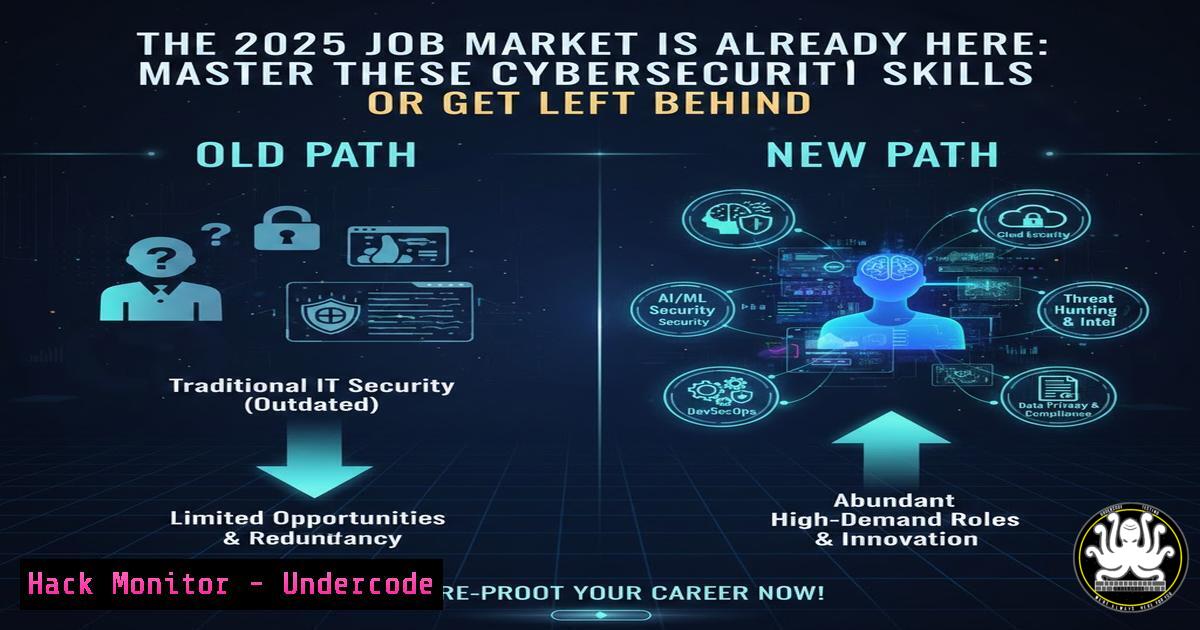
The 2025 job market is no longer a future concept; it’s unfolding today, driven by the rapid convergence of Artificial Intelligence and cybersecurity. Professionals who fail to adapt to this new paradigm, where AI is both a powerful tool and a potent threat vector, risk obsolescence. This article decodes the essential technical skills you need to master now to secure your career and defend against the next generation of AI-powered cyber attacks.
Learning Objectives:
- Understand the critical intersection of AI and cybersecurity and its implications for modern IT infrastructure.
- Acquire practical, hands-on skills in AI-augmented security operations, API hardening, and cloud security configuration.
- Learn to implement proactive defense measures against emerging threats like AI-generated phishing and automated vulnerability exploitation.
You Should Know:
- AI-Augmented Security Operations: From Log Analysis to Threat Hunting
The core of modern SecOps is shifting from manual log review to AI-driven analysis and automation. Security Information and Event Management (SIEM) systems and Extended Detection and Response (XDR) platforms now leverage AI to identify anomalies and orchestrate responses at machine speed.
Step‑by‑step guide explaining what this does and how to use it.
Step 1: Ingest and Normalize Logs. Use an open-source tool like the Elastic Stack (ELK) to collect logs from various sources (servers, firewalls, endpoints).
Command to install Elasticsearch and Kibana on a Linux server:
 Ubuntu/Debian
wget -qO - https://artifacts.elastic.co/GPG-KEY-elasticsearch | sudo apt-key add -
echo "deb https://artifacts.elastic.co/packages/7.x/apt stable main" | sudo tee /etc/apt/sources.list.d/elastic-7.x.list
sudo apt update && sudo apt install elasticsearch kibana
sudo systemctl daemon-reload
sudo systemctl enable elasticsearch kibana
sudo systemctl start elasticsearch kibana
Step 2: Implement AI-Powered Anomaly Detection. In Kibana, navigate to the Machine Learning section. Create a job to analyze, for example, `network destination.bytes` to find servers receiving unusually high data transfers, a potential sign of data exfiltration.
Step 3: Automate Response with a Playbook. Use a SOAR platform like TheHive or Shuffle to create a playbook. Trigger an automated investigation when the AI model detects an anomaly, such as isolating a compromised endpoint via its API.
2. Hardening API Security Against AI-Fuzzing Attacks
APIs are the backbone of modern applications and a primary target. Attackers are now using AI to “fuzz” APIs—automatically generating massive, malformed requests to discover vulnerabilities that would be missed by manual testing.
Step‑by‑step guide explaining what this does and how to use it.
Step 1: Implement Strict Schema Validation. Enforce a strong schema for all incoming and outgoing API requests using a library like `Joi` for Node.js or Pydantic for Python. This blocks malformed data at the gateway.
Example Python/FastAPI code:
from pydantic import BaseModel, constr, conint
from fastapi import FastAPI, HTTPException

app = FastAPI()

class UserCreate(BaseModel):
username: constr(min_length=3, max_length=50)  Strict string length
age: conint(gt=0, lt=120)  Integer must be between 1 and 119

@app.post("/users/")
async def create_user(user: UserCreate):
 Pydantic automatically validates the request body
 Invalid data automatically returns a 422 error
return {"message": "User created", "user": user.dict()}
Step 2: Deploy a Robust API Gateway. Use a gateway like Kong or AWS WAF to enforce rate limiting, preventing AI-driven brute force attacks.
Example Kong rate-limiting configuration via its Admin API:
curl -X POST http://localhost:8001/services/{service-name}/plugins \
--data "name=rate-limiting" \
--data "config.minute=5" \
--data "config.hour=100" \
--data "config.policy=local"
Step 3: Leverage Dynamic Application Security Testing (DAST). Integrate an API security scanner like OWASP ZAP into your CI/CD pipeline to automatically discover and test your API endpoints for vulnerabilities before deployment.
3. Cloud Infrastructure Hardening for a Zero-Trust World
The perimeter is dead. A Zero-Trust architecture, which mandates “never trust, always verify,” is essential. This involves meticulously configuring Identity and Access Management (IAM) and network security groups.
Step‑by‑step guide explaining what this does and how to use it.
Step 1: Enforce the Principle of Least Privilege (PoLP) in IAM. Regularly audit and prune IAM policies in AWS, Azure, or GCP. Use tools like `iam-lint` or cloud-specific policy simulators to find and remove over-permissive policies.
Step 2: Implement Micro-Segmentation with Security Groups. Instead of allowing broad `0.0.0.0/0` inbound rules, define precise rules.
Example Terraform code for a restrictive AWS Security Group:
resource "aws_security_group" "app_server" {
name = "app-server-sg"
description = "Allow HTTP/HTTPS and SSH only from bastion"

ingress {
from_port = 443
to_port = 443
protocol = "tcp"
cidr_blocks = ["0.0.0.0/0"]  Public web traffic
}

ingress {
from_port = 22
to_port = 22
protocol = "tcp"
cidr_blocks = ["10.0.1.100/32"]  SSH only from the bastion host
}

egress {
from_port = 0
to_port = 0
protocol = "-1"
cidr_blocks = ["0.0.0.0/0"]
}
}
Step 3: Mandate Multi-Factor Authentication (MFA) for All Privileged Accounts. Enforce this via Azure Active Directory Conditional Access policies or AWS IAM best practices. This is a critical control that dramatically reduces the risk of credential theft.
4. Proactive Defense Against AI-Generated Social Engineering
AI models like GPT can generate highly convincing and personalized phishing emails at scale. Defending against this requires a multi-layered approach combining technical controls and user training.
Step‑by‑step guide explaining what this does and how to use it.
Step 1: Deploy Advanced Email Security Gateways. Use solutions that leverage AI to detect synthetic text, anomalous sender behavior, and newly registered domains used in phishing campaigns.
Step 2: Implement DMARC, DKIM, and SPF Records. These DNS records prevent email spoofing, making it harder for attackers to impersonate your domain.
Example DNS TXT records:
; SPF Record
example.com. IN TXT "v=spf1 mx include:_spf.google.com ~all"

; DMARC Record
_dmarc.example.com. IN TXT "v=DMARC1; p=quarantine; rua=mailto:[email protected]"
Step 3: Conduct Continuous Security Awareness Training. Use platforms that simulate AI-generated phishing attacks to keep users vigilant and test the human firewall.
5. Mastering Penetration Testing in an AI-Enhanced Landscape
Penetration testers must now use AI tools to keep pace with attackers. This involves using AI to write custom exploits, automate reconnaissance, and analyze code for vulnerabilities.
Step‑by‑step guide explaining what this does and how to use it.
Step 1: AI-Assisted Reconnaissance. Use a tool like `recon-ng` or the `sublist3r` module to automate subdomain enumeration.
Command example:
python sublist3r.py -d example.com -o subdomains.txt
Step 2: Automated Vulnerability Scanning with AI Context. Go beyond traditional scanners. Use a tool like Burp Suite’s Scanner, which employs heuristic analysis, and cross-reference findings with the MITRE ATT&CK framework to understand the attack path.
Step 3: Proof-of-Concept Exploitation. For a discovered vulnerability (e.g., a SQL Injection), use a tool like `sqlmap` to automate exploitation, demonstrating the real-world impact.
Command example:
sqlmap -u "http://example.com/page.php?id=1" --risk=3 --level=5 --batch
What Undercode Say:
- Adapt or Perish: The dichotomy is no longer between technical and non-technical roles, but between those who leverage AI as a force multiplier and those who are rendered inefficient by it. Cybersecurity is the core domain where this battle is being fought.
- The Skills Mosaic is Critical: Success hinges on building a mosaic of skills. Deep, specialized knowledge in cloud configuration or penetration testing must now be interwoven with a functional understanding of AI/ML principles and automation scripting. A specialist who cannot automate is as limited as a generalist with no depth.
The post by Jasuja correctly identifies the tectonic shifts in the job market, but the underlying message is more urgent: the tools and tactics of attackers have already evolved. Defenders are in an arms race, not just for new technology, but for a new mindset. The “2025 job market” is a euphemism for the current reality where defensive strategies from two years ago are already obsolete. The professionals who will thrive are those viewing AI not as a magical solution, but as a powerful new component in their technical toolkit—one that requires as much skill to wield effectively as any traditional security tool. The time for upskilling was yesterday.
Prediction:
The convergence of AI and cybersecurity will lead to the emergence of fully autonomous security operations centers (SOCs) within 5-7 years, where AI agents will handle Tier-1 and a significant portion of Tier-2 alert triage and response. This will not eliminate human jobs but will radically redefine them. The demand will skyrocket for “AI Security Engineers” who can train, fine-tune, and defend the AI models themselves, and for “Cyber Threat Hunters” who use AI-driven insights to conduct deep, proactive investigations into sophisticated threat actors. The failure to integrate AI literacy into core cybersecurity training today will create a massive skills gap tomorrow, leaving organizations vulnerable to a class of attacks they are not equipped to even detect.
🎯Let’s Practice For Free:
IT/Security Reporter URL:
Reported By: Jasuja If – Hackers Feeds
Extra Hub: Undercode MoN
Basic Verification: Pass ✅


