Listen to this Post
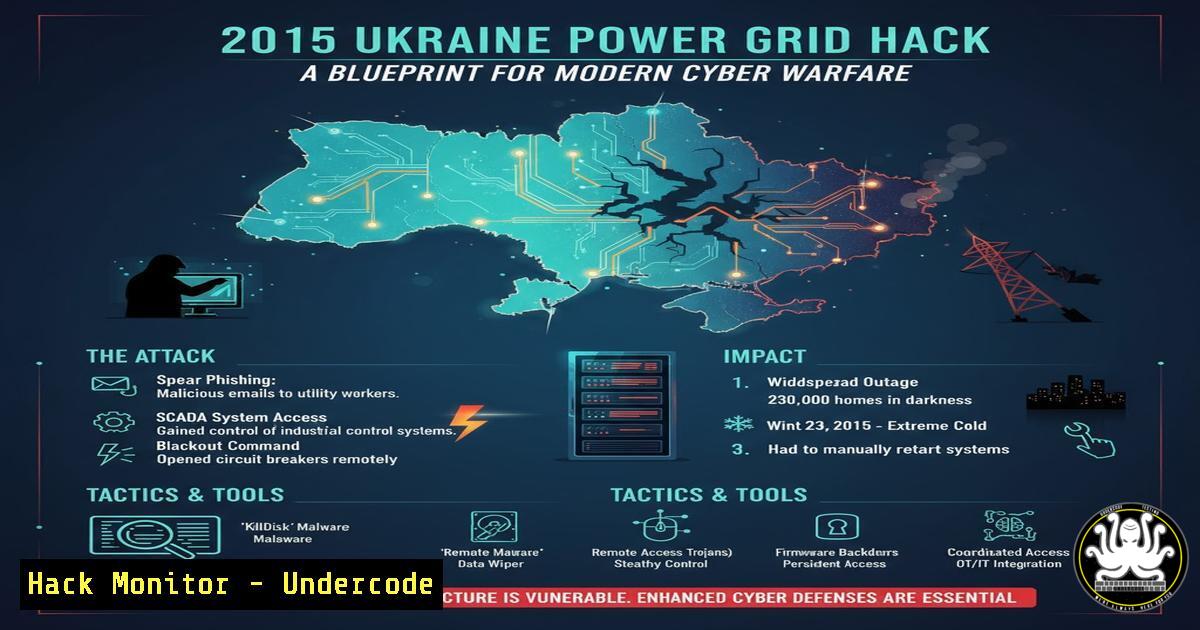
Introduction:
The 2015 cyber attack on Ukraine’s power grid stands as a seminal moment in the history of cybersecurity, marking a clear transition from digital espionage to kinetic, real-world disruption. This incident demonstrated that cyber operations could directly impact civilian critical infrastructure, causing widespread blackouts and threatening public safety in sub-zero temperatures. By analyzing this attack, we can extract vital lessons for defending Industrial Control Systems (ICS) and Operational Technology (OT) against sophisticated threats.
Learning Objectives:
- Understand the attack vectors and methodologies used in the 2015 Ukraine grid compromise.
- Learn practical, actionable steps to harden ICS/OT networks against similar attacks.
- Develop a security mindset focused on resilience and recovery in critical infrastructure environments.
You Should Know:
1. The Attack Vector: Weaponized Remote Access
The initial compromise of the Ukraine power grid is widely attributed to the spear-phishing of employees, leading to the theft of legitimate remote access credentials. Attackers used these credentials to access the Human-Machine Interface (HMI) systems responsible for controlling circuit breakers. Once inside, they operated these interfaces with the same authority as a legitimate operator, methodically opening breakers to cause the blackout.
Step‑by‑step guide explaining what this does and how to use it.
Step 1: Initial Foothold. Attackers delivered malicious Microsoft Office documents via email, which installed malware like BlackEnergy3 when opened. This provided a backdoor.
Step 2: Lateral Movement. Using harvested credentials and network reconnaissance tools, the attackers moved from the corporate IT network to the operational OT network.
Step 3: Payload Execution. The final payload included a KillDisk component to wipe systems and hinder recovery, alongside the manual operation of HMIs to cause the physical outage.
2. Mitigation 1: Network Segmentation and Zero-Trust Architecture
The ability of the attackers to move from the corporate network to the control network highlights a critical failure in network segmentation. A Zero-Trust model, which mandates “never trust, always verify,” is essential.
Step‑by‑step guide explaining what this does and how to use it.
Step 1: Deploy an Industrial Demilitarized Zone (IDMZ). This is a controlled buffer network between the corporate IT and OT networks. All cross-traffic must pass through security controls here.
Step 2: Implement Firewall Rules. Use next-generation firewalls to enforce strict, whitelisted communication paths. For example, a rule might state that only specific engineering workstations can communicate with PLCs on port 502 (Modbus).
Example Linux `iptables` concept (for protecting a management server): `iptables -A INPUT -s 10.10.1.0/24 -p tcp –dport 22 -j ACCEPT` (Only allow SSH from the OT network).
Step 3: Micro-segmentation. Within the OT network, use VLANs and firewalls to create segments for different processes (e.g., generation, transmission, distribution) to limit lateral movement.
- Mitigation 2: Securing Remote Access with Multi-Factor Authentication (MFA)
The attack relied on stolen, single-factor credentials. MFA adds a critical layer of security by requiring a second form of verification.
Step‑by‑step guide explaining what this does and how to use it.
Step 1: Choose an MFA Solution. Select a solution compatible with your remote access infrastructure (e.g., VPN concentrators, jump hosts). Time-based One-Time Passwords (TOTP) or hardware tokens are recommended.
Step 2: Policy Enforcement. Mandate MFA for all remote access, including vendors and third-party support. There should be no exceptions.
Step 3: Monitor for Anomalies. Use a SIEM to correlate MFA login events with other data. An alert should trigger if a login from a foreign country is followed immediately by access to an HMI system.
4. Mitigation 3: System Hardening and Change Management
Many OT systems run on unpatched or legacy operating systems with default configurations, making them easy targets.
Step‑by‑step guide explaining what this does and how to use it.
Step 1: Change Default Passwords. This is a foundational step. Use a privileged access management (PAM) solution to manage and rotate complex, unique passwords for all ICS assets.
Step 2: Patch Management. Develop a risk-based patching strategy. Test patches in a non-production environment before deployment. For systems that cannot be patched, compensate with additional network controls (e.g., Intrusion Prevention Systems).
Step 3: Application Whitelisting. Use tools like Windows AppLocker or a dedicated OT solution to prevent the execution of unauthorized software, effectively blocking many malware payloads.
5. Mitigation 4: Proactive Monitoring and Anomaly Detection
As Mike Holcomb asked, “How many OT/ICS networks would know if an attacker was inside?” Continuous monitoring is the answer.
Step‑by‑step guide explaining what this does and how to use it.
Step 1: Deploy a Passive Monitoring Solution. Use tools that can passively listen to network traffic (e.g., via SPAN ports) and decode industrial protocols like Modbus TCP, DNP3, and S7comm.
Step 2: Baseline Normal Operations. Understand what “normal” traffic looks like in your control network—typical source/destination pairs, command frequencies, and register values.
Step 3: Create Alerting Rules. Set up alerts for anomalies, such as:
A engineering workstation from the corporate network writing to a PLC.
DNP3 “Trip” or “Open” commands being sent outside of a scheduled maintenance window.
Network scans originating from within the OT network.
- Mitigation 5: Resilience through Backup and Recovery Planning
The Ukrainian operators’ ability to restore power manually within hours was the ultimate mitigation. A robust recovery plan is the last line of defense.
Step‑by‑step guide explaining what this does and how to use it.
Step 1: The 3-2-1 Backup Rule. Maintain at least THREE copies of data, on TWO different media, with ONE copy stored offline and off-site. This protects against ransomware and wipers like KillDisk.
Step 2: Test Restores Regularly. A backup is only as good as your ability to restore from it. Conduct recovery drills quarterly or semi-annually to ensure the process works.
Step 3: Practice Manual Override Procedures. Ensure operators are trained and equipped to perform critical operations manually when digital systems are compromised. Document these procedures and keep them in a readily accessible, non-digital format.
What Undercode Say:
- Manual Operations are the Ultimate Safety Net. The successful fallback to manual control in Ukraine prevented a prolonged catastrophe, underscoring that human skill and procedural rigor remain indispensable in the age of automation.
- Cybersecurity is a Prerequisite for Public Safety. When critical infrastructure is targeted, a cyber incident is no longer just a data breach; it becomes a direct threat to human welfare and national security, demanding a proportional response.
The 2015 attack was not just a hack; it was a strategic probe. It tested the resilience of a nation’s critical infrastructure and provided a playbook that other state and non-state actors have since studied. The defensive measures outlined are not merely IT best practices; they are operational necessities for any organization responsible for keeping the lights on, the water flowing, and society functioning. The convergence of IT and OT means the attack surface is larger than ever, and a failure to adapt will have tangible, physical consequences.
Prediction:
The 2015 Ukraine attack will be seen as a primitive precursor to future, more automated grid attacks. We will see the emergence of AI-powered malware capable of autonomously learning grid topologies and executing disruption campaigns across multiple facilities simultaneously. Furthermore, the weaponization of IoT and consumer energy assets (like smart inverters and EVs) will create new, distributed vectors for destabilizing power grids, moving beyond centralized control systems to attack the grid’s edge. Defenses will need to evolve from static perimeter-based models to dynamic, self-healing networks that can detect and isolate malicious activity in real-time.
🎯Let’s Practice For Free:
IT/Security Reporter URL:
Reported By: Https: – Hackers Feeds
Extra Hub: Undercode MoN
Basic Verification: Pass ✅


