Listen to this Post
Introduction:
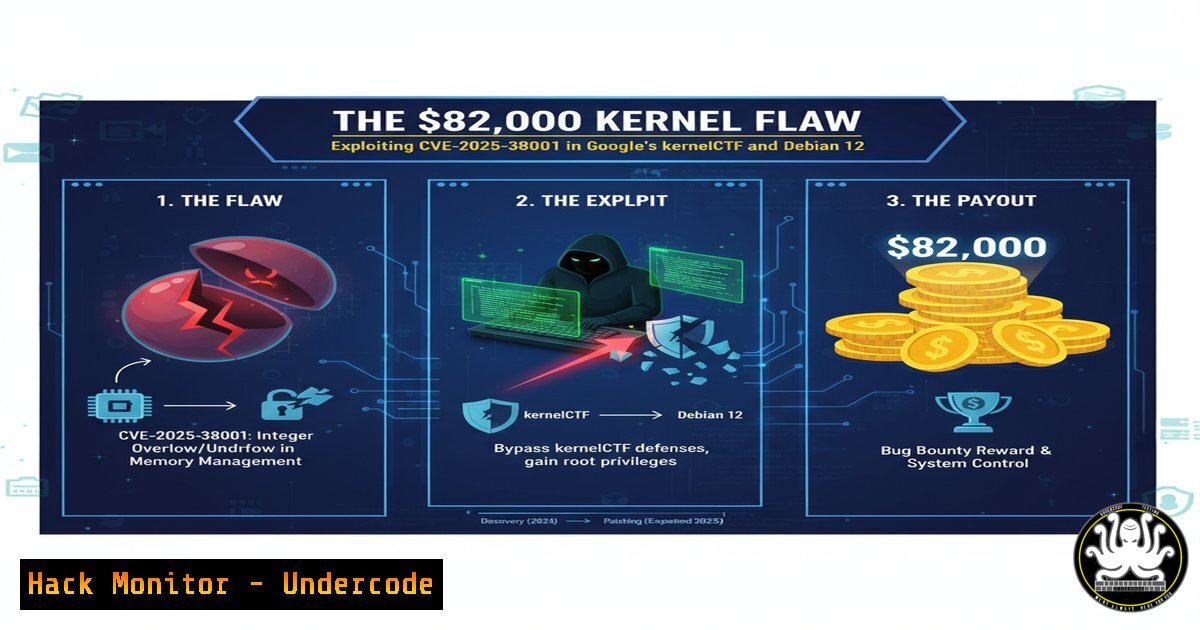
A recently disclosed vulnerability, CVE-2025-38001, has sent shockwaves through the cybersecurity community by demonstrating a full exploit chain against Google’s hardened kernelCTF instances and the latest Debian 12 Linux distribution. This critical flaw, residing within the kernel’s Red-Black Tree (RBTree) memory management, underscores the persistent threats lurking within foundational operating system components, even those subjected to rigorous security testing. The successful exploitation, which earned a substantial bug bounty, highlights the sophisticated techniques modern attackers employ to breach core system defenses.
Learning Objectives:
- Understand the root cause and impact of the CVE-2025-38001 RBTree vulnerability.
- Learn the diagnostic commands to identify vulnerable kernel versions on Linux systems.
- Master mitigation strategies and system hardening techniques to protect against similar kernel-level exploits.
You Should Know:
1. Identifying Your Kernel Vulnerability
The first step in defense is awareness. Determining if your system is running a vulnerable kernel version is crucial for prioritizing patches.
uname -r
cat /proc/version
dpkg -l | grep linux-image
Step-by-step guide:
The `uname -r` command is the quickest way to check your current kernel release version. Compare this version against the patched releases from your distribution’s security advisory. For Debian-based systems like Debian 12, `dpkg -l | grep linux-image` lists all installed kernel images, allowing you to verify the specific package versions. The `cat /proc/version` command provides additional compilation details, which can be useful for confirming the exact build.
2. Kernel Configuration and RBTree Integrity Checks
Understanding how your kernel is configured can reveal potential exploit mitigation states. The kernel sysctl interface exposes numerous security settings.
sysctl -a | grep slab
cat /boot/config-$(uname -r) | grep CONFIG_SLAB_FREELIST_HARDENED
sysctl -a | grep kernel.kptr_restrict
Step-by-step guide:
The `sysctl -a | grep slab` command displays settings related to the kernel’s slab allocator, which is central to this vulnerability. Checking for `CONFIG_SLAB_FREELIST_HARDENED` in your kernel configuration (accessed via the `/boot/config-` file) confirms if a key hardening feature is enabled, which can complicate exploitation. The `kernel.kptr_restrict` setting controls whether kernel pointers are exposed in proc filesystem outputs, a common information leak source for attackers.
3. System Monitoring for Anomalous Kernel Activity
Detecting exploitation attempts requires vigilant monitoring of system calls and kernel logs for unusual patterns.
dmesg -T | tail -50
journalctl --since "1 hour ago" -k --grep="BUG"
auditctl -l | grep syscall
ausearch -ts today -m ANOMALY
Step-by-step guide:
The `dmesg` command displays the kernel ring buffer, where many critical errors and warnings are logged. Using `dmesg -T` with a pipe to `tail` lets you review the most recent entries. For systems using systemd, `journalctl –since “1 hour ago” -k` filters the journal for kernel messages only. The Linux Audit Daemon (auditctl, ausearch) is a powerful tool for tracking specific system calls that might be abused during an exploit; here we search for anomalies reported today.
4. Exploit Mitigation and Control Verification
Modern Linux distributions include exploit mitigation technologies. Verifying their status is a key defensive step.
cat /proc/cpuinfo | grep smep
cat /proc/cpuinfo | grep smap
cat /proc/sys/kernel/randomize_va_space
grep -i pa /proc/cpuinfo
Step-by-step guide:
SMEP (Supervisor Mode Execution Protection) and SMAP (Supervisor Mode Access Prevention) are CPU-level features that prevent the kernel from executing code or accessing data in user-space pages, significantly raising the bar for kernel exploits. The `/proc/cpuinfo` file reveals if your CPU supports these features. Kernel Address Space Layout Randomization (KASLR) is controlled by randomize_va_space; a value of ‘2’ indicates full randomization is enabled.
5. Containment with Linux Security Modules (LSM)
While a patch is developed, restricting the kernel’s exposure using security modules can limit the attack surface.
cat /sys/kernel/security/lsm
getenforce  For SELinux
apparmor_status  For AppArmor
Step-by-step guide:
Linux Security Modules (LSMs) like SELinux and AppArmor enforce mandatory access control policies, confining what processes can do even if they gain elevated privileges. The command `cat /sys/kernel/security/lsm` shows which modules are active. `getenforce` checks the status of SELinux (Enforcing, Permissive, or Disabled), while `apparmor_status` does the same for AppArmor. Ensuring these are in “Enforcing” mode is critical for containment.
6. Network Hardening to Block Initial Access
Kernel exploits often require an initial foothold. Hardening network services is the first line of defense.
ss -tuln
iptables -L -n -v  Or 'nft list ruleset'
ufw status verbose  For systems using UFW
Step-by-step guide:
The `ss -tuln` command lists all listening TCP and UDP ports, revealing potentially unnecessary services that could be used for initial access. Firewall rules (viewed with `iptables -L` or nft list ruleset) should be minimal, allowing only essential traffic. Uncomplicated Firewall (ufw) provides a simpler interface; `ufw status verbose` shows the active rules and default policies. The goal is to reduce the number of avenues an attacker can use to reach a vulnerable service.
7. Patching and System Update Procedures
The ultimate mitigation for CVE-2025-38001 is applying the official kernel patch from your distribution vendor.
sudo apt update && sudo apt list --upgradable  Debian/Ubuntu
sudo yum check-update  RHEL/CentOS
sudo apt-get install --only-upgrade linux-image-$(uname -r)
Step-by-step guide:
Always start by updating your package list with `apt update` or yum check-update. This fetches the latest metadata on available packages, including security updates. The command `apt list –upgradable` shows which installed packages have updates available. To specifically upgrade only the kernel package on a Debian system, use sudo apt-get install --only-upgrade linux-image-$(uname -r). A system reboot is required to load the new, patched kernel.
What Undercode Say:
- The Illusion of Invulnerability in Hardened Systems: Google’s kernelCTF is designed to be a fortress, yet it fell to a single logic flaw. This serves as a stark reminder that no system, regardless of its security pedigree, is immune to novel vulnerabilities. Over-reliance on a “secure by design” label can create a false sense of security.
- The Economics of Cyber Warfare: The $82,000 bounty reflects the extreme value of a reliable, weaponized kernel exploit. This market dynamic fuels a thriving grey economy where such capabilities are coveted by state-sponsored actors and cybercriminals alike, making prompt patching not just a technical necessity but a critical business imperative.
The discovery and exploitation of CVE-2025-38001 is not an isolated incident but a symptom of a broader trend: the increasing sophistication of attacks targeting the very core of our digital infrastructure. The fact that a single flaw compromises both a custom-hardened platform like kernelCTF and a mainstream distribution like Debian 12 demonstrates the monolithic risk inherent in the widespread use of the Linux kernel. This event will inevitably accelerate two opposing forces: defenders will push for more aggressive kernel hardening, segmentation, and zero-trust architectures at the operating system level, while attackers will refine their fuzzing and static analysis techniques to find the next critical chink in the kernel’s armor. The era of the user-space exploit is giving way to the battle for the kernel, and the stakes have never been higher.
Prediction:
The successful exploitation of CVE-2025-38001 will catalyze a paradigm shift in how organizations approach endpoint security. Within the next 18-24 months, we predict a significant move away from reliance solely on traditional antivirus solutions and towards widespread adoption of Kernel-level Runtime Application Self-Protection (KRASP) and hardware-enforced security boundaries (like Intel CET and ARM MTE) becoming standard in enterprise environments. This incident will serve as a key case study, pushing for more deterministic memory safety solutions within the Linux kernel itself, potentially even sparking serious investment in rewriting critical subsystems in memory-safe languages like Rust. The fallout will extend beyond technical controls, influencing cyber insurance policies to mandate stricter kernel integrity monitoring and faster patch deployment timelines as a condition for coverage.
🎯Let’s Practice For Free:
IT/Security Reporter URL:
Reported By: Florian Hansemann – Hackers Feeds
Extra Hub: Undercode MoN
Basic Verification: Pass ✅


