Listen to this Post
Introduction:
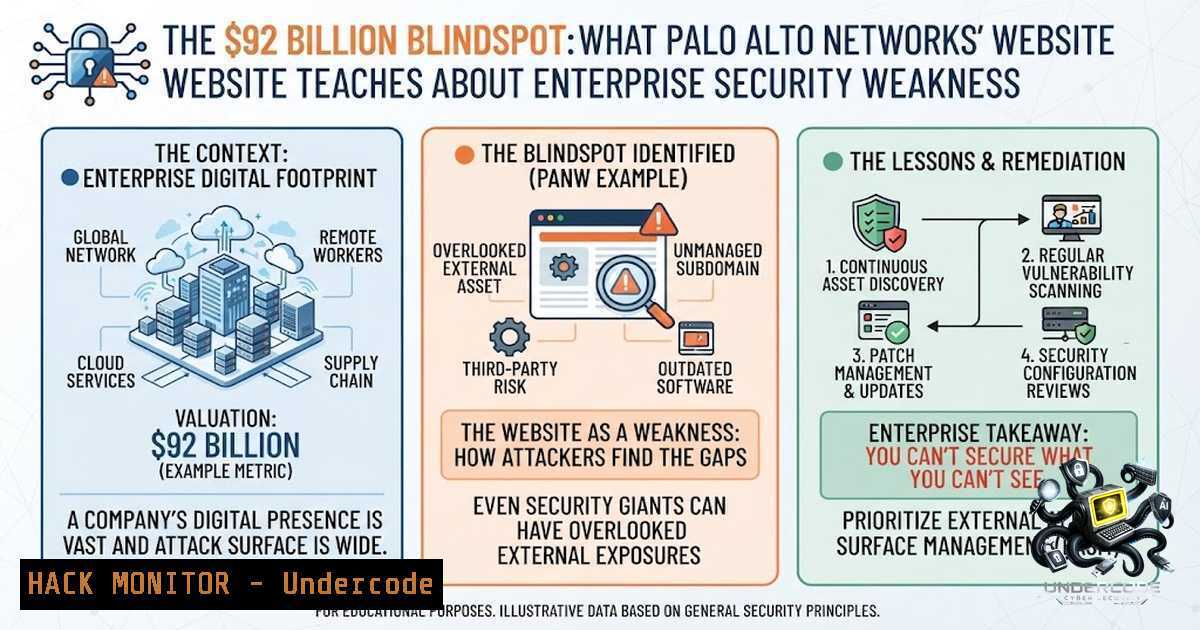
In an era where cyberattacks are inevitable, the gap between a company’s security posture and its public-facing narrative can be its greatest vulnerability. This forensic audit of paloaltonetworks.com reveals critical lessons for CISOs, security architects, and IT professionals: even the world’s largest pure-play cybersecurity company can suffer from avoidable communication and technical gaps that attackers could exploit for reconnaissance or social engineering. Understanding these gaps—and how to audit your own organization’s digital footprint—is essential for building a robust zero-trust architecture that holds up to both technical and human scrutiny.
Learning Objectives:
- Master website forensic auditing techniques to uncover hidden security and trust signals.
- Understand and implement enterprise-grade trust bars, incident response CTAs, and platformization messaging.
- Decode AI security claims and integrate API hardening, cloud hardening, and vulnerability mitigation strategies.
- Apply Linux and Windows commands for security assessments, log analysis, and threat intelligence gathering.
- Develop a CISO’s mindset for evaluating vendor platforms and internal security operations.
You Should Know:
1. The “Under Attack?” CTA: Incident Response Readiness
Palo Alto Networks places “Under Attack?” in its permanent top navigation bar, linking directly to Unit 42 Incident Response. This is a gold standard for emergency readiness. For your organization, this means ensuring that your incident response (IR) plan is not buried in a knowledge base but is front-and-center for both external and internal stakeholders. Attackers often probe websites to gauge how quickly a company can respond—a visible, functioning IR link demonstrates proactive security operations.
Step-by-step guide to hardening your IR web presence:
- Audit your current IR contact path: Navigate your own website as a user. Time how long it takes to find a “Report a Security Incident” or “Emergency Contact” button. If it takes more than one click, you have a gap.
-
Implement a persistent top-bar CTA: Use HTML/CSS to place a sticky header button that links directly to your dedicated IR ticketing system or phone number.
-
Test your IR link under load: Attackers often target IR forms with DDoS or data injection attempts. Use `curl` to test the endpoint’s response and resilience.
Linux Command for basic endpoint testing:
curl -I https://yourdomain.com/incident-response-endpoint
This returns HTTP headers. Look for `200 OK` or 302 Found. If you receive `500` errors, your IR infrastructure may be misconfigured.
- Secure the IR form against injection: Run a quick SQL injection test using `sqlmap` (with proper authorization).
Linux Command:
sqlmap -u "https://yourdomain.com/ir-form?id=1" --batch --level=2
Note: Only use on systems you own or have explicit permission to test.
5. Windows PowerShell Check for IR Page Availability:
Invoke-WebRequest -Uri "https://yourdomain.com/incident-response" -Method GET
Analyze the `StatusCode` and StatusDescription. If unavailable, investigate your web server logs via Event Viewer or IIS logs.
- The Trust Bar: Fortifying Your Public Security Narrative
The audit revealed that Palo Alto Networks’ most powerful market signal—”95% of the Fortune 100″—is buried inside a product tab. A trust bar displaying customer count, market penetration, and Gartner leader positions should be visible above the fold. For cybersecurity professionals, this is a lesson in “defensive marketing.” Attackers look for overhype; a visible, truthful trust bar builds credibility and deters social engineering attempts.
Step-by-step guide to creating and hardening a trust bar:
- Extract your organizational trust signals: Identify key metrics such as customer count, threat blocks per day, regulatory compliance standards (GDPR, HIPAA, SOC2), and recognized industry awards.
-
Implement the trust bar in your web application: Ensure it is part of the site’s critical path. Use a `
` with high z-index to keep it persistent.Monitor and log trust bar clicks: Use web analytics to track which trust signals generate the most engagement. This can inform your security awareness training.
Hardening the trust bar data source: Ensure the data displayed (e.g., “30.9B attacks blocked”) is pulled from a secure API, not a static, easily manipulable frontend file. Validate the API endpoint.
API Security Check (Linux):
curl -X GET "https://api.yourdomain.com/trust-metrics" -H "Authorization: Bearer YOUR_API_TOKEN"
Check for proper authentication and rate-limiting. If the API returns data without a token, it’s a critical misconfiguration.
- Implement Subresource Integrity (SRI) for any external scripts: If your trust bar uses external JavaScript, use SRI hashes to prevent tampering.
<script src="https://cdn.trustbar.com/trust.js" integrity="sha384-oqVuAfXRKap7fdgcCY5uykM6+R9GqQ8K/uxy9rx7HNQlGYl1kPzQho1wx4JwY8wC" crossorigin="anonymous"></script>
3. Platformization and ROI: Consolidating Security Vendors
Palo Alto Networks promotes “Platformization” but fails to quantify the ROI—how many vendors an average Fortune 500 runs (often 40-60) and the associated TCO reduction. Consolidating onto a single platform reduces attack surface and simplifies security operations. This is a critical CISO decision that requires hard numbers. As a security engineer, you must be able to generate these metrics for your environment.
Step-by-step guide to calculating your platformization ROI and audit readiness:
- Inventory your current security tools: Use a combination of Linux and Windows commands to list all installed security agents across endpoints.
Windows Command (PowerShell) to list installed software:
Get-WmiObject -Class Win32_Product | Where-Object {$_.Name -like "Security"} | Select-Object Name, Version, VendorLinux Command to list installed packages (Debian-based):
dpkg -l | grep -i "security|firewall|av"
For Red Hat-based:
rpm -qa | grep -i "security|firewall|av"
- Map vendors to functionalities: Create a spreadsheet with columns: Vendor, Product, Annual Cost, of Engineers Managing, MTTR for incidents, and Number of Licenses.
-
Calculate your total cost of ownership (TCO): Include licensing, hardware, engineering hours, and training. This is the baseline for consolidation savings.
-
Simulate a consolidation scenario: Choose a platform (e.g., Palo Alto Networks Prisma, CrowdStrike, Microsoft Sentinel). Estimate the new licensing cost and the reduction in management overhead.
-
Automate cost and vulnerability reporting: Use an API to pull threat data from your current solutions. The goal is to identify overlaps—e.g., three tools with similar endpoint detection capabilities.
-
Cloud Hardening for Platform Consolidation: If you’re migrating to a cloud-1ative platform, ensure your AWS/Azure/GCP environments are hardened.
Azure CLI command to check for unmanaged security groups:
az network nsg list --query "[?contains(name, 'default')]"
Remove or restrict overly permissive rules.
4. Decoding “Precision AI” and AI Security Posture
Palo Alto Networks uses “Precision AI” as a differentiator but fails to define it clearly. In security, AI claims must be substantiated by training data, model updates, and transparent threat detection methodologies. For your organization, auditing AI-powered tools is crucial. You need to know if the AI is truly advanced or just rebranded machine learning.
Step-by-step guide to auditing AI security claims and hardening AI pipelines:
- Ask the vendor for specific threat detection examples: How does the AI detect a zero-day? Request a demo where they show the AI’s decision-making process. Don’t accept “black-box” answers.
-
Verify model update frequency: Check the vendor’s status page for AI model update logs. If updates are sporadic, the AI may be stale.
-
Test the AI with adversarial inputs: In a lab environment, use open-source tools like `Adversarial Robustness Toolbox` to attempt to fool the AI. This tests its resilience.
-
Implement AI model monitoring: If you develop in-house AI for security (e.g., for anomaly detection), log all model inputs and outputs. Set up alerts for sudden accuracy drops.
Python snippet to monitor model drift:
import numpy as np from scipy.stats import ks_2samp Compare training data distribution to production data training_dist = np.random.normal(0, 1, 1000) production_dist = np.load('prod_data.npy') statistic, p_value = ks_2samp(training_dist, production_dist) if p_value < 0.05: print("Model drift detected. Retraining required.")- Secure your AI API endpoints: Ensure your AI inference endpoints are protected with strong authentication and rate-limiting.
Linux Command to test rate limiting on an AI endpoint:
for i in {1..100}; do curl -X POST https://api.yourdomain.com/ai-predict -d '{"data":"sample"}' -H "Content-Type: application/json"; doneIf you receive `200 OK` for all 100 requests without a `429 Too Many Requests` at any point, your endpoint is not rate-limited and is vulnerable to abuse.
5. Forensic Web Auditing: Tools and Commands
The audit itself—scoring paloaltonetworks.com 71/100—is a methodology you can replicate. This involves analyzing header security, SSL/TLS configuration, cookie management, and content security policies (CSP). Every CISO and security team should regularly audit their own public-facing assets.
Step-by-step guide to performing your own forensic web audit:
- Check SSL/TLS configuration: Use `testssl.sh` on Linux for a comprehensive analysis.
Linux Command:
./testssl.sh -U --sneaky paloaltonetworks.com
Look for cipher suites, protocol versions (disable TLS 1.0 and 1.1), and weak elliptic curves.
- Analyze HTTP Security Headers: Use `curl` to inspect headers. Look for
Strict-Transport-Security,Content-Security-Policy,X-Frame-Options, andX-Content-Type-Options.
Linux Command:
curl -I https://paloaltonetworks.com
Missing or improperly configured headers indicate a gap. For example, a missing `X-Frame-Options` leaves the site vulnerable to clickjacking.
- Check for exposed hidden directories: Use `gobuster` to brute-force directories.
Linux Command:
gobuster dir -u https://paloaltonetworks.com -w /usr/share/wordlists/dirbuster/directory-list-2.3-medium.txt
This can reveal admin panels or sensitive files that shouldn’t be public.
4. Windows PowerShell for Header Analysis:
Invoke-WebRequest -Uri "https://paloaltonetworks.com" -Method Head
Review the `Headers` property in the output.
- Document your findings: Create a report with the score (e.g., 71/100) and categorize issues as Critical, High, Medium, or Low.
-
Vulnerability Exploitation and Mitigation: Learning from the Gaps
The three gaps identified—buried trust signals, undefined ROI, and vague AI claims—are not just marketing failings; they represent vulnerabilities in the overall security narrative that can be exploited. An attacker can use a lack of clarity to craft convincing spear-phishing emails claiming to be “from Palo Alto Networks,” offering to “fix” the AI issues or “provide consolidation consulting.” These attacks exploit the public’s confusion.
Step-by-step guide to identifying and mitigating exploitation paths:
- Map narrative gaps to social engineering vectors: For each missing piece of information (e.g., “Precision AI defined”), assess how an attacker could impersonate your company and fill that gap with malicious content.
-
Implement a brand monitoring solution: Use a tool like Shodan or Censys to see what information about your infrastructure is publicly available.
Censys Command (Linux via API):
curl -X POST "https://search.censys.io/api/v2/certificates/search" -d '{"q": "paloaltonetworks.com"}' -H "Authorization: Basic YOUR_API_KEY"This shows SSL certificates, which can reveal subdomains.
- Conduct a red team exercise focused on web narrative: Have your red team attempt to create a convincing clone of your website that fixes the “gaps” you’ve identified. Can they trick users? This reveals the urgency of closing those gaps.
-
Patch and remediate: Based on the audit, update your web content to ensure clarity. Train your security awareness team to recognize phishing attempts that exploit any vagueness in your public messaging.
-
Post-Remediation Scan: Re-run the `testssl.sh` and `gobuster` scans after changes to ensure no new vulnerabilities were introduced.
-
Cloud Hardening and API Security for Public Trust Assets
The public website is part of your cloud estate. Hardening your website’s hosting environment—whether AWS, Azure, or GCP—is critical. The audit reminds us that public-facing assets are a primary target.
Step-by-step guide to hardening your web hosting environment:
- Restrict inbound access: Use cloud-1ative security groups (AWS Security Groups, Azure NSGs, GCP Firewall Rules) to only allow traffic on ports 80 and 443, and potentially 22 for administrative access (with strict IP restrictions).
AWS CLI Command to list Security Groups:
aws ec2 describe-security-groups --group-ids sg-12345678
Verify no rule has `0.0.0.0/0` on sensitive ports (e.g., 22, 3306).
- Enable WAF (Web Application Firewall): Deploy AWS WAF, Azure WAF, or Cloudflare. Create rules to block SQL injection and XSS attacks.
-
Secure your API endpoints: All trust bar data and AI interactions should pass through a secure API gateway. Implement OAuth 2.0 or JWT tokens for authentication.
Linux Command to test for basic API auth bypass:
curl -X GET https://api.yourdomain.com/sensitive-data
If data is returned without a token, you have a critical API vulnerability.
- Implement logging and monitoring: Enable detailed logging for your web server and cloud environment. Use a SIEM to correlate events.
-
Conduct regular compliance scans: Use tools like `OpenSCAP` on Linux to check for CIS benchmarks.
Linux Command for OpenSCAP:
sudo oscap xccdf eval --profile xccdf_org.ssgproject.content_profile_cis --results scan_results.xml /usr/share/xml/scap/ssg/content/ssg-ubuntu2004-ds.xml
This scans your Ubuntu server for CIS compliance and provides a list of failures to remediate.
What Undercode Say:
Key Takeaway 1: Even market leaders suffer from critical communication gaps that, while not traditional technical vulnerabilities, create exploitable attack surfaces for social engineering and reconnaissance. The absence of a trust bar above the fold and undefined AI claims are not just marketing failures; they are operational security weaknesses that undermine the entire cybersecurity posture.
Key Takeaway 2: A forensic website audit is a vital security exercise that combines web analysis, API testing, cloud hardening, and narrative review. The 71/100 score for Palo Alto Networks highlights that no organization, regardless of size, is immune to oversights that can be discovered through methodical, publicly accessible scanning.
Analysis: The audit reveals a classic tension between technical excellence and clear communication. Palo Alto Networks blocks 30.9 billion threats daily, but its public persona lacks the specificity and credibility that CISOs require to justify consolidation decisions. This mirrors a broader industry trend where complex security solutions are often sold with buzzwords rather than proof. As an IT professional, you must adopt a CISO mindset—one that demands transparency, quantifiable ROI, and demonstrable AI efficacy. The seven guides provided above offer a practical playbook for auditing your own environment, consolidating tools, and hardening your cloud and API assets. The real lesson is that your security narrative must be as robust as your network security. If an attacker can confuse your customers with a better-explained fake version of your website, your physical defenses are weakened by public perception. Remediation starts with a clear, visible, and truthful presentation of your security capabilities. Simultaneously, you must rigorously test your infrastructure with the same tools used by attackers to ensure that your technology backs up your claims. Only then can you truly achieve a zero-trust posture that is both proven and communicated.
Prediction:
- +1 The increasing scrutiny of public-facing cybersecurity messaging will force vendors to create “transparency dashboards” that display real-time threat intelligence and TCO calculators, fostering a new era of accountable security marketing.
- -1 The rise of AI-powered social engineering will become a primary threat, with attackers using sophisticated language models to craft highly convincing phishing campaigns that exploit any ambiguity in a company’s security narrative, rendering traditional email filters ineffective.
- +1 Cyber insurance providers will begin mandating forensic web audits (similar to the 71/100 scoring model) as a prerequisite for coverage, driving widespread adoption of these open-source auditing tools and hardening best practices across the industry.
- -1 Organizations that fail to consolidate their security vendors (platformization) will suffer increased incident response times and elevated TCO, making them prime targets for ransomware groups that exploit the chaos of managing dozens of disparate security tools.
- -1 The lack of a clear, defined “Precision AI” standard will lead to a “wild west” of AI security claims, resulting in regulatory fines for false advertising and a spate of supply chain attacks that exploit poorly secured, vaguely described AI pipelines.
- +1 The cybersecurity community will rally to create open-source frameworks for evaluating and scoring vendor public postures, culminating in a standardized “CISO Trust Index” that simplifies consolidation decisions and elevates the baseline security hygiene of all enterprise websites.
▶️ Related Video (80% Match):
🎯Let’s Practice For Free:
🎓 Live Courses & Certifications:
Join Undercode Academy for Verified Certifications
🚀 Request a Custom Project:
Secure, high-velocity infrastructure and disruptive technological engineering. Contact our engineering team for high-tier development and proprietary systems:
[email protected]
💎 Smart Architecture | 🛡️ Secure by Design | ⭐ Trusted by ThousandsIT/Security Reporter URL:
Reported By: Arv28 Palo – Hackers Feeds
Extra Hub: Undercode MoN
Basic Verification: Pass ✅🔐JOIN OUR CYBER WORLD [ CVE News • HackMonitor • UndercodeNews ]
📢 Follow UndercodeTesting & Stay Tuned:


