
Listen to this Post
Introduction:
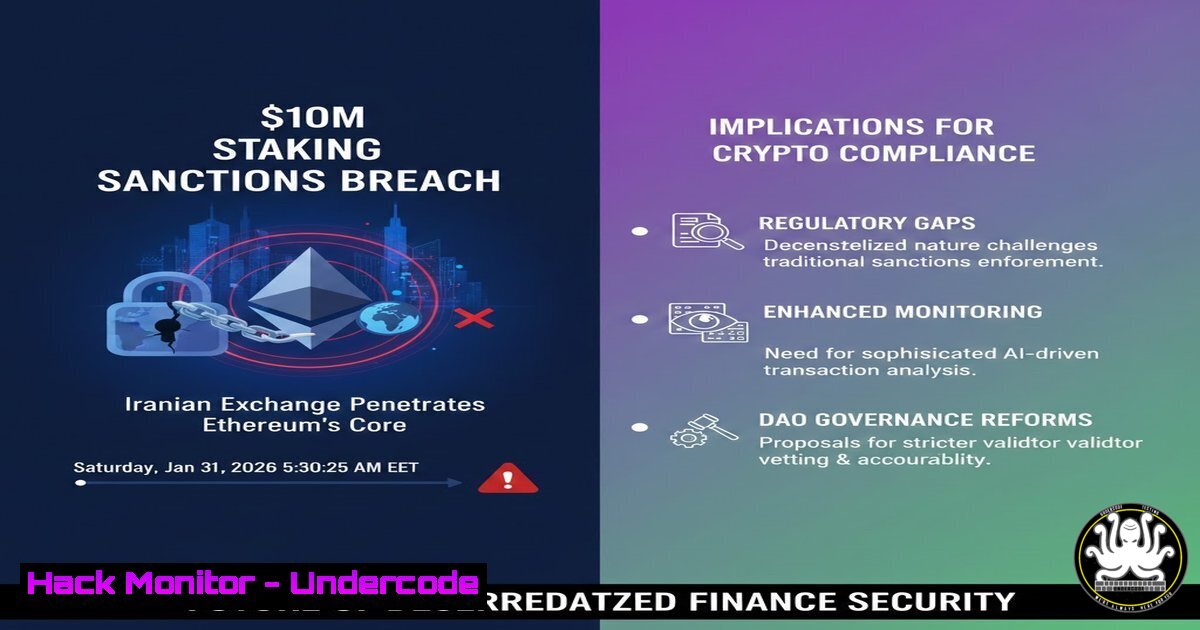
A recent blockchain analytics report from NOMINIS has revealed that Nobitex, Iran’s largest cryptocurrency exchange, successfully staked over $10 million in ETH through a major staking protocol. This incident starkly highlights the collision between the permissionless ethos of decentralized protocols and the rigid requirements of global financial sanctions regimes. It forces a critical examination of validator responsibilities, infrastructure-layer compliance, and the very future of institutional crypto participation.
Learning Objectives:
- Understand the technical pathway of a native Ethereum staking transaction and identify potential compliance checkpoints.
- Learn to use blockchain explorers and analytics tools to trace staking deposits and assess validator associations.
- Implement monitoring strategies and CLI commands to screen for sanctioned entities within blockchain activity.
- Evaluate the legal and technical tensions between decentralized network operations and regulatory enforcement.
- Explore potential technical and policy-based mitigations for sanctions compliance at the protocol level.
You Should Know:
- Deconstructing the Staking Pathway: From Exchange to Validator
The foundational question is understanding the exact route the funds took. “Native staking” involves directly depositing 32 ETH into the Ethereum consensus layer contract, while using a staking service or liquid staking token (LST) provider adds an intermediary layer.
Step‑by‑step guide:
Step 1: Identify the Transaction. Using the Ethereum block explorer (Etherscan), one would search for large, recent outflows from known Nobitex exchange wallets. The transaction destination is key: the `DepositContract` (address 0x00000000219ab540356cBB839Cbe05303d7705Fa) for native staking, or a staking pool/LST contract.
Step 2: Trace the Validator. If native, the deposit transaction emits a log containing the unique `pubkey` of the validator. This key can be tracked on beacon chain explorers like Beaconchain.in.
Step 3: Analyze the Validator’s Operations. Investigate the validator’s proposed blocks and attestations. Tools like `chaincl` (Chainlink CLI) or direct Beacon API queries can reveal if the validator is part of a known pool or running independently.
 Example using curl to query a Beacon Chain node for validator info
curl -X GET "http://<BEACON_NODE_API>:5052/eth/v1/beacon/states/head/validators?ids=0x<pubkey>" -H "accept: application/json"
The critical compliance checkpoint is the entry point: the user-facing staking service or the block-building relay if the stake was routed through a MEV pipeline.
2. Infrastructure as the New Compliance Battleground
The Roman Storm (Tornado Cash) conviction sets a precedent that infrastructure providers cannot claim absolute neutrality. This places staking pool operators, node-hosting services, and even core developers under potential scrutiny.
Step‑by‑step guide:
Step 1: Map the Infrastructure Stack. For any staked asset, identify every entity between the end-user and the live validator: Custodian -> Staking Pool Software -> Node Host (AWS, Google Cloud, etc.) -> Beacon Chain Client -> Execution Client.
Step 2: Assess Legal Exposure. Each layer presents a potential “choke point.” A hosted node provider has Terms of Service; a cloud provider can terminate instances. The OFAC SDN list is the primary filter.
Step 3: Implement Transaction Screening. Entities can integrate real-time screening tools. While not a direct blockchain command, services like Chainalysis or TRM Labs offer APIs that can be wired into funding workflows.
 Conceptual pseudo-code for pre-stake screening
 1. Extract deposit address from incoming transaction
 2. Query compliance API
COMPLIANCE_CHECK=$(curl -X POST https://api.screeningtool.com/v1/check \
-H "Authorization: Bearer $API_KEY" \
-d '{"address": "'$DEPOSIT_ADDRESS'", "chain": "ethereum"}')
 3. Evaluate risk score and flag/block if high-risk
3. Active Blockchain Surveillance with On-Chain Analytics
Proactive monitoring is essential for compliance officers and risk analysts. This involves setting up alerts for transactions linked to sanctioned jurisdictions or entities.
Step‑by‑step guide:
Step 1: Cluster Addresses. Use heuristics to link addresses to a single entity (e.g., Nobitex). Techniques include multi-signature ownership, funding source patterns, and off-chain intelligence.
Step 2: Set Up Alerting. Platforms like Nansen or Dune Analytics allow you to create dashboards and alerts for specific address activity.
Step 3: Manual CLI Investigation with geth. For a deep dive, you can trace transactions locally.
 Attach to a running geth console
geth attach http://localhost:8545
 Get transaction details
eth.getTransaction("0xTransactionHash")
 Get transaction receipt (includes logs, like validator pubkey for deposits)
eth.getTransactionReceipt("0xTransactionHash")
- The Validator’s Dilemma: Technical Impotence vs. Legal Liability
A core technical truth is that once ETH is deposited, the validator software cannot selectively censor a specific staker without undermining its own operation and facing slashing risks.
Step‑by‑step guide:
Step 1: Understand the Protocol Design. Validator duties are automated. The client software follows the consensus rules; it does not perform KYC checks on the origin of its 32 ETH deposit.
Step 2: Recognize the Slashing Risk. Attempting to manually interfere with block proposals or attestations based on transaction origin risks being slashed (penalized) by the network for non-conformance.
Step 3: Identify the True Control Point. The only feasible control is at the staking interface before the transaction is signed and broadcast. This could be a staking pool’s front-end or a custodian’s internal controls.
5. Potential Mitigations: Protocol-Level Changes and Layer-2 Solutions
The community is exploring technical solutions that attempt to reconcile decentralization and compliance, though all involve trade-offs.
Step‑by‑step guide:
Step 1: Evaluate “Compliance-Enabled” Staking Pools. These pools act as regulated gatekeepers at the onboarding layer, performing checks before pooling user funds and running validators.
Step 2: Explore Layer-2 Staking Derivatives. Solutions may emerge where staking rights are tokenized on a compliant L2 rollup, with screening happening at the L2 bridge entry point.
Step 3: Follow EIPs on Proposer-Builder Separation (PBS). PBS (e.g., in EIP-4844) separates block building from proposing. Regulated block builders could screen transactions, while validators simply propose the highest-value block. This centralizes screening but not validation.
 This is a forward-looking concept. Today, you can inspect mev-boost relay lists to see who builds blocks.
curl https://boost-relay.flashbots.net/relay/v1/data/bidtraces/proposer_payload_delivered | jq .
What Undercode Say:
- Key Takeaway 1: The compliance bottleneck has shifted from exchanges to the staking infrastructure layer. The entity that controls the user interface (UI) or the pooled funds before they hit the Ethereum deposit contract is the de facto gatekeeper, whether they desire that role or not.
- Key Takeaway 2: Native, permissionless staking is fundamentally incompatible with traditional, entity-based sanctions enforcement. Attempting to enforce at the validator level is technically messy and risks network integrity, creating an almost unsolvable paradox for regulators.
The analysis reveals a deepening fault line. The Storm conviction and this incident demonstrate regulators’ intent to treat decentralized infrastructure as accountable intermediaries. The crypto industry’s push for institutional adoption is ironically creating the very choke points—large staking pools, regulated custodians, institutional block builders—that regulators will target. The future may see a bifurcated system: a “compliant” layer of regulated staking services for institutions, and a permissionless but potentially isolated layer for hardcore cypherpunks. The technical community’s response, through innovations like privacy-preserving compliance proofs or more robust PBS designs, will determine if this bifurcation is inevitable.
Prediction:
Within the next 18-24 months, we will see the first enforcement action against a major staking-as-a-service provider or a liquid staking token issuer for failing to screen a sanctioned entity. This will trigger a rapid professionalization and segmentation of the staking industry, pushing large-scale capital towards explicitly regulated staking vehicles. Concurrently, it will fuel development of “compliant-by-design” protocol modifications and a resurgence of privacy-focused staking research, as the core community seeks to preserve censorship resistance. The regulatory pressure will not break Ethereum but will fundamentally reshape its surface layer and economic landscape.
▶️ Related Video (70% Match):
🎯Let’s Practice For Free:
IT/Security Reporter URL:
Reported By: Snir Levi – Hackers Feeds
Extra Hub: Undercode MoN
Basic Verification: Pass ✅


