Listen to this Post
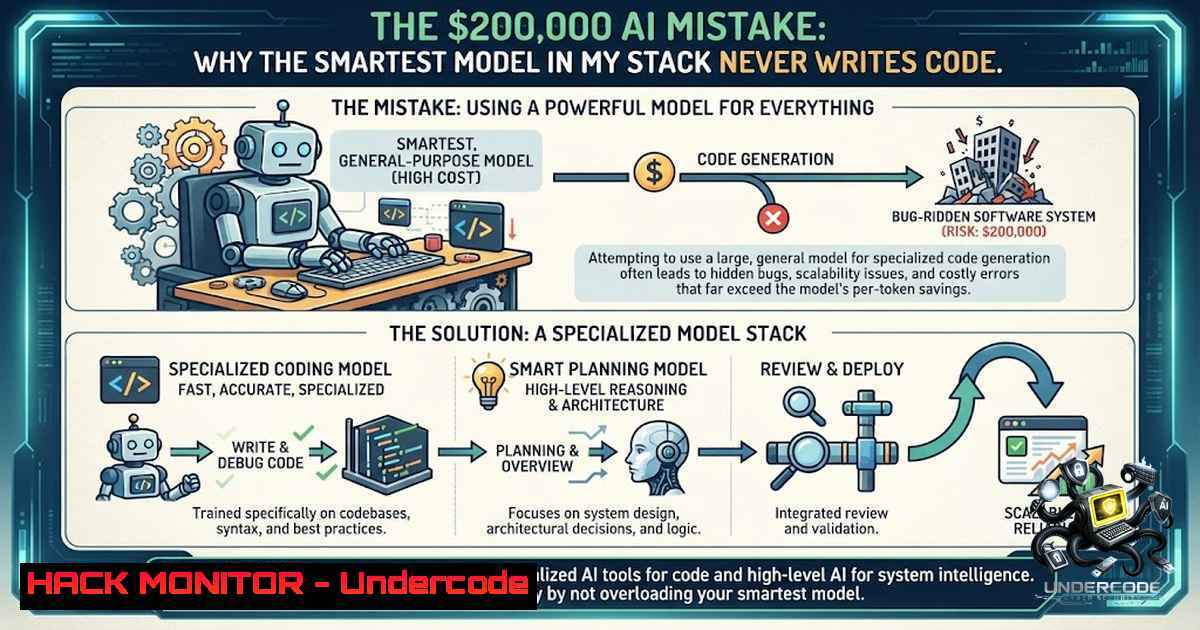
Introduction:
The rapid proliferation of Large Language Models (LLMs) has created a new bottleneck in the software development lifecycle: cost versus capability. While the instinct is to deploy the most sophisticated model—like GPT-4 or Claude Opus—for every coding task, this “throwaway architecture” leads to exponential token burn and diminishing returns. A new paradigm is emerging, championed by solo developers and enterprise architects alike, that treats AI not as a monolithic genius, but as a tiered consultancy, using cheaper models for context and expensive models strictly for high-level reasoning.
Learning Objectives:
- Understand the economic impact of token usage and how to optimize AI costs through “model routing.”
- Learn how to implement a “Consultant Pattern” (Cheap Model for RAG, Expensive Model for Decision) in your development workflow.
- Master the technical commands and configurations to restrict file access and define roles for different AI agents.
You Should Know:
1. The Economics of AI Cognition (Token-Efficient Strategy)
The core thesis of the original post is that paying premium rates for an AI to “read your filing cabinet” is financial folly. The expensive model (referred to as “Fable” in the text) has a high IQ but slow processing and high per-token cost. The cheaper model (“Sonnet 5”) has a lower IQ but is faster and more cost-effective.
To implement this, you must understand the metrics: Cost per Million Input Tokens vs. Output Tokens. The strategy suggests that a massive input context window should be processed by the cheaper model to generate a “brief.” This brief is then fed to the expensive model to generate the “recommendation.”
Step‑by‑step guide explaining what this does and how to use it:
– Step 1: Audit your current token usage. Use tools to measure the average size of your codebase (e.g., `cloc .` to count lines of code). Estimate token count (roughly 4 characters per token).
– Step 2: The “Shrinking” Prompt. Instruct the cheaper model (e.g., Claude Sonnet) with a specific system prompt: “You are a Technical Summarizer. Read the provided code and architecture files. Output only a 500-word briefing covering: Core Architecture, Critical Business Logic, and the specific bug/feature request.”
– Step 3: The “Advisor” Prompt. Feed this summary to the expensive model (e.g., Claude Opus). Your prompt should be: “Based on the attached summary, provide strategic architectural advice. Do not read the raw code. Focus on design patterns and edge cases.”
– Step 4: Automation. Use scripting to capture the output of Model 1 and pipe it directly into Model 2’s API call.
2. Restricting Context Access in AI Agents
The author explicitly states, “I never let Fable read every file itself.” In engineering terms, this is “Restricted Context Injection.” If you are using tools like Cursor, Continue.dev, or the VS Code Copilot API, you can enforce this by controlling which files are included in the prompt context.
Step‑by‑step guide explaining what this does and how to use it:
– Linux/Mac Command (Excluding folders): If you are using a script to feed files into an API, use `find` to exclude large directories.
find . -1ame ".py" -1ot -path "./venv/" -1ot -path "./.git/" -exec cat {} \;
– Windows Command (PowerShell): Use `Get-ChildItem` to filter files.
Get-ChildItem -Recurse -Include .js, .py | Where-Object { $<em>.FullName -1otlike "node_modules" } | ForEach-Object { Get-Content $</em>.FullName }
– API Configuration: When building a custom workflow, write a middleware script that intercepts the API payload. Remove any `file_path` references that match a blacklist before the request is sent to the expensive endpoint.
3. Model Routing Architecture (The “Traffic Cop” Setup)
The idea of “I use Fable to think. Not to type” implies a distinct separation of duties. In MLOps, this is known as a “Router.” The router detects the intent of the user prompt and routes it to the appropriate model.
Step‑by‑step guide explaining what this does and how to use it:
– Define the Roles:
– “Reader” (Sonnet 5): Handles --summarize, --debug, `–search` tasks.
– “Thinker” (Fable/Opus 4.8): Handles --architect, --plan, `–review` tasks.
– Implementation (Pseudocode):
if "write code" in user_prompt or "debug" in user_prompt:
model = "claude-3-5-sonnet-latest"  Cheaper
elif "architecture" in user_prompt or "strategy" in user_prompt:
model = "claude-3-opus-latest"  Expensive
– Cost Logic: Ensure the cheaper model has the larger context window if you are feeding it a whole repository. This is the “photocopy” step, and it is cheaper to pay the junior to copy the files than the senior.
4. The “Human in the Loop” Steering Wheel
The text states, “We’re still the ones on the steering wheel.” This is a critical security and governance feature. If you grant an expensive agent autonomy to read, write, and execute code, the token cost is the least of your worries; the risk of “Prompt Injection” or a “Hallucinated Security Hole” is high.
Step‑by‑step guide explaining what this does and how to use it:
– Always set `Read-Only` permissions for expensive models. Use file system permissions to restrict the “Fable” model access.
– Linux: `setfacl -m u:ai_user:r– ./src` (Read only).
– Implement a “Veto” phase. Before the expensive model pushes changes, a command must run to generate a “diff” file. You review the diff file before merging.
git diff > review_this.patch
– Use “Guardrails.” In the system prompt of the expensive model, include: “You are not authorized to run code. You are only allowed to output JSON containing ‘recommendation’ and ‘reasoning’.”
5. Practical Metrics: Measuring “R.O.I.” of AI Tokens
To justify this strategy, you need to measure “Good Decisions per Dollar.”
Step‑by‑step guide explaining what this does and how to use it:
– Log all API calls. Create a logging interceptor that records Input_Tokens, Output_Tokens, and Model_Type.
– Calculate Savings: If Opus costs $75/million input and Sonnet costs $3/million, and you are feeding the expensive model 200k tokens of context, you are spending $15 per call. By summarizing it down to 500 tokens ($0.015), the expensive model costs you pennies. The savings ratio is approximately 1000:1.
– Linux Command to track API usage:
curl -X POST https://api.anthropic.com/v1/messages \
-H "anthropic-version: 2023-06-01" \
--data '{"model": "claude-3-opus-20240229", "max_tokens": 1024, "messages": [{"role": "user", "content": "Brief me on this summary"}]}'
(Ensure you monitor the `usage` field in the response JSON).
6. Cloud Hardening for AI Workloads
If you are building a system that routes tasks between AI models, you must secure the orchestration layer. API keys are the new gold.
Step‑by‑step guide explaining what this does and how to use it:
– Never hardcode keys. Use environment variables (export ANTHROPIC_API_KEY="sk-...").
– Implement a Proxy. Instead of the client calling the AI directly, build a proxy that holds the API keys. The client sends requests to your proxy; your proxy enforces the “Cost Routing Policy.”
– Mitigation against “Model Denial of Wallet”: Set a hard budget limit. Use the `max_tokens` parameter strictly. If the prompt is too large, reject it and force the user to use the “Summarization” endpoint first.
What Undercode Say:
- Key Takeaway 1: Token strategy is a business requirement, not just a technical one. Using a “Consultant Pattern” (cheap model reads, expensive model advises) saves up to 90% on API costs while retaining the quality of architectural output.
- Key Takeaway 2: Limiting the context window via summarization forces the expensive LLM to focus on high-level abstraction, preventing it from getting lost in irrelevant implementation details and reducing “hallucinations” regarding specific variable names.
Analysis:
The post highlights a mature understanding of AI limitations: the models are powerful, but their “attention” is wasted on boilerplate. By artificially limiting the expensive model’s vision, the author improves its reasoning capabilities. It also reflects a DevOps shift towards “FinOps,” where developers are becoming acutely aware of cloud spend. The comparison of the expensive AI to a “Senior Consultant” is apt; just as a consultant doesn’t sift through every email, the AI shouldn’t parse every file. This approach also inherently improves security, as you are sharing less sensitive raw code with the most powerful (and potentially most attacked) endpoint. The explicit mention that the author is a “solo builder working this out” validates that even non-CS backgrounds can architect sophisticated, cost-efficient AI pipelines.
Expected Output:
Prediction:
- -1: A potential drawback is increased complexity in the orchestration layer. If the summarizer misinterprets the code, the advisor’s output will be high-quality garbage. This leads to “Bad Decision Amplification.”
- +1: We will see the rise of “Meta-LLMs” specifically designed to generate prompts for other LLMs. The summarizer will be custom fine-tuned to extract architectural essence, completely replacing the human “briefing” task.
- +1: Agentic workflows will become more efficient. Instead of one agent doing a “Tree of Thought,” we will see “Hives” where Role-Based LLMs (Reader, Writer, Planner) are strictly segregated, mirroring human organizational structures.
- +1: This model routing concept will become a standard feature in major AI cloud providers, offering a “Cheapest Effective Model” recommendation engine that automatically routes your prompt based on a “Tone” and “Complexity” analysis.
- -1: If the cost of “Context” memory (Vector Databases) becomes cheaper than the cost of “Computation” (Reasoning), this model may reverse. Eventually, we might want the expensive model to read the entire vector database.
- +1: The biggest gain is in data privacy. By ensuring the expensive model never sees raw PII or proprietary source code, companies can pass compliance audits more easily, as the “model” only sees a sanitized summary.
- +1: The “Human in the Loop” aspect will become formalized as a “Quality Assurance” gate, moving developers into a more strategic “Reviewer” role, rather than “Prompter.”
- +1: The trend of using “Smart” models to write prompts for “Cheap” models will spawn a new generation of “Prompt Engineering” tools that optimize for cost rather than just accuracy.
- -1: The risk of “Summarization Attack” exists. If the cheaper summarizer is compromised or poisoned with data, it can easily manipulate the expensive advisor into approving malicious code, highlighting a new attack vector in AI supply chains.
- +1: Ultimately, this proves that the future of AI isn’t just about the power of the model, but the architecture that harnesses it. Cost-efficiency will drive adoption more than raw token intelligence.
▶️ Related Video (80% Match):
🎯Let’s Practice For Free:
🎓 Live Courses & Certifications:
Join Undercode Academy for Verified Certifications
🚀 Request a Custom Project:
Secure, high-velocity infrastructure and disruptive technological engineering. Contact our engineering team for high-tier development and proprietary systems:
[email protected]
💎 Smart Architecture | 🛡️ Secure by Design | ⭐ Trusted by Thousands
IT/Security Reporter URL:
Reported By: Aidi Hamid – Hackers Feeds
Extra Hub: Undercode MoN
Basic Verification: Pass ✅


