Listen to this Post
Introduction:
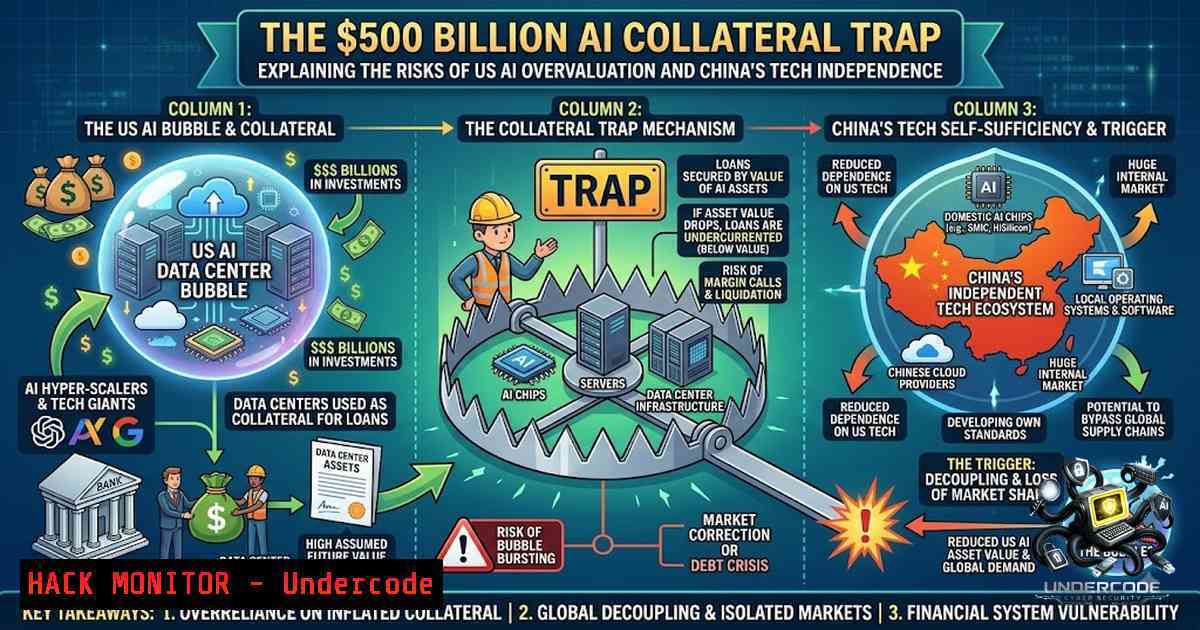
The Chinese technology ecosystem has achieved a level of self-sufficiency that fundamentally challenges the economic foundations of American AI dominance. By employing a USD sterilization mechanism through the People’s Bank of China (PBOC) that buffers exchange rate pressures and redirects export revenues into infrastructure projects like the Belt and Road Initiative, China has built a hermetically sealed industrial base from raw materials to advanced semiconductors. This strategic sacrifice of local purchasing power in exchange for technological independence now poses an existential threat to US technology leadership, as low-cost Chinese AI models and hardware flood global markets, threatening to devalue the billions invested in American data center infrastructure.
Learning Objectives:
- Understand the macroeconomic sterilization mechanisms enabling China’s tech self-sufficiency and their impact on global AI economics
- Analyze the token economy dynamics where Chinese AI models capture nearly half of US enterprise AI usage volume but minimal revenue
- Evaluate the cybersecurity implications of a bifurcated AI ecosystem and the potential for state-sponsored AI-driven cyberattacks
- Learn practical commands and configurations for monitoring AI supply chain risks and securing multi-vendor AI deployments
You Should Know:
1. The PBOC Sterilization Mechanism and Tech Self-Sufficiency
The People’s Bank of China operates as an exchange rate buffer, routing the overflow of USD from Chinese exports into US treasuries and, more recently, into supply chain control through infrastructure projects. This mechanism ensures the Yuan-USD exchange ratio has barely budged in two decades despite persistent trade surpluses. The result is a completely self-sufficient ecosystem from base materials to high-tech manufacturing, operating at an order of magnitude more cost-efficient than the USD system around it.
Step-by-Step Guide: Monitoring Currency Manipulation and Tech Supply Chain Risks
For security analysts and financial researchers tracking these dynamics:
Linux Command – Tracking Semiconductor Supply Chain Indicators:
 Monitor Chinese semiconductor import/export trends via trade data APIs
curl -s "https://api.trade.gov/ HarmonizedSystem?hsCode=8542&country=CN&year=2026" | jq '.records[] | {month: .month, imports: .imports, exports: .exports}'

Analyze PBOC reserve movements (requires Bloomberg/Reuters API access)
 Simulated reserve tracking using public data
curl -s "https://www.safe.gov.cn/safe/whglj/index.html" | grep -oP '\d+.\d+' | head -5
Windows PowerShell – Monitoring AI Chip Export Controls:
 Track US export control announcements affecting AI chips
Invoke-WebRequest -Uri "https://www.bis.gov/export-control" | Select-Object -ExpandProperty Content | Select-String "AI|semiconductor|China"

Monitor Nvidia stock correlation with China AI policy news
$nvda = Invoke-RestMethod -Uri "https://query1.finance.yahoo.com/v8/finance/chart/NVDA" | ConvertFrom-Json
$nvda.chart.result[bash].meta.regularMarketPrice
2. The Token Economy: Volume Without Revenue
According to OpenRouter statistics, US enterprises now use Chinese AI models for nearly half of their total AI token volume, peaking at 46%. However, Chinese providers capture less than 10% of the revenue from this usage. This disparity reflects US security reviews and compliance concerns that prevent full monetization. The threat is that Chinese models, priced at less than 10% of US equivalents, will continue capturing market share, deflating the expected returns on the $500 billion in data center investments.
Step-by-Step Guide: Auditing AI Model Supply Chain Risk
Linux – Analyzing Token Usage Patterns:
 Monitor API gateway logs for model origin detection
grep -E "model.(deepseek|qwen|baidu|alibaba)" /var/log/nginx/access.log | \
awk '{print $1, $7, $NF}' | sort | uniq -c | sort -1r

Set up OpenRouter API monitoring for usage analytics
curl -X GET "https://openrouter.ai/api/v1/auth/key" \
-H "Authorization: Bearer $OPENROUTER_API_KEY" | jq '.usage'
Python Script – AI Model Origin Detection:
import re
import json

Model origin mapping
model_origins = {
'gpt': 'US', 'claude': 'US', 'gemini': 'US',
'deepseek': 'CN', 'qwen': 'CN', 'baidu': 'CN', 'ernie': 'CN'
}

def detect_model_origin(model_name):
for pattern, origin in model_origins.items():
if re.search(pattern, model_name, re.IGNORECASE):
return origin
return 'unknown'

Parse API logs
with open('api_logs.json', 'r') as f:
logs = json.load(f)
us_usage = sum(1 for log in logs if detect_model_origin(log['model']) == 'US')
cn_usage = sum(1 for log in logs if detect_model_origin(log['model']) == 'CN')
print(f"US model usage: {us_usage}, CN model usage: {cn_usage}")
- AI Model Distillation and the National Security Threat
Chinese AI laboratories like DeepSeek are leveraging “model distillation” techniques to replicate the performance of US frontier models at a fraction of the cost. Recent Reuters investigations revealed that Chinese military researchers are using outputs from OpenAI and Anthropic models to train domestic AI systems for defense applications. Meanwhile, Chinese cybersecurity firm 360 has developed vulnerability detection tools that could supercharge cyberattacks, with 67% of surveyed executives reporting AI-targeted attacks within the past year.
Step-by-Step Guide: Securing Against AI Model Distillation and Data Exfiltration
Linux – Detecting Unauthorized API Access and Model Extraction:
 Monitor for anomalous API call patterns indicating distillation attempts
 High frequency + low temperature = potential distillation
tail -f /var/log/api/gateway.log | \
awk '$9 == 200 && $11 > 100 {print strftime("%Y-%m-%d %H:%M:%S"), $0}' | \
grep -E "temperature.0.[0-2]"

Implement rate limiting for API endpoints
iptables -A INPUT -p tcp --dport 443 -m limit --limit 10/minute -j ACCEPT
iptables -A INPUT -p tcp --dport 443 -j DROP
Windows PowerShell – AI Supply Chain Security Audit:
 Audit AI model dependencies for origin verification
Get-ChildItem -Path "C:\AI\Models" -Recurse -Include ".json",".h5",".pt" | ForEach-Object {
$metadata = Get-Content $<em>.FullName | ConvertFrom-Json
if ($metadata.origin -eq "CN" -or $metadata.license -match "China") {
Write-Warning "Chinese origin model detected: $($</em>.Name)"
}
}

Monitor network connections to Chinese IP ranges
$cnRanges = @("14.0.0.0/8","58.0.0.0/8","59.0.0.0/8","60.0.0.0/8","61.0.0.0/8")
Get-1etTCPConnection | Where-Object {
$remote = $<em>.RemoteAddress -as [bash]
if ($remote) {
$cnRanges | ForEach-Object { [bash]::Parse($</em>.Split('/')[bash]) } |
ForEach-Object { $remote.Address -eq $_.Address }
}
}
4. Cloud Hardening for Multi-Vendor AI Deployments
As organizations increasingly adopt cost-effective Chinese AI models alongside US offerings, cloud architectures must evolve to manage this heterogeneous environment securely. The risk of data leakage, model poisoning, and supply chain compromise demands robust isolation strategies.
Step-by-Step Guide: Securing Hybrid AI Cloud Deployments
AWS CLI – Implementing Model Origin Isolation:
 Create isolated VPC for Chinese-origin model processing
aws ec2 create-vpc --cidr-block 10.0.0.0/16 --tag-specifications \
'ResourceType=vpc,Tags=[{Key=Name,Value=CN-Model-VPC}]'

Configure network ACLs to restrict data flow
aws ec2 create-1etwork-acl --vpc-id vpc-12345678
aws ec2 create-1etwork-acl-entry --1etwork-acl-id acl-12345678 \
--rule-1umber 100 --protocol -1 --rule-action allow \
--cidr-block 10.0.0.0/16 --egress

Enable VPC flow logs for anomaly detection
aws ec2 create-flow-logs --resource-type VPC --resource-id vpc-12345678 \
--traffic-type ALL --log-destination-type cloud-watch-logs \
--log-group-1ame /aws/vpc/ai-model-flow
Kubernetes – Network Policy for Model Isolation:
apiVersion: networking.k8s.io/v1
kind: NetworkPolicy
metadata:
name: isolate-cn-models
spec:
podSelector:
matchLabels:
model-origin: cn
policyTypes:
- Ingress
- Egress
ingress:
- from:
- podSelector:
matchLabels:
app: api-gateway
egress:
- to:
- podSelector:
matchLabels:
app: data-sanitizer
ports:
- protocol: TCP
port: 443
5. Vulnerability Exploitation and Mitigation in AI Systems
The emergence of autonomous AI agents capable of conducting sophisticated cyberattacks represents a new frontier in cybersecurity. Chinese state-sponsored actors have reportedly directed AI systems to autonomously conduct attack campaigns against government agencies across multiple countries. Organizations must prepare for AI-driven attacks that evolve in real-time.
Step-by-Step Guide: AI Threat Hunting and Mitigation
Linux – AI Attack Pattern Detection:
 Monitor for AI-generated attack patterns in system logs
journalctl -f | grep -E "failed password|authentication failure|connection refused" | \
while read line; do
echo "$line" | awk '{print $1, $2, $3, $NF}' >> /var/log/ai-attack-patterns.log
 Check for pattern frequency indicating automated attack
tail -1 100 /var/log/ai-attack-patterns.log | sort | uniq -c | sort -1r | head -10
done

Deploy fail2ban with AI-specific rules
cat << EOF > /etc/fail2ban/filter.d/ai-attack.conf
[bash]
failregex = ^.Failed password for . from <HOST> port \d+ ssh2$
^.authentication failure.rhost=<HOST>.$
ignoreregex =
EOF

systemctl restart fail2ban
Windows – Implementing AI Threat Detection:
 Enable advanced audit logging for AI system access
auditpol /set /subcategory:"Logon" /success:enable /failure:enable
auditpol /set /subcategory:"Process Creation" /success:enable /failure:enable

Monitor for unusual process creation patterns (potential AI-driven attacks)
Get-WinEvent -FilterHashtable @{LogName='Security'; ID=4688} |
Where-Object { $<em>.Properties[bash].Value -match "python|node|java" } |
Select-Object TimeCreated, @{N='Process';E={$</em>.Properties[bash].Value}} |
Group-Object Process | Where-Object Count -gt 50

Configure Windows Defender for AI-specific threat signatures
Add-MpPreference -AttackSurfaceReductionRules_Ids 3b576869-a4ec-45e9-9e0f-5f8d4e4f8e2a -AttackSurfaceReductionRules_Actions Enabled
What Undercode Say:
- Key Takeaway 1: China’s strategic decision to sacrifice short-term purchasing power for long-term technological self-sufficiency represents a fundamental reordering of global economic power. The PBOC’s sterilization mechanism is not merely a monetary policy tool but a geopolitical weapon that has enabled the creation of a parallel technology ecosystem.
-
Key Takeaway 2: The AI token economy reveals a dangerous asymmetry: US enterprises are becoming dependent on Chinese AI infrastructure for cost reasons, yet Chinese providers capture minimal revenue from this usage. This creates a vulnerability where a sudden policy shift—such as a US ban on Chinese AI models or a Chinese export restriction—could disrupt US AI operations overnight.
The analysis reveals that the United States has fundamentally misunderstood the nature of the competition. While American policymakers focused on export controls and sanctions, China built a comprehensive industrial base from raw materials to finished technology products. The semiconductor self-sufficiency target of 70% domestic content by 2030, backed by a $47 billion Integrated Circuit Fund, demonstrates the scale of this commitment. US technology giants, having invested hundreds of billions in data centers predicated on continued AI demand growth, now face the prospect of Chinese competition deflating the value of these assets. The social ramifications of protectionism for trillion-dollar companies hoping to harvest their national oligopoly will be devastating, as the recent failure of US trade policy to break Chinese protectionism demonstrates.
Prediction:
- +1 The emergence of a bifurcated global AI ecosystem will accelerate innovation as two distinct technological paradigms compete, potentially benefiting consumers through lower prices and more diverse AI capabilities.
-
-1 US technology giants face a $500 billion collateral crisis as Chinese low-cost AI models and hardware flood the market, potentially triggering a financial contagion that could destabilize the broader technology sector.
-
-1 State-sponsored AI-driven cyberattacks will become the primary vector of geopolitical conflict, with autonomous AI agents conducting sophisticated, self-evolving attack campaigns that overwhelm traditional security defenses.
-
+1 The pressure to compete with Chinese AI will force US companies to dramatically improve efficiency, potentially leading to breakthrough innovations in AI architecture and hardware design.
-
-1 Protectionist measures to seal the US AI ecosystem from Chinese competition will fragment the global internet, creating a “splinternet” that increases costs and reduces innovation for all parties involved.
▶️ Related Video (70% Match):
https://www.youtube.com/watch?v=9VmgQ3IlaJU
🎯Let’s Practice For Free:
🎓 Live Courses & Certifications:
Join Undercode Academy for Verified Certifications
🚀 Request a Custom Project:
Secure, high-velocity infrastructure and disruptive technological engineering. Contact our engineering team for high-tier development and proprietary systems:
[email protected]
💎 Smart Architecture | 🛡️ Secure by Design | ⭐ Trusted by Thousands
IT/Security Reporter URL:
Reported By: https://lnkd.in/p/exqD63SU – Hackers Feeds
Extra Hub: Undercode MoN
Basic Verification: Pass ✅


