Listen to this Post
Introduction:
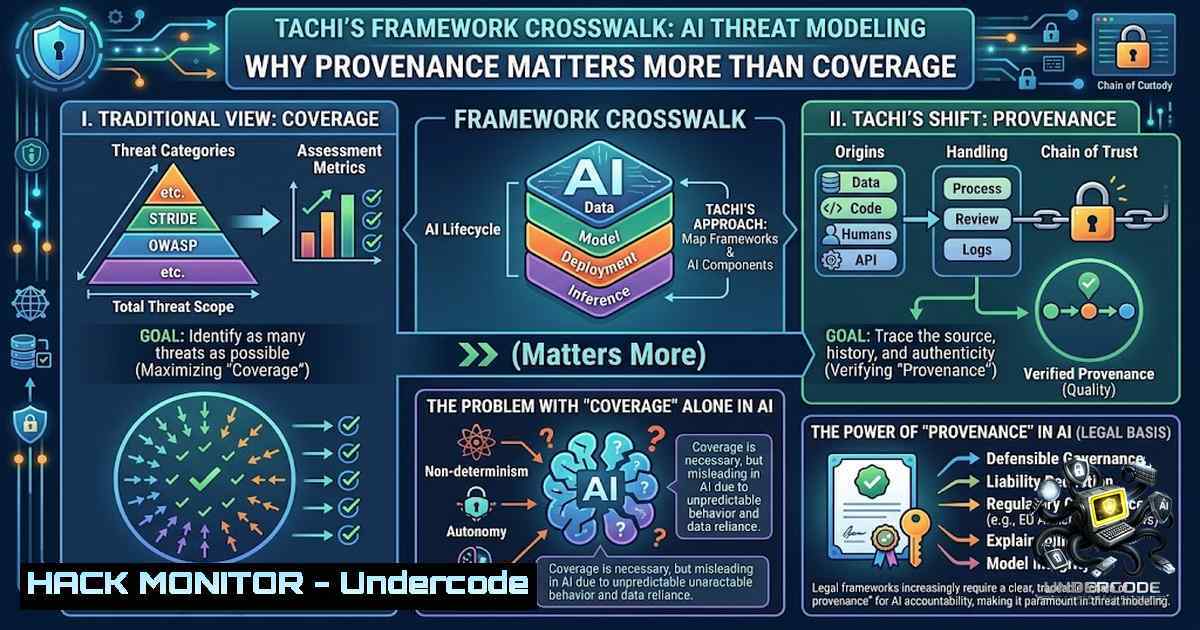
In the rapidly evolving landscape of AI security, the gap between detection and defensibility has never been wider. Most vulnerability scanners excel at generating findings but fail to provide the essential provenance—the citation trail that proves why a finding matters and which authoritative standard it violates. David Matousek’s open-source tool, tachi, addresses this critical shortcoming by implementing a comprehensive framework crosswalk that maps every detected threat across eight security catalogs, transforming raw scan results into auditable, standards-backed intelligence【7†L4-L7】【8†L1-L3】.
Learning Objectives:
- Understand how tachi implements framework crosswalking to map vulnerabilities across OWASP, MITRE ATT&CK, NIST AI 600-1, and CWE catalogs
- Learn to deploy and configure tachi for local-first AI threat modeling and compliance validation
- Master the MAESTRO taxonomy for agentic-AI threat classification and layer-based risk assessment
- Implement automated provenance verification and link-rot monitoring for security documentation
- Apply practical commands for integrating tachi with existing CI/CD pipelines and SAST workflows
You Should Know:
1. The Architecture of Standards-Based Threat Detection
tachi operates on a fundamental principle: a vulnerability finding without a standards citation is merely an opinion. The tool maintains a dynamic crosswalk—a mapping layer that resolves each detected threat to one or more authoritative standards across eight distinct catalogs【8†L5-L7】. These catalogs span the complete spectrum of modern security concerns: OWASP Top 10 for web application risks, both MITRE ATT&CK frameworks (enterprise and mobile), NIST’s AI-risk inventories including the newly added NIST AI 600-1 for generative-AI threats, and the Common Weakness Enumeration (CWE) catalog【7†L8-L10】.
The crosswalk currently comprises 645 individual cross-references, split into 608 direct mappings and 37 related mappings, with zero dangling endpoints—meaning every citation resolves to a live, verifiable source【8†L5-L7】【9†L3-L5】. This architecture transforms tachi from a simple scanner into a compliance verification engine capable of substantiating security claims during audits.
Step-by-Step Guide: Deploying tachi Locally
 Clone the repository
git clone https://github.com/davidmatousek/tachi.git
cd tachi

Verify the crosswalk edge count (should return 645)
python -c "import json; data=json.load(open('schemas/taxonomy/crosswalk.json')); print(len(data['mappings']))"

Run tachi against your project directory
./tachi scan --path ./your-project --format json --output results.json

Generate a report with MAESTRO layer annotations
./tachi report --input results.json --layers all --format html --output report.html
2. Understanding the MAESTRO Taxonomy for Agentic AI
The MAESTRO taxonomy represents a significant advancement in agentic-AI threat classification. Unlike traditional threat models that treat AI systems as static components, MAESTRO recognizes the dynamic, autonomous nature of agentic AI【7†L12-L14】. The taxonomy comprises seven distinct layers, each addressing a specific category of threats unique to autonomous AI agents. These layers include the Agent Layer (dealing with agent identity and权限), the Environment Layer (addressing contextual threats), the State Layer (managing agent memory and state corruption), the Trust Layer (handling inter-agent trust relationships), the Resource Layer (monitoring agent consumption patterns), the Objective Layer (verifying goal alignment), and the Protocol Layer (securing agent communication channels)【9†L8-L10】.
tachi now reports on all seven MAESTRO layers for every finding, marking each as covered, clean, or not applicable【7†L12-L14】. This visibility transforms abstract AI risk into actionable intelligence, allowing security teams to identify gaps in their agentic-AI defenses with unprecedented granularity.
Implementation Example: MAESTRO Layer Validation
 Python script to validate MAESTRO layer coverage
import requests
import json

def check_maestro_coverage(report_file):
with open(report_file, 'r') as f:
data = json.load(f)

layers = ['agent', 'environment', 'state', 'trust', 'resource', 'objective', 'protocol']
coverage = {layer: {'covered': 0, 'clean': 0, 'na': 0} for layer in layers}

for finding in data['findings']:
for layer in layers:
status = finding.get('maestro', {}).get(layer, 'na')
coverage[bash][status] += 1

Generate compliance summary
for layer, stats in coverage.items():
total = sum(stats.values())
covered_pct = (stats['covered'] / total  100) if total > 0 else 0
print(f"{layer.upper()}: {covered_pct:.1f}% covered ({stats['covered']}/{total})")

return coverage

Usage
check_maestro_coverage('results.json')
3. Automated Provenance Verification and Link-Rot Prevention
One of tachi’s most innovative features is its automated link-rot detection system【7†L16-L19】. Security documentation frequently suffers from broken citations—references to standards that no longer resolve, undermining audit credibility and compliance claims. tachi addresses this through a scheduled job that checks every cited source weekly【7†L16-L17】. When a link fails to resolve, the system opens a tracking issue and automatically closes it once the link recovers【7†L18-L19】. This proactive approach ensures that provenance remains verifiable over time, a critical requirement for long-term compliance programs.
The system never blocks a merge due to a broken link, recognizing that security findings shouldn’t be delayed by documentation issues【7†L19】. Instead, it maintains a separate tracking mechanism that allows teams to address citation rot without disrupting development workflows.
Practical Implementation: Link-Rot Monitoring
 Check all citations in the crosswalk
./tachi verify-links --crosswalk schemas/taxonomy/crosswalk.json --output broken_links.txt

Generate a provenance report for auditors
./tachi provenance --input results.json --format pdf --output provenance_report.pdf

Schedule weekly verification (cron example)
 Add to crontab: 0 0   0 cd /path/to/tachi && ./tachi verify-links --auto-fix --1otify
4. Crosswalk Depth vs. Coverage Breadth
The June release of tachi marked a strategic shift from breadth to depth【8†L7-L9】. While coverage held steady at fifty-for-fifty across OWASP frameworks and the agent count remained at fourteen, the focus was on deepening the crosswalk’s mapping fidelity【8†L9-L10】. This approach recognizes that superficial coverage across many standards is less valuable than precise, verifiable mappings against key frameworks【8†L11-L12】.
The crosswalk now supports 608 direct mappings and 37 related mappings, with every number reconcilable against files in the repository【8†L5-L7】【9†L3-L5】. This transparency is fundamental to tachi’s philosophy: a coverage claim that cannot be recomputed is a claim that must be taken on faith【8†L13-L14】. By making every mapping auditable and reproducible, tachi transforms security claims from marketing assertions into verifiable facts.
Verification Commands:
 Recompute the crosswalk edge count
cd /path/to/tachi
find schemas/taxonomy -1ame ".json" -exec jq '.mappings | length' {} \; | awk '{sum+=$1} END {print sum}'

Validate all mappings resolve
./tachi validate --crosswalk schemas/taxonomy/crosswalk.json --strict

Export crosswalk for audit purposes
./tachi export --format csv --output crosswalk_audit.csv
5. Integration with Existing Security Toolchains
tachi is designed to complement, not replace, existing security tools【7†L22】. The crosswalk provides provenance—it doesn’t perform static analysis or dependency scanning natively【7†L22-L23】. Instead, tachi enhances the output of existing SAST tools, DAST scanners, and dependency checkers by adding a layer of standards-based context【7†L23】.
When integrated into a CI/CD pipeline, tachi can ingest findings from multiple sources and resolve them against the crosswalk, producing a unified report that maps every vulnerability to its corresponding standards citations【7†L22-L24】. This approach eliminates the manual effort of rebuilding citation trails during audits, a process that typically occurs precisely when auditors are demanding answers【7†L5-L6】.
CI/CD Integration Example:
 GitHub Actions workflow example
name: Security Scan with tachi
on: [push, pull_request]

jobs:
security-scan:
runs-on: ubuntu-latest
steps:
- uses: actions/checkout@v3

<ul>
<li>name: Run SAST scan
run: |
semgrep --config auto --json --output semgrep_results.json</p></li>
<li><p>name: Enrich findings with tachi
run: |
git clone https://github.com/davidmatousek/tachi.git
cd tachi
./tachi enrich --input ../semgrep_results.json --crosswalk schemas/taxonomy/crosswalk.json --output enriched_results.json</p></li>
<li><p>name: Generate compliance report
run: |
./tachi report --input enriched_results.json --format html --output report.html</p></li>
<li><p>name: Upload report
uses: actions/upload-artifact@v3
with:
name: security-report
path: report.html
What Undercode Say:
- Provenance is the new perimeter: In an era of AI-generated code and autonomous agents, the ability to substantiate security claims with authoritative citations has become the defining characteristic of mature security programs
- Depth over breadth: tachi’s focus on deepening the crosswalk rather than expanding coverage demonstrates that precision and verifiability matter more than the number of frameworks superficially supported
Analysis:
The significance of tachi’s crosswalk extends beyond technical capability into organizational risk management. Security teams face increasing pressure to demonstrate compliance with multiple, often overlapping, regulatory frameworks. The traditional approach of maintaining separate compliance artifacts for each standard is unsustainable and error-prone【7†L5-L6】. tachi’s unified crosswalk model offers a path forward: a single source of truth that maps findings to all relevant standards simultaneously. This reduces audit preparation time from weeks to hours and eliminates the manual citation-building that typically occurs under audit pressure. Furthermore, the MAESTRO taxonomy addresses a critical gap in AI security—the absence of a standardized threat model for agentic systems【7†L12-L14】. As organizations deploy increasingly autonomous AI agents, the ability to classify and communicate risks across seven distinct layers will become essential for board-level risk reporting and insurance underwriting.
Prediction:
+1 The framework crosswalk approach will become the industry standard for AI security tools within 18 months, driven by regulatory requirements for auditable provenance
+1 tachi’s open-source model and local-first architecture position it as the foundational layer for enterprise AI security programs, enabling organizations to maintain control over sensitive threat data
-1 Organizations that continue to rely on standalone scanners without provenance capabilities will face increasing audit failures and compliance gaps as regulators demand verifiable citations
+1 The MAESTRO taxonomy’s seven-layer model will influence the development of next-generation AI security standards, potentially shaping NIST’s future AI risk frameworks
+1 Link-rot prevention mechanisms will become a mandatory feature for security documentation tools as standards bodies increasingly update and retire publications
▶️ Related Video (82% Match):
🎯Let’s Practice For Free:
🎓 Live Courses & Certifications:
Join Undercode Academy for Verified Certifications
🚀 Request a Custom Project:
Secure, high-velocity infrastructure and disruptive technological engineering. Contact our engineering team for high-tier development and proprietary systems:
[email protected]
💎 Smart Architecture | 🛡️ Secure by Design | ⭐ Trusted by Thousands
IT/Security Reporter URL:
Reported By: Davidmatousek Standards – Hackers Feeds
Extra Hub: Undercode MoN
Basic Verification: Pass ✅


