Listen to this Post
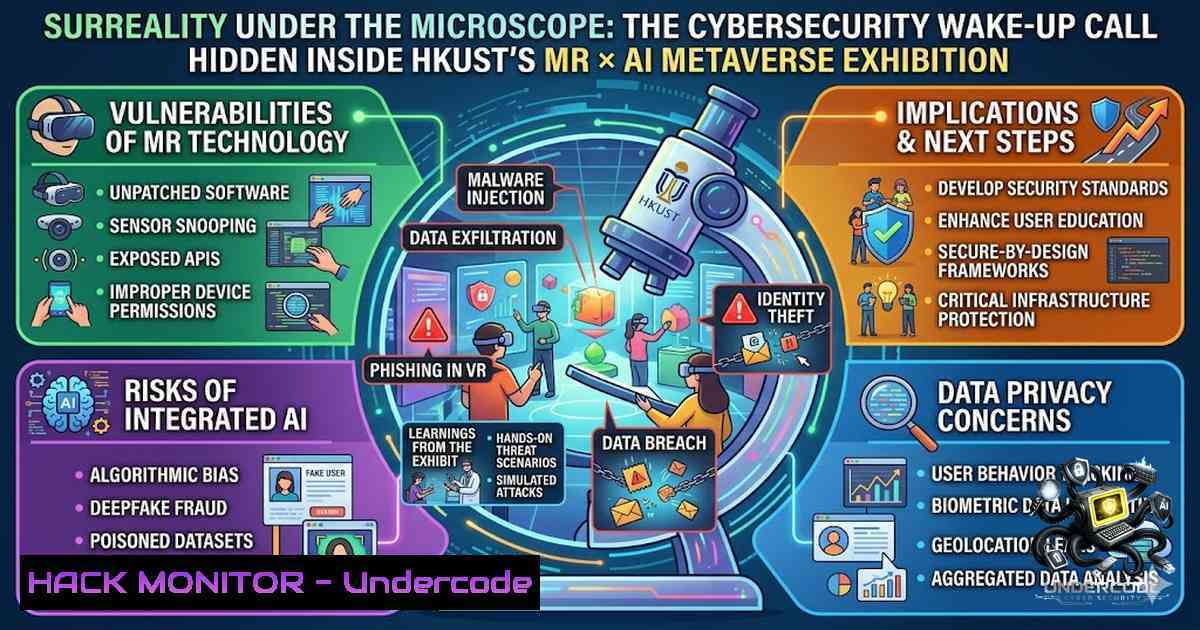
Introduction:
When The Hong Kong University of Science and Technology (HKUST) and its Guangzhou campus unveiled “SURREALITY” — the world’s first large-scale cross-regional Mixed Reality (MR) × Artificial Intelligence (AI) digital art exhibition — the world saw a celebration of computational creativity. Cybersecurity professionals, however, saw something else: an expansive new attack surface where spatial computing, real-time rendering, and AI-generated content converge across 130 kilometers of network infrastructure. As nearly 50 works by over 70 digital artists from 23 countries transform two campuses into a unified metaverse, the exhibition’s centerpiece — “The Gate” — doesn’t just connect Clear Water Bay and Nansha through a virtual portal. It exposes the raw vulnerabilities of an emerging digital frontier where every sensor, every rendered pixel, and every AI model becomes a potential entry point for adversaries.
Learning Objectives:
- Understand the technical architecture powering large-scale cross-campus MR × AI deployments and their inherent security blind spots.
- Identify specific attack vectors targeting spatial computing pipelines, AI art generation models, and metaverse network infrastructure.
- Master practical Linux, Windows, and cloud-hardening commands to secure MR/AI exhibition environments and similar immersive deployments.
You Should Know:
- The SURREALITY Tech Stack: What’s Really Running Under the Hood
SURREALITY isn’t just art — it’s a distributed computing ecosystem. Visitors wearing MR headsets explore three exhibition areas — Living Currents, Future Fables, and Beyond Mind — while AI-generated artworks blend with physical campus environments through spatial computing and real-time rendering technologies. The signature piece, “The Gate,” uses 3D scanning and reconstruction to recreate campus topography, enabling virtual traversal between Hong Kong and Guangzhou.
What this means for security: Every MR headset becomes a sensor node transmitting biometric data — hand gestures, eye contact, tone of voice, pulse rate, and even facial vibrations captured through motion sensors. The Center for Metaverse and Computational Creativity (MC² Lab) at HKUST(GZ) drives this infrastructure, but with great sensory data comes great responsibility.
Linux Command — Monitor Network Connections from MR Headsets:
sudo tcpdump -i any -1 -vvv host <MR_HEADSET_IP> or port 443
This captures all traffic from MR devices to detect unusual data exfiltration patterns.
Windows Command — Check Open Ports on MR Application Servers:
netstat -ano | findstr LISTENING
Identify unexpected listening services that could indicate backdoors in the rendering pipeline.
- The AI Art Pipeline: Model Poisoning and Prompt Injection Risks
The exhibition showcases AI-generated artworks integrated with physical spaces. But AI art generation pipelines are vulnerable to model poisoning — attackers can inject malicious training data or fine-tuned LoRA plugins that contain hidden functionalities. Recent research demonstrates that text-to-image models can be backdoored through composite-trigger attacks, where specific input prompts trigger undesirable or offensive outputs.
Step-by-step: Securing AI Art Generation Pipelines
- Validate all training data sources — Implement cryptographic hashing of datasets:
sha256sum /path/to/training/images/ > dataset_hashes.txt
- Deploy prompt filtering — Use regex-based input sanitization before sending prompts to generative models:
import re dangerous_patterns = [r"<script", r"DROP TABLE", r"eval("] for pattern in dangerous_patterns: if re.search(pattern, user_prompt): reject_prompt() - Monitor model output drift — Log all generated outputs and compare against baseline embeddings to detect adversarial perturbations:
python -c "import hashlib; print(hashlib.sha256(open('output.png','rb').read()).hexdigest())" -
Spatial Computing and Real-Time Rendering: A Side-Channel Goldmine
The exhibition’s immersive experience depends on spatial computing and real-time rendering. But rendering engines like Unity and Unreal — the backbone of most MR applications — expose performance metrics (frame rates, frame times) that attackers can exploit. The EyeSpy attack demonstrates how adversaries can sweep imperceptible high-cost objects across a user’s field of view and infer eye gaze patterns from rendering performance side-channels. Even worse, 3D Gaussian Splatting pipelines — increasingly used for real-time scene reconstruction — are vulnerable to stealthy poisoning attacks that inject malicious views at specific attack viewpoints.
Linux Command — Monitor Rendering Server Performance Anomalies:
htop -d 1
Watch for unexpected CPU/GPU spikes that could indicate side-channel exploitation attempts.
Windows PowerShell — Check for Unexpected Rendering Processes:
Get-Process | Where-Object { $<em>.CPU -gt 50 -and $</em>.ProcessName -match "render|unity|unreal" }
4. Cross-Campus Network Architecture: The 130-Kilometer Attack Surface
The “Unified HKUST, Complementary Campuses” framework connects two campuses 130 kilometers apart through a virtual metaverse. This distributed architecture introduces latency, authentication, and encryption challenges. Metaverse implementations typically use secure transport connections to communicate with cloud servers rather than direct peer-to-peer communication. However, 5G and 6G-enabled metaverse applications will face significant security challenges when integrating heterogeneous network architectures.
Step-by-step: Hardening Cross-Campus MR Network Infrastructure
- Implement end-to-end encryption for all MR data streams:
openssl enc -aes-256-cbc -salt -in sensor_data.bin -out sensor_data.enc -pass pass:$(cat /etc/ssl/mr_key.pem)
- Deploy edge computing nodes to reduce latency and localize data processing — keep biometric data off the wide-area network whenever possible.
3. Configure VLAN isolation for MR traffic:
ip link add link eth0 name eth0.100 type vlan id 100
ip addr add 10.0.100.1/24 dev eth0.100
ip link set dev eth0.100 up
4. Enable firewall rules to restrict MR device communication:
iptables -A INPUT -p tcp --dport 443 -s 10.0.100.0/24 -j ACCEPT
iptables -A INPUT -p tcp --dport 443 -j DROP
- MR Headset Biometric Data Exposure: The Privacy Time Bomb
VR/AR headsets track personal data that users may not even be aware of — pulse rate, eye movements, body gestures, voice, and geolocation history. Motion sensors, typically accessed without explicit user permission, can capture subtle facial vibrations that leak speech, identity, and physiological information. In the SURREALITY context, every visitor wearing an MR headset becomes a data source for potential profiling, manipulation, or invasive targeted advertising.
Linux Command — Encrypt Biometric Data at Rest:
sudo cryptsetup luksFormat /dev/sda1
sudo cryptsetup open /dev/sda1 biometric_data
Windows Command — Enable BitLocker for MR Data Drives:
Manage-bde -on C: -RecoveryPassword
- Blockchain, NFTs, and Digital Identity in the Metaverse
HKUST has previously explored issuing diplomas in digital format with unique blockchain marks. The metaverse’s integration with blockchain creates decentralized virtual platforms where users face even higher risks of identity fraud, deepfake manipulation, and financial vulnerabilities. In decentralized environments, centralized content moderation is either impractical or ineffectual, making these platforms vulnerable to deepfakes, hate speech, and disinformation abuse.
Step-by-step: Securing Digital Identity in Metaverse Deployments
1. Implement multi-factor authentication for all virtual identities:
sudo apt-get install libpam-google-authenticator
google-authenticator
2. Use asymmetric encryption for all identity-related data:
openssl genrsa -out private_key.pem 2048
openssl rsa -in private_key.pem -pubout -out public_key.pem
3. Log all authentication events for audit trails:
tail -f /var/log/auth.log | grep -E "Accepted|Failed"
- Cloud and API Security: The Backend of Immersive Experiences
The exhibition’s backend likely relies on cloud APIs for content delivery, user authentication, and real-time synchronization. Poor permission control in XR environments allows malicious applications to exploit excessive privileges for unauthorized access. API security becomes paramount — unvalidated inputs, broken object-level authorization, and insecure direct object references can compromise the entire exhibition infrastructure.
Linux Command — Scan for Open API Endpoints:
nmap -p 80,443,8080,8443 <TARGET_IP> -sV
Windows Command — Test API Authentication:
Invoke-WebRequest -Uri "https://api.surreality.hkust.edu/v1/artworks" -Headers @{"Authorization"="Bearer test_token"}
Cloud Hardening Checklist for MR/AI Deployments:
- Enable AWS WAF or Azure WAF with rate limiting
- Use secrets management (AWS Secrets Manager, Azure Key Vault) for API keys
- Implement OAuth 2.0 with PKCE for mobile/headset authentication
- Enable VPC flow logs to monitor north-south traffic
- Deploy intrusion detection systems (Snort, Suricata) at network boundaries
What Undercode Say:
- Key Takeaway 1: SURREALITY isn’t just an art exhibition — it’s a production-scale deployment of every major emerging technology (MR, AI, spatial computing, metaverse) with all their associated security baggage. The cybersecurity community should treat it as a live-fire exercise in securing distributed immersive environments.
- Key Takeaway 2: The real threat isn’t the technology itself — it’s the data. Biometric signals, behavioral patterns, and real-time physiological data collected through MR headsets represent a new class of sensitive information that existing privacy frameworks were never designed to protect. The exhibition’s success in demonstrating technical feasibility should be matched by equally rigorous demonstrations of privacy-preserving architectures.
Analysis: The SURREALITY exhibition represents a watershed moment for both the art world and the cybersecurity industry. By deploying MR headsets that capture biometric data, AI models that generate art from user inputs, and a cross-campus metaverse that spans 130 kilometers, HKUST has inadvertently created a testbed for every major security challenge of the next decade. The attack surface is staggering: side-channel attacks on rendering pipelines, model poisoning in AI art generation, biometric data exfiltration from headsets, and network-level compromises across distributed infrastructure. Organizations planning similar immersive deployments must implement defense-in-depth strategies — encrypting data at rest and in transit, isolating MR traffic on dedicated VLANs, validating all AI model inputs and outputs, and deploying continuous monitoring for rendering performance anomalies that could indicate side-channel exploitation. The tools and commands outlined above provide a starting point, but the real solution lies in embedding security-by-design principles into the architecture from day one — something that, in the rush to demonstrate technological prowess, is often overlooked until the first breach occurs.
Prediction:
- -1 As MR and AI exhibitions become more common, we will see the first major data breach originating from biometric data collected through headsets — likely involving eye-tracking or physiological data sold to advertisers or used for psychological profiling without user consent. The regulatory backlash will be severe, potentially slowing adoption of immersive technologies in sensitive environments.
-
-1 AI-generated art pipelines will be weaponized through model poisoning attacks, with adversaries injecting backdoors that trigger offensive or misleading outputs when specific prompts are used. The reputational damage to institutions hosting such exhibitions could be catastrophic.
-
+1 The security community will develop specialized XR security frameworks and certification standards, similar to PCI-DSS for payment cards, creating a new cybersecurity sub-industry focused on immersive environments. This will generate demand for trained professionals and specialized training courses.
-
+1 HKUST’s Center for Metaverse and Computational Creativity will emerge as a leader in metaverse security research, leveraging the SURREALITY exhibition as a real-world testbed to develop and validate next-generation security protocols, privacy-preserving AI, and secure spatial computing architectures.
-
-1 Cross-campus metaverse deployments will become prime targets for nation-state actors seeking to compromise educational institutions, steal research data, or conduct surveillance on international visitors. The 130-kilometer network link between Hong Kong and Guangzhou represents a geopolitical vulnerability as much as a technical one.
▶️ Related Video (76% Match):
https://www.youtube.com/watch?v=6IQf6EwPaRA
🎯Let’s Practice For Free:
🎓 Live Courses & Certifications:
Join Undercode Academy for Verified Certifications
🚀 Request a Custom Project:
Secure, high-velocity infrastructure and disruptive technological engineering. Contact our engineering team for high-tier development and proprietary systems:
[email protected]
💎 Smart Architecture | 🛡️ Secure by Design | ⭐ Trusted by Thousands
IT/Security Reporter URL:
Reported By: Surreality Mr – Hackers Feeds
Extra Hub: Undercode MoN
Basic Verification: Pass ✅


