
Listen to this Post
Introduction:
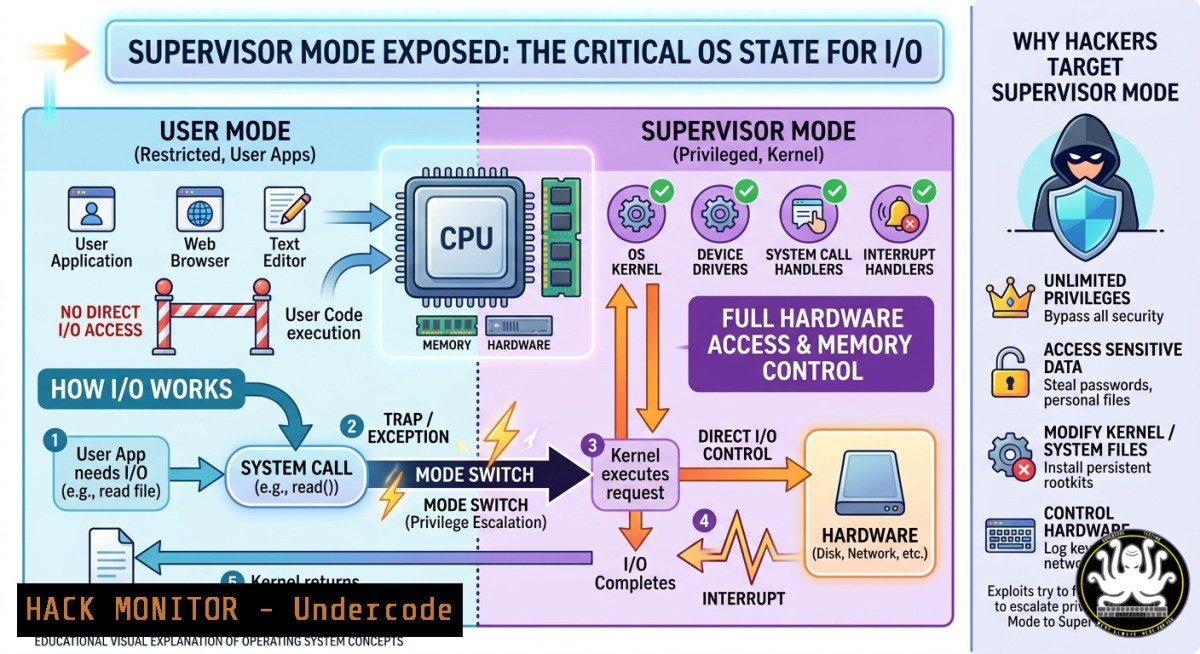
Modern computer systems rely on strict privilege separation to prevent unauthorized access to hardware resources. The poll question “In which state must a computer system operate to process input/output instructions?” – with the correct answer being Supervisor mode (also known as kernel mode) – highlights a fundamental security boundary. When a program needs to read from a disk, send a network packet, or write to a display, the CPU must temporarily switch from restricted User mode to the all-powerful Supervisor mode, giving the operating system kernel direct hardware control. This transition, however, is a prime attack surface: if an adversary can inject malicious code into Supervisor mode, they can bypass every security control in the system.
Learning Objectives:
- Understand the difference between User mode and Supervisor (Kernel) mode in x86/ARM architectures.
- Identify common I/O instruction vulnerabilities and privilege escalation techniques.
- Apply practical Linux and Windows commands to inspect, monitor, and harden kernel-mode security.
You Should Know:
- Understanding CPU Privilege Levels – From Poll Question to Exploitation
The poll correctly identifies Supervisor mode (ring 0 on x86, EL1 on ARM) as the required state for processing I/O instructions likeIN,OUT, `MOV` to device memory, orCPUID. User mode applications (ring 3) cannot directly access hardware; they must invoke system calls. If a system incorrectly allows I/O from user mode (e.g., misconfigured I/O permission bitmaps), a local attacker can directly manipulate devices.
Step‑by‑step: Verify current privilege level and I/O port access on Linux
1. Check if a process is running in user space: `cat /proc/self/status | grep -i uid` (User mode is default).
2. Examine I/O port permissions for a running process (requires root):
`cat /proc/
`grep -i iopl /proc/
3. Use `msr-tools` to read the I/O permission bitmap from the Task State Segment (TSS) on x86:
`sudo modprobe msr`
`sudo rdmsr -p 0 0x` – this requires deep kernel knowledge.
4. Windows alternative: Use WinDbg to inspect the I/O permission bitmap of a process:
`!process 0 0` → find process address → `!process
What this does: These commands reveal whether a process has been granted unusual direct I/O access – a common red flag in rootkit or virtual machine escape attacks.
- The System Call Gateway – How User Mode Safely Triggers I/O
Because user mode cannot execute I/O instructions directly, operating systems expose system calls (e.g.,read(),write(),DeviceIoControl()). The transition from user to supervisor mode is managed via software interrupts (int 0x80on legacy Linux), `syscall` (x86_64), orsysenter. Every syscall is a potential security boundary if input validation fails.
Step‑by‑step: Trace and monitor system calls for malicious I/O patterns
– On Linux: `strace -e trace=open,read,write,ioctl ./your_program`
Look for unexpected device file accesses like /dev/mem, /dev/port, or /dev/sg.
– Monitor real-time syscalls across the system: `sudo perf trace -e ioctl,openat –filter ‘filename ~ “/dev/”‘`
– Windows (Sysmon) : Install Sysmon with a config that logs `FileCreate` events for `\Device\PhysicalMemory` or direct disk access. Example command:
`Sysmon64.exe -accepteula -i sysmon-config.xml` (where config includes rule: <TargetFilename condition="contains">PhysicalMemory</TargetFilename>)
Tutorial context: After tracing, an analyst might see an exploit attempting `open(“/dev/mem”, O_RDWR)` – a clear sign of an attempt to read or write physical memory from user space, which should be blocked by default (CONFIG_STRICT_DEVMEM).
- Privilege Escalation – From User to Supervisor Mode via Vulnerable Drivers
Once an attacker gains user execution, the most common path to Supervisor mode is through a vulnerable kernel driver. Missing input sanitization in an IOCTL handler can allow arbitrary kernel code execution. For example, a buggy driver that lets user mode write to an arbitrary kernel address.
Step‑by‑step: Exploit mitigations and detection
- List loaded kernel modules (Linux:
lsmod, Windows: `driverquery` orfltmc). - Check for known vulnerable drivers using a tool like `DriverView` (Windows) or `modinfo` (Linux). Look for drivers with direct physical memory access or unrestricted I/O ports.
- Simulate a mitigation: On Linux, enable `CONFIG_IO_STRICT_DEVMEM` and verify:
`cat /proc/sys/kernel/security/restrict_devmem` (should be 1). If not, set:sudo sysctl -w kernel.security.restrict_devmem=1. - Windows specific: Use `Device Guard` and `Hypervisor-protected Code Integrity (HVCI)` to block unsigned or vulnerable drivers. Check status:
`Get-ComputerInfo -Property “DeviceGuard”, “HyperV”`
Key takeaway: Many recent BYOVD (Bring Your Own Vulnerable Driver) attacks leverage legitimate but flawed drivers to execute ring‑0 code. Security teams must enforce driver block lists (e.g., Microsoft’s HVCI or Linux’s module signing).
- Hardening the User‑to‑Supervisor Transition – CPU Features & Configuration
Modern CPUs provide hardware defenses that prevent even Supervisor mode from being easily compromised. Two critical features: SMEP (Supervisor Mode Execution Prevention) – blocks kernel execution of user‑mode pages; SMAP (Supervisor Mode Access Prevention) – blocks kernel access to user‑mode pages unless explicitly intended.
Step‑by‑step: Verify and enable these protections
- Linux: Check kernel command line for
nosmep,nosmap:
`cat /proc/cmdline` (if present, they are disabled). Enable them by removing those boot parameters. - Verify runtime status: `grep smep /proc/cpuinfo` and `grep smap /proc/cpuinfo` – flags should appear.
- Windows: Check using `Coreinfo` from Sysinternals:
`coreinfo.exe -v` – look for SMEP, SMAP as “” (enabled) or “-” (disabled). On modern Windows 10/11 with HVCI, they are forced on.
Tutorial snippet: If you are writing a kernel exploit, you must bypass SMEP/SMAP using techniques like “return-to-user” (ret2usr) is blocked, so adversaries now use “ROP in kernel space” or abuse missing STAC/CLAC instructions.
- Practical Lab: Detecting I/O Instructions in User-Space Processes
Because normal user processes never executeIN,OUT,CLI,STI, etc., their presence in a memory dump is a strong indicator of a rootkit or a hypervisor escape. Use static analysis to scan for these opcodes.
Step‑by‑step using `ndisasm` (Linux) on a suspicious binary
- Dump the executable’s code section: `objdump -d ./suspicious | grep -E “out|in|cli|sti”`
2. For raw scanning: `ndisasm -b 64 suspicious_binary | grep -E “out|in”`
Example output: `0x00001234 EE out dx,al` – this should never appear in user-mode code. - Windows (with WinDbg) : Load the driver or process memory and use `!opcodemap` (from a forensic plugin) to find privileged instructions.
What this does: If you find `out` or `in` in a user-mode process’s disassembly, it is either a packed exploit (attempting to write directly to hardware) or the process is actually running in ring 0 (e.g., a kernel driver disguised as a user executable).
- Container and Virtualization Implications – When “Supervisor” Is Nested
In virtualized environments, guest Supervisor mode (ring 0) is actually User mode relative to the hypervisor (ring -1). I/O instructions executed by a guest kernel trap to the hypervisor via VMX/SVM. This adds another security layer, but flaws like CVE-2019-5736 (runc container breakout) show that even container isolation can be broken.
Step‑by‑step: Check if you are running inside a VM and inspect I/O trapping
– Linux: `dmesg | grep -i hypervisor` or lscpu | grep Hypervisor.
– Check if the `kvm_intel` module traps I/O: `cat /sys/module/kvm_intel/parameters/allow_unsafe_assigned_interrupts` (should be 0).
– Test I/O trapping with a simple C program that tries `out` instruction (requires `iopl(3)` which fails without CAP_SYS_RAWIO). Compile and run as non-root – it will segfault because the hypervisor blocks it.
Container hardening: Use `seccomp` to block all ioctl syscalls that could lead to device assignment. Example Docker seccomp profile that denies `ioctl` on /dev/net/tun:
`{ “names”: [“ioctl”], “action”: “SCMP_ACT_ERRNO” }` saved as deny-ioctl.json, then run: `docker run –security-opt seccomp=deny-ioctl.json …`
What Undercode Say:
- Key Takeaway 1: The poll’s correct answer, Supervisor mode, is not just trivia – it’s the cornerstone of operating system security. Any failure to enforce this mode transition (via misconfigurations or exploits) results in total system compromise.
- Key Takeaway 2: Attackers constantly hunt for ways to execute I/O instructions without proper privilege elevation – whether through vulnerable drivers, I/O bitmap loopholes, or hypervisor bugs. Defenders must monitor for direct hardware access attempts using tools like
strace, Sysmon, and memory forensics.
Analysis (10 lines): The “Supervisor mode vs User mode” concept is often overlooked in penetration testing courses, yet it underpins every kernel exploit (e.g., Dirty Pipe, PrintNightmare). Modern mitigations (SMEP, SMAP, KPTI) have raised the bar, but they are not silver bullets – attackers pivot to abusing legitimate driver IOCTLs or side-channel attacks (like MMIO). The poll results (showing only 4 votes at time of capture) suggest that many IT professionals confuse supervisor mode with stateful inspection (a firewall concept) or interprocess communication. This knowledge gap is dangerous because without understanding privilege rings, security engineers cannot properly configure I/O memory management units (IOMMUs) or enforce seccomp policies. In practice, every single I/O operation – from reading a file to sending a network packet – must cross the user/kernel boundary. As IoT and cloud-native workloads grow, misconfigured device passthrough (e.g., VFIO) becomes a common attack vector. Training courses must include hands-on labs where students trigger a system call and trace the transition into kernel code. Finally, the rise of eBPF (which runs in kernel context) adds another layer: unprivileged eBPF programs can now execute certain I/O-related helpers, blurring the line further.
Prediction:
Within the next three years, we will see a surge in attacks targeting “firmware I/O” – exploiting Direct Memory Access (DMA) via Thunderbolt, USB4, or CXL bypassing Supervisor mode entirely (since DMA does not involve CPU privilege levels). Consequently, IOMMU-based protections (e.g., Intel VT-d, AMD-Vi) will become as critical as SMEP/SMAP. Moreover, as more hardware accelerators (GPUs, NPUs, FPGAs) are integrated into cloud instances, attackers will shift from classic kernel exploits to I/O instruction abuse via userspace driver frameworks like DPDK or SPDK, which map hardware registers directly into user memory. Defenders must adopt memory tagging and capability-based security models (like CHERI) to isolate I/O buffers, rendering today’s “Supervisor mode” a relic of the past. If you haven’t already, start auditing your systems for unprotected /dev/mem, unchecked IOCTLs, and missing VT-d. The next big breach won’t need a kernel bug – it will just ask the hardware politely.
▶️ Related Video (70% Match):
🎯Let’s Practice For Free:
IT/Security Reporter URL:
Reported By: UgcPost 7464212461009862656 – Hackers Feeds
Extra Hub: Undercode MoN
Basic Verification: Pass ✅


