
Listen to this Post
Introduction:
Subnetting is the make-or-break skill that separates competent network engineers from the rest. It underpins everything from efficient IP address management and VLSM to security boundary enforcement and routing protocol operation. Without mastering mask boundaries, binary conversion, and the 2ⁿ–2 host rule, even basic tasks like designing a point-to-point link or a multi‑VLAN enterprise LAN become error‑prone nightmares.
Learning Objectives:
- Calculate subnet masks, network IDs, and broadcast addresses using CIDR notation and binary arithmetic.
- Apply VLSM to prevent IP exhaustion in real‑world enterprise designs.
- Use Linux/Windows command‑line tools to verify and troubleshoot subnet configurations instantly.
You Should Know:
- CIDR, Binary Masks, and the “Magic Number” Method
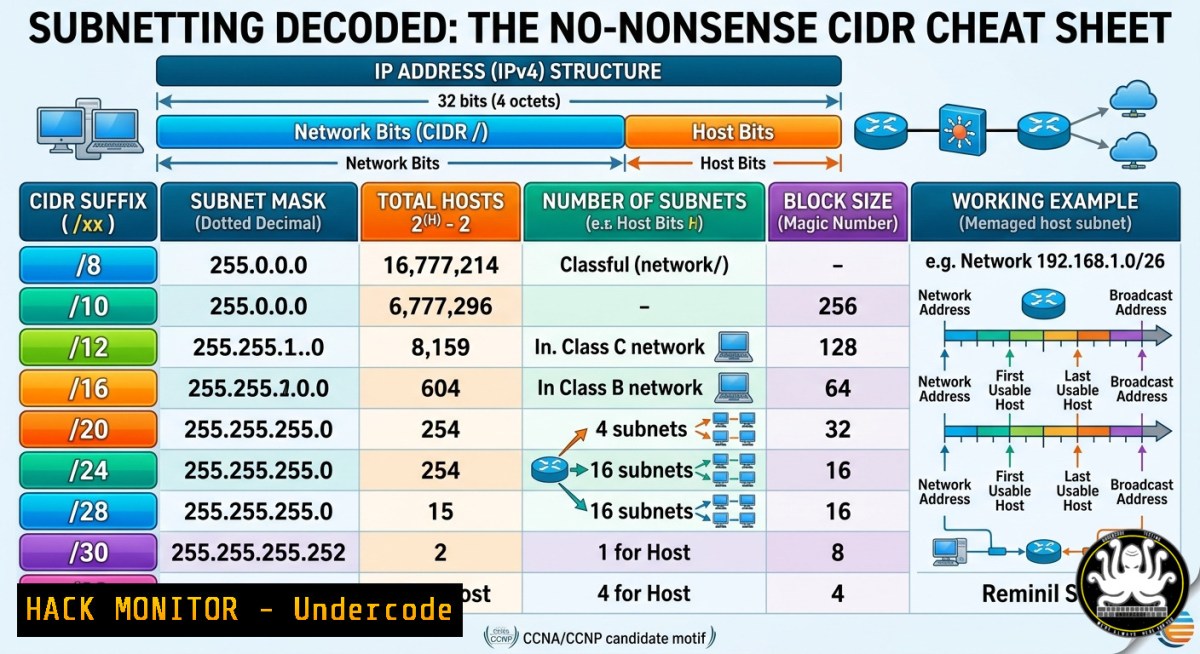
Start with the post’s cheat sheet – it maps CIDR prefixes (e.g., /24, /26, /30) to dotted‑decimal masks and binary blocks. The key insight: each mask bit “1” locks the corresponding IP bit in the network portion. The “magic number” is 256 minus the last non‑zero octet of the mask.
Step‑by‑step guide to find the network ID:
- Write the IP address and mask (e.g., 192.168.5.37 /26 → mask 255.255.255.192).
- Magic number = 256 – 192 = 64.
- Network ID is the highest multiple of 64 ≤ 37 → 0. So network = 192.168.5.0/26.
- Broadcast = network + magic – 1 = 192.168.5.63.
Linux command to verify: `ipcalc 192.168.5.37/26` (install if needed:sudo apt install ipcalc).
Windows alternative: Use `netsh interface ip show config` or download the `subnet` PowerShell module.
2. The 2ⁿ–2 Rule and Point‑to‑Point Links
For any subnet, usable hosts = 2^(host bits) – 2 (network + broadcast). A /30 (mask 255.255.255.252) gives 2 host bits → 2²–2 = 2 usable addresses – perfect for router‑to‑router links. A /31 (RFC 3021) eliminates broadcast, offering 2 usable hosts without waste.
Step‑by‑step configuration on Cisco IOS:
– `interface g0/0`
– `ip address 10.0.0.0 255.255.255.254` (for /31)
– `no shutdown`
Linux point‑to‑point setup:
ip addr add 10.0.0.0/31 dev eth0
ip link set eth0 up
Windows (PowerShell admin):
New-NetIPAddress -InterfaceAlias "Ethernet0" -IPAddress 10.0.0.0 -PrefixLength 31
3. VLSM in Action – Preventing IP Exhaustion
VLSM allows subnets of different sizes within the same major network. Example: You need 100 hosts for Sales, 50 for Engineering, 2 for a WAN link. Instead of three /24s (wasting 400+ addresses), use:
– Sales: 192.168.1.0/25 (126 hosts)
– Engineering: 192.168.1.128/26 (62 hosts)
– WAN link: 192.168.1.192/30 (2 hosts)
Step‑by‑step VLSM design:
1. Sort requirements (largest first).
- Allocate smallest CIDR that satisfies each (ceil(log2(hosts+2)) bits).
3. Assign contiguous blocks from the starting address.
Verification on Linux: `ip route show table all` or `ip neigh show` to see active subnets.
Windows verification: `route print -4` and `arp -a`.
4. Hands‑On Lab: Cisco / Linux Subnetting Drill
Build a mini‑network with three subnets using Linux namespaces or virtual machines.
Step‑by‑step with Linux network namespaces:
ip netns add router
ip netns add lan1
ip netns add lan2
ip link add veth-r-lan1 type veth peer name veth-lan1-r
ip link add veth-r-lan2 type veth peer name veth-lan2-r
ip link set veth-r-lan1 netns router
ip link set veth-lan1-r netns lan1
 assign IPs: router side 192.168.1.1/24, lan1 side 192.168.1.2/24
ip netns exec router ip addr add 192.168.1.1/24 dev veth-r-lan1
ip netns exec lan1 ip addr add 192.168.1.2/24 dev veth-lan1-r
 bring up interfaces, add default routes, test ping
Windows substitute: Use Hyper‑V with three small VMs (or WSL2 with bridged adapters) and the `New-VMSwitch` PowerShell cmdlet.
- Subnetting for Security – Broadcast Containment and ACL Scope
Over‑sized broadcast domains increase attack surface (broadcast storms, ARP spoofing). Proper subnetting limits lateral movement. For example, place all public‑facing servers in a /28 (14 usable) and management interfaces in a separate /26.
Step‑by‑step firewall rule (FortiGate CLI):
config firewall policy
edit 1
set srcintf "internal"
set dstintf "dmz"
set srcaddr "192.168.10.0/28"  only this small subnet
set dstaddr "10.0.0.5"
set action accept
next
end
Linux iptables example: iptables -A FORWARD -s 192.168.10.0/28 -d 10.0.0.5 -j ACCEPT.
Windows Defender Firewall with subnet restriction: Use New-NetFirewallRule -RemoteAddress 192.168.10.0/28.
- Subnet Calculation Commands – Cheat Sheet for Real‑Time Ops
When you’re in a terminal without a calculator, use built‑in tools.
Linux:
– `ipcalc 10.20.30.40/27` → shows netmask, network, broadcast, host range.
– `sipcalc 192.168.1.0/24` → more detailed (install via apt install sipcalc).
– `python3 -c “import ipaddress; print(ipaddress.IPv4Network(‘192.168.1.100/26’, strict=False))”`
Windows:
- PowerShell: `[bash]::new(0x0A141E28).AddressToString()` and bitwise shift for mask.
– `wmic nicconfig get ipaddress,ipsubnet` (legacy).
Online (but air‑gapped?) – use the WhatsApp community from the post: https://lnkd.in/d-kemJU6 for shared cheat sheets and peer support.
- Common Subnetting Mistakes and How to Fix Them
– Mistake: Overlapping subnets.
Check: `ip route` on Cisco, `route -n` on Linux – duplicate entries cause asymmetric routing.
– Mistake: Forgetting the broadcast address when reserving DHCP pools.
Fix: Set DHCP range from network+1 to broadcast‑1 (e.g., 192.168.0.1 – 192.168.0.254 for /24).
– Mistake: Using /16 or /8 in labs (wastes IPs, slow convergence).
Fix: Always start with /24 or smaller unless you need >254 hosts.
Step‑by‑step recovery:
- Identify misconfigured interface: `ip addr show` (Linux) / `ipconfig /all` (Windows).
- Remove incorrect subnet:
ip addr del 192.168.1.1/16 dev eth0. - Add correct:
ip addr add 192.168.1.1/24 dev eth0. - Verify no overlap with `arping -I eth0 192.168.1.255` to check broadcast domain leakage.
What Undercode Say:
- Subnetting isn’t just about passing exams – it directly reduces your attack surface by limiting broadcast domains and enabling granular ACLs. The /31 trick for point‑to‑point links is criminally underused in production.
- Most engineers rely on calculators, but binary fluency helps troubleshoot real issues: e.g., why a /27 subnet’s broadcast appears as a “wrong” IP in tcpdumps. Memorize the “magic number” method from this post – it’s faster than any app.
Analysis (approx. 10 lines): The post correctly emphasizes VLSM as the weapon against IPv4 exhaustion – many enterprises still waste /24s on tiny links. Adding the /31 standard (RFC 3021) saves address space and simplifies configs. The cheat sheet’s binary conversion column is crucial: when a packet’s destination IP is ANDed with the mask, hardware makes forwarding decisions in nanoseconds. Without internalizing that, advanced topics like route summarisation (aggregating multiple subnets into one advertisement) remain black magic. Also, subnetting affects network security audits: compliance frameworks (PCI‑DSS, NIST) require documented segmentation. A sloppy subnet plan leads to flat networks where a single compromised printer can reach the finance database. Finally, the post’s invitation to join a WhatsApp group (+923059299396, lnkd.in/d-kemJU6) is a smart move – peer review of subnetting schemas catches errors before they hit production.
Prediction:
As IPv6 adoption slowly climbs, subnetting will not become obsolete – it will transform. IPv6’s standard /64 subnets eliminate the “host calculation” step, but the principles of hierarchy, summarisation, and security zoning become even more critical. Expect network automation tools (Ansible, Terraform) to embed subnetting logic natively, auto‑generating VLSM plans from intent (e.g., “I need 50 VLANs with at most 200 hosts each”). Additionally, AI‑driven misconfiguration detection will flag overlapping subnets in real time. However, the immediate future belongs to hybrid environments where network engineers must simultaneously manage legacy IPv4 subnets and new IPv6 prefixes – making this cheat sheet a vital reference for years to come.
▶️ Related Video (84% Match):
🎯Let’s Practice For Free:
IT/Security Reporter URL:
Reported By: Sayed Hamza – Hackers Feeds
Extra Hub: Undercode MoN
Basic Verification: Pass ✅


