Listen to this Post
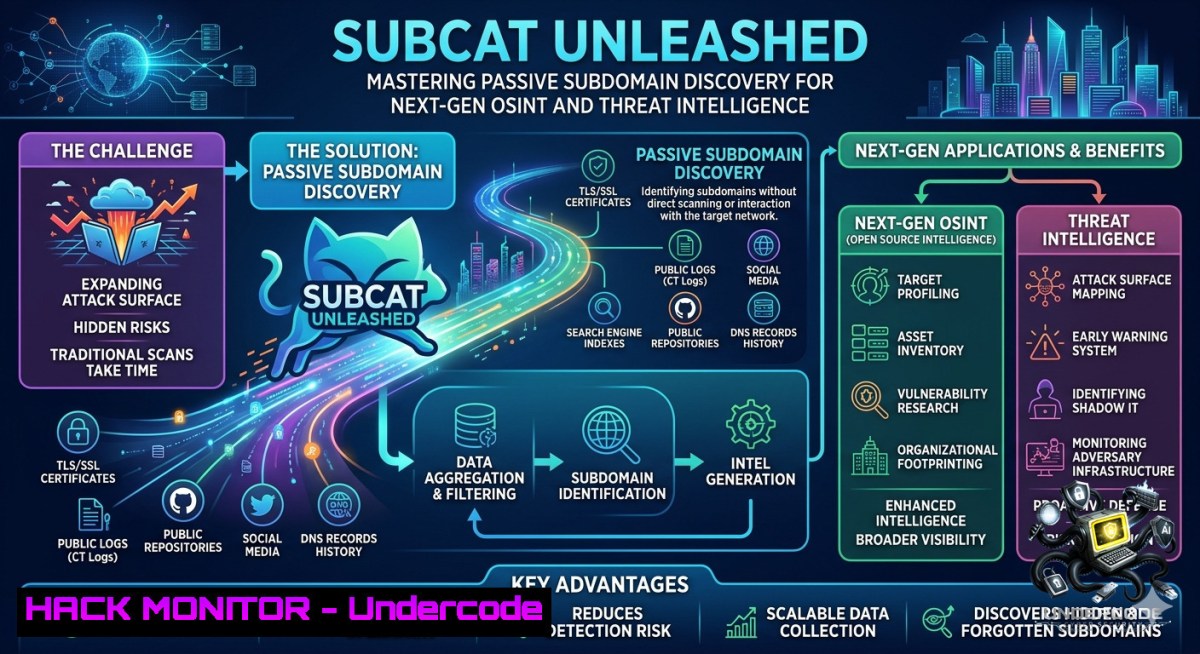
Introduction:
Passive subdomain discovery is a cornerstone of modern attack surface mapping, allowing security professionals to enumerate domain assets without sending a single packet to the target. SubCat, a fast, passive subdomain discovery tool, aggregates data from multiple open‑source intelligence (OSINT) sources, delivering comprehensive results while maintaining operational stealth. This article dives deep into SubCat’s capabilities, provides hands‑on tutorials for Linux and Windows environments, and explores how defenders can use similar techniques to harden cloud and DNS configurations.
Learning Objectives:
– Understand the mechanics of passive subdomain enumeration and its advantages over active scanning.
– Deploy and configure SubCat to aggregate subdomain data from multiple OSINT sources efficiently.
– Integrate SubCat with API security best practices, cloud hardening measures, and automated threat intelligence workflows.
You Should Know
1. Installing and Configuring SubCat on Linux – The Fast Track to Passive Recon
SubCat is designed for speed and minimal footprint. It collects subdomain records from sources such as VirusTotal, SecurityTrails, AlienVault OTX, and certificate transparency logs. Below is a verified installation and configuration guide for Ubuntu/Debian.
Step‑by‑step installation:
 Clone the SubCat repository (assuming it’s hosted on GitHub; adjust URL as needed)
git clone https://github.com/example/subcat.git  Replace with actual repo if available
cd subcat

 Install Python dependencies
pip3 install -r requirements.txt

 Verify installation
python3 subcat.py -h
Configuration for multiple data sources:
Many passive sources require API keys. Store them securely using environment variables:
export SECURITYTRAILS_API_KEY="your_key_here"
export VIRUSTOTAL_API_KEY="your_key_here"
export ALIENVAULT_OTX_KEY="your_key_here"
To make these persistent, add them to `~/.bashrc` or `~/.zshrc`. SubCat will automatically read these variables at runtime.
2. Running Your First Subdomain Scan – From Zero to Results
Once installed, SubCat can be used to enumerate subdomains for any domain. The tool aggregates results and removes duplicates, providing a clean output.
Basic command structure:
python3 subcat.py -d target.com -o subdomains.txt
– `-d` : target domain
– `-o` : output file (optional)
Example output snippet:
[] Querying SecurityTrails...
[] Querying VirusTotal...
[] Querying Crt.sh...
[+] Found 142 unique subdomains for target.com
api.target.com
admin.target.com
mail.target.com
dev.target.com
...
Using with additional sources:
python3 subcat.py -d target.com --sources virustotal,crtsh,otx --output results.json
The `–sources` flag lets you specify exactly which OSINT feeds to query, reducing noise.
3. Leveraging API Keys and Handling Rate Limits – API Security for OSINT
Most OSINT APIs enforce rate limits. SubCat implements intelligent delays and retries, but you must secure your API keys properly. Hardcoding keys in scripts is a common security pitfall.
Secure API key management on Linux:
 Use a .env file (add to .gitignore!)
echo "VT_API_KEY=abc123" >> .env
echo "ST_API_KEY=xyz789" >> .env
 Load in script
source .env
python3 subcat.py -d target.com --vt-key $VT_API_KEY --st-key $ST_API_KEY
Windows equivalent (PowerShell):
$env:VT_API_KEY = "abc123"
$env:ST_API_KEY = "xyz789"
python subcat.py -d target.com
Mitigating API key leakage:
– Never commit `.env` or API keys to public repositories.
– Use a dedicated OSINT API gateway or proxy to rotate keys.
– Monitor API usage dashboards for anomalous spikes (indicating key compromise).
4. Windows PowerShell Alternatives for Subdomain Discovery – No Linux? No Problem
If you are on Windows and SubCat isn’t directly compatible, you can build a passive discovery script using PowerShell and public APIs. Below is a minimal example querying crt.sh (Certificate Transparency logs).
PowerShell script `Get-PassiveSubdomains.ps1`:
param([bash]$Domain)

$url = "https://crt.sh/?q=%25.$Domain&output=json"
$response = Invoke-WebRequest -Uri $url -UseBasicParsing
$data = $response.Content | ConvertFrom-Json

$subdomains = $data | ForEach-Object { $_.name_value } | Where-Object { $_ -like ".$Domain" } | Sort-Object -Unique
$subdomains | Out-File -FilePath "subdomains_$Domain.txt"
Write-Host "Found $($subdomains.Count) unique subdomains"
Run it:
.\Get-PassiveSubdomains.ps1 target.com
For a more feature‑rich Windows solution, consider using WSL (Windows Subsystem for Linux) to run SubCat natively, or compile a Go‑based tool like `subfinder` (which also supports passive sources).
5. Mitigating Subdomain‑Based Attacks – Hardening Your Cloud and DNS
Attackers use tools like SubCat to discover forgotten subdomains that may be vulnerable to takeover (e.g., dangling CNAME records pointing to expired cloud services). Defenders can use the same technique proactively.
Step‑by‑step defensive hardening:
1. Run a passive subdomain audit on your own domains:
python3 subcat.py -d yourcompany.com -o all_subs.txt
2. Check for dangling DNS records:
For each subdomain, resolve its CNAME or A record and verify the target service is still active.
 Linux command to resolve and follow CNAME
dig CNAME sub.yourcompany.com +short
 Check if the target cloud bucket/VM exists (example for AWS S3)
aws s3 ls s3://dangling-bucket-1ame --1o-sign-request
3. Automate detection with a simple bash loop:
while read sub; do
cname=$(dig CNAME $sub +short)
if [[ $cname == ".s3.amazonaws.com" ]]; then
echo "Potential S3 takeover: $sub -> $cname"
fi
done < all_subs.txt
4. Implement DNS records with monitoring – use tools like SecurityTrails or passive DNS databases to detect unauthorized subdomain creations.
5. Cloud hardening actions:
– Remove orphaned cloud resources (S3 buckets, Azure Storage, CloudFront distributions).
– Enable subdomain takeover protections via cloud WAF (e.g., AWS Shield, Cloudflare).
– Regularly review certificate transparency logs for unexpected subdomain certificates.
6. Automating SubCat in Threat Intelligence Workflows
Integrate SubCat into daily or weekly cron jobs to track changes in your organization’s attack surface.
Linux cron example (daily at 2 AM):
0 2 cd /opt/subcat && /usr/bin/python3 subcat.py -d mycompany.com -o /var/log/subdomains_$(date +\%Y\%m\%d).txt && /usr/bin/python3 /opt/alert_new_subs.py
Python alert script `alert_new_subs.py`: Compare today’s subdomains with yesterday’s using `set` difference and send a Slack/Teams alert.
import json
with open('subdomains_today.txt') as f:
today = set(f.read().splitlines())
with open('subdomains_yesterday.txt') as f:
yesterday = set(f.read().splitlines())
new = today - yesterday
if new:
print(f"New subdomains detected: {', '.join(new)}")
 Send to webhook
This continuous monitoring aligns with the OSINT and threat intelligence reporting role highlighted by Mario Santella’s profile.
What Undercode Say:
– Passive aggregation is a game changer – Combining multiple OSINT sources eliminates single‑point blindness and reduces false negatives compared to using one source alone.
– Defenders must adopt attacker techniques – Running SubCat against your own infrastructure is the most effective way to discover misconfigurations before adversaries do.
– API security is often the weakest link – Many analysts store keys in plaintext scripts; using environment variables or secret managers should be mandatory.
– Cloud hardening cannot ignore DNS – A forgotten subdomain with a dangling CNAME to an expired AWS bucket is a direct path to compromise. Passive tools make these issues visible.
– Automation transforms one‑time recon into continuous intelligence – Scheduled passive scans with delta alerts provide an early warning system for unauthorized subdomain creation (e.g., shadow IT).
Analysis (≈10 lines):
SubCat exemplifies the shift toward passive, noise‑free reconnaissance in cybersecurity. Unlike active scanners that trigger intrusion detection alerts, passive tools rely on publicly archived data (certificate logs, DNS databases, search engines). This makes them ideal for red teamers and blue teams alike. However, the ease of use also lowers the barrier for malicious actors. Organizations can no longer rely on obscurity; they must proactively discover and secure every subdomain. The provided Linux and Windows commands equip both offensive and defensive practitioners with immediate, actionable skills. By integrating API security best practices and automation, teams can build a robust subdomain monitoring pipeline. As cloud adoption grows, so does the attack surface – making tools like SubCat essential for modern threat intelligence.
Expected Output:
Prediction:
– +1 Wider adoption of passive OSINT tools – As regulations like NIS2 and DORA demand continuous asset discovery, passive subdomain enumeration will become a standard compliance requirement for attack surface management.
– -1 Increased weaponization by script kiddies – User‑friendly tools aggregated on platforms like osintrack.com lower the skill floor, leading to a surge in subdomain takeover attacks against poorly maintained cloud assets.
– +1 Integration with AI for predictive discovery – Future versions may use machine learning to infer subdomain naming patterns (e.g., `dev-`, `test-`) from existing data, uncovering assets not yet listed in any public source.
– -1 API rate limits and monetization – Free tiers of OSINT APIs are shrinking; researchers and defenders may face increased operational costs, pushing some towards less ethical data scraping methods.
– +1 Emergence of defensive subdomain firewalls – Expect new cloud security services that dynamically block requests to dangling subdomains and automatically alert on passive enumeration attempts detected via DNS logs.
▶️ Related Video (84% Match):
🎯Let’s Practice For Free:
🎓 Live Courses & Certifications:
[Join Undercode Academy for Verified Certifications](https://undercode.co.uk/certifications/)
🚀 Request a Custom Project:
Secure, high-velocity infrastructure and disruptive technological engineering. Contact our engineering team for high-tier development and proprietary systems:
[[email protected]](mailto:[email protected])
💎 Smart Architecture | 🛡️ Secure by Design | ⭐ Trusted by Thousands
IT/Security Reporter URL:
Reported By: [Mariosantella Osint](https://www.linkedin.com/posts/mariosantella_osint-domainint-share-7469282435034296320-LXQZ/) – Hackers Feeds
Extra Hub: Undercode MoN
Basic Verification: Pass ✅
🔐JOIN OUR CYBER WORLD [ CVE News • HackMonitor • UndercodeNews ]
[💬 Whatsapp](https://undercode.help/whatsapp) | [💬 Telegram](https://t.me/UndercodeCommunity)
📢 Follow UndercodeTesting & Stay Tuned:
[𝕏 formerly Twitter 🐦](https://x.com/undercodeupdate) | [@ Threads](https://www.threads.net/@undercodetesting) | [🔗 Linkedin](https://www.linkedin.com/company/undercodetesting/) | [🦋BlueSky](https://bsky.app/profile/undercode.bsky.social)


