Listen to this Post
Introduction:
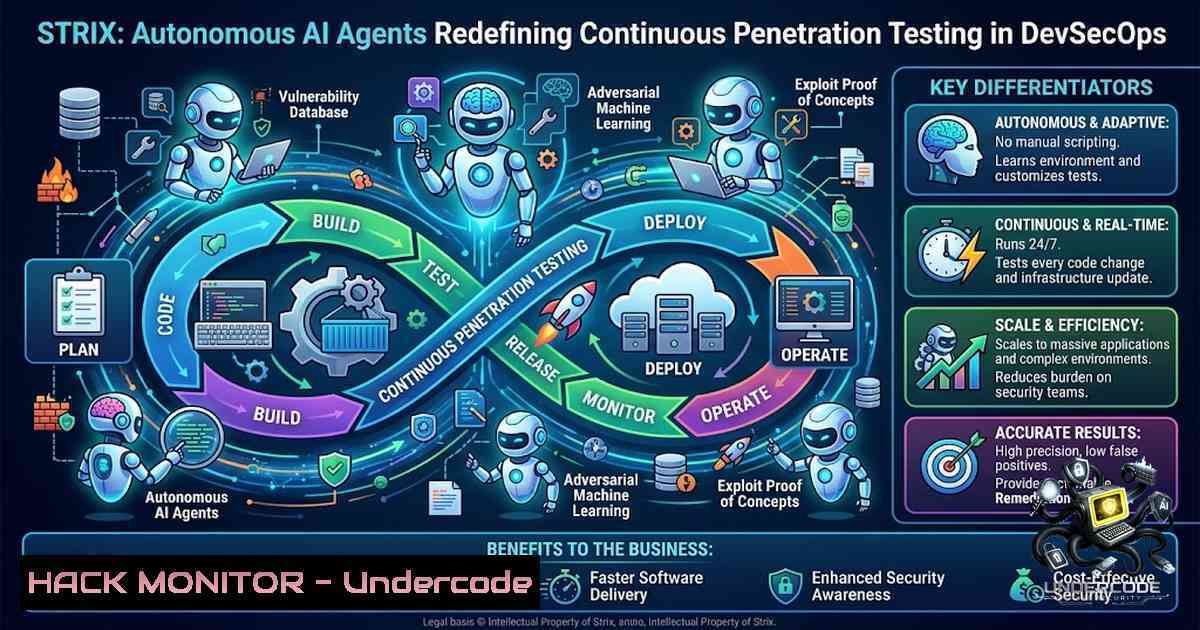
The integration of security testing into the software development lifecycle has long been a challenge, often lagging behind the speed of modern CI/CD pipelines. Traditional vulnerability scanners are notorious for generating excessive false positives, while manual penetration testing remains a costly, periodic exercise that struggles to keep pace with continuous deployment. Strix, an open-source framework of autonomous AI agents, addresses this gap by simulating the behavior of human hackers—dynamically running code, probing applications, and validating vulnerabilities through actual proof-of-concepts (PoCs). This approach moves beyond simple signature matching, offering a paradigm shift towards continuous, validated, and agentic security testing that can be seamlessly embedded into the developer workflow.
Learning Objectives & Secrets:
- Objective 1: Understand the Agentic Pentesting Paradigm. Grasp how Strix utilizes autonomous AI agents to perform the full penetration testing lifecycle—from reconnaissance and exploitation to validation and remediation—without human intervention. The secret is its multi-agent architecture, where specialized agents collaborate on different attack vectors, scaling testing efforts in parallel.
-
Objective 2 Secret Tip: Master PoC-Driven Validation to Eliminate False Positives. The key to Strix’s accuracy lies in its requirement to generate a working exploit for every finding. Instead of flagging potential issues, it proves they are exploitable. This validation step drastically reduces the noise of traditional scanners, allowing teams to focus on confirmed risks.
-
Objective 3 Secret Tip: Leverage CI/CD Integration for Shift-Left Security. Integrate Strix directly into GitHub Actions to automatically trigger security scans on every pull request. By blocking insecure code before it reaches production, security becomes a preventative measure rather than a reactive one, embodying a true DevSecOps culture.
You Should Know:
1. Installation and First Scan with Strix CLI
Strix is designed to be developer-friendly, with a straightforward CLI for quick setup. The following steps outline how to install and run your first security assessment.
- Prerequisites: Ensure Docker is installed and running on your system. You will also need an API key from a supported LLM provider like OpenAI.
- Installation: The simplest method is using the official installer script. Alternatively, you can install it via
pipx.Install via official script curl -sSL https://strix.ai/install | bash
Or install via pipx
pipx install strix-agent
-
Configuration: Set the environment variables for your LLM provider.
export STRIX_LLM="openai/gpt-5"
export LLM_API_KEY="your-api-key-here"
-
First Scan: Point Strix at your target. This can be a local directory, a GitHub repository, or a live web application.
Scan a local codebase (White-box)
strix --target ./app-directory
Scan a live web application (Black-box)
strix --target https://your-app.com
On the first run, Strix will automatically pull the necessary sandbox Docker image. The results are saved to a `strix_runs/` directory for later review.
2. Configuring Strix for API Security Testing
Modern applications are heavily API-driven. Strix excels in this area by ingesting API specifications to conduct systematic testing of every declared endpoint.
- Testing with OpenAPI/Swagger: You can provide an OpenAPI specification file directly. Strix will use it to understand the API’s attack surface.
strix --target ./openapi.yaml --target https://api.example.com
Pairing the spec with the base URL gives the agent a reachable host to attack.
-
Testing with Postman Collections: Strix can fetch and test Postman collections. This requires setting a `POSTMAN_API_KEY` environment variable.
export POSTMAN_API_KEY="your-postman-api-key"
strix --target postman://<collection-uuid>
You can also include a specific environment to resolve variables like
{{baseUrl}}.strix --target postman://<collection-uuid>?env=<environment-uid>
This approach ensures that Strix tests the full, intended functionality of your APIs, including edge cases defined in the specification, rather than just crawling for discovered endpoints.
3. Customizing Scans with Instructions
Strix allows for a high degree of customization through the `–instruction` flag, enabling you to guide the agents’ behavior for specific testing scenarios.
- Authenticated Testing: For grey-box testing, you can provide credentials to allow the agents to test authenticated endpoints and privilege escalation paths.
strix --target https://your-app.com --instruction "Perform authenticated testing using credentials: user:password"
-
Focus Areas: You can direct the agents to concentrate on particular types of vulnerabilities or specific parts of the application.
strix --target https://your-app.com --instruction "Focus on testing for business logic flaws and IDOR vulnerabilities in the /api/v2/ endpoints."
- Integrating Strix into CI/CD Pipelines with GitHub Actions
To operationalize continuous security, Strix can be integrated directly into your CI/CD pipeline. The project provides a ready-to-use GitHub Actions workflow. Here is a sample configuration:
name: Strix Security Scan
on:
pull_request:
branches: [ main ]

jobs:
strix-scan:
runs-on: ubuntu-latest
steps:
- uses: actions/checkout@v4
- name: Run Strix Security Assessment
uses: usestrix/strix-action@v1
with:
target: './'  Scan the entire repository
llm_provider: 'openai/gpt-5'
llm_api_key: ${{ secrets.OPENAI_API_KEY }}
When integrated, Strix triggers automatically on every pull request and merge to the main branch. The `-1` flag can be used to run Strix in a headless mode, making it suitable for CI/CD logs. This acts as a powerful guardrail, ensuring that vulnerabilities are caught and blocked before they can ever reach production.
5. Advanced Vulnerability Detection and Remediation
Strix’s capabilities extend far beyond basic scanning. Its agents are equipped with a comprehensive “hacker toolkit” that enables them to identify and exploit a wide range of vulnerabilities.
- Detection Capabilities: Strix can validate complex vulnerabilities including:
- Access Control: IDOR, privilege escalation, authentication bypass.
- Injection Attacks: SQL, NoSQL, and command injection.
- Server-Side: SSRF, XXE, and deserialization flaws.
- Business Logic: Race conditions and workflow manipulation.
-
Remediation: Strix doesn’t just find vulnerabilities; it helps fix them. For each validated finding, it can generate a merge-ready pull request with the proposed fix. Agents will then retest the application to confirm the vulnerability has been successfully remediated. This closes the loop from finding to fixing, accelerating the entire remediation process.
What Undercode Say:
-
Key Takeaway 1: Strix represents a fundamental shift from reactive, periodic security testing to proactive, continuous validation. By embedding autonomous AI agents into the development lifecycle, it transforms security from a bottleneck into an integrated, automated part of the CI/CD pipeline.
-
Key Takeaway 2: The emphasis on generating working Proofs-of-Concept is a game-changer. It directly addresses the industry-wide problem of alert fatigue caused by false positives, providing developers and security teams with actionable, verified intelligence on real, exploitable risks.
Prediction:
-
+1 The adoption of agentic AI for security testing will accelerate, moving beyond simple scanning to autonomous remediation. Tools like Strix will evolve to not only find and validate vulnerabilities but also to automatically deploy fixes, creating a self-healing security posture for applications.
-
-1 The reliance on LLMs introduces a new attack surface. Adversaries may develop techniques to poison the training data or craft inputs that cause the AI agents to miss vulnerabilities or generate incorrect, potentially harmful, remediation advice.
▶️ Related Video (88% Match):
https://www.youtube.com/watch?v=4ZafFotzDkY
🎯Let’s Practice For Free:
🎓 Live Courses & Certifications:
Join Undercode Academy for Verified Certifications
🚀 Request a Custom Project:
Secure, high-velocity infrastructure and disruptive technological engineering. Contact our engineering team for high-tier development and proprietary systems:
[email protected]
💎 Smart Architecture | 🛡️ Secure by Design | ⭐ Trusted by Thousands
IT/Security Reporter URL:
Reported By: https://lnkd.in/p/efzDwJ6N – Hackers Feeds
Extra Hub: Undercode MoN
Basic Verification: Pass ✅


