
Listen to this Post
Introduction:
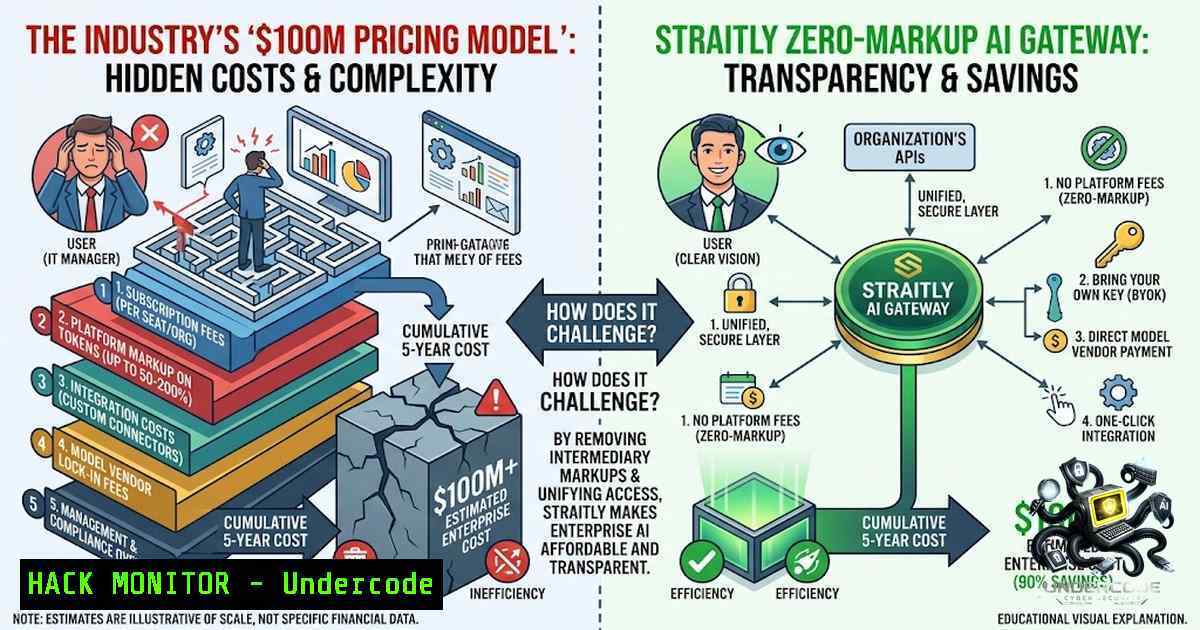
The AI gateway market—long dominated by platforms like OpenRouter that charge 5–5.5% markups on every token—is facing a disruptive challenger. Straitly has launched with a bold promise: zero markup on all token usage, 142+ models from 20+ providers, a single API key for unified access, and an intelligent re-routing system that claims a 99.98% success rate. This move directly threatens the revenue model that generated over $100 million in gross merchandise value for incumbents last year. For developers and enterprises, the question is no longer just about model selection—it’s about whether the gateway layer itself can survive as a margin business.
Learning Objectives & Secrets:
- Objective 1: Understand the AI Gateway Economics — Learn how traditional routers like OpenRouter monetize through 5–5.5% platform fees on credit purchases and BYOK management, and how zero-markup models like Straitly and Vercel AI Gateway fundamentally alter this equation.
-
Objective 2 Secret Tip: Leverage Intelligent Re-Routing for High Availability — Straitly’s 99.98% success rate isn’t just marketing; it’s achieved through dynamic provider failover. When one provider degrades, requests are automatically rerouted to another offering the same model—without any code changes on your side. This is the same architecture Vercel AI Gateway uses: automatic failover to the same model on a different provider, versus manual fallback arrays that many other gateways require.
-
Objective 3 Secret Tip: Optimize Multi-Provider Spend Without the Tax — With zero markup, the cost of using Straitly equals the provider’s list price. This allows you to implement sophisticated routing policies—cost-based, latency-based, or availability-based—without paying a percentage premium on every request. Combine this with BYOK (Bring Your Own Key) for providers where you already have commitments, and you eliminate gateway fees entirely while maintaining unified access.
You Should Know:
- The Anatomy of an AI Gateway: How Straitly and Its Competitors Work
AI gateways sit between your application and multiple AI model providers (OpenAI, Anthropic, Google, DeepSeek, etc.), exposing a single, OpenAI-compatible API endpoint. When your application sends a request, the gateway handles authentication to each provider, selects an endpoint based on rules you define (price, throughput, availability), translates between different provider schemas, and meters usage for billing.
The architecture typically consists of:
- Decision Layer: Who gets access, to which models, on whose keys, with what retention posture, and at what budget.
- Mechanics Layer: Provider integrations, schema unification, failover execution, observability, and cost metering.
Straitly’s intelligent re-routing adds a critical layer: real-time health checks and automatic failover, achieving that 99.98% success rate by instantly switching traffic when a provider becomes unreliable.
- API Key Configuration: Getting Started with a Unified Gateway
Setting up an AI gateway like Straitly typically requires just three steps:
Step 1: Generate Your Gateway API Key
Navigate to the gateway’s dashboard and create a new API key. For Vercel AI Gateway (a comparable zero-markup platform), this is done via the API Keys page in the dashboard.
Step 2: Configure Environment Variables
Add the key to your environment:
export AI_GATEWAY_API_KEY="your_api_key_here"
export AI_GATEWAY_BASE_URL="https://gateway.provider.com/v1"
For Azure AI Gateway, the pattern is similar:
export AI_GATEWAY_BASE_URL="https://<gateway>.azure-api.net/default/models/openai/v1"
export AI_GATEWAY_API_KEY="<gateway-key>"
Step 3: Point Your Client at the Gateway
The gateway exposes an OpenAI-compatible endpoint, so an existing OpenAI SDK client only needs a new base URL:
import openai
openai.api_base = "https://your-gateway.com/v1"
openai.api_key = os.environ["AI_GATEWAY_API_KEY"]
response = openai.ChatCompletion.create(
model="openai/gpt-4",  creator/model-1ame format
messages=[{"role": "user", "content": "Hello"}]
)
For Node.js with the AI SDK, the gateway reads `AI_GATEWAY_API_KEY` from the environment by default.
- Intelligent Routing and Failover: The 99.98% Success Rate Explained
Straitly’s claimed 99.98% success rate comes from a sophisticated routing engine that monitors provider health in real time. When a provider experiences latency spikes, returns errors, or hits rate limits, the gateway automatically reroutes to the next best available provider—often in under 14ms.
To configure routing policies, you typically define a `models` array with fallback order:
{
"model": "gpt-4",
"providerOptions": {
"gateway": {
"models": [
{ "id": "openai/gpt-4", "provider": "openai" },
{ "id": "azure/gpt-4", "provider": "azure" },
{ "id": "anthropic/claude-3-opus", "provider": "anthropic" }
]
}
}
}
The gateway tries each in sequence until one succeeds.
This approach—automatic failover to the same model on a different provider—is what Vercel AI Gateway uses and is considered superior to manual fallback arrays that may route to a different model entirely.
4. Cost Optimization: Zero Markup vs. Traditional Fees
Traditional AI gateways like OpenRouter charge a percentage fee: 5.5% on credit purchases and 5% on BYOK usage after free thresholds. With OpenRouter processing over 10 trillion tokens daily from 400+ models and 10 million+ users, that translates to substantial revenue.
Zero-markup models like Straitly and Vercel AI Gateway pass provider list prices through with no token markup. The business model shifts from taking a cut of every transaction to monetizing through value-added services: enterprise subscriptions, advanced observability, team seats, compliance features, and SLAs.
For a team spending $10,000/month on inference, a 5% markup means $500/month in gateway fees—$6,000/year. At scale, that’s $50,000–100,000/year just to route API calls. Zero-markup gateways eliminate this tax entirely.
5. Security and API Hardening for Gateway Deployments
When using an AI gateway, several security considerations apply:
- API Key Rotation: Regularly rotate gateway API keys and provider keys stored in the gateway. Most gateways support encrypted BYOK key storage.
-
Zero Data Retention (ZDR): Configure the gateway to enforce ZDR with providers, ensuring no training data leakage.
-
Budget Controls: Set per-project budget limits and spend caps to prevent runaway costs. Gateways typically implement Redis-based spend tracking with Lua scripts for real-time enforcement.
-
Audit Logging: Enable comprehensive logging for all requests—who accessed which model, at what cost, and with what response.
-
Network Security: For production deployments, place the gateway behind a WAF, use TLS 1.3, and implement IP allowlisting.
- Building Your Own Router vs. Using a Gateway
Building a model router from scratch means maintaining provider integrations, a unified request schema, failover logic, key management, cost metering, and a model catalog—estimated at 6 to 12 months of engineering work.
Using a gateway like Straitly, Vercel AI Gateway, or Cloudflare AI Gateway lets you focus on the decision layer (routing policy, keys, spend rules, retention) while the gateway handles the mechanics layer. The tradeoffs:
| Feature | Vercel AI Gateway | Cloudflare AI Gateway |
||-|-|
| Markup | 0% | 5% on credits |
| Failover | Automatic to same model | Manual fallback array |
| Free Tier | Unlimited logs | 100,000 logs cap |
| BYOK | 0% markup | 5% fee |
What Undercode Say:
- Key Takeaway 1: Straitly’s zero-markup model is not unique—Vercel AI Gateway already offers zero markup, and Helicone AI Gateway and OrcaRouter have followed suit. The real disruption is the acceleration of a trend: the gateway layer is commoditizing, and margin compression is inevitable.
-
Key Takeaway 2: The sustainability of zero-markup depends on whether gateways can monetize through enterprise features (observability, compliance, team management, SLAs) rather than transaction fees. If they can’t, this is a growth-hacking play to capture market share before raising prices—or being acquired.
Analysis: The AI gateway market is at an inflection point. OpenRouter’s reported $100M+ GMV and Stripe’s reported $8B+ acquisition interest show that the layer between applications and models has enormous strategic value. But zero-markup competitors are forcing a race to the bottom on pricing. The winners will be those who build deep observability, security, and governance features that enterprises are willing to pay for separately—not those who simply skim off token usage. For developers, this is excellent news: gateway fees are becoming an optional cost rather than an unavoidable tax. The long-term question is whether the gateway itself remains a distinct layer or gets absorbed into broader platforms (like Stripe’s payment infrastructure or Vercel’s deployment ecosystem).
Prediction:
- +1 Zero-markup will become the industry standard for AI gateways within 12–18 months, as competitive pressure forces every major player to eliminate token markups.
-
-1 Consolidation will accelerate: smaller gateways that cannot monetize through enterprise features will be acquired or shut down, reducing choice in the long run.
-
+1 Enterprises will benefit from lower costs and more transparent pricing, enabling broader AI adoption across more use cases.
-
-1 The gateway layer may become a loss-leader for larger platforms, potentially leading to vendor lock-in as gateways bundle with other infrastructure services (deployment, payments, observability).
-
+1 Intelligent routing and failover will become the primary differentiator, not price—leading to better reliability and performance for end users.
-
-1 If zero-markup proves unsustainable, the industry could see a backlash with sudden price hikes once market share is captured, similar to past “growth-hacking” plays in cloud services.
-
+1 The rise of native micro-payment protocols (like MPP and x402) could eventually eliminate the need for gateways entirely, as AI agents pay providers directly.
-
-1 Until then, the gateway remains a critical layer—and zero-markup is a disruptive but potentially fragile equilibrium.
🎯Let’s Practice For Free:
🎓 Live Courses & Certifications:
Join Undercode Academy for Verified Certifications
🚀 Request a Custom Project:
Secure, high-velocity infrastructure and disruptive technological engineering. Contact our engineering team for high-tier development and proprietary systems:
[email protected]
💎 Smart Architecture | 🛡️ Secure by Design | ⭐ Trusted by Thousands
IT/Security Reporter URL:
Reported By: https://lnkd.in/p/en3TrKgj – Hackers Feeds
Extra Hub: Undercode MoN
Basic Verification: Pass ✅


