
Listen to this Post
Introduction:
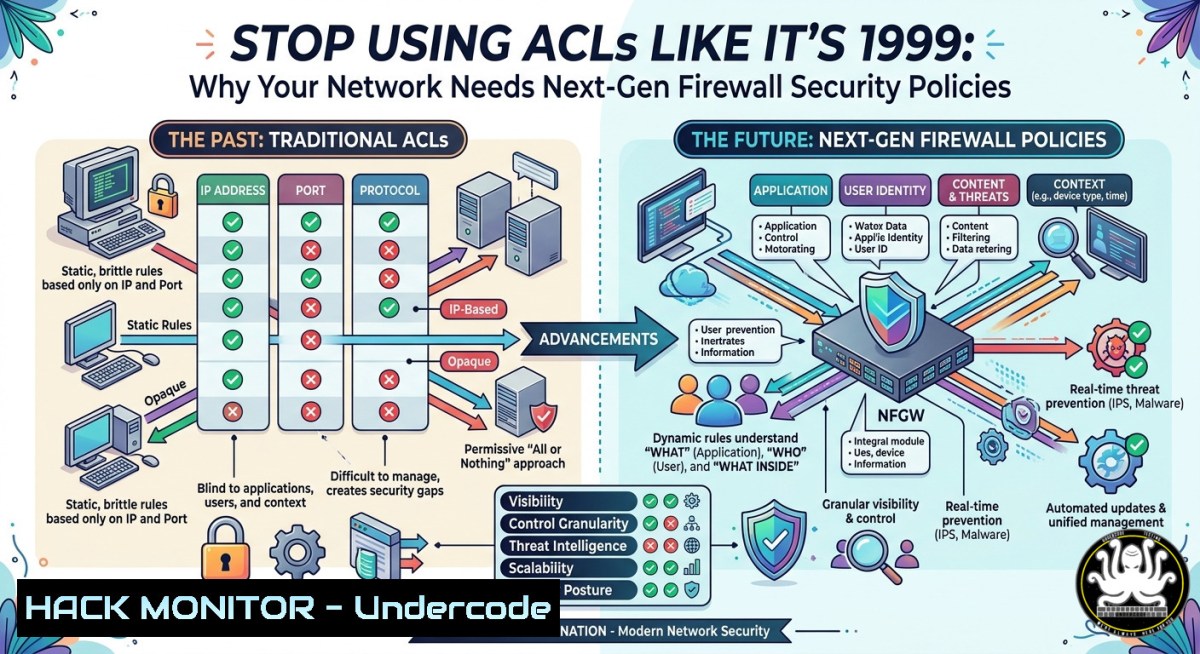
For decades, Access Control Lists (ACLs) have served as the trusty gatekeepers of network infrastructure, permitting or denying traffic based purely on IP addresses, ports, and protocols. However, in an era where threats are encrypted, applications disguise their traffic, and users roam across cloud and campus, these basic filters are no longer sufficient. Enterprises are now shifting to Next-Generation Firewall (NGFW) security policies that offer deep packet inspection, application identification, and user-based context, understanding not just the traffic, but the intent behind it.
Learning Objectives:
- Understand the Core Differences: Clearly distinguish between stateless ACL packet filtering and stateful, context-aware NGFW security policies.
- Master Next-Gen Security Controls: Learn to configure application-based policies, user identification, and advanced threat prevention on platforms like Palo Alto and Fortinet.
- Implement Layered Defenses: Discover how to blend traditional ACLs and modern firewall policies in hybrid environments, including cloud platforms like AWS.
You Should Know:
- Traditional ACLs: The Fast and Simple Traffic Filter
Access Control Lists are the workhorses of routers and switches, processing packets at wire speed without tracking connection states. Their main job is to perform basic filtering, allowing an administrator to permit or deny traffic using a small set of L3/L4 criteria.
A typical standard IP ACL, for example, can block a specific host (e.g., deny host 192.168.1.10), while an extended ACL offers more granular control. On a Cisco router, you can create an extended named ACL to block an entire department’s VLAN from reaching a specific server subnet: `ip access-list extended block-to-server` followed by `deny ip 10.10.10.0 0.0.0.255 host 192.168.1.100` to block the VLAN, and `permit ip any any` to allow all other traffic. These ACLs are stateless, meaning if you block incoming traffic on a port, you must remember to explicitly block the corresponding return traffic, as the router does not automatically associate request and reply packets.
- The Deployment Guide: Standard ACLs in Linux, Windows, and AWS
Understanding how ACLs are implemented across different platforms is key to modern security operations. Here are essential commands for implementing basic traffic filtering at the network layer.
- Linux (using the modern `nftables` framework): The `nftables` firewall is the successor to `iptables` and is the default on most modern distributions. It provides cleaner syntax for ACL-like rules. To set a default policy of `drop` on the `input` chain while allowing return traffic and SSH, you can use the following table: flush the ruleset; create an `inet filter` table; add an `input` chain; set the policy to
drop; then allow established and related connections, loopback traffic, and TCP dport 22, before finally adding a counter to log dropped packets. - Windows (PowerShell automation): Windows Defender Firewall with Advanced Security is the built-in ACL management tool. Instead of using the GUI, you can automate rule creation with PowerShell. To block a specific IP address from inbound traffic, you would use
New-NetFirewallRule -DisplayName "Block IP" -Direction Inbound -Action Block -RemoteAddress 198.51.100.23. This is far more scalable for enterprise environments. - AWS Cloud (Network ACLs): In AWS, stateless ACLs operate at the subnet level. If you need to block a malicious IP at the perimeter, you would open the VPC console, select your Network ACL, and add an inbound rule. A typical rule would deny all traffic from an IP range, for example `100` with Rule number
100, TypeAll Traffic, Source203.0.113.0/24, and ActionDENY.
3. NGFW Security Policies: “Understanding” the Traffic
A Next-Generation Firewall moves beyond simple ACLs by performing Deep Packet Inspection (DPI) and using application identification engines. Instead of just looking at the packet header, the firewall examines the payload to identify the specific application using behavioral analysis, even if it is hopping ports or using encryption.
For example, Palo Alto Networks uses App-ID™ technology and User-ID™ to enforce policies based on identity and application. A security policy can be written to allow a specific user group access to an application, regardless of the IP address they are using. The User-ID feature maps network activity to specific users by integrating directly with directory services like Active Directory, allowing rules to be written for “Sales_Team” rather than an IP range.
4. Platform-Specific NGFW Configuration: Palo Alto and Fortinet
Here is how you can implement these policies on leading enterprise platforms:
- Palo Alto Networks (PAN-OS): The most common mistake is creating an “Allow” policy without attached Security Profiles. The “Golden Rule” for a Palo Alto firewall is to always attach Antivirus, Vulnerability, and WildFire profiles to your allow rules. If you do not, you are using a high-end security device as a basic $50 router. Furthermore, you must ensure your rulebase uses “application-default” for the service, which forces the application to use its standard port, preventing a user from tunneling BitTorrent over port 443.
- Fortinet (FortiGate): To enforce application-specific controls, you must set the device to NGFW Policy-Based Mode to allow Application Control directly in the policy. The configuration involves using the CLI: `config system settings` then `set inspection-mode flow` and
set ngfw-mode policy-based. Once enabled, you can create a policy that explicitly blocks risky applications like “WhatsApp” while allowing “Zoom” for the Finance department.
- Layered Defense Strategies: API Security and Cloud Hardening
While NGFWs monitor east-west and north-south traffic, a modern security architecture also requires perimeter protection for web applications. WAF and API Security: For public-facing web applications and APIs, ACLs are insufficient to stop application-layer attacks. Amazon AWS WAF, for instance, sits at the application layer and inspects HTTP/HTTPS requests. A critical WAF ACL rule is rate limiting, which prevents an attacker from brute-forcing a login endpoint by blocking any IP address that attempts more than a set number of requests in a short window. WAF rules complement network ACLs by filtering SQL injection or cross-site scripting attempts before they ever reach the server.
What Undercode Say:
- Key Takeaway 1: Know Your Stack. ACLs are not dead; they are still the fastest, most efficient way to perform basic L3/L4 filtering on core infrastructure. Use ACLs for rough perimeter filtering and internal segmentation, but never rely on them for threat prevention.
- Key Takeaway 2: Context is King in Zero-Trust. In a modern network, especially with cloud and mobile workforces, an IP address is no longer a reliable indicator of trust. NGFWs provide the essential context of Who (User-ID), What (App-ID), and Content (Payload) needed to enforce a true zero-trust model.
-
Analysis: The fundamental shift from ACLs to Firewall Policies mirrors the evolution of cybersecurity itself. We have moved from a “block/allow” binary to a “detect/inspect/respond” model. While ACLs are cheap in CPU cycles, they are blind to modern threats like malware in SSL traffic or users using non-standard ports. The enterprise cannot afford “blind” filtering; it requires “sighted” inspection. Therefore, a layered defense where stateless ACLs block the obvious garbage and stateful NGFWs analyze the remaining traffic is the only sustainable path forward.
Prediction:
The role of the traditional ACL will not vanish, but it will be relegated to the data center core and hardware switching layers, where speed is the primary concern. Meanwhile, the “Security Policy” will evolve into a unified, AI-driven SASE (Secure Access Service Edge) construct. We will see the convergence of NGFW, SWG (Secure Web Gateway), and ZTNA (Zero Trust Network Access) into a single cloud-managed policy. In the next 2-3 years, manual rule creation will be augmented by predictive AI that analyzes traffic patterns to automatically suggest policy groupings and identify shadow IT, forcing network engineers to become data scientists as much as command-line experts.
Telegram Channel for more: https://lnkd.in/dk_ev_gb
▶️ Related Video (76% Match):
🎯Let’s Practice For Free:
IT/Security Reporter URL:
Reported By: Mohamed Abdelgadr – Hackers Feeds
Extra Hub: Undercode MoN
Basic Verification: Pass ✅


