Listen to this Post
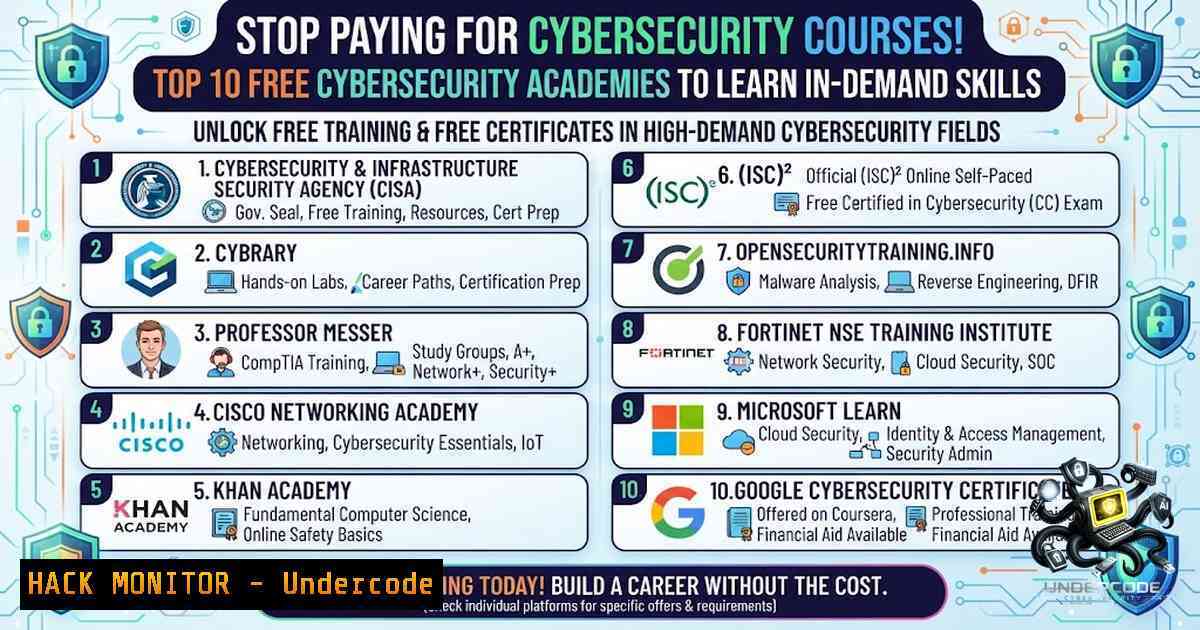
Introduction:
The cybersecurity industry faces a critical talent shortage, with an estimated workforce gap of over 4 million professionals globally. This shortage has created unprecedented opportunities for career changers and IT professionals alike—yet the cost of traditional training often creates a significant barrier to entry. Leading technology companies and cybersecurity organizations have responded by offering completely free, high-quality training programs that rival paid alternatives. Several of these academies also provide industry-recognized certificates and digital badges, allowing learners to build verifiable credentials without spending thousands of dollars on bootcamps or degree programs. This article explores the top 10 free cybersecurity academies and provides a structured learning path to help you build a strong foundation in cybersecurity while earning valuable certifications.
Learning Objectives:
- Identify and evaluate the top free cybersecurity training platforms across different specialization areas
- Understand the certification and badging opportunities available through each academy
- Build a structured learning path from foundational concepts to hands-on practical skills
- Implement practical cybersecurity techniques using Linux and Windows command-line tools
- Develop a strategic approach to career development in cybersecurity without financial barriers
- Cisco Networking Academy – Building Foundational Network Security Skills
Cisco Networking Academy offers industry-recognized training with free digital badges and certificates for eligible courses. The platform features a comprehensive “Introduction to Cybersecurity” course covering threat landscapes, defensive strategies, and career pathways. For those seeking deeper expertise, the CCST Cybersecurity certification pathway includes six free courses totaling approximately 120 hours of self-paced learning.
Step-by-Step Guide to Getting Started:
- Navigate to www.netacad.com and create a free account
- Browse the “Courses” section and filter by “Free” courses
- Enroll in “Introduction to Cybersecurity” to earn your first digital badge
- Progress through the CCST Cybersecurity pathway—complete all six courses and pass the free pathway exam
- Schedule and sit the CCST Cybersecurity certification exam independently to earn the full credential
Practical Commands for Network Security Assessment:
 Linux - Scan for open ports and services
nmap -sV -p- 192.168.1.0/24

Linux - Capture network traffic for analysis
tcpdump -i eth0 -w capture.pcap

Windows - Display active network connections
netstat -ano | findstr ESTABLISHED

Windows - Test network connectivity and trace route
tracert 8.8.8.8
- Fortinet Training Institute – Security Fundamentals and NSE Certification
Fortinet provides complete self-paced cybersecurity training at no cost through its Training Institute. The curriculum covers everything from cybersecurity basics and threat landscapes to security-driven networking, adaptive cloud security, and zero-trust network access. Certificates of completion are issued to learners who finish the training. The NSE Certification program includes over 30 security courses across five proficiency levels.
Step-by-Step Guide:
- Visit the Fortinet Training Institute at www.fortinet.com/training
- Enroll in the no-cost, self-paced curriculum covering fundamentals to advanced topics
- Complete individual courses to earn Certificates of Completion
- Progress through the NSE Certification levels from Foundation to Architect
- Leverage the Security Awareness and Training service for organizational security culture building
3. IBM SkillsBuild – Cybersecurity and AI Integration
IBM SkillsBuild offers over 1,000 free courses spanning cybersecurity, AI, data science, and cloud computing. The Cybersecurity Fundamentals learning path provides practical skills including security posture evaluation, vulnerability assessment, network architecture, cloud infrastructure security, and incident reporting. Upon completion, learners earn industry-recognized IBM digital credentials via Credly.
Step-by-Step Guide:
- Register at skillsbuild.org for free access
- Select the Cybersecurity learning path from the course catalog
- Complete required courses to earn the Cybersecurity Fundamentals digital credential
- Explore additional learning paths in AI and cloud security for specialization
-
Microsoft Learn – Cloud Security and Identity Management
Microsoft Learn provides free learning paths and achievement badges covering Azure security, identity and access management, compliance, and data protection. The platform offers structured training for Microsoft certifications including Azure Administrator (AZ-104) and Azure Security Technologies (AZ-500).
Step-by-Step Guide for Azure Security:
- Access learn.microsoft.com and create a free profile
- Navigate to the Security learning path under Azure
- Complete foundational modules covering Azure architectural components and core services
- Progress to associate-level training for Azure Security Technologies
5. Earn achievement badges for completed learning paths
Azure CLI Security Commands:
 List all Azure resources with their security configurations
az resource list --query "[].{name:name, type:type, location:location}" -o table

Check Azure AD security defaults
az ad security-defaults show

Enable Defender for Cloud on a subscription
az security auto-provisioning-setting update --1ame default --auto-provision On
5. TryHackMe – Hands-On Ethical Hacking Practice
TryHackMe offers over 350 free rooms and hands-on labs for ethical hacking practice. The platform covers Linux, web exploitation, digital forensics, and Active Directory enumeration. Free rooms are categorized by learning path and difficulty level, making it accessible for absolute beginners.
Step-by-Step Guide:
- Register for a free account at tryhackme.com
2. Start with beginner-friendly rooms covering Linux fundamentals
3. Progress through categorized learning paths
4. Practice CTF challenges and complete walkthroughs
- Explore the VulnNet series for Active Directory exploitation practice
Linux Commands for CTF Practice:
 Enumerate system information
uname -a && cat /etc/os-release

Find SUID binaries for privilege escalation
find / -perm -4000 -type f 2>/dev/null

Scan for open ports
nmap -sC -sV localhost

Check for running services
systemctl list-units --type=service --state=running
6. Google Cybersecurity – Career-Focused Learning
Google’s Cybersecurity Certificate program, available through Grow with Google, covers eight courses designed to prepare learners for cybersecurity analyst positions. Topics include cybersecurity fundamentals, risk and threat management, network and data protection, and incident response.
Step-by-Step Guide:
- Access grow.google and explore the cybersecurity offerings
2. Enroll in the Cybersecurity Professional Certificate program
- Complete the eight hands-on courses designed around real-world blue-team operations
- Develop job-ready skills without requiring prior cybersecurity experience
5. Leverage the certificate for entry-level cybersecurity positions
7. OpenLearn (The Open University) – University-Level Learning
OpenLearn provides free university-level courses with Statements of Participation available for most courses. “Introduction to Cyber Security: Stay Safe Online” covers threat landscapes, malware, network security, and identity theft.
Step-by-Step Guide:
- Visit www.open.edu/openlearn
2. Browse the cybersecurity course catalog
- Enroll in “Introduction to cyber security” for foundational knowledge
- Complete courses to earn free digital badges or Statements of Participation
- Progress to intermediate courses like “Information Security” for deeper understanding
-
Palo Alto Networks – Beacon – SOC and Cloud Security
Palo Alto Networks Beacon offers SOC Analyst training and cloud security courses with selected free courses and digital badges.
Step-by-Step Guide:
- Access the Beacon platform at www.paloaltonetworks.com/beacon
2. Explore available SOC Analyst training modules
- Enroll in cloud security courses for defensive operations
- Complete selected free courses to earn digital badges
9. OWASP – Web Application and API Security
OWASP provides completely free learning resources for web application and API security. Resources include the OWASP Top 10, security testing guides, and project documentation.
Step-by-Step Guide:
- Visit owasp.org
- Access the OWASP Top 10 for web application security risks
- Explore the API Security Top 10 for API-specific vulnerabilities
4. Review security testing guides and best practices
- Contribute to or utilize OWASP projects for hands-on practice
API Security Testing Commands:
 Test API endpoint for authentication bypass using curl
curl -X GET https://api.example.com/v1/users -H "Authorization: Bearer invalid_token"

Fuzz API parameters for injection vulnerabilities
ffuf -u https://api.example.com/v1/search?q=FUZZ -w /usr/share/wordlists/common.txt

Test for rate limiting
for i in {1..100}; do curl -s -o /dev/null -w "%{http_code}\n" https://api.example.com/v1/data; done
10. ISC2 – Entry-Level Cybersecurity Certification
ISC2 offers free training opportunities for the Certified in Cybersecurity (CC) certification during selected programs and promotions.
Step-by-Step Guide:
- Visit www.isc2.org
2. Check for current free training promotions
- Enroll in the Certified in Cybersecurity training program when available
- Prepare for the CC certification exam using free resources
💡 Recommended Learning Path
For beginners serious about building a cybersecurity career, follow this structured roadmap:
- Start with Cisco Networking Academy – Build foundational network security knowledge and earn your first digital badge
- Progress to Fortinet Training Institute – Develop comprehensive security fundamentals across multiple domains
- Add IBM SkillsBuild – Integrate AI and cloud security perspectives into your skillset
- Master cloud security with Microsoft Learn – Specialize in Azure security and identity management
- Apply your skills with TryHackMe – Gain hands-on practical experience through ethical hacking labs
What Undercode Say:
- Free certifications from industry leaders carry real weight – Cisco, Fortinet, IBM, and Microsoft all provide verifiable digital badges that employers recognize. These credentials demonstrate commitment and foundational knowledge without the financial barrier of paid certifications.
-
Hands-on practice is non-1egotiable – Theory alone won’t prepare you for cybersecurity roles. Platforms like TryHackMe provide the practical experience that employers demand. Combine theoretical learning from academies with regular CTF practice to build genuine competence.
-
The learning path matters more than the platform – Following a structured progression from fundamentals to specialized topics accelerates skill development. Start broad, then specialize based on your career interests—whether that’s cloud security, SOC analysis, or application security.
-
Document your learning journey – Each certificate and badge you earn should be showcased on your LinkedIn profile and CV. This builds a verifiable track record that demonstrates continuous learning and professional development.
-
Community engagement accelerates growth – Participate in forums, contribute to OWASP projects, and connect with peers on LinkedIn. The cybersecurity community is remarkably supportive of newcomers who show genuine initiative.
Prediction:
-
+1 The democratization of cybersecurity education through free academies will significantly reduce the skills gap over the next 3-5 years. As more professionals enter the field without financial barriers, organizations will benefit from a more diverse talent pool with varied perspectives on security challenges.
-
+1 The rise of AI-integrated security training (as seen with IBM SkillsBuild) will produce a new generation of security professionals who understand both traditional security principles and AI-driven defense mechanisms—a critical combination for future threat landscapes.
-
-1 The abundance of free certificates may lead to credential inflation, where employers place less value on entry-level certifications and demand more practical experience. Candidates will need to supplement certificates with demonstrable hands-on skills through platforms like TryHackMe.
-
-1 Without proper guidance, self-paced learners risk developing gaps in their knowledge or pursuing unstructured learning paths. The recommended learning path addresses this, but many learners may still struggle with direction.
-
+1 The NIST-aligned training from Fortinet and Cisco’s industry-recognized pathways will continue to gain relevance as organizations prioritize compliance with established security frameworks, making these free certifications increasingly valuable for career advancement.
▶️ Related Video (70% Match):
https://www.youtube.com/watch?v=20W7BML1JRI
🎯Let’s Practice For Free:
🎓 Live Courses & Certifications:
Join Undercode Academy for Verified Certifications
🚀 Request a Custom Project:
Secure, high-velocity infrastructure and disruptive technological engineering. Contact our engineering team for high-tier development and proprietary systems:
[email protected]
💎 Smart Architecture | 🛡️ Secure by Design | ⭐ Trusted by Thousands
IT/Security Reporter URL:
Reported By: Khaliqr Cybersecurity – Hackers Feeds
Extra Hub: Undercode MoN
Basic Verification: Pass ✅


