Listen to this Post
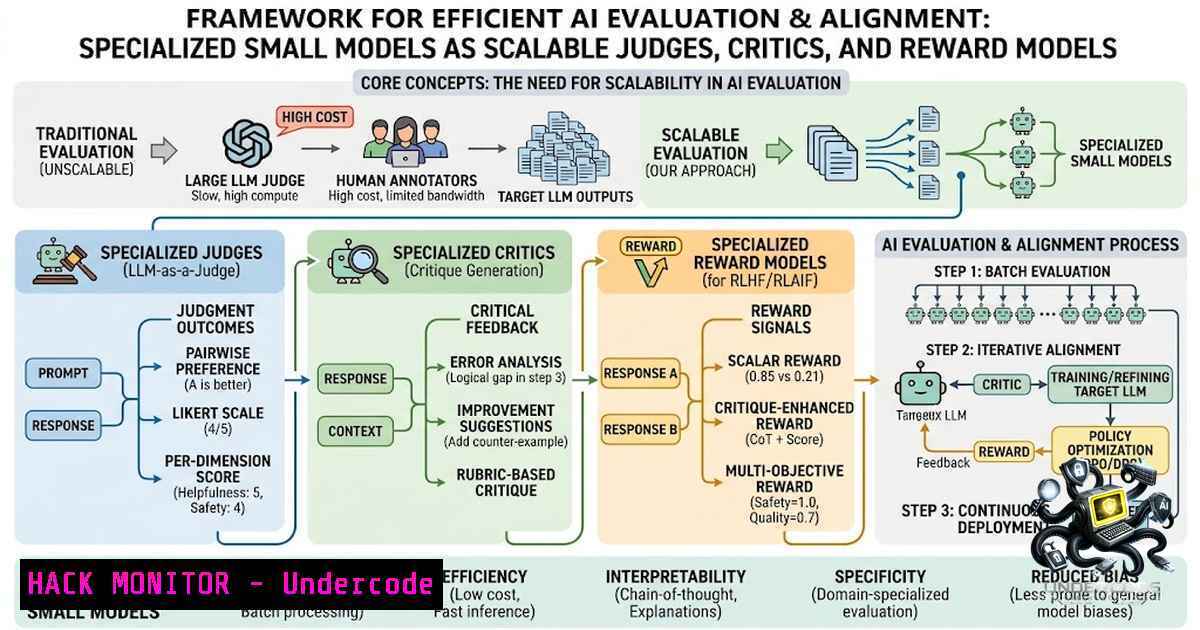
Introduction:
The rapid adoption of large language models (LLMs) as automated evaluators, critics, and reward models has created severe scalability, cost, and reproducibility bottlenecks. A growing body of research proposes that domain-specialized small language models (SLMs) with 0.4B to 14B parameters can replace massive general-purpose LLMs for many evaluation tasks. This report provides a rigorous, critical synthesis of the evidence, examining frameworks including SLMJury, TinyRM, JudgeLM, PHUDGE, JUDGE-BENCH, Self-Play Critic, and DeepMind Debate Training. The findings reveal that specialized SLMs are promising for narrow, high-volume, verifiable tasks—such as binary mathematical correctness or safety-preference filtering—where they can match or exceed large models at a fraction of inference cost. However, claims of a universal “paradigm shift” are premature, as current evidence is undermined by reliance on model–model agreement rather than human ground truth, benchmark contamination, unfair comparisons, and unquantified out-of-distribution fragility. The conclusion is conditional: specialized SLMs are a valuable complement, not a wholesale replacement, for large generalist judges.
Learning Objectives & Secrets:
- Objective 1: Understand the Scalability Crisis in Model-Based Evaluation. Traditional lexical metrics like BLEU and ROUGE measure surface overlap and fail on open-ended, semantically complex outputs. The LLM-as-a-Judge (LaaJ) paradigm using proprietary models like GPT‑4, Claude, and Gemini introduces three structural bottlenecks: prohibitive API costs (in RLHF/RLAIF, the evaluator is called at least as often as the generator), latency constraints that stall iterative training loops, and opacity with silent version changes that make longitudinal studies unscientific. Secret tip: When designing evaluation pipelines, always calculate total cost of ownership (TCO) using the formula C = N(αB_in + βB_out), where N is the number of evaluations, α and β are per-token prices, and B_in/B_out are token budgets.
-
Objective 2: Master the Small Model Hypothesis and Its Limitations. The specialized small model hypothesis states that a domain-specialized SLM—fine-tuned on task-relevant data with appropriate loss functions and architectural adaptations—can serve as a more cost-effective, deterministic, and sufficiently accurate judge for specific evaluation tasks than a large general-purpose model. Secret tip: The hypothesis does not claim that small models are universally better—it claims that evaluative capability is compressible for a defined class of tasks. Always validate SLM judges against human ground truth, not just agreement with GPT‑4, as matching a biased oracle does not guarantee human alignment.
-
Objective 3: Deploy SLM Judges with Controlled Comparison Protocols. SLMJury benchmarks 16 SLM judges (0.6B-14B parameters) from four model families across ten benchmarks, spanning closed-ended tasks (mathematical, scientific, and general reasoning) and open-ended scoring (SummEval and MT-Bench). Secret tip: The “overthinking effect” is domain-dependent—for most judges, quick 10-token verdicts match or beat extended reasoning on mathematical judging (by 2-7%), while reasoning wins on general tasks by up to 23%. Use temperature zero for deterministic, reproducible outputs, and always test out-of-distribution generalization before production deployment.
You Should Know:
- SLMJury Framework: Evaluating Small Language Models as Judges
SLMJury is a comprehensive framework that investigates whether Small Language Models (0.6B-14B parameters) can serve as reliable judges across both closed-ended (accuracy-based) and open-ended (correlation-based) evaluation paradigms. The project explores six evaluation modes: individual judging, persona-based evaluation, majority-vote ensembles, multi-agent debate, human agreement scoring (SummEval), and LLM agreement scoring (MT-Bench).
Step-by-step guide to using SLMJury:
- Installation: Install from PyPI with
pip install slmjury. For GPU inference with vLLM, usepip install slmjury[bash]. For Together API for oracle scoring, usepip install slmjury[bash]. For everything, usepip install slmjury[bash]. -
From Source (Development): Clone the repository with `git clone https://github.com/anishh15/SLMJury.git`, navigate to the directory with `cd SLMJury
, and install withpip install -e .`. -
CLI Scripts – Step 1: Run student model inference – `python scripts/run_student.py –model qwen2.5-32b –datasets gsm8k math`
- CLI Scripts – Step 2: Run judge evaluations – `python scripts/run_judge.py –judge qwen3-4b –max-tokens 10 8192`
- CLI Scripts – Step 3: Evaluate all judgements and generate summaries – `python scripts/run_evaluation.py`
- Python API: Import the core modules –
from slmjury.core.solver import StudentSolver,from slmjury.core.judge import JudgeModel,from slmjury.core.evaluator import JudgeEvaluator. Solve problems withsolver = StudentSolver("qwen2.5-32b"), runresults = solver.solve_batch(problems, "gsm8k"), and save withsolver.save_results(results, "gsm8k"). Judge solutions withjudge = JudgeModel("qwen3-4b"), runjudgements = judge.evaluate_batch(results, max_tokens=10), and save withjudge.save_results(judgements, "qwen2.5-32b", "gsm8k", 10). Evaluate accuracy with `evaluator = JudgeEvaluator(“qwen3-4b”, “qwen2.5-32b”, “gsm8k”, 10, judgements)` andsummary = evaluator.evaluate().
The SLMJury leaderboard is available at https://anishh15.github.io/SLMJury/ and the paper at arXiv:2606.07810. Four key findings emerge: (1) the overthinking effect is domain-dependent; (2) domain generalization separates model families, with math-to-general accuracy gaps ranging from under 10% to nearly 40%; (3) closed-ended and open-ended judging draw on different capabilities—the best binary judge (Phi-4) drops to rank 9 on MT-Bench; (4) under the Reflect-Critique-Refine (RCR) debate protocol, multi-agent debate degrades accuracy across all tested configurations.
2. TinyRM: Lightweight Bidirectional Reward Models
TinyRM is a family of small, bidirectional masked language models (MLMs) with as few as 400 million parameters that rival the capabilities of models over 175 times larger on reasoning and safety preference modeling tasks. TinyRM combines FLAN-style prompting, Directional Low-Rank Adaptation (DoRA), and layer freezing to achieve strong performance on RewardBench despite using significantly fewer resources.
Step-by-step guide to understanding TinyRM’s architecture:
- Model Architecture: TinyRM uses bidirectional masked language models (MLMs) rather than decoder-only architectures, enabling more efficient preference modeling.
-
Fine-tuning Strategy: Apply FLAN-style prompting for instruction following, Directional Low-Rank Adaptation (DoRA) for parameter-efficient fine-tuning, and layer freezing to reduce computational requirements.
-
Performance: Experiments suggest that small models benefit from domain-specific tuning strategies, particularly in reasoning, where lightweight finetuning methods are especially effective. TinyRM achieves strong performance on RewardBench while using significantly fewer resources than larger models.
-
Limitations: Challenges remain in building generalist models and conversational preference modeling. However, preliminary results highlight the promise of lightweight bidirectional architectures as efficient, scalable alternatives for preference modeling.
3. JudgeLM: Fine-tuned LLMs as Scalable Judges
JudgeLM fine-tunes LLMs as scalable judges to evaluate LLMs efficiently and effectively in open-ended benchmarks. The approach includes a comprehensive, large-scale, high-quality dataset containing task seeds, LLMs-generated answers, and GPT-4-generated judgments for fine-tuning high-performance judges, as well as a new benchmark for evaluating the judges. JudgeLM is trained at different scales from 7B, 13B, to 33B parameters.
Key biases and mitigation techniques:
- Position Bias: Addressed through swap augmentation—exchanging the order of candidate answers during training.
-
Knowledge Bias: Mitigated with reference support—providing reference answers to ground the judge’s evaluation.
-
Format Bias: Reduced with reference drop—randomly dropping reference information to prevent over-reliance on format.
JudgeLM achieves state-of-the-art judge performance on both the existing PandaLM benchmark and the proposed new benchmark. JudgeLM-7B only needs 3 minutes to judge 5K samples with 8 A100 GPUs. JudgeLM obtains high agreement with the teacher judge, achieving an agreement exceeding 90% that even surpasses human-to-human agreement.
4. PHUDGE: Phi-3 as Scalable Judge
PHUDGE is a robust production-grade and scalable SOTA model for relative and absolute grading of LLM (as well as human) responses. Given a question and its response, it can judge the quality of response from a scale of 1-5. It is trained to be used in absolute settings (1 Question – 1 Answer) but can be used for relative tasks too.
Step-by-step guide to using PHUDGE:
- Installation: Install libraries using `sh ./scripts/create_conda_env.sh` or install them one by one using the versions from the file. Note: For transformers, use the dev version as of 12/05/2024. This code works perfectly with Python 3.10 + A10 GPU.
-
Configuration: Change the configuration in `/scripts/accelerate_default_config.yaml` based on your system and save it to
~/.cache/huggingface/accelerate/default_config.yaml. For example, if you have 8 GPUs, change `num_processes` from 4 to 8. -
Training: Go to respective `classif, causal, reg` directories and create data using the steps given there. Each training file type along with their commands is given in the
/scripts. For example, to train a regression model without augmentation, useaccelerate launch ./train_phi-3-reg_classif.py --deepspeed "auto". -
Inference: Load the model, attach LoRA, and predict. A Kaggle notebook is available at https://www.kaggle.com/deshwalmahesh/phudge-inference.
PHUDGE is currently SOTA in 4 benchmarks despite being 10x smaller than Prometheus-2 and being trained on one third of the data. It is second best for JudgeLM and better than PandaLM in zero-shot settings.
5. JUDGE-BENCH: A Benchmark for Evaluating LLM-Based Judges
JUDGE-BENCH is an extensible collection of 20 NLP datasets with human annotations covering a broad range of evaluated properties and types of data. It comprehensively evaluates 11 current LLMs, covering both open-weight and proprietary models, for their ability to replicate the annotations. Evaluations show substantial variance across models and datasets. Models are reliable evaluators on some tasks, but overall display substantial variability depending on the property being evaluated, the expertise level of the human judges, and whether the language is human or model-generated. The conclusion: LLMs should be carefully validated against human judgments before being used as evaluators.
6. Self-Play Critic and Debate Training
Self-Play Critic (SPC) is a novel approach where a critic model evolves its ability to assess reasoning steps through adversarial self-play games. Think of it like having an internal debate team—one side makes arguments while the other side pokes holes in the logic. Through many rounds of debate, both sides learn to make stronger arguments and spot subtle flaws. DeepMind’s debate training tests the robustness of debate as a method of scalable oversight by training models to debate with data generated via self-play. Reward hacking is reduced by debate training, but only about 45% of the performance gap is recovered—the majority remains exploitable.
7. Total Cost of Ownership (TCO) Model
For a proprietary judge processing N solutions at token budget B, the total evaluation cost scales as C_total = N · (αB_in + βB), where α and β are per-token input/output prices and B_in is the prompt length. At evaluation scale (N > 10⁴), this cost becomes a bottleneck for workflows like RLHF and constitutional AI. Beyond cost, the proprietary paradigm introduces privacy risks (inputs leave the local network), result opacity (model versions change silently), and latency. SLMs only break even for high-volume, stable, narrow-domain tasks. For low-volume or rapidly changing evaluations, large APIs can be cheaper and far more flexible.
What Undercode Say:
- Key Takeaway 1: Specialized SLMs are a valuable complement, not a wholesale replacement. The evidence from SLMJury, TinyRM, JudgeLM, PHUDGE, JUDGE-BENCH, Self-Play Critic, and DeepMind Debate Training shows that small specialized judges are ready for deployment in carefully scoped, verifiable tasks—like binary mathematical correctness or safety preference filtering. For open-ended, safety-critical, or shifting evaluation, human oversight and large-model fallback remain essential. Organizations should adopt a hybrid approach: deploy SLM judges for high-volume, stable tasks while maintaining LLM fallbacks for complex or out-of-distribution scenarios.
-
Key Takeaway 2: Benchmark contamination and unfair comparisons are widespread. A fine-tuned 7B model beating zero-shot GPT‑4 is not a controlled result. Many studies rely on agreement with GPT‑4 rather than human ground truth—matching a biased oracle does not guarantee human alignment. The field needs a multi-level validation hierarchy (from objective ground truth to model-model agreement), a controlled comparison protocol, and rigorous out-of-distribution testing. Researchers and practitioners must demand human validation before deploying any automated judge in production.
Analysis: The trend toward specialized SLM judges represents a maturing of the AI evaluation field—moving from “anything goes” to engineering discipline. The evidence is clear: small models can be remarkably effective for narrow, high-volume tasks, but the hype around a universal paradigm shift is premature. The key insight from the synthesized research is that evaluative capability is compressible for defined classes of tasks, but not universally. Organizations must carefully scope their evaluation needs, calculate total cost of ownership, validate against human ground truth, and maintain fallback mechanisms. The frameworks reviewed—SLMJury, TinyRM, JudgeLM, PHUDGE—provide the tools, but human judgment remains the gold standard. The research agenda moving forward should focus on out-of-distribution robustness, multi-level validation, and controlled comparison protocols. The future is not SLM or LLM judges—it’s both, deployed intelligently based on task requirements, volume, and criticality.
Prediction:
- +1 Specialized SLM judges will become standard in production pipelines for high-volume, verifiable evaluation tasks (e.g., automated grading, content moderation, binary correctness checks) within 12-18 months, driven by orders-of-magnitude cost savings and deterministic behavior at temperature zero.
-
+1 Open-source frameworks like SLMJury, PHUDGE, and TinyRM will accelerate adoption by providing standardized benchmarks, leaderboards, and production-ready code, democratizing access to efficient AI evaluation.
-
-1 Benchmark contamination will remain a critical issue, with fine-tuned SLMs continuing to be compared unfairly against zero-shot LLMs, leading to overhyped claims and misguided deployment decisions.
-
-1 Out-of-distribution fragility will cause production failures when SLM judges encounter tasks outside their narrow training domains, potentially leading to safety incidents in safety-critical applications.
-
-1 The total cost of ownership will be consistently underestimated, with organizations failing to account for fine-tuning costs, maintenance, and human oversight, leading to budget overruns and project cancellations.
-
+1 Hybrid architectures—combining SLM judges for initial screening with LLM fallbacks for ambiguous cases—will emerge as the dominant production pattern, balancing cost, speed, and accuracy.
-
+1 Research on out-of-distribution robustness, multi-level validation hierarchies, and controlled comparison protocols will mature, transforming AI evaluation from anecdote to engineering discipline.
-
-1 Reward hacking will remain a significant challenge, with debate training recovering only about 45% of the performance gap—the majority remains exploitable, limiting the reliability of SLM-based reward models in RLHF pipelines.
-
+1 The growing body of evidence and frameworks will lead to industry standards and best practices for deploying SLM judges, reducing the risk of failures and increasing trust in automated evaluation.
-
+1 Small, open-weight evaluators will increasingly replace proprietary models for many evaluation tasks, addressing privacy concerns, reproducibility issues, and vendor lock-in, while fostering innovation in the open-source community.
▶️ Related Video (66% Match):
https://www.youtube.com/watch?v=a3SMraZWNNs
🎯Let’s Practice For Free:
🎓 Live Courses & Certifications:
Join Undercode Academy for Verified Certifications
🚀 Request a Custom Project:
Secure, high-velocity infrastructure and disruptive technological engineering. Contact our engineering team for high-tier development and proprietary systems:
[email protected]
💎 Smart Architecture | 🛡️ Secure by Design | ⭐ Trusted by Thousands
IT/Security Reporter URL:
Reported By: https://lnkd.in/p/eFnCuuz9 – Hackers Feeds
Extra Hub: Undercode MoN
Basic Verification: Pass ✅


