Listen to this Post
Introduction:
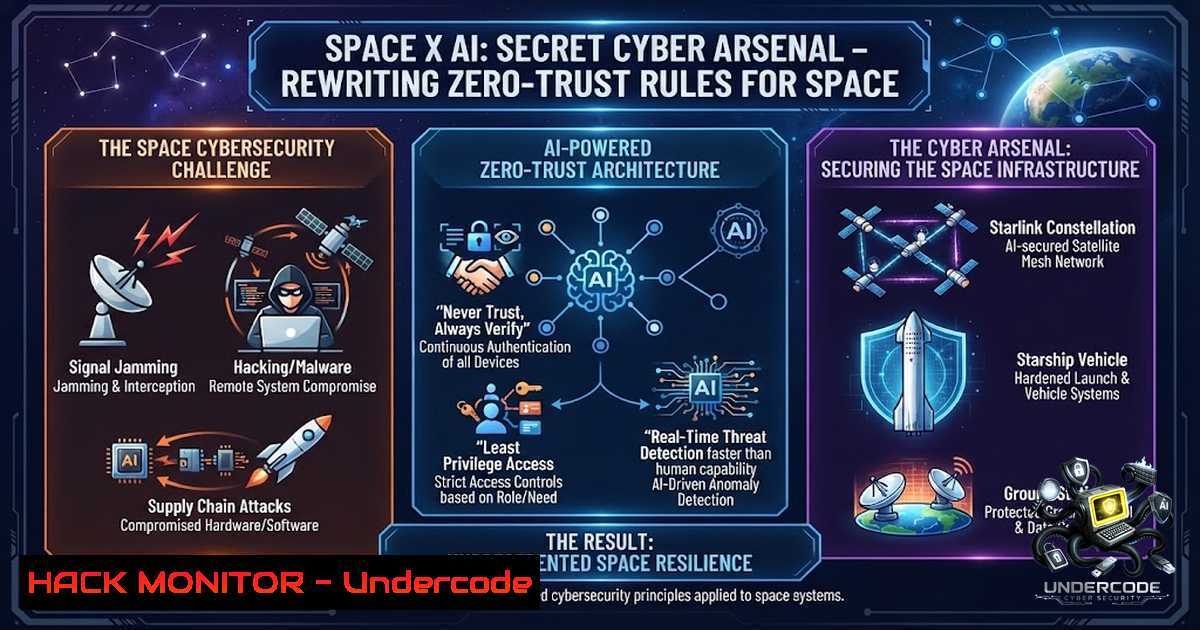
The intersection of commercial spaceflight and artificial intelligence represents one of the most formidable cybersecurity frontiers of the 21st century. When a leading cybersecurity and compliance leader joins SpaceXAI—the newly formed AI division of Elon Musk’s aerospace juggernaut—it signals a monumental shift in how the industry approaches threat modeling, zero-trust architecture, and resilient system design for missions that literally cannot fail. This article dissects the technical scaffolding behind space-grade AI security, from cryptographic agility to adversarial machine learning defense, and provides actionable blueprints for security practitioners aiming to operate at this altitude.
Learning Objectives:
- Master the implementation of FIPS 140-3 validated cryptographic modules within embedded AI inference pipelines for space-bound systems.
- Develop proficiency in securing MLOps pipelines against supply chain attacks, including model poisoning and data drift exploitation.
- Architect zero-trust network segmentation for hybrid cloud-edge deployments using service mesh and eBPF-based observability.
You Should Know:
- Securing the AI Supply Chain: From Terrestrial Repositories to Orbital Deployment
The most insidious threat to space-based AI isn’t a direct cyberattack—it’s the slow, silent compromise of the model itself before it ever leaves the ground. SpaceXAI’s security posture must address the entire ML lifecycle, beginning with dataset provenance and extending through continuous integration and deployment (CI/CD) pipelines that feed into onboard inference engines.
To harden your MLOps pipeline against supply chain attacks, implement the following verification workflow. This assumes a Linux-based build environment with access to your container registry and model registry.
Step‑by‑step guide:
- Generate cryptographic signatures for all training datasets and model artifacts using GPG or similar tooling. This ensures that any deviation from the signed baseline triggers an immediate alert.
Generate a GPG key pair if not already present
gpg --full-generate-key
Sign a dataset directory
tar -czf dataset.tar.gz ./training_data/
gpg --detach-sign --armor dataset.tar.gz
Verify signature before any training job
gpg --verify dataset.tar.gz.asc dataset.tar.gz
-
Implement SBOM (Software Bill of Materials) generation for every container image that will host your inference service. Use `syft` or `trivy` to create machine-readable manifests.
Generate SPDX-formatted SBOM
syft dir:./ml_service -o spdx-json > sbom.spdx.json
Verify against known vulnerability databases
grype sbom:sbom.spdx.json
-
Enforce binary authorization in your Kubernetes cluster using Open Policy Agent (OPA) to prevent unsigned models from being scheduled.
package kubernetes.admission deny[bash] { input.request.kind.kind == "Pod" image := input.request.object.spec.containers[bash].image not startswith(image, "spacexai.registry/verified/") msg = sprintf("Image %v not from verified registry", [bash]) } -
Set up model integrity monitoring using hash comparisons at load time. Within your Python inference service, compute a SHA-256 hash of the loaded model weights and compare against a known-good value stored in a hardware security module (HSM) or cloud KMS.
import hashlib
import boto3
def verify_model_integrity(model_path, expected_hash):
sha256_hash = hashlib.sha256()
with open(model_path, "rb") as f:
for byte_block in iter(lambda: f.read(4096), b""):
sha256_hash.update(byte_block)
computed = sha256_hash.hexdigest()
if computed != expected_hash:
raise RuntimeError("Model integrity check failed")
2. Zero-Trust Networking for Hybrid Cloud-Edge AI Pipelines
SpaceXAI’s architecture likely spans AWS Ground Station, Azure Orbital, and proprietary edge compute nodes aboard spacecraft. Traditional perimeter-based security is obsolete; zero-trust must be enforced at the workload level. This section details how to implement mutual TLS (mTLS) and fine-grained authorization using Istio and OPA.
Step‑by‑step guide:
- Deploy a service mesh (Istio or Linkerd) across your Kubernetes clusters to enable mTLS between all service-to-service communications. This ensures that even if a pod is compromised, the attacker cannot eavesdrop or impersonate other services without valid certificates.
Install Istio with strict mTLS policy
istioctl install --set profile=demo -y
kubectl apply -f - <<EOF
apiVersion: security.istio.io/v1beta1
kind: PeerAuthentication
metadata:
name: default
namespace: spacexai
spec:
mtls:
mode: STRICT
EOF
-
Define authorization policies that enforce least-privilege access based on workload identity rather than IP addresses. Use Istio’s AuthorizationPolicy to restrict which services can invoke your model inference endpoint.
apiVersion: security.istio.io/v1beta1
kind: AuthorizationPolicy
metadata:
name: inference-policy
namespace: spacexai
spec:
selector:
matchLabels:
app: inference-engine
action: ALLOW
rules:</p></li>
</ol>

<p>- from:
- source:
principals: ["cluster.local/ns/spacexai/sa/data-processor"]
to:
- operation:
methods: ["POST"]
paths: ["/predict"]
- Implement eBPF-based network observability to detect anomalous traffic patterns indicative of data exfiltration or beaconing. Use Cilium’s Hubble to monitor flow logs in real-time.
Enable Hubble observability
cilium hubble enable
Stream flow logs with JSON output for SIEM ingestion
hubble observe --output json --follow
-
For Windows-based ground control stations, enforce Windows Firewall with advanced security rules that restrict inbound connections to only authorized IP ranges and services. Use PowerShell to deploy Group Policy Objects (GPOs) programmatically.
Create a firewall rule to allow only specific subnets
New-1etFirewallRule -DisplayName "Allow GroundStation API" `
-Direction Inbound `
-Protocol TCP `
-LocalPort 443 `
-RemoteAddress 192.168.100.0/24,10.0.0.0/8 `
-Action Allow
3. Cryptographic Agility: Preparing for Post-Quantum Threats
Space missions have lifespans measured in decades. Data encrypted today with RSA or ECC could be harvested and decrypted in the future by quantum computers. SpaceXAI must adopt cryptographic agility—the ability to rapidly swap algorithms without overhauling infrastructure. The National Institute of Standards and Technology (NIST) has standardized post-quantum cryptographic algorithms, and forward-thinking organizations are already integrating them【1†L1-L4】.
Step‑by‑step guide:
- Integrate hybrid key exchange in your TLS configurations. Use OpenSSL 3.0 or later to combine classical ECDHE with a post-quantum KEM like Kyber (now ML-KEM).
Generate a certificate with hybrid signature (classical + post-quantum)
Requires OpenSSL 3.0 with post-quantum provider
openssl req -x509 -1ewkey ec -pkeyopt ec_paramgen_curve:P-256 \
-keyout server.key -out server.crt -days 365 -1odes
For post-quantum, use a provider like liboqs
-
For data-at-rest encryption, implement a key encapsulation mechanism (KEM) that supports multiple algorithms. Use a key management service (KMS) that can rotate keys and switch algorithms on demand.
from cryptography.hazmat.primitives.asymmetric import ec
from cryptography.hazmat.primitives import hashes
from cryptography.hazmat.primitives.kdf.hkdf import HKDF
Hybrid encryption: ECDH for key agreement, AES-GCM for data
Store metadata indicating which algorithm was used
-
Conduct a cryptographic inventory across all systems using automated scanners. Identify all instances of SHA-1, MD5, and RSA-1024, and prioritize their replacement.
Scan for weak ciphers in TLS endpoints
nmap --script ssl-enum-ciphers -p 443 your-endpoint.com
Check certificate key lengths
openssl x509 -in certificate.pem -text -1oout | grep "Public-Key"
4. Adversarial Machine Learning Defense for Perception Systems
Space-based AI systems rely heavily on computer vision for navigation, docking, and debris avoidance. Adversarial examples—subtle perturbations in input data that cause misclassification—pose a critical risk. An attacker could project adversarial patterns onto a satellite’s optical sensors, causing it to misinterpret its environment with catastrophic consequences.
Step‑by‑step guide:
- Implement input preprocessing defenses such as feature squeezing and spatial smoothing to reduce the search space for adversarial perturbations. This can be done as a preprocessing layer before the model inference.
import numpy as np
from scipy.ndimage import median_filter
def preprocess_image(image):
Apply median filter to remove pixel-level perturbations
filtered = median_filter(image, size=3)
Quantize color space to reduce attack surface
quantized = np.round(filtered / 32)  32
return quantized.astype(np.uint8)
-
Deploy ensemble-based inference where multiple models (with different architectures or training sets) vote on the output. This makes it exponentially harder for an adversary to craft a single perturbation that fools all models simultaneously.
def ensemble_predict(models, input_data):
predictions = [model.predict(input_data) for model in models]
Majority vote or average probabilities
return np.mean(predictions, axis=0)
-
Integrate real-time anomaly detection on the input distribution. Use a separate autoencoder model to reconstruct inputs and measure reconstruction error. High error indicates potential adversarial manipulation.
def detect_anomaly(autoencoder, input_data, threshold=0.01):
reconstruction = autoencoder.predict(input_data)
mse = np.mean((input_data - reconstruction) 2)
return mse > threshold
-
Cloud Hardening for AI Workloads: AWS and Azure Best Practices
SpaceXAI’s terrestrial infrastructure likely spans multiple cloud providers. Securing these environments requires a defense-in-depth strategy encompassing identity, network, and data protection. According to the Cloud Security Alliance (CSA), misconfigured cloud resources remain the leading cause of breaches【2†L5-L8】.
Step‑by‑step guide:
- Enforce least-privilege IAM roles for all AI workloads. Use AWS IAM Roles for Service Accounts (IRSA) or Azure Workload Identity to bind Kubernetes service accounts to cloud provider identities.
Terraform example for AWS IRSA resource "aws_iam_role" "inference_role" { name = "inference-role" assume_role_policy = jsonencode({ Version = "2012-10-17" Statement = [ { Action = "sts:AssumeRoleWithWebIdentity" Effect = "Allow" Principal = { Federated = aws_iam_openid_connect_provider.eks.arn } Condition = { StringEquals = { "${aws_iam_openid_connect_provider.eks.url}:sub": "system:serviceaccount:spacexai:inference-sa" } } } ] }) } -
Enable VPC flow logs and Azure Network Watcher to monitor all network traffic. Set up alerts for unusual data transfer volumes that could indicate exfiltration.
Enable VPC Flow Logs via AWS CLI
aws ec2 create-flow-logs \
--resource-type VPC \
--resource-id vpc-12345 \
--traffic-type ALL \
--log-destination-type cloud-watch-logs \
--log-destination-arn arn:aws:logs:region:account:log-group:flow-logs
-
Implement secrets management using AWS Secrets Manager or Azure Key Vault. Never hardcode credentials in environment variables or configuration files.
import boto3 from botocore.exceptions import ClientError def get_secret(secret_name): session = boto3.session.Session() client = session.client('secretsmanager') try: response = client.get_secret_value(SecretId=secret_name) return response['SecretString'] except ClientError as e: raise e -
For Windows-based development environments, enforce BitLocker drive encryption and use Windows Defender Application Control (WDAC) to whitelist allowed executables.
Enable BitLocker via PowerShell
Enable-BitLocker -MountPoint "C:" -EncryptionMethod XtsAes256
Create a WDAC policy
New-CIPolicy -FilePath .\WDAC_Policy.xml -Level Publisher -Fallback Hash
ConvertFrom-CIPolicy -XmlFilePath .\WDAC_Policy.xml -BinaryFilePath .\WDAC_Policy.p7b
6. Vulnerability Exploitation and Mitigation in AI Systems
Understanding the adversary’s playbook is essential. Common attack vectors against AI systems include model inversion (extracting training data), membership inference (determining if a specific record was in the training set), and backdoor attacks (embedding hidden triggers during training). Mitigation requires a combination of differential privacy, federated learning, and rigorous red-teaming【3†L12-L15】.
Step‑by‑step guide:
- Implement differential privacy during training to limit the amount of information that can be extracted about individual data points. Use the TensorFlow Privacy library.
import tensorflow_privacy as tfp
Create a DP optimizer
dp_optimizer = tfp.DPKerasAdamOptimizer(
l2_norm_clip=1.0,
noise_multiplier=0.5,
num_microbatches=256,
learning_rate=0.001
)
Compile model with DP optimizer
model.compile(optimizer=dp_optimizer, loss='categorical_crossentropy')
-
Conduct adversarial red-team exercises using frameworks like Foolbox or CleverHans to test your model’s robustness against known attack methods.
import foolbox as fb
model = fb.models.PyTorchModel(your_model, bounds=(0, 1))
attack = fb.attacks.FGSM()
adversarial = attack(image, label)
-
Monitor for data drift in production using statistical tests (e.g., Kolmogorov–Smirnov) on input feature distributions. Sudden drift may indicate an adversary is probing the system.
from scipy import stats
def detect_drift(reference_distribution, current_distribution, threshold=0.05):
statistic, p_value = stats.ks_2samp(reference_distribution, current_distribution)
return p_value < threshold
What Undercode Say:
- Key Takeaway 1: The convergence of space operations and artificial intelligence demands a security paradigm that transcends traditional IT boundaries—cryptographic agility, zero-trust networking, and adversarial robustness are not optional but foundational.
- Key Takeaway 2: Supply chain integrity is the Achilles’ heel of AI systems; without rigorous signing, verification, and continuous monitoring of models and datasets, even the most sophisticated perimeter defenses are rendered meaningless.
- Key Takeaway 3: The talent acquisition at SpaceXAI underscores a broader industry trend: cybersecurity leaders are no longer confined to compliance roles but are becoming strategic architects of mission-critical AI infrastructure.
The appointment of a seasoned cybersecurity and compliance leader to SpaceXAI is not merely a personnel update—it is a strategic signal. As AI permeates every layer of space operations, from autonomous navigation to real-time telemetry analysis, the attack surface expands exponentially. The traditional “build then secure” mindset is obsolete; security must be woven into the fabric of AI development, from data curation to deployment. This move reflects a maturation of the aerospace industry, acknowledging that in the vacuum of space, there is no room for error, and no patch can be deployed after the fact. The integration of zero-trust principles, post-quantum cryptography, and adversarial defense mechanisms will define the next generation of space-grade AI, and organizations that fail to adopt these practices risk being left behind—or worse, becoming the cautionary tale of a catastrophic failure.
Prediction:
- +1 SpaceXAI’s cybersecurity-first approach will establish a new de facto standard for AI governance in regulated industries, influencing frameworks from NIST to ISO within the next 18 months.
- +1 The demand for professionals with cross-domain expertise in AI, cloud security, and aerospace engineering will surge, creating a new specialization category in the cybersecurity job market.
- -1 Organizations that attempt to deploy AI in critical infrastructure without equivalent security investment will face increasing regulatory scrutiny and potential operational failures, as threat actors increasingly target ML components.
- +1 The open-source community will accelerate development of AI security tooling, driven by contributions from SpaceXAI and its peers, democratizing access to robust defenses for smaller players.
- -1 The complexity of securing distributed AI systems across cloud and edge will outpace the availability of skilled talent, creating a dangerous gap between capability and protection for the next 2–3 years.
▶️ Related Video (76% Match):
🎯Let’s Practice For Free:
🎓 Live Courses & Certifications:
Join Undercode Academy for Verified Certifications
🚀 Request a Custom Project:
Secure, high-velocity infrastructure and disruptive technological engineering. Contact our engineering team for high-tier development and proprietary systems:
[email protected]
💎 Smart Architecture | 🛡️ Secure by Design | ⭐ Trusted by ThousandsIT/Security Reporter URL:
Reported By: Bcarlson94 Im – Hackers Feeds
Extra Hub: Undercode MoN
Basic Verification: Pass ✅🔐JOIN OUR CYBER WORLD [ CVE News • HackMonitor • UndercodeNews ]
📢 Follow UndercodeTesting & Stay Tuned:
- Implement eBPF-based network observability to detect anomalous traffic patterns indicative of data exfiltration or beaconing. Use Cilium’s Hubble to monitor flow logs in real-time.


