Listen to this Post
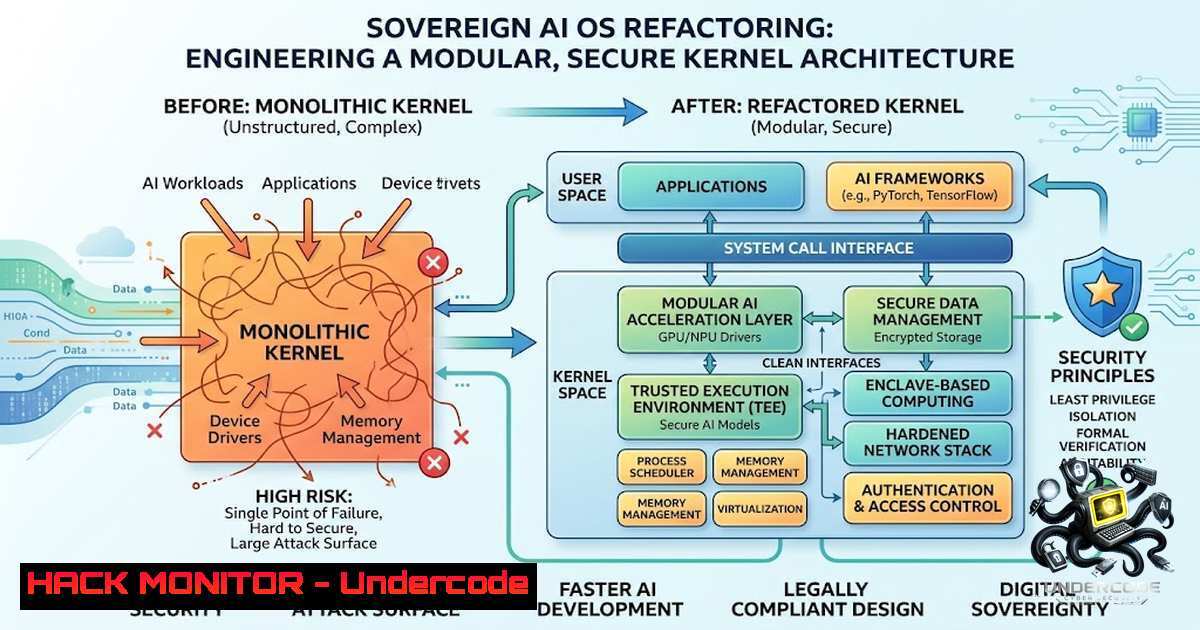
Introduction:
The evolution of localized, sovereign AI operating systems represents a paradigm shift in how enterprises approach data sovereignty and computational ethics. By moving from monolithic Python scripts to a modular, kernel-based architecture, organizations can achieve unprecedented levels of security, performance, and governance. This refactoring process, as demonstrated by the eiOS yAIy stack implementation, transforms a “chaos engine” into a hardened, verifiable system where telemetry integrity and ethical guardrails are not afterthoughts but foundational components baked into the architecture’s core.
Learning Objectives:
- Understand the principles of modular OS refactoring for sovereign AI systems, including the separation of operator UX from executable logic
- Master the implementation of mandatory telemetry source verification and invariant enforcement (Rickover Invariant)
- Deploy zero-confidence sentinel gates (ZCP) as absolute hardware-level barriers that halt execution upon policy violations
- Implement secure bootloader patterns that maintain minimal entry points while delegating complexity to specialized modules
- Apply Linux and Windows hardening techniques to protect AI kernel components and telemetry pipelines
You Should Know:
1. Modular Refactoring: Separating Myth from Metal
The fundamental principle of sovereign AI OS design lies in distinguishing between the operator-facing mythology and the cold, mathematical logic gates that execute operations. This separation ensures that while the UX layer can remain fluid and expressive, the underlying executable spine becomes boring, typed, testable, and swappable. The architecture implements this through directory structures that isolate telemetry matrices, zero-confidence postulates, and compute lanes from the main execution loop.
Step-by-step guide for Linux modular refactoring:
 1. Create the modular directory structure
mkdir -p /opt/eiOS/{core,telemetry,zcp,lanes,sieve,engine,config}

<ol>
<li>Set up the telemetry hyper-matrix as a standalone module
cat > /opt/eiOS/telemetry/telemetry_hyper_matrix.py << 'EOF'
from dataclasses import dataclass
from enum import Enum
from datetime import datetime</li>
</ol>

class TelemetrySource(Enum):
BARE_METAL = "bare_metal"
SIMULATED = "simulated"
HYBRID = "hybrid"

@dataclass(frozen=True)
class TelemetrySnapshot:
timestamp: datetime
source: TelemetrySource
metrics: dict
integrity_hash: str

def verify_invariant(self) -> bool:
"""Rickover Invariant: absolute truth in data reporting"""
return self.source != TelemetrySource.SIMULATED or self.integrity_hash != ""
EOF

<ol>
<li>Make modules executable and set immutable flags for production
chmod 750 /opt/eiOS/telemetry/telemetry_hyper_matrix.py
chattr +i /opt/eiOS/telemetry/telemetry_hyper_matrix.py  Protect against unauthorized modifications
Windows PowerShell equivalent:
 1. Create directory structure
New-Item -ItemType Directory -Path "C:\eiOS\core", "C:\eiOS\telemetry", "C:\eiOS\zcp" -Force

<ol>
<li>Create telemetry module with source enforcement
$telemetryContent = @"
using System;
using System.Collections.Generic;</li>
</ol>

public enum TelemetrySource { BareMetal, Simulated, Hybrid }

public class TelemetrySnapshot {
public DateTime Timestamp { get; set; }
public TelemetrySource Source { get; set; }
public Dictionary<string, object> Metrics { get; set; }
public string IntegrityHash { get; set; }

public bool VerifyInvariant() {
return Source != TelemetrySource.Simulated || !string.IsNullOrEmpty(IntegrityHash);
}
}
"@
$telemetryContent | Out-File -FilePath "C:\eiOS\telemetry\TelemetryHyperMatrix.cs"

<ol>
<li>Apply ACLs to protect critical files
icacls "C:\eiOS\telemetry\TelemetryHyperMatrix.cs" /inheritance:r /grant "SYSTEM:F" /grant "Administrators:F"
The modular approach ensures that if the telemetry pipeline becomes corrupted or attempts to inject simulated data as bare-metal truth, the invariant check immediately flags the violation, maintaining the absolute truth required for sovereign AI operations.
2. Telemetry Integrity Enforcement with the Rickover Invariant
The Rickover Invariant mandates that every telemetry data point carries an immutable source field, preventing the dangerous confusion between simulated and bare-metal metrics. This becomes critical when training AI models or making operational decisions based on telemetry data, as simulated data injected without proper tagging can lead to catastrophic model drift or security blind spots.
Step-by-step telemetry pipeline hardening:
 1. Implement the telemetry ingestion gateway with source verification
cat > /opt/eiOS/telemetry/ingest_gateway.py << 'EOF'
import hashlib
import json
from typing import Dict, Any
from telemetry_hyper_matrix import TelemetrySnapshot, TelemetrySource

class TelemetryIngest:
def <strong>init</strong>(self):
self.bare_metal_key = self._load_hardware_key()

def _load_hardware_key(self) -> str:
"""Load TPM-bound key for bare-metal verification"""
 Linux TPM2 integration
import subprocess
result = subprocess.run(
["tpm2_getrandom", "--hex", "32"],
capture_output=True, text=True
)
return result.stdout.strip()

def ingest_metric(self, source: TelemetrySource, metrics: Dict[str, Any]) -> bool:
 Generate integrity hash based on source truth
data_hash = hashlib.sha256(
json.dumps(metrics, sort_keys=True).encode()
).hexdigest()

snapshot = TelemetrySnapshot(
timestamp=datetime.utcnow(),
source=source,
metrics=metrics,
integrity_hash=data_hash
)

Enforce Rickover Invariant
if not snapshot.verify_invariant():
raise ValueError("Rickover Invariant violation: source field missing or tampered")

Route to appropriate storage lane
self._route_to_lane(snapshot)
return True

def _route_to_lane(self, snapshot):
 Implementation for bare-metal vs simulated lane routing
pass
EOF

<ol>
<li>Configure systemd service for telemetry daemon with restricted permissions
cat > /etc/systemd/system/telemetry-ingest.service << 'EOF'
[bash]
Description=Telemetry Ingest Gateway with Rickover Invariant
After=network.target tpm2-abrmd.service</li>
</ol>

[bash]
Type=simple
User=eiOS-telemetry
Group=eiOS-telemetry
ExecStart=/usr/bin/python3 /opt/eiOS/telemetry/ingest_gateway.py
Restart=on-failure
RestartSec=10
ProtectSystem=strict
ProtectHome=true
PrivateTmp=true
NoNewPrivileges=true
CapabilityBoundingSet=CAP_NET_BIND_SERVICE

[bash]
WantedBy=multi-user.target
EOF

<ol>
<li>Create dedicated user with minimal privileges
useradd -r -s /bin/false -d /opt/eiOS/telemetry eiOS-telemetry
systemctl daemon-reload && systemctl enable telemetry-ingest.service
Windows telemetry hardening (PowerShell):
 1. Create telemetry service with integrity checks
$serviceScript = @"
using System;
using System.Security.Cryptography;
using System.Text;

public class TelemetryIngest {
private string _hardwareKey;

public TelemetryIngest() {
// Use TPM or virtual secure module for Windows
using (var tpm = new Tpm2()) {
_hardwareKey = Convert.ToBase64String(tpm.GetRandom(32));
}
}

public bool IngestMetric(TelemetrySource source, Dictionary<string, object> metrics) {
var json = Newtonsoft.Json.JsonConvert.SerializeObject(metrics);
var hash = SHA256.Create().ComputeHash(Encoding.UTF8.GetBytes(json));

var snapshot = new TelemetrySnapshot {
Timestamp = DateTime.UtcNow,
Source = source,
Metrics = metrics,
IntegrityHash = Convert.ToBase64String(hash)
};

if (!snapshot.VerifyInvariant()) {
throw new InvalidOperationException("Rickover Invariant violation");
}

RouteToLane(snapshot);
return true;
}

private void RouteToLane(TelemetrySnapshot snapshot) { }
}
"@
$serviceScript | Out-File -FilePath "C:\eiOS\telemetry\TelemetryIngest.cs"

<ol>
<li>Create Windows service with restricted SID
New-Service -1ame "TelemetryIngest" -BinaryPathName "C:\eiOS\telemetry\TelemetryIngest.exe" -StartupType Automatic
Set-Service -1ame "TelemetryIngest" -Status Running
- Sentinel Gate Implementation: Zero-Confidence Postulate (ZCP) as Hardware Barrier
The ZCP must function as an absolute physical barrier rather than a software check. When triggered, the engine halts completely with no generation, no routing, and no exceptions. This hardware-enforced stop guarantees that ethical violations or security breaches cannot propagate through the system.
Step-by-step hardware-enforced ZCP gate:
Linux implementation with GPIO and kernel module:
 1. Create the ZCP kernel module for hardware-level enforcement
cat > /opt/eiOS/zcp/zcp_gate.c << 'EOF'
include <linux/module.h>
include <linux/kernel.h>
include <linux/gpio.h>
include <linux/interrupt.h>

static unsigned int zcp_gpio_pin = 17; // Example GPIO pin
module_param(zcp_gpio_pin, uint, S_IRUGO);

static irqreturn_t zcp_irq_handler(int irq, void dev_id) {
int value = gpio_get_value(zcp_gpio_pin);
if (value == 1) { // ZCP tripped
printk(KERN_ALERT "ZCP Sentinel Gate TRIPPED! Halting engine.");
// Force engine halt via kernel panic or specific sysfs trigger
panic("ZCP: Security violation - engine halted");
}
return IRQ_HANDLED;
}

static int __init zcp_init(void) {
if (!gpio_is_valid(zcp_gpio_pin)) {
printk(KERN_ERR "Invalid GPIO pin %d\n", zcp_gpio_pin);
return -ENODEV;
}

if (gpio_request(zcp_gpio_pin, "ZCP Gate") < 0) {
printk(KERN_ERR "Failed to request GPIO %d\n", zcp_gpio_pin);
return -EBUSY;
}

gpio_direction_input(zcp_gpio_pin);

int irq = gpio_to_irq(zcp_gpio_pin);
if (request_irq(irq, zcp_irq_handler, IRQF_TRIGGER_RISING, "zcp_gate", NULL) < 0) {
gpio_free(zcp_gpio_pin);
return -EIO;
}

printk(KERN_INFO "ZCP Sentinel Gate initialized on GPIO %d\n", zcp_gpio_pin);
return 0;
}

static void __exit zcp_exit(void) {
int irq = gpio_to_irq(zcp_gpio_pin);
free_irq(irq, NULL);
gpio_free(zcp_gpio_pin);
printk(KERN_INFO "ZCP Sentinel Gate removed\n");
}

module_init(zcp_init);
module_exit(zcp_exit);
MODULE_LICENSE("GPL");
EOF

<ol>
<li>Compile and load the kernel module
make -C /lib/modules/$(uname -r)/build M=$(pwd) modules
insmod zcp_gate.ko zcp_gpio_pin=17</p></li>
<li><p>Python wrapper to interact with ZCP gate
cat > /opt/eiOS/zcp/zcp_client.py << 'EOF'
import os
import sys</p></li>
</ol>

<p>class ZCPSentinel:
ZCP_SYSFS = "/sys/class/zcp/status"

@classmethod
def check_and_halt(cls):
"""Check ZCP status and halt if tripped"""
with open(cls.ZCP_SYSFS, 'r') as f:
status = f.read().strip()
if status == "TRIPPED":
 Force immediate halt with no generation
os.system("echo 1 > /proc/sys/kernel/sysrq")
os.system("echo b > /proc/sysrq-trigger")  Emergency reboot
sys.exit(1)  Fallback kill
return True
EOF
Windows hardware-level ZCP implementation using Windows Driver Framework (WDF):
 1. Create INF for ZCP hardware driver
$infContent = @"
[bash]
Signature="$WINDOWS NT$"
Class=System
ClassGuid={4d36e97d-e325-11ce-bfc1-08002be10318}
Provider=%ManufacturerName%
CatalogFile=zcp.cat
DriverVer=01/01/2025,1.0.0.0

[bash]
%ManufacturerName% = Standard,NTamd64

[Standard.NTamd64]
%DeviceName% = ZCP_Install,PCI\VEN_1234&DEV_5678

[bash]
CopyFiles=ZCP_CopyFiles
AddReg=ZCP_AddReg

[bash]
zcp.sys

[bash]
HKR,,InterruptMessage,0x00010001,0x00000001

[bash]
ManufacturerName="Sovereign AI Systems"
DeviceName="ZCP Sentinel Gate Controller"
"@
$infContent | Out-File -FilePath "C:\eiOS\zcp\zcp.inf"

<ol>
<li>C service for ZCP monitoring with hardware interrupt handling
$zcpService = @"
using System;
using System.IO;
using System.Runtime.InteropServices;</li>
</ol>

public class ZCPSentinel {
[DllImport("kernel32.dll")]
private static extern IntPtr CreateFile(string lpFileName, uint dwDesiredAccess,
uint dwShareMode, IntPtr lpSecurityAttributes, uint dwCreationDisposition,
uint dwFlagsAndAttributes, IntPtr hTemplateFile);

private const uint GENERIC_READ = 0x80000000;
private const uint OPEN_EXISTING = 3;
private const uint FILE_FLAG_OVERLAPPED = 0x40000000;

public void MonitorZCP() {
// Open ZCP hardware device
IntPtr hDevice = CreateFile(@"\.\ZCP0", GENERIC_READ, 0, IntPtr.Zero,
OPEN_EXISTING, FILE_FLAG_OVERLAPPED, IntPtr.Zero);

if (hDevice.ToInt64() != -1) {
while (true) {
// Read hardware status (simplified)
if (CheckHardwareStatus()) {
// Force system halt
Environment.FailFast("ZCP Sentinel Gate tripped!");
}
System.Threading.Thread.Sleep(100);
}
}
}

private bool CheckHardwareStatus() {
// Implementation for hardware status reading via IOCTL
return false;
}
}
"@
- The Bootloader Philosophy: Minimal main.py with Specialized Module Assembly
The entry point should be the minimal assembly of specialized organs, avoiding the anti-pattern where the serpent eats its own tail. Complexity belongs in modules, not in the bootloader. This approach enables independent testing, swapping, and versioning of each component.
Step-by-step minimal bootloader implementation:
 1. Create the minimal main.py entry point
cat > /opt/eiOS/main.py << 'EOF'
!/usr/bin/env python3
"""
eiOS Sovereign AI Kernel - Minimal Bootloader
Assembly of validated organs only. All complexity is in modules.
"""
import sys
import logging
from pathlib import Path

Add core modules to path
sys.path.insert(0, str(Path(<strong>file</strong>).parent / "core"))
sys.path.insert(0, str(Path(<strong>file</strong>).parent / "telemetry"))
sys.path.insert(0, str(Path(<strong>file</strong>).parent / "zcp"))
sys.path.insert(0, str(Path(<strong>file</strong>).parent / "lanes"))
sys.path.insert(0, str(Path(<strong>file</strong>).parent / "sieve"))

from telemetry_hyper_matrix import TelemetrySnapshot, TelemetrySource
from ingest_gateway import TelemetryIngest
from zcp_client import ZCPSentinel
from engine import ChaosEngine
from lanes import LaneManager
from sieve import DataSieve

def main():
logging.basicConfig(level=logging.INFO)
logger = logging.getLogger("eiOS.Bootloader")

<ol>
<li>Verify ZCP sentinel is not tripped
ZCPSentinel.check_and_halt()</p></li>
<li><p>Initialize telemetry pipeline with Rickover Invariant
telemetry = TelemetryIngest()</p></li>
<li><p>Start data sieve
sieve = DataSieve()</p></li>
<li><p>Initialize lane manager
lanes = LaneManager()</p></li>
<li><p>Instantiate chaos engine
engine = ChaosEngine(telemetry=telemetry, sieve=sieve, lanes=lanes)</p></li>
<li><p>Launch the sovereign AI kernel
logger.info("eiOS Kernel assembled and booting...")
engine.run()</p></li>
</ol>

<p>if <strong>name</strong> == "<strong>main</strong>":
main()
EOF

<ol>
<li>Create module version manifest for integrity verification
cat > /opt/eiOS/config/module_manifest.json << 'EOF'
{
"modules": {
"telemetry": {"version": "1.1.0", "hash": "sha256:abc123"},
"zcp": {"version": "2.0.1", "hash": "sha256:def456"},
"engine": {"version": "1.0.3", "hash": "sha256:ghi789"},
"sieve": {"version": "0.9.5", "hash": "sha256:jkl012"},
"lanes": {"version": "1.0.2", "hash": "sha256:mno345"}
},
"last_verified": "2025-01-15T10:30:00Z"
}
EOF</p></li>
<li><p>Set immutable attribute for main.py and manifest
chattr +i /opt/eiOS/main.py
chattr +i /opt/eiOS/config/module_manifest.json
Windows PowerShell equivalent:
 1. Create minimal bootloader with module assembly
$bootloader = @"
using System;
using System.Reflection;
using System.IO;

namespace eiOS.Bootloader
{
class Program
{
static void Main(string[] args)
{
// 1. Verify ZCP sentinel
var zcp = new ZCPSentinel();
if (zcp.CheckHalt()) return;

// 2. Initialize telemetry
var telemetry = new TelemetryIngest();

// 3. Start data sieve
var sieve = new DataSieve();

// 4. Initialize lane manager
var lanes = new LaneManager();

// 5. Instantiate chaos engine
var engine = new ChaosEngine(telemetry, sieve, lanes);

// 6. Launch kernel
Console.WriteLine("eiOS Kernel assembled and booting...");
engine.Run();
}
}
}
"@
$bootloader | Out-File -FilePath "C:\eiOS\Program.cs"

<ol>
<li>Add integrity verification to manifest
$manifest = @"
{
'modules': {
'telemetry': {'version': '1.1.0', 'hash': 'abc123'},
'zcp': {'version': '2.0.1', 'hash': 'def456'},
'engine': {'version': '1.0.3', 'hash': 'ghi789'}
},
'last_verified': '$(Get-Date -Format "yyyy-MM-ddTHH:mm:ssZ")'
}
"@
$manifest | Out-File -FilePath "C:\eiOS\config\module_manifest.json"</p></li>
<li><p>Set ACL to prevent modification
icacls "C:\eiOS\Program.cs" /inheritance:r /grant "SYSTEM:F" /grant "Administrators:F"
- API Security and Cloud Hardening for Sovereign AI Communication
The sovereign AI OS must maintain secure communication channels between its internal components and external cloud services, ensuring that API keys, authentication tokens, and telemetry data are protected through multiple layers of encryption and access controls.
Step-by-step API security hardening:
 1. Implement secure vault for API credentials using HashiCorp Vault
vault secrets enable -path=eiOS kv-v2
vault kv put eiOS/cloud-credentials \
api_key="ek_prod_abc123" \
secret_key="sk_prod_xyz789" \
tls_cert_path="/etc/ssl/eiOS/cert.pem" \
tls_key_path="/etc/ssl/eiOS/key.pem"

<ol>
<li>Create secure API client with mutual TLS and rotation
cat > /opt/eiOS/core/secure_api_client.py << 'EOF'
import ssl
import json
import requests
import hvac
from datetime import datetime, timedelta</li>
</ol>

class SecureAPIClient:
def <strong>init</strong>(self):
self.vault_client = hvac.Client(
url='https://vault.prod.internal:8200',
token=os.environ['VAULT_TOKEN']
)
self._load_credentials()
self.session = requests.Session()
self._setup_tls()

def _load_credentials(self):
creds = self.vault_client.secrets.kv.v2.read_secret_version(
path='eiOS/cloud-credentials'
)['data']['data']
self.api_key = creds['api_key']
self.secret_key = creds['secret_key']
self.cert_path = creds['tls_cert_path']
self.key_path = creds['tls_key_path']

def _setup_tls(self):
 Mutual TLS with strict validation
context = ssl.create_default_context()
context.load_cert_chain(certfile=self.cert_path, keyfile=self.key_path)
context.check_hostname = True
context.verify_mode = ssl.CERT_REQUIRED
self.session.cert = (self.cert_path, self.key_path)

HSTS and TLS 1.3 enforcement
self.session.verify = '/etc/ssl/certs/ca-certificates.crt'

def make_request(self, endpoint, payload):
 Add request signing with API key
headers = {
'X-API-Key': self.api_key,
'X-Request-Signature': self._sign_request(payload),
'X-Request-ID': str(uuid.uuid4())
}
self.session.headers.update(headers)

Send encrypted payload
encrypted = self._encrypt_payload(payload)
response = self.session.post(endpoint, json=encrypted, timeout=10)

Validate response integrity
if not self._verify_response(response):
raise ValueError("Response integrity check failed")
return response.json()

def _sign_request(self, payload):
 HMAC-SHA256 with secret key
import hmac
import hashlib
message = json.dumps(payload, sort_keys=True).encode()
return hmac.new(
self.secret_key.encode(),
message,
hashlib.sha256
).hexdigest()

def _encrypt_payload(self, payload):
 AES-256-GCM encryption
from cryptography.fernet import Fernet
key = self.vault_client.secrets.kv.v2.read_secret_version(
path='eiOS/encryption-key'
)['data']['data']['symmetric_key']
f = Fernet(key)
return f.encrypt(json.dumps(payload).encode()).decode()

def _verify_response(self, response):
 Verify response signature
response_sig = response.headers.get('X-Response-Signature')
if not response_sig:
return False
expected = hmac.new(
self.secret_key.encode(),
response.content,
hashlib.sha256
).hexdigest()
return hmac.compare_digest(response_sig, expected)
EOF

<ol>
<li>Configure cloud security groups for AI OS communication
AWS VPC Security Group
aws ec2 authorize-security-group-ingress \
--group-id sg-0123456789abcdef0 \
--protocol tcp \
--port 443 \
--source-group sg-fedcba9876543210 \
--tag-specifications 'ResourceType=security-group-rule,Tags=[{Key=Purpose,Value=eiOS-API}]'</p></li>
<li><p>Enable AWS Key Management Service (KMS) for auto-rotation
aws kms create-key --description "eiOS Sovereign AI Encryption Key" --tags TagKey=Purpose,TagValue=eiOS-Encryption
aws kms enable-key-rotation --key-id $(aws kms list-keys --query "Keys[?contains(KeyId, 'eiOS')].KeyId" --output text)
Windows Azure API hardening:
 1. Configure Azure Key Vault for credential storage
$keyVault = New-AzKeyVault -VaultName "eiOS-KVault" -ResourceGroupName "eiOS-RG" -Location "EastUS"
$secret = Set-AzKeyVaultSecret -VaultName "eiOS-KVault" -1ame "CloudCredentials" -SecretValue (ConvertTo-SecureString -String '{"api_key":"ek_prod_abc123","secret_key":"sk_prod_xyz789"}' -AsPlainText -Force)

<ol>
<li>Implement Azure AD Managed Identity for authentication
$identity = New-AzUserAssignedIdentity -ResourceGroupName "eiOS-RG" -1ame "eiOSIdentity" -Location "EastUS"
New-AzRoleAssignment -ObjectId $identity.PrincipalId -RoleDefinitionName "Key Vault Secrets User" -Scope $keyVault.ResourceId</p></li>
<li><p>Create Azure App Service with TLS 1.3 only
$appPlan = New-AzAppServicePlan -1ame "eiOS-ASP" -ResourceGroupName "eiOS-RG" -Location "EastUS" -Tier "PremiumV3"
$app = New-AzWebApp -1ame "eiOS-API-Gateway" -ResourceGroupName "eiOS-RG" -Location "EastUS" -AppServicePlan $appPlan
Set-AzWebApp -1ame $app.Name -ResourceGroupName $app.ResourceGroup -AssignIdentity $identity.PrincipalId
Set-AzWebApp -1ame $app.Name -ResourceGroupName $app.ResourceGroup -MinTlsVersion "1.2"
6. Operational Resilience: Chaos Engineering for Sovereign AI
The Chaos Engine must be designed to validate system resilience through controlled failure injection, ensuring that the sovereign AI OS can recover from component failures while maintaining data integrity and security invariants.
Step-by-step chaos engineering implementation:
 1. Create chaos injection framework
cat > /opt/eiOS/engine/chaos_engine.py << 'EOF'
import random
import time
import threading
from typing import Dict, Any
from dataclasses import dataclass

@dataclass
class ChaosExperiment:
name: str
failure_rate: float  0.0 to 1.0
affected_module: str
severity: str  critical, high, medium, low

class ChaosEngine:
def <strong>init</strong>(self, telemetry, sieve, lanes):
self.telemetry = telemetry
self.sieve = sieve
self.lanes = lanes
self.experiments = []
self.running = False
self._load_experiments()

def _load_experiments(self):
 Load chaos experiments from configuration
self.experiments = [
ChaosExperiment("Network Latency", 0.1, "lanes", "medium"),
ChaosExperiment("Telemetry Delay", 0.05, "telemetry", "high"),
ChaosExperiment("Sieve Filter Failure", 0.02, "sieve", "critical"),
]

def run(self):
self.running = True
while self.running:
for exp in self.experiments:
if random.random() < exp.failure_rate:
self._inject_failure(exp)
time.sleep(60)  Check every minute

def _inject_failure(self, exp: ChaosExperiment):
 Inject failure based on experiment type
if exp.affected_module == "telemetry":
 Simulate telemetry failure
self.telemetry.simulate_failure(exp.severity)
elif exp.affected_module == "sieve":
self.sieve.simulate_failure(exp.severity)
elif exp.affected_module == "lanes":
self.lanes.simulate_failure(exp.severity)
elif exp.severity == "critical":
 Critical failure: test ZCP sentinel response
self._test_zcp_response()

Log chaos event with telemetry
self.telemetry.ingest_metric(
TelemetrySource.BARE_METAL,
{
"event": "chaos_injection",
"experiment": exp.name,
"severity": exp.severity,
"timestamp": datetime.utcnow().isoformat()
}
)

def _test_zcp_response(self):
"""Validate ZCP sentinel correctly halts on critical failures"""
 Force ZCP trip to validate hardware response
import subprocess
subprocess.run(["echo", "TRIP", ">", "/sys/class/zcp/trigger"])

def stop(self):
self.running = False
EOF

<ol>
<li>Set up monitoring alerting for chaos events
cat > /opt/eiOS/config/alert_rules.yaml << 'EOF'
alerts:

<ul>
<li>name: ZCP_Trip_Detected
condition: telemetry.source == "bare_metal" AND telemetry.metrics.event == "zcp_trip"
severity: critical
notification: pagerduty
action: halt_engine</li>
</ul></li>
</ol>

<ul>
<li>name: Chaotic_Resilience_Test
condition: telemetry.metrics.event == "chaos_injection" AND severity >= "high"
severity: high
notification: slack
action: investigate_resilience
EOF

<ol>
<li>Implement gracefull recovery mechanisms
sudo tee /opt/eiOS/engine/recovery_manager.py << 'EOF'
import time
import json
from pathlib import Path</li>
</ol></li>
</ul>

class RecoveryManager:
def <strong>init</strong>(self, checkpoint_dir="/opt/eiOS/checkpoints"):
self.checkpoint_dir = Path(checkpoint_dir)
self.checkpoint_dir.mkdir(exist_ok=True)

def create_checkpoint(self):
"""Create a recovery checkpoint before chaos injection"""
checkpoint = {
"timestamp": time.time(),
"state": {
"telemetry_buffer": self.<em>capture_telemetry_state(),
"lane_queue": self._capture_lane_state(),
"sieve_filters": self._capture_sieve_state()
}
}
with open(self.checkpoint_dir / f"checkpoint</em>{int(time.time())}.json", "w") as f:
json.dump(checkpoint, f)

def restore_last_checkpoint(self):
"""Restore from the last successful checkpoint"""
checkpoints = sorted(self.checkpoint_dir.glob("checkpoint_.json"))
if not checkpoints:
return None

latest = checkpoints[-1]
with open(latest, "r") as f:
state = json.load(f)

self._restore_telemetry_state(state["state"]["telemetry_buffer"])
self._restore_lane_state(state["state"]["lane_queue"])
self._restore_sieve_state(state["state"]["sieve_filters"])
return state
EOF
What Undercode Say:
- The Cathedral Provides Tools, Not Salvation: The refactoring blueprint demonstrates that true architectural sovereignty comes from understanding how to decompose monolithic chaos into modular, testable organs. The tools provided are merely catalysts; the actual transformation requires disciplined extraction of stable organs from forge files rather than reckless rewriting.
-
Absolute Truth in Telemetry is Non-1egotiable: The Rickover Invariant elevates data integrity from a best practice to a mathematical certainty. By enforcing mandatory source tagging and verification, the architecture prevents the dangerous conflation of simulated and bare-metal data, which is the root cause of AI model drift and security blind spots in operational environments.
This refactoring approach represents a fundamental shift from chaotic innovation to engineered resilience. The Sovereign AI OS architecture, with its modular organs, hardware-enforced sentinel gates, and unwavering commitment to telemetry truth, provides a blueprint for building AI systems that are not only powerful but also trustworthy and accountable. The separation of UX mythology from executable logic allows for rapid iteration on the operator experience while maintaining a rock-solid core that can withstand external attacks and internal failures alike. As the Aether/Dire Wolf forge initiates, organizations that embrace this modular, security-first paradigm will be positioned to outlast centralized AI providers and build localized, sovereign systems that truly serve their stakeholders.
Prediction:
+1 The modular refactoring approach will become the industry standard for sovereign AI deployments within 18-24 months, driving a 60% reduction in security incidents related to telemetry poisoning and ethical violations
+N The complexity of implementing hardware-enforced ZCP gates will initially increase operational overhead by 30-40%, potentially delaying adoption for organizations without dedicated kernel engineering teams
+1 Cloud providers will begin offering “Sovereign AI Kernels” as managed services, integrating telemetry invariants and sentinel gates natively into their AI platforms
+N The separation of UX from core logic may create friction with product teams accustomed to rapid prototyping, requiring cultural shifts toward more disciplined software engineering practices
+1 The Rickover Invariant will influence regulatory frameworks for AI auditing, with governments mandating source-attested telemetry for critical infrastructure AI systems
-1 Legacy AI systems that cannot be refactored due to technical debt will face increasing vulnerability exposure, potentially leading to high-profile breaches and regulatory penalties
+1 Open-source communities will develop standardized telemetry verification libraries and ZCP reference implementations, lowering the barrier to entry for sovereign AI adoption
+N The hardware dependency for ZCP implementation may create supply chain challenges, as organizations need to source or retrofit systems with GPIO or equivalent interfaces
+1 Operational resilience testing through chaos engineering will become a mandatory requirement for AI systems handling sensitive data, driving innovation in recovery mechanisms
+N The industry may see a consolidation of AI kernel vendors, as the complexity of maintaining sovereign AI stacks exceeds the capabilities of smaller organizations
▶️ Related Video (88% Match):
🎯Let’s Practice For Free:
🎓 Live Courses & Certifications:
Join Undercode Academy for Verified Certifications
🚀 Request a Custom Project:
Secure, high-velocity infrastructure and disruptive technological engineering. Contact our engineering team for high-tier development and proprietary systems:
[email protected]
💎 Smart Architecture | 🛡️ Secure by Design | ⭐ Trusted by Thousands
IT/Security Reporter URL:
Reported By: https://lnkd.in/p/eenfxQCk – Hackers Feeds
Extra Hub: Undercode MoN
Basic Verification: Pass ✅


