Listen to this Post
Introduction:
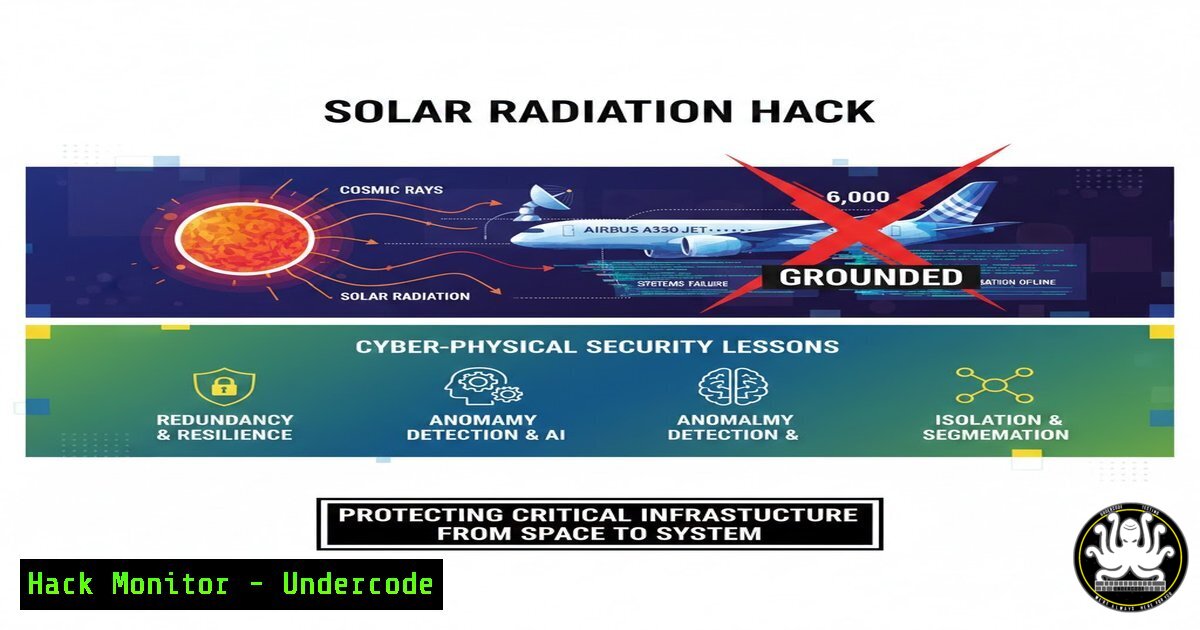
The recent grounding of nearly 6,000 Airbus A320 aircraft due to a software vulnerability triggered by solar radiation marks a pivotal moment in cybersecurity. This incident transcends traditional network threats, highlighting a critical new front: the security of cyber-physical systems where code directly interacts with, and can be disrupted by, the physical world. The response by Airbus—a massive containment and patching operation—mirrors a large-scale cyber incident response, forcing the industry to reconsider what truly falls under the cybersecurity umbrella.
Learning Objectives:
- Understand the nature of Single Event Upsets (SEUs) and how environmental factors can be exploited as attack vectors.
- Learn how to apply cybersecurity incident response protocols to cyber-physical system failures.
- Identify hardening techniques for critical systems across Linux, Windows, and Cloud environments to mitigate similar risks.
You Should Know:
- The Threat: Single Event Upsets (SEUs) as a Cyber-Physical Vulnerability
A Single Event Upset (SEU) is a change of state caused by a single ionizing particle striking a sensitive node in a microelectronic device. In the Airbus case, solar radiation (cosmic rays) was the trigger. From a cybersecurity perspective, this is a potent reminder that a threat vector does not need to be a malicious actor; it can be a natural phenomenon that exploits a system’s lack of resilience. The core vulnerability was software that could not gracefully handle such a hardware fault, leading to potential system failure.
Step‑by‑step guide explaining what this does and how to use it.
While you cannot block cosmic rays, you can build systems that are resilient to the faults they cause.
1. Error Detection through Parity and ECC Memory: Use Error-Correcting Code (ECC) memory in all critical servers. ECC can detect and correct single-bit errors, which are the most common type of SEU.
Linux: Check for ECC support on a running system. `edac-utils` is a common package for this.
 Install edac-utils on Debian/Ubuntu
sudo apt-get install edac-utils
 Check for ECC error corrections
sudo edac-util --status
Windows: ECC is a hardware feature, but you can verify if your Windows system is using ECC memory via PowerShell.
Get-CimInstance -ClassName Win32_PhysicalMemory | Select-Object DataWidth, TotalWidth
If `TotalWidth` is greater than `DataWidth` (e.g., 72 vs 64), the memory module has ECC bits.
2. Software-Level Fault Tolerance: Implement watchdog timers and heartbeats in critical software. If a process hangs due to a bit flip, the watchdog can trigger a restart.
Linux Systemd Service Example:
[bash]
Description=My Critical Service
[bash]
ExecStart=/usr/bin/my_critical_app
Restart=always
RestartSec=5
 This acts as a software watchdog
[bash]
WantedBy=multi-user.target
- The Response: Airbus’s Cyber-Incident Playbook for a Physical Problem
Airbus’s reaction was a textbook example of a high-severity cybersecurity incident response, applied to an aviation problem. The steps—Identification, Containment, Eradication, Recovery—map directly onto their actions.
Step‑by‑step guide explaining what this does and how to use it.
1. Identification & Analysis: The flaw was identified, likely through testing or field reports. The risk was assessed as critical to flight safety.
2. Containment: The immediate action was to immobilize the affected aircraft. In cyber terms, this is akin to taking a compromised network segment offline. The command to ground planes is the ultimate containment strategy.
3. Eradication: Developing and testing a software patch for the majority of the fleet. For the most critically affected units, a hardware remediation was required.
4. Recovery: The phased process of applying the patch and returning aircraft to service, ensuring the mitigation was effective.
3. Hardening Linux Systems for Critical Workloads
For servers running aviation control systems, cloud infrastructure, or any critical service, the underlying OS must be hardened against instability.
Step‑by‑step guide explaining what this does and how to use it.
1. Kernel Hardening: Use a kernel with PaX/Grsecurity patches or enable built-in Linux kernel hardening features.
 Check kernel security features
cat /proc/sys/kernel/randomize_va_space
 Output should be '2' for full ASLR (Address Space Layout Randomization)
2. System Call Filtering: Use `seccomp-bpf` to restrict the system calls an application can make, limiting the damage from a compromised process.
3. Mandatory Access Control: Enforce policies with SELinux or AppArmor.
 Check SELinux status
sestatus
 Set SELinux to enforcing mode
sudo setenforce 1
4. Securing Windows in Embedded and Industrial Systems
Modern aircraft and industrial control systems often use Windows-based components. These must be locked down extensively.
Step‑by‑step guide explaining what this does and how to use it.
1. Disable Unnecessary Services: Reduce the attack surface.
 Get a list of all running services
Get-Service | Where-Object {$_.Status -eq 'Running'}
 Disable a specific service (e.g., unneeded remote registry)
Set-Service -Name "RemoteRegistry" -StartupType Disabled
Stop-Service -Name "RemoteRegistry"
2. Apply Application Control Policies: Use Windows Defender Application Control (WDAC) to allow only authorized software to run.
 Get the WDAC policy status
Get-CimInstance -Namespace root/Microsoft/Windows/CI -ClassName MSFT_HVCISettings
3. Enable Credential Guard and Device Guard: Protect against pass-the-hash attacks and ensure kernel integrity.
- Cloud Hardening and API Security for Supporting Infrastructure
The backend systems that support fleets (maintenance, updates, telemetry) are often cloud-based and accessed via APIs. These are prime targets.
Step‑by‑step guide explaining what this does and how to use it.
1. API Security Hardening:
Use API Gateways: Implement throttling, authentication, and schema validation.
Validate All Inputs: Ensure all API endpoints rigorously check and sanitize incoming data to prevent injection attacks.
Use Mutual TLS (mTLS): Enforce mutual authentication for service-to-service communication, a critical control for internal microservices architectures common in modern platforms.
2. Cloud Workload Hardening:
AWS IAM: Apply the principle of least privilege. Never use root access keys for operational tasks.
 Use AWS CLI to check your current user's permissions
aws iam list-attached-user-policies --user-name $(aws iam get-user --query 'User.UserName' --output text)
What Undercode Say:
- Safety Over Cost is the New “Security Over Convenience.” Airbus’s decision to absorb massive financial losses rather than risk passenger safety sets a new precedent. In cybersecurity, this translates to proactively investing in resilient architectures and fault-tolerant code, even when the ROI is difficult to calculate.
- The Vulnerability Landscape is Now Three-Dimensional. Threats are no longer just digital; they are digital exploits of physical and environmental weaknesses. Risk assessments must now include “acts of nature” and supply chain dependencies as potential threat actors.
The Airbus incident is a powerful case study that shatters the traditional silo between “cybersecurity,” “software quality,” and “physical safety.” The argument that software quality is not a cybersecurity concern is rendered obsolete when a software flaw, triggered by a solar event, can lead to physical catastrophe. This forces a convergence of disciplines, demanding that CISOs, developers, and engineers collaborate on building systems that are not just secure from hackers, but resilient against a hostile universe.
Prediction:
In the next 3-5 years, we will see a rise in “environmental hacking,” where threat actors research natural phenomena (like solar radiation, electromagnetic pulses, or extreme temperatures) to find and exploit system vulnerabilities that can be triggered remotely or predictably. Regulatory frameworks like ISO 27001 and NIST CSF will be updated to mandate formal threat models that include environmental and physical fault induction. Furthermore, the insurance industry for critical infrastructure will pivot, requiring proof of cyber-physical resilience—including hardware-level fault tolerance and environmental testing—as a prerequisite for coverage, creating a significant financial driver for the adoption of these advanced security measures.
🎯Let’s Practice For Free:
IT/Security Reporter URL:
Reported By: Chaf007 Airbus – Hackers Feeds
Extra Hub: Undercode MoN
Basic Verification: Pass ✅


