Listen to this Post
Introduction
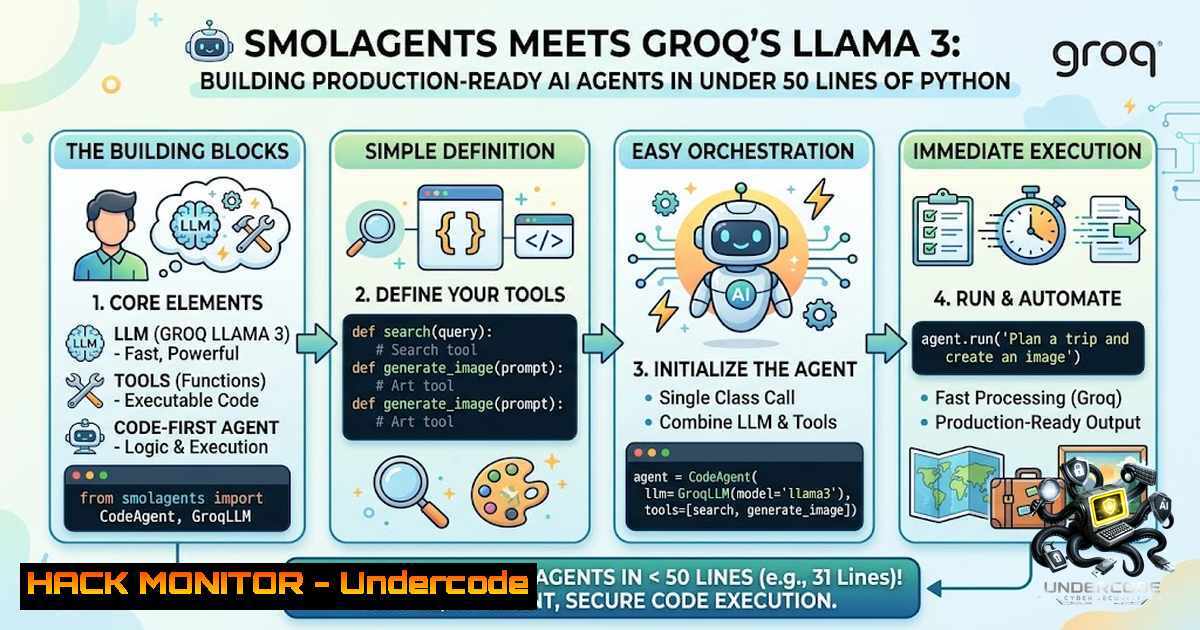
The rapid evolution of Large Language Models (LLMs) has transformed how developers approach automation and intelligent decision‑making. At the heart of this shift lies the concept of AI agents—autonomous systems that can reason, plan, and execute tasks using natural language as their primary interface. SmolAgents, a lightweight agent framework from Hugging Face, combined with Groq’s ultra‑fast inference engine running Llama 3.3 70B, offers a compelling stack for building conversational AI agents with minimal overhead. This article dissects a practical implementation that accepts user questions and generates context‑aware responses, while exploring the underlying architecture, security considerations, and extensibility patterns that make this approach suitable for everything from prototyping to enterprise deployment.
Learning Objectives
- Understand the architecture of a SmolAgents‑based AI agent and how it interfaces with Groq’s LLM API.
- Master the end‑to‑end setup, including environment configuration, dependency management, and secure API key handling.
- Learn to extend the base agent with custom tools, memory, and external data sources for advanced use cases.
You Should Know
- The SmolAgents + Groq Stack: Why Speed and Simplicity Matter
SmolAgents is a minimalistic agent framework that abstracts away the complexity of prompt engineering, tool calling, and multi‑turn conversation management. Unlike heavier frameworks such as LangChain or AutoGen, SmolAgents focuses on being lightweight and developer‑friendly, making it ideal for quick prototypes and educational projects. Groq, on the other hand, delivers sub‑second inference for Llama 3.3 70B through its custom LPU (Language Processing Unit) architecture, which significantly outperforms traditional GPU‑based inference in latency and throughput.
The combination allows you to build a fully functional AI agent that can maintain conversation context, handle user queries, and generate coherent responses—all with less than 50 lines of Python code. The project structure is deliberately simple:
SmolAgents-Groq-AI-Agent/
├── main.py  Agent orchestration
├── requirements.txt  Dependencies
├── README.md  Documentation
└── .env  API key (excluded from version control)
Step‑by‑step setup:
1. Clone the repository (or create your own):
git clone https://github.com/Akhila-939211/SmolAgents-Groq-AI-Agent.git
cd SmolAgents-Groq-AI-Agent
2. Install dependencies:
pip install -r requirements.txt
The `requirements.txt` typically includes smolagents, groq, python-dotenv, and `openai` (for compatibility).
3. Configure your Groq API key:
Create a `.env` file in the project root:
GROQ_API_KEY=your_actual_groq_api_key_here
⚠️ Security note: Never commit `.env` to version control. Add it to `.gitignore` immediately.
4. Run the agent:
python main.py
The agent starts an interactive loop where you can type questions and receive AI‑generated answers. The session continues until you type exit.
- Inside the Code: How the Agent Orchestrates LLM Inference
The core logic resides in main.py. While the exact implementation may vary, a typical SmolAgents setup with Groq involves:
import os
from dotenv import load_dotenv
from smolagents import CodeAgent, HfApiModel

load_dotenv()

Initialize the Groq-powered model
model = HfApiModel(
model_id="groq/llama-3.3-70b-versatile",
api_key=os.getenv("GROQ_API_KEY"),
provider="groq"
)

Create the agent
agent = CodeAgent(
model=model,
tools=[],  Extend with custom tools here
add_base_tools=True
)

Interactive loop
print("SmolAgents AI Agent Started! Ask your question:")
while True:
user_input = input("You: ")
if user_input.lower() == "exit":
print("Agent stopped. Goodbye!")
break
response = agent.run(user_input)
print(f"Agent: {response}")
What this does:
- Loads the Groq API key from the `.env` file.
- Initialises a `HfApiModel` pointing to Groq’s Llama 3.3 70B endpoint. The `provider=”groq”` parameter ensures the correct API routing.
- Creates a `CodeAgent` that can execute Python code as part of its reasoning—this is a powerful feature that allows the agent to perform calculations, data manipulation, or even call external APIs.
- Runs an infinite loop that captures user input, passes it to the agent, and prints the response.
Windows vs. Linux considerations:
- On Windows, use `python main.py` in Command Prompt or PowerShell. Ensure that the `python` command points to your Python 3.8+ installation.
- On Linux/macOS, the same command works. For headless servers, consider using `nohup python main.py &` to run the agent in the background.
3. Securing API Keys and Managing Environment Variables
API key leakage is one of the most common security oversights in AI projects. The project uses `python-dotenv` to load variables from a `.env` file, which is a best practice endorsed by the Open Web Application Security Project (OWASP) for credential management.
Enhanced security measures:
- Restrict file permissions on Linux:
chmod 600 .env
This ensures only the owner can read or write the file.
-
Use environment variables directly in CI/CD pipelines (e.g., GitHub Actions secrets) instead of hard‑coding keys.
-
Rotate keys regularly via the Groq console.
-
Audit dependencies with `pip-audit` to catch known vulnerabilities:
pip install pip-audit
pip-audit
- Extending the Agent with Custom Tools and Memory
The real power of SmolAgents lies in its extensibility. The `tools` parameter in the `CodeAgent` constructor accepts a list of custom tools that the agent can invoke dynamically. For example, you can add a web search tool:
from smolagents import Tool

class WebSearchTool(Tool):
name = "web_search"
description = "Searches the web for current information."
inputs = {"query": {"type": "string", "description": "The search query"}}
output_type = "string"

def forward(self, query: str) -> str:
 Integrate with a search API (e.g., SerpAPI, Brave Search)
return f"Search results for '{query}' ..."
Then attach it to the agent:
agent = CodeAgent(model=model, tools=[WebSearchTool()], add_base_tools=True)
Adding memory for long‑term conversation context can be achieved by using a vector database like Chroma or FAISS, or by simply storing the conversation history in a list and passing it to the model as part of the system prompt. This enables the agent to remember previous interactions and provide more coherent responses over time.
5. Testing and Debugging Your AI Agent
Testing an AI agent is inherently probabilistic, but you can adopt several strategies to increase reliability:
- Unit tests for individual tools: Ensure each tool returns expected outputs given controlled inputs.
- Integration tests with mock API responses: Use `unittest.mock` to simulate Groq API calls and verify agent behaviour without incurring costs.
- Logging to trace agent decisions: Insert `print` statements or use Python’s `logging` module to see which tools the agent called and what reasoning steps it took.
Example of enabling debug logging:
import logging
logging.basicConfig(level=logging.DEBUG)
Common pitfalls:
- Rate limiting: Groq’s free tier has request limits. Implement exponential backoff with `tenacity` to handle retries.
- Token limits: Llama 3.3 70B has a 128k context window, but be mindful of sending excessively long histories.
- Hallucinations: Always validate critical outputs, especially when the agent is used in production workflows.
6. From Prototype to Production: Deployment and Scaling
Deploying your SmolAgents agent as a service involves wrapping it in a web framework like FastAPI or Flask. Here’s a minimal FastAPI example:
from fastapi import FastAPI, HTTPException
from pydantic import BaseModel

app = FastAPI()

class Query(BaseModel):
question: str

@app.post("/ask")
async def ask(query: Query):
try:
response = agent.run(query.question)
return {"answer": response}
except Exception as e:
raise HTTPException(status_code=500, detail=str(e))
Run with:
uvicorn main:app --host 0.0.0.0 --port 8000
Scaling considerations:
- Use asynchronous processing to handle multiple concurrent requests.
- Implement caching for repeated queries using Redis.
- Monitor token usage and latency with tools like Prometheus and Grafana.
What Undercode Say
- Key Takeaway 1: The SmolAgents + Groq stack demonstrates that building a capable AI agent does not require complex infrastructure. With a few lines of Python and a well‑managed API key, developers can create interactive, LLM‑powered applications that rival more heavyweight solutions.
-
Key Takeaway 2: Security and extensibility are not afterthoughts—they are integral to the design. By using environment variables for credentials and designing a pluggable tool system, this project sets a solid foundation for production‑grade AI agents that can evolve with business needs.
Analysis: This project encapsulates the current zeitgeist of generative AI development: rapid prototyping, open‑source tooling, and a focus on developer experience. However, it also highlights the critical gap between a working prototype and a secure, scalable enterprise service. The absence of authentication, rate limiting, and observability in the base implementation are deliberate simplifications, but they serve as excellent teaching points. For organisations looking to adopt AI agents, the path forward involves layering these production concerns atop a solid core—exactly what SmolAgents enables. The growing ecosystem around SmolAgents, including integrations with LangChain and LlamaIndex, suggests that this lightweight approach is not just a toy but a viable foundation for next‑generation automation.
Expected Output
When you run the agent, you should see something like:
SmolAgents AI Agent Started! Ask your question:
You: Explain Generative AI
Agent: Generative AI is a type of artificial intelligence that can create new content—such as text, images, or audio—by learning patterns from existing data. Unlike discriminative models that classify or predict, generative models produce original outputs that resemble the training distribution.

You: What are the ethical concerns?
Agent: Key ethical concerns include misinformation (deepfakes), bias amplification, copyright infringement, and job displacement. Responsible deployment requires transparent data sourcing, fairness audits, and human oversight.

You: exit
Agent stopped. Goodbye!
Prediction
- +1 The democratisation of AI agent development through frameworks like SmolAgents will accelerate innovation in vertical domains such as healthcare, legal tech, and education, where custom agents can be tailored to specific knowledge bases and workflows.
-
+1 Groq’s focus on low‑latency inference will become a competitive differentiator, pushing other providers to optimise their hardware and software stacks, ultimately benefiting the entire AI ecosystem with faster, more cost‑effective models.
-
-1 The ease of building AI agents also lowers the barrier for malicious actors to deploy automated social engineering, disinformation campaigns, and credential‑harvesting bots. Defensive AI and robust authentication mechanisms will become non‑negotiable.
-
-1 Over‑reliance on a single LLM provider (Groq) introduces supply‑chain risks. Organisations should design their agents to be provider‑agnostic, using abstraction layers that allow seamless switching between models from different vendors.
▶️ Related Video (78% Match):
https://www.youtube.com/watch?v=0J_fz6RlqVg
🎯Let’s Practice For Free:
🎓 Live Courses & Certifications:
Join Undercode Academy for Verified Certifications
🚀 Request a Custom Project:
Secure, high-velocity infrastructure and disruptive technological engineering. Contact our engineering team for high-tier development and proprietary systems:
[email protected]
💎 Smart Architecture | 🛡️ Secure by Design | ⭐ Trusted by Thousands
IT/Security Reporter URL:
Reported By: Akhila Singam – Hackers Feeds
Extra Hub: Undercode MoN
Basic Verification: Pass ✅


