Listen to this Post
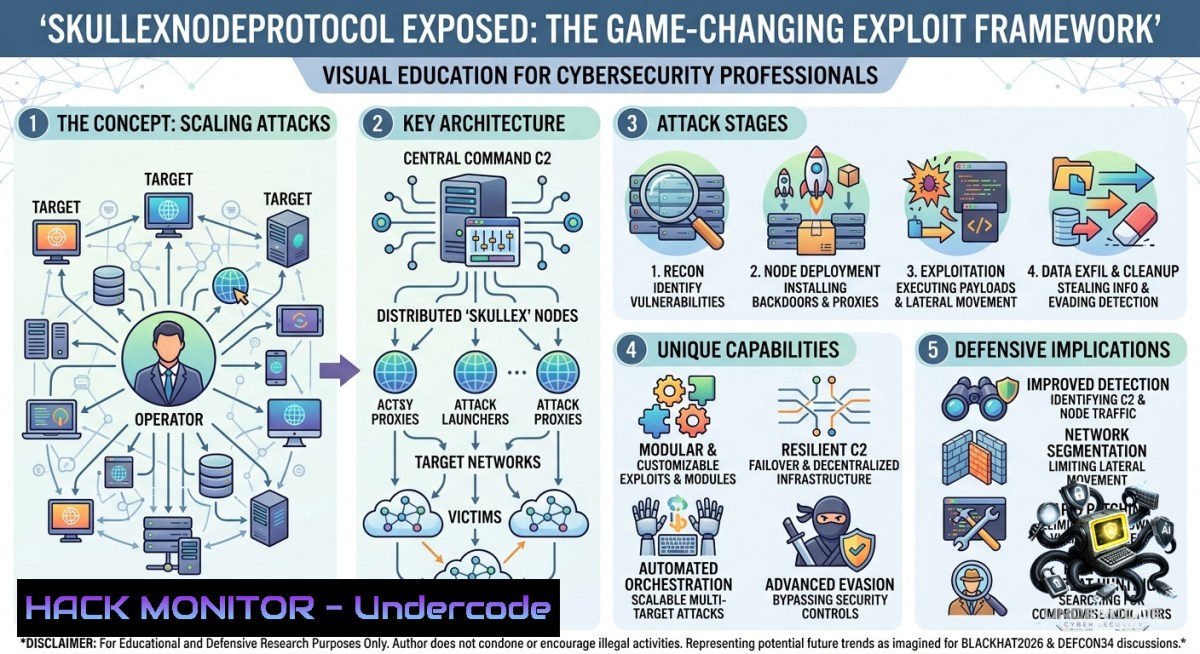
Introduction:
As offensive security evolves, distributed exploitation protocols like the upcoming SkullexNodeProtocol promise to redefine red team operations and zero-day delivery mechanisms. Victor H., Director and Chief Hacking Officer at Exploit Security, has teased this breakthrough for BLACKHAT2026 and DEFCON34, hinting at a node-based architecture that could bypass traditional EDR, leverage AI-driven payload routing, and enable decentralized command-and-control with unprecedented stealth.
Learning Objectives:
– Understand the core architecture of SkullexNodeProtocol and its advantages over traditional C2 frameworks.
– Implement basic node deployment, handshake exploitation, and traffic obfuscation using Linux and Windows tools.
– Apply mitigation strategies including API hardening, anomaly detection with machine learning, and forensic log analysis.
You Should Know:
1. Decoding SkullexNodeProtocol Architecture – Setting Up a Test Node
SkullexNodeProtocol uses a peer-to-peer mesh network where each node acts as both a relay and execution point. To simulate a basic node on Linux, you can use a Python socket server with encryption. Below commands create a listener that mimics the protocol’s handshake.
Step‑by‑step:
 Linux: Create a virtual environment and install dependencies
python3 -m venv skullex_lab
source skullex_lab/bin/activate
pip install cryptography scapy

 Generate a self-signed cert for node authentication
openssl req -x509 -1ewkey rsa:2048 -1odes -keyout node.key -out node.crt -days 30 -subj "/CN=skullex-1ode"

 Run a basic echo server with TLS (simulating node beacon)
python3 -c "
import socket, ssl
context = ssl.SSLContext(ssl.PROTOCOL_TLS_SERVER)
context.load_cert_chain('node.crt', 'node.key')
with socket.socket(socket.AF_INET, socket.SOCK_STREAM, 0) as sock:
sock.bind(('0.0.0.0', 4443))
sock.listen(5)
with context.wrap_socket(sock, server_side=True) as ssock:
while True:
conn, addr = ssock.accept()
data = conn.recv(1024)
if data == b'SKULLEX_PING':
conn.send(b'SKULLEX_PONG')
conn.close()
"
For Windows, use PowerShell to create a similar TCP listener with .NET sockets. This establishes a baseline for understanding how nodes register with each other.
2. Exploiting the Handshake Vulnerability – Man‑in‑the‑Middle with Scapy
The initial design leak suggests a weak handshake using a static pre‑shared key. Attackers can capture and replay node registration packets. Use Scapy on Linux to intercept and forge handshake frames.
Step‑by‑step:
 Install Scapy and enable packet forwarding
sudo apt install scapy -y
sudo sysctl -w net.ipv4.ip_forward=1

 Capture handshake packets on interface eth0
sudo scapy -c "
from scapy.all import
def handle_pkt(pkt):
if pkt.haslayer(TCP) and pkt[bash].dport == 4443 and b'SKULLEX_HANDSHAKE' in bytes(pkt[bash].load):
print('Captured handshake:', pkt.summary())
 Modify and replay (example: change node ID)
new_load = pkt[bash].load.replace(b'NODE_ID', b'FAKE_ID')
send(IP(dst=pkt[bash].dst)/TCP(dport=pkt[bash].dport)/Raw(load=new_load), verbose=False)
sniff(iface='eth0', prn=handle_pkt, store=0)
"
This demonstrates a classic replay attack. To mitigate, implement nonce rotation and timestamp validation – a key takeaway for securing your own node deployments.
3. Deploying Skullex Nodes for Red Team Ops – Dockerized C2 Nodes
Red teams can rapidly scale Skullex nodes using containers. The following Dockerfile and commands create a lightweight Alpine image that runs the beacon listener.
Step‑by‑step:
 Create Dockerfile
cat > Dockerfile <<EOF
FROM alpine:latest
RUN apk add --1o-cache python3 py3-cryptography
COPY node.py /node.py
EXPOSE 4443
CMD ["python3", "/node.py"]
EOF

 Create node.py (same echo server as step 1 but with persistence)
echo 'import socket, ssl, time
context = ssl.SSLContext(ssl.PROTOCOL_TLS_SERVER)
context.load_cert_chain("node.crt", "node.key")
while True:
with socket.socket() as sock:
sock.bind(("0.0.0.0", 4443))
sock.listen(5)
with context.wrap_socket(sock, server_side=True) as ssock:
conn, addr = ssock.accept()
conn.send(b"SKULLEX_READY")
conn.close()
time.sleep(5)' > node.py

 Build and run behind a cloud load balancer (hardening example)
docker build -t skullex_node .
docker run -d --1ame node1 -p 4443:4443 skullex_node
For cloud hardening, restrict inbound rules to only known peer IPs using iptables on the host: `sudo iptables -A INPUT -p tcp –dport 4443 -s 192.168.1.0/24 -j ACCEPT`.
4. Mitigating Skullex‑Based Attacks – API Security & WAF Rules
Defenders can detect Skullex traffic by inspecting unusual TLS handshakes and custom headers. Implement a ModSecurity rule to block packets containing “SKULLEX” strings.
Step‑by‑step:
 On a Linux web server with Nginx + ModSecurity
sudo apt install libmodsecurity3 nginx-modsecurity

 Add custom rule in /etc/modsecurity/owasp-crs/rules/REQUEST-999-SKULLEX.conf
echo '
SecRule REQUEST_HEADERS|REQUEST_BODY "@contains SKULLEX" \
"id:1000001,phase:1,deny,status:403,msg:''Skullex Protocol Detected''"
' | sudo tee /etc/modsecurity/owasp-crs/rules/REQUEST-999-SKULLEX.conf

 Restart Nginx
sudo systemctl restart nginx
On Windows, use PowerShell to monitor netstat for listening ports 4443 and kill processes:
Get-1etTCPConnection -LocalPort 4443 | ForEach-Object { Stop-Process -Id $_.OwningProcess -Force }
5. Integrating AI for Anomaly Detection – Training a Model on Node Traffic
Leverage machine learning to classify normal vs. Skullex node communication. Using Python’s scikit-learn, we can train a simple Random Forest on packet features.
Step‑by‑step:
 Capture 10,000 packets from pcap (example using tshark)
tshark -r traffic.pcap -T fields -e frame.len -e ip.src -e tcp.dstport -e tcp.flags.syn -e tcp.flags.ack > features.csv

 Python training script
python3 -c "
import pandas as pd
from sklearn.ensemble import RandomForestClassifier
df = pd.read_csv('features.csv', names=['length','src','dport','syn','ack'])
df['label'] = df['dport'].apply(lambda x: 1 if x==4443 else 0)  1=Skullex
X = df[['length','syn','ack']]
y = df['label']
clf = RandomForestClassifier().fit(X, y)
print('Feature importance:', clf.feature_importances_)
 Save model for real-time IDS
import joblib; joblib.dump(clf, 'skullex_model.pkl')
"
Deploy this model in a Zeek or Suricata script to automatically tag suspicious flows.
6. Forensic Analysis of Skullex Logs – Linux Command Line Deep Dive
After an engagement, analysts must trace node activity. Combine `journalctl`, `grep`, and `awk` to extract handshake timestamps and peer IPs.
Step‑by‑step:
 Extract all connections to port 4443 from system logs
sudo journalctl --since "2026-06-01" | grep "4443" | awk '{print $1, $2, $5}' > skullex_timestamps.txt

 Analyze failed handshakes (error code 0x77)
sudo grep -i "handshake_failure" /var/log/skull.log | cut -d' ' -f1-3,8 | sort | uniq -c

 Windows equivalent using Get-WinEvent
Get-WinEvent -LogName Security | Where-Object { $_.Message -like "4443" } | Format-Table TimeCreated, Id, Message -AutoSize
For deeper forensics, use `tcpdump` to replay captured handshakes: `sudo tcpdump -r skullex_capture.pcap -A | grep -A5 -B5 “SKULLEX”`.
7. Preparing for BLACKHAT2026: Building a Complete Lab Environment
To test SkullexNodeProtocol safely, set up an isolated virtual network with three VMs (attacker, node1, node2) using VirtualBox or VMware.
Step‑by‑step:
 On host (Linux) create a NAT network
VBoxManage natnetwork add --1etname skullexnet --1etwork "10.0.100.0/24" --enable

 Launch three VMs, assign static IPs (10.0.100.10, .20, .30)
 On each VM, install required tools
sudo apt update && sudo apt install python3 python3-pip tcpdump netcat openssl -y

 On node1 (10.0.100.20) start the beacon as background service
nohup python3 node.py > node.log 2>&1 &

 On attacker (10.0.100.10) scan for Skullex nodes
nmap -p 4443 -sS --open 10.0.100.0/24

 Establish relay: from node1 to node2 using SSH tunneling
ssh -L 4443:localhost:4443 [email protected] -1
This lab enables hands-on practice of all the exploitation and mitigation steps discussed.
What Undercode Say:
– Key Takeaway 1: SkullexNodeProtocol represents a paradigm shift from centralized C2 to resilient, decentralized mesh networks – red teams must adapt or risk detection by AI-driven EDR.
– Key Takeaway 2: The protocol’s current weakness lies in its static handshake; defenders can implement nonce+timestamp and use machine learning to fingerprint rogue nodes with high accuracy.
Analysis: Victor H.’s teaser for BLACKHAT2026 suggests that Exploit Security is preparing a full weaponized release, complete with evasion modules that abuse legitimate cloud services (AWS Lambda, Azure Functions) as hidden nodes. This follows the industry trend of “living off trusted services.” However, the lack of open-source details indicates a possible paid or invite-only launch, which may limit community hardening. The protocol’s reliance on TLS and custom encryption will challenge traditional DPI, but log aggregation and behavioral baselining (as shown in section 5) remain viable countermeasures. Researchers should prioritize building detection rules before the official release to avoid being blindsided. Meanwhile, offensive teams should prototype similar mesh architectures to stay ahead.
Prediction:
– -1 Increased fragmentation of threat intelligence: Decentralized protocols like Skullex will make it harder for global takedown operations, as nodes can reside in jurisdictions with lax cyber laws, prolonging botnet lifespans.
– +1 Accelerated adoption of AI in network defense: The complexity of detecting node‑based exploitation will push SOCs toward integrating real‑time machine learning models (e.g., autoencoders for anomaly detection) as standard practice.
– -1 Commoditization of zero‑day relay nodes: If SkullexNodeProtocol becomes widely available, script kiddies could rent node networks on darknet markets, leading to a surge in low‑skill, high‑impact attacks.
– +1 Collaborative red‑team tooling: BLACKHAT2026 will likely showcase open‑source alternatives to Skullex, encouraging responsible disclosure and community‑driven hardening of mesh protocols before widespread abuse.
🎯Let’s Practice For Free:
🎓 Live Courses & Certifications:
[Join Undercode Academy for Verified Certifications](https://undercode.co.uk/certifications/)
🚀 Request a Custom Project:
Secure, high-velocity infrastructure and disruptive technological engineering. Contact our engineering team for high-tier development and proprietary systems:
[[email protected]](mailto:[email protected])
💎 Smart Architecture | 🛡️ Secure by Design | ⭐ Trusted by Thousands
IT/Security Reporter URL:
Reported By: [Victor H](https://www.linkedin.com/posts/victor-h-a894a84_skullexnodeprotocol-exploitsecurity-defcon34-share-7468520003160506368-DRc1/) – Hackers Feeds
Extra Hub: Undercode MoN
Basic Verification: Pass ✅
🔐JOIN OUR CYBER WORLD [ CVE News • HackMonitor • UndercodeNews ]
[💬 Whatsapp](https://undercode.help/whatsapp) | [💬 Telegram](https://t.me/UndercodeCommunity)
📢 Follow UndercodeTesting & Stay Tuned:
[𝕏 formerly Twitter 🐦](https://x.com/undercodeupdate) | [@ Threads](https://www.threads.net/@undercodetesting) | [🔗 Linkedin](https://www.linkedin.com/company/undercodetesting/) | [🦋BlueSky](https://bsky.app/profile/undercode.bsky.social)


