Listen to this Post
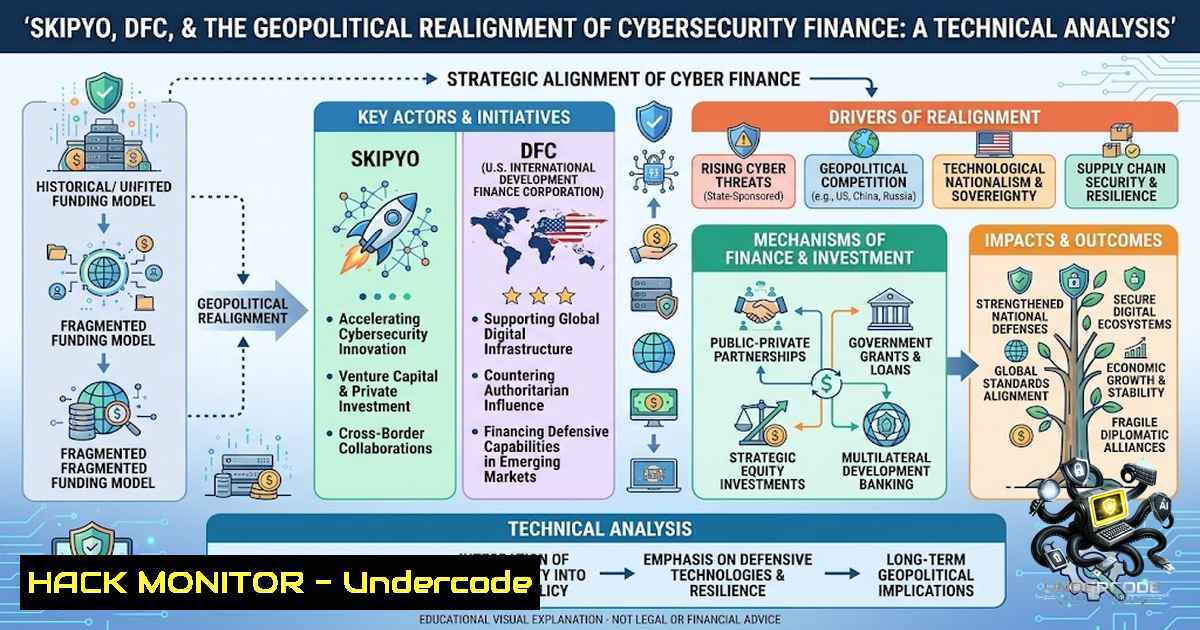
Introduction:
The intersection of sovereign development finance, venture capital, and cybersecurity has entered a new phase of strategic realignment. When a founder publicly offers to structure a private equity fund contingent on excluding specific venture capital firms—Andreessen Horowitz (a16z) and Sequoia Capital—from participation in a Maghreb-focused finance brand, it signals more than personal preference; it reflects underlying tensions between U.S. state-aligned capital (DFC), Israeli-defense-affiliated VC ecosystems, and the broader cybersecurity-industrial complex. This article examines the technical, financial, and geopolitical dimensions of this proposal, extracting actionable cybersecurity, IT, and AI training insights from the surrounding landscape.
Learning Objectives:
- Understand the role of the U.S. International Development Finance Corporation (DFC) as an instrument of economic statecraft and its implications for cybersecurity investment in Africa.
- Analyze the technical and strategic drivers behind excluding venture capital firms with Israeli-defense and U.S. military-cyber ties from regional investment vehicles.
- Identify practical cybersecurity auditing, cloud hardening, and AI governance measures relevant to multinational finance and infrastructure projects.
You Should Know:
- DFC’s Africa Digital Infrastructure Strategy: Technical and Security Dimensions
The DFC has positioned Africa as central to U.S. strategic competition, particularly in digital infrastructure and cybersecurity. Through its Connect Africa initiative, DFC commits over $1 billion to telecommunications, internet access, and critical infrastructure across the continent. A flagship example is the $50 million equity investment into Cassava Technologies, a pan-African digital infrastructure platform operating over 110,000 kilometers of fiber optic networks across 30 countries, alongside carrier-1eutral data centers providing secure services to American hyperscalers.
Step-by-Step Guide: Auditing Digital Infrastructure Investments for Cybersecurity Compliance
For organizations evaluating or participating in DFC-backed infrastructure projects, the following technical audit framework applies:
- Network Segmentation Verification: Confirm that fiber backbone and data center architectures isolate client traffic using VXLAN or MPLS-based segmentation. Example (Cisco):
vlan 100
name CLIENT-A-SEGMENT
vlan 200
name CLIENT-B-SEGMENT
interface vlan100
ip address 10.1.1.1 255.255.255.0
-
Data Center Physical Security Logging: Ensure biometric access logs are retained for minimum 12 months and integrated with SIEM.
– Windows: `Get-WinEvent -LogName Security | Where-Object { $_.Id -eq 4624 -or $_.Id -eq 4625 } | Export-Csv -Path C:\Audit\AccessLogs.csv`
– Linux: `sudo ausearch -m USER_LOGIN -ts today | aureport -f -i`
3. Encryption at Rest and in Transit: Verify AES-256 for storage and TLS 1.3 for data-in-motion across all fiber POPs. Use `openssl s_client -connect pop-site:443 -tls1_3` to validate.
- Supply Chain Threat Modeling: Map all third-party hardware vendors (routers, switches, optical transport) against known CVE databases. Example using NVD API:
curl -X GET "https://services.nvd.nist.gov/rest/json/cves/2.0?keywordSearch=Cisco&resultsPerPage=10"
-
The Venture Capital-Cybersecurity Nexus: A16Z, Sequoia, and Military AI
The post’s reference to barring a16z and Sequoia from involvement is contextualized by recent events: Cathedral, a stealth military cybersecurity startup founded by four former Department of Government Efficiency staffers, raised $160 million at a $1.4 billion valuation, with a16z and Sequoia co-leading the round and taking board seats. Cathedral plans AI-driven offensive and defensive cyber operations against U.S. adversaries, including China. Co-founder Gavin Kliger served as the Pentagon’s chief data officer.
Step-by-Step Guide: Implementing AI Cybersecurity Governance for Multinational Finance Vehicles
Given the proposal to structure a DFC-backed finance brand for the Maghreb region (Mauritania, Morocco, Tunisia, Algeria, Egypt), AI governance becomes paramount:
- Establish AI Usage Policies: Define which AI models (e.g., generative AI for financial modeling, threat detection) are permissible. Use frameworks like NIST AI RMF 1.0.
– Document: `sudo nano /etc/ai-policy.yaml` with fields: model_type, data_origin, retention_period, audit_frequency.
- Implement Model Access Controls: Restrict API keys to specific models and log all queries.
– Linux: `auditctl -w /etc/ai-models/ -p rwxa -k ai_model_access`
– Windows: Use Advanced Audit Policy → Object Access → Audit File System.
- Deploy Adversarial Input Detection: For AI-driven cyber defense tools, implement input sanitization to prevent prompt injection.
import re
def sanitize_prompt(input_text):
Remove potential injection patterns
cleaned = re.sub(r'[;\'"\]', '', input_text)
return cleaned
-
Conduct Regular Red-Teaming: Simulate AI model poisoning and data exfiltration attempts. Example using open-source tools:
git clone https://github.com/adversarial-robustness-toolbox/art.git
python -m art.attacks.poisoning
-
Cybersecurity Audit and AI Regulation: Responding to State-Level Breaches
The post references “State Department originally breached leveraging Meta” and subsequent calls for “Cybersecurity Audit and AI Regulation to the US Congress.” This aligns with ongoing investigations into Meta’s data access practices and encryption standards.
Step-by-Step Guide: Conducting a Compliance-Focused Cybersecurity Audit
- Inventory All Data Flows: Map data movement between finance platforms, government systems, and third-party APIs.
– Use Wireshark: `tshark -i eth0 -f “port 443” -w data_flow.pcap`
2. Review Encryption Standards: Verify compliance with FIPS 140-2/3 for government-aligned projects.
– Linux: `openssl ciphers -v ‘HIGH:!aNULL:!eNULL’ | grep TLS`
– Windows (PowerShell): `Get-TlsCipherSuite | Where-Object { $_.Name -match “TLS” }`
3. Audit Access Controls: Ensure principle of least privilege across all systems.
– Linux: `sudo cat /etc/sudoers | grep -v “^” | grep -v “^$”`
– Windows: `Get-LocalGroupMember -Group “Administrators”`
4. Implement Continuous Monitoring: Deploy SIEM with real-time alerting.
– Example with Wazuh (open-source):
curl -s https://packages.wazuh.com/key/GPG-KEY-WAZUH | apt-key add -
apt-get install wazuh-agent
systemctl enable wazuh-agent
4. Cloud Hardening for Multinational Financial Platforms
Any DFC-backed finance brand operating across the Maghreb requires robust cloud security architecture. DFC’s Roadmap for Impact emphasizes investing in cloud computing expansion, data center businesses, and digital work facilities.
Step-by-Step Guide: Hardening Cloud Deployments
- Identity and Access Management (IAM) : Enforce MFA for all administrative accounts.
– AWS: `aws iam list-users –query ‘Users[?PasswordLastUsed==null]’`
– Azure: `Get-AzRoleAssignment | Where-Object {$_.RoleDefinitionName -eq “Contributor”}`
2. Network Security Groups (NSGs) : Restrict inbound traffic to only necessary ports.
– Example NSG rule (Azure CLI):
az network nsg rule create --1sg-1ame Finance-1SG --1ame Allow-SSH --priority 100 --direction Inbound --access Allow --protocol Tcp --source-port-range '' --destination-port-range 22 --source-address-prefixes '10.0.0.0/8'
- Data Encryption: Enable default encryption for storage buckets and databases.
– AWS S3: `aws s3api put-bucket-encryption –bucket finance-data –server-side-encryption-configuration ‘{“Rules”:[{“ApplyServerSideEncryptionByDefault”:{“SSEAlgorithm”:”AES256″}}]}’`
4. Vulnerability Scanning: Schedule regular scans using tools like Trivy or Clair.
trivy image --severity HIGH,CRITICAL finance-app:latest
- API Security for Cross-Border Financial and Government Systems
The Skipyo finance brand’s proposal to partner with DFC and the State Department implies API integrations between private finance platforms and government systems—a high-risk attack surface.
Step-by-Step Guide: Securing APIs in Government-Aligned Finance
- Implement OAuth 2.0 with PKCE: Ensure all API calls use short-lived tokens.
curl -X POST https://auth.dfc.gov/oauth/token -d "grant_type=client_credentials&client_id=skipyo&client_secret="
2. Rate Limiting: Prevent brute-force and DoS attacks.
- Nginx example: `limit_req_zone $binary_remote_addr zone=api:10m rate=10r/s;`
3. Input Validation: Sanitize all JSON payloads.
import json
def validate_payload(payload):
try:
data = json.loads(payload)
if 'amount' in data and not isinstance(data['amount'], (int, float)):
raise ValueError("Invalid amount")
return data
except json.JSONDecodeError:
return None
- Logging and Monitoring: Implement structured logging for all API transactions.
– Example using Fluentd: `
What Undercode Say:
- Key Takeaway 1: The exclusion of a16z and Sequoia from a DFC-backed Maghreb finance vehicle is not merely financial—it reflects a strategic decoupling from venture capital ecosystems deeply intertwined with U.S. military cyber operations and Israeli defense infrastructure. Cathedral’s $1.4 billion valuation for an unproven AI cyber product demonstrates that “access as a moat” now outweighs technical merit in defense-tech venture capital.
-
Key Takeaway 2: DFC’s $50 million investment in Cassava Technologies and its $1 billion Connect Africa initiative underscore a deliberate U.S. strategy to counter Chinese influence through secure, transparent digital infrastructure. For finance brands like Skipyo seeking DFC alignment, technical compliance with U.S. cybersecurity standards (NIST, FIPS, FedRAMP) is non-1egotiable and requires rigorous cloud hardening, API security, and continuous auditing.
Analysis: The post’s narrative—grounding a high-stakes financial proposal in personal physical discipline (21 pull-ups, 380-pound lat-pulldowns, Muay Thai fractures) and dietary experimentation (Mongol Airag liquid diet)—serves as a rhetorical device to frame the founder as resilient, unconventional, and battle-tested. This is a common pattern in founder-led geopolitical finance pitches: personal endurance signals institutional endurance. However, the technical substance lies in the proposed realignment of capital flows away from Israeli-defense-affiliated VCs toward U.S. state-aligned development finance. The DFC’s expanded authorities—$205 billion investment cap, enhanced equity authorities, and a new revolving equity fund—make such partnerships structurally feasible. The Maghreb focus (Mauritania, Morocco, Tunisia, Algeria, Egypt) aligns with DFC’s existing operational footprint, including offices in Morocco and active investment consideration in Algeria and Tunisia. For cybersecurity professionals, this scenario demands preparedness for audits that scrutinize not just technical controls but also the geopolitical provenance of investment partners—a new layer in supply chain risk assessment.
Prediction:
- +1 DFC’s expanded authorities will accelerate U.S.-aligned digital infrastructure investment in North and West Africa, driving demand for cybersecurity professionals certified in NIST 800-53 and FedRAMP compliance, particularly in Morocco and Egypt.
-
-1 The explicit exclusion of top-tier VCs like a16z and Sequoia from regional investment vehicles may fragment the defense-tech funding ecosystem, potentially slowing AI-driven cyber defense innovation in the Maghreb if alternative capital sources lack the technical depth to vet advanced cybersecurity startups.
-
+1 The Cathedral funding round signals that AI military cyber startups will continue to attract premium valuations based on government access, creating a new career track for cybersecurity engineers with DoD or intelligence community backgrounds.
-
-1 Tensions between U.S.-aligned development finance and Israeli-defense-affiliated VC ecosystems could complicate multinational cybersecurity information-sharing agreements, particularly if the DFC-backed Skipyo brand becomes operational and excludes Israeli cyber firms from regional partnerships.
-
+1 The growing emphasis on “cybersecurity audit and AI regulation” in congressional discourse will likely result in new compliance frameworks within 12–18 months, expanding the market for third-party auditing firms and automated compliance tools.
-
-1 If DFC-backed projects prioritize political alignment over technical merit, there is a risk of deploying suboptimal cybersecurity infrastructure in the Maghreb, creating vulnerabilities that adversarial state actors could exploit.
-
+1 The convergence of development finance, AI governance, and cybersecurity presents a unique upskilling opportunity for IT professionals; Coursera’s Deep Learning and Machine Learning Specializations—referenced in the post—remain relevant, but should be complemented with specialized courses in AI security (e.g., adversarial ML, model poisoning defense) and cloud compliance.
▶️ Related Video (84% Match):
https://www.youtube.com/watch?v=0haa71C3Xhc
🎯Let’s Practice For Free:
🎓 Live Courses & Certifications:
Join Undercode Academy for Verified Certifications
🚀 Request a Custom Project:
Secure, high-velocity infrastructure and disruptive technological engineering. Contact our engineering team for high-tier development and proprietary systems:
[email protected]
💎 Smart Architecture | 🛡️ Secure by Design | ⭐ Trusted by Thousands
IT/Security Reporter URL:
Reported By: https://lnkd.in/p/er4Q_Akk – Hackers Feeds
Extra Hub: Undercode MoN
Basic Verification: Pass ✅


