Listen to this Post
Introduction
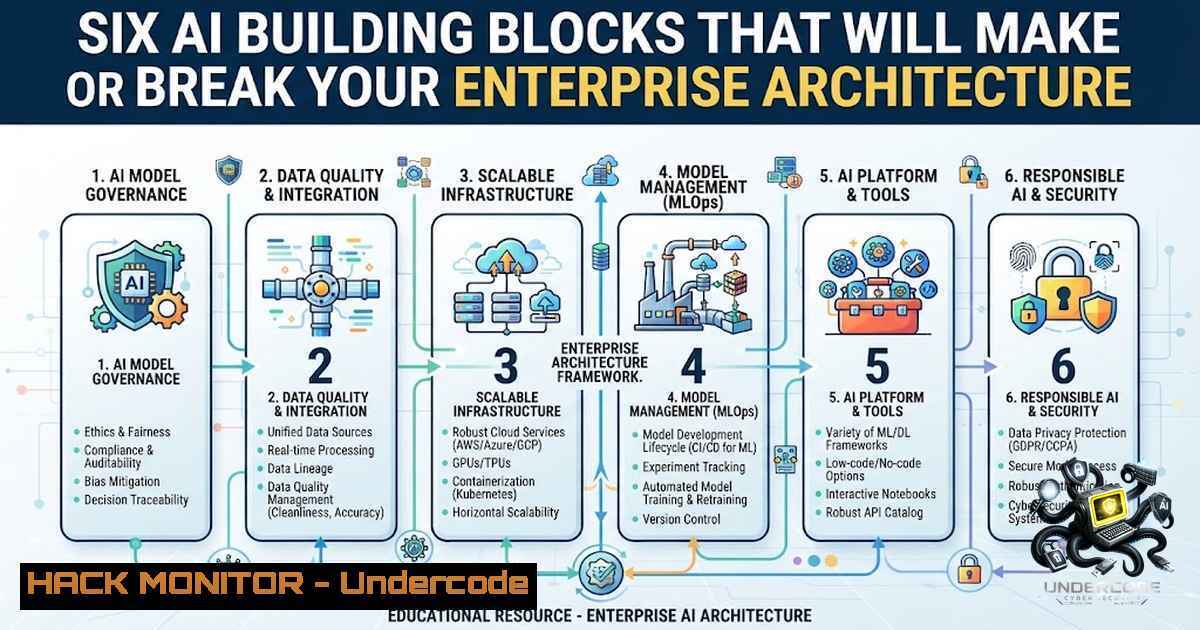
The enterprise AI landscape is rapidly shifting from model-centric discussions to system-oriented architectures. While everyone is talking about AI agents, few practitioners actually understand the foundational components that determine whether these systems succeed or fail in production environments. This article breaks down six critical building blocks—Model Context Protocol, Agent Loops, Skills, Single vs Multi-Agent architectures, Agentic RAG, and Agent Memory—that are becoming the de facto standards for enterprise AI deployment.
Learning Objectives
- Understand the architectural patterns that enable production-grade AI agents in enterprise environments
- Learn how to implement standardised tool connections using MCP and Skills frameworks
- Master the decision-making process between single and multi-agent architectures for complex workflows
You Should Know
1. Model Context Protocol (MCP): The Universal Connector
Think of MCP as USB-C for AI—it provides a standardised way for AI applications to connect to tools and data sources without building custom integrations every time. In enterprise environments, this means connecting Claude to Salesforce, GitHub, Jira, SharePoint, and internal databases through a common interface.
Step-by-Step Implementation Guide:
- Set up the MCP server on your infrastructure:
Linux installation
curl -fsSL https://mcp-server.example.com/install.sh | sudo bash
sudo systemctl start mcp-server
sudo systemctl enable mcp-server
-
Configure tool connections in the MCP configuration file:
{
"tools": {
"salesforce": {
"type": "rest",
"endpoint": "https://your-instance.salesforce.com",
"auth": "oauth2"
},
"github": {
"type": "graphql",
"endpoint": "https://api.github.com/graphql",
"auth": "token"
}
}
}
3. Test the connection using the MCP CLI:
mcp-cli test --tool salesforce --query "SELECT Id, Name FROM Account LIMIT 5"
- Integrate with your AI application using the MCP SDK:
from mcp_sdk import MCPClient</li>
</ol>

client = MCPClient("config.json")
response = client.query(
tool="salesforce",
query="Find all opportunities closing this quarter"
)
5. Monitor connection health with built-in telemetry:
mcp-cli metrics --export prometheus
2. Agent Loops: The Reasoning Engine
Agents don’t need to stop after one response—they can plan, act, evaluate outcomes, and iterate until reaching objectives or stopping conditions. This capability transforms AI from a one-shot responder into a true autonomous problem-solver.
Step-by-Step Implementation Guide:
1. Define your agent loop structure in Python:
class AgentLoop:
def <strong>init</strong>(self, max_iterations=10):
self.max_iterations = max_iterations
self.history = []

def run(self, objective):
for i in range(self.max_iterations):
 Plan phase
plan = self.plan(objective, self.history)
 Act phase
action = self.act(plan)
 Evaluate phase
result = self.evaluate(action)
self.history.append(result)

if self.check_condition(result, objective):
break
return self.final_answer()
2. Implement planning logic with prompting strategies:
def plan(self, objective, history):
context = f"Objective: {objective}\nPrevious attempts: {history}"
prompt = f"You are an AI agent. Create a plan based on {context}"
return llm.generate(prompt)
3. Set stopping conditions using validation logic:
def check_condition(self, result, objective):
if result["quality_score"] > 0.9:
return True
if len(self.history) > self.max_iterations:
return True
return False
4. Use Windows PowerShell for agent orchestration:
 Start the agent loop with monitoring
Start-Job -ScriptBlock {
python agent_loop.py --objective "Review contract for compliance"
}

Check job status
Get-Job | Receive-Job
5. Implement timeout handling to prevent infinite loops:
import signal

def timeout_handler(signum, frame):
raise TimeoutError("Agent loop exceeded time limit")

signal.signal(signal.SIGALRM, timeout_handler)
signal.alarm(300)  5 minutes timeout
3. Skills: Bridging Text to Action
Skills are the capabilities an agent uses to interact with the real world. Without them, an agent only generates text. Skills enable actions like querying Snowflake, executing SQL, calling SAP APIs, sending Outlook emails, creating Jira tickets, or triggering Power Automate workflows.
Step-by-Step Implementation Guide:
1. Define skill functions in your agent framework:
from typing import Dict, Any

def query_snowflake(sql_query: str) -> Dict[str, Any]:
import snowflake.connector
conn = snowflake.connector.connect(
user=os.getenv('SNOWFLAKE_USER'),
password=os.getenv('SNOWFLAKE_PASSWORD')
)
cursor = conn.cursor()
cursor.execute(sql_query)
return cursor.fetchall()

def create_jira_ticket(summary: str, description: str) -> str:
import requests
response = requests.post(
'https://your-domain.atlassian.net/rest/api/2/issue',
json={'fields': {'summary': summary, 'description': description}},
auth=(os.getenv('JIRA_EMAIL'), os.getenv('JIRA_TOKEN'))
)
return response.json()['key']
2. Register skills with your agent:
skills = { "query_snowflake": query_snowflake, "create_jira_ticket": create_jira_ticket, "send_outlook_email": send_outlook_email }- Test skills independently using the Windows command line:
python test_skills.py --skill query_snowflake --param "SELECT COUNT() FROM orders"
4. Implement error handling for skill execution:
def execute_skill(skill_name: str, kwargs):
try:
skill_func = skills.get(skill_name)
if not skill_func:
raise ValueError(f"Unknown skill: {skill_name}")
return skill_func(kwargs)
except Exception as e:
return {"error": str(e), "skill": skill_name}
5. Create skill discovery for dynamic agent capabilities:
def discover_skills():
import inspect
available_skills = {}
for name, func in skills.items():
signature = inspect.signature(func)
available_skills[bash] = {
"params": list(signature.parameters.keys()),
"description": func.<strong>doc</strong>
}
return available_skills
4. Single vs Multi-Agent Architecture
One agent can perform an entire workflow, but multiple specialised agents often produce better results by focusing on different tasks. For example, a Research Agent gathers evidence, a Finance Agent validates assumptions, a Compliance Agent checks policy, and a Writer Agent prepares the executive report.
Step-by-Step Implementation Guide:
1. Design your multi-agent system architecture:
class MultiAgentSystem:
def <strong>init</strong>(self):
self.agents = {
"research": ResearchAgent(),
"finance": FinanceAgent(),
"compliance": ComplianceAgent(),
"writer": WriterAgent()
}
2. Implement agent communication using message passing:
class AgentMessage:
def <strong>init</strong>(self, sender, recipient, content):
self.sender = sender
self.recipient = recipient
self.content = content

def send_message(message):
recipient = message.recipient
if recipient in agents:
agents[bash].receive(message)
3. Define specialised agent logic:
class FinanceAgent:
def validate_assumptions(self, assumptions):
 Validate financial assumptions
return validation_result
4. Orchestrate agent workflow:
def orchestrate_agents(task):
research_result = agents["research"].gather(task)
finance_result = agents["finance"].validate(research_result)
compliance_result = agents["compliance"].check(finance_result)
return agents["writer"].prepare(compliance_result)
5. Monitor agent performance:
 Linux
watch -1 5 "python agent_monitor.py --metrics"

Windows PowerShell
while ($true) { python agent_monitor.py --metrics; Start-Sleep -Seconds 5 }
5. Agentic RAG: Intelligent Retrieval
Traditional RAG retrieves information; Agentic RAG reasons about retrieval. It decides what information is needed, where to find it, whether it can be trusted, and whether another search is required. This creates a dynamic, self-improving retrieval system.
Step-by-Step Implementation Guide:
1. Implement retrieval reasoning:
class AgenticRAG:
def <strong>init</strong>(self, vector_store, data_sources):
self.vector_store = vector_store
self.data_sources = data_sources
self.retrieval_history = []

def reason_and_retrieve(self, query):
reasoning = self.reason_about_query(query)
if reasoning.get("requires_search"):
results = self.search_multiple_sources(reasoning)
validated = self.validate_results(results)
if not validated["trusted"]:
return self.refine_search(query)
return self.generate_answer(query, validated)
2. Implement cross-source validation:
def validate_results(self, results):
validated = {
"trusted": True,
"sources": []
}
for source, content in results.items():
if self.check_source_authenticity(source):
validated["sources"].append(content)
else:
validated["trusted"] = False
return validated
3. Use hybrid search with multiple backends:
def search_multiple_sources(self, reasoning):
sharepoint_results = self.query_sharepoint(reasoning)
teams_results = self.query_teams(reasoning)
salesforce_results = self.query_salesforce(reasoning)
return self.merge_results([sharepoint_results, teams_results, salesforce_results])
4. Test retrieval performance:
curl -X POST http://localhost:8080/retrieve \
-H "Content-Type: application/json" \
-d '{"query": "board paper requirements", "sources": ["sharepoint", "teams", "salesforce"]}'
6. Agent Memory: Context Across Interactions
Memory allows agents to maintain context across interactions without retraining the model. They remember previous conversations, user preferences, work completed, and maintain context across long-running cases.
Step-by-Step Implementation Guide:
1. Implement memory storage:
class AgentMemory:
def <strong>init</strong>(self, storage_type="redis"):
import redis
self.redis_client = redis.Redis(host='localhost', port=6379, db=0)

def store_memory(self, user_id: str, key: str, value: Any):
memory_key = f"memory:{user_id}:{key}"
self.redis_client.set(memory_key, value)

def retrieve_memory(self, user_id: str, key: str):
memory_key = f"memory:{user_id}:{key}"
return self.redis_client.get(memory_key)
2. Create session-based memory:
def create_session_context(session_id: str):
context = {
"preferences": {},
"decisions": [],
"status": "active"
}
memory.store_memory(session_id, "context", context)
return context
3. Manage memory lifecycle:
def expire_old_memories():
import datetime
for memory_key in redis.scan_iter("memory:"):
timestamp = redis.get(f"{memory_key}:timestamp")
if (datetime.now() - timestamp).days > 30:
redis.delete(memory_key)
redis.delete(f"{memory_key}:timestamp")
4. Windows PowerShell memory management:
 Monitor Redis memory usage
redis-cli INFO memory

Set memory expiration policy
redis-cli CONFIG SET maxmemory 2gb
redis-cli CONFIG SET maxmemory-policy allkeys-lru
5. Implement memory retrieval for context:
def get_context_with_memory(user_id: str, session_id: str):
preferences = memory.retrieve_memory(user_id, "preferences")
recent_decisions = memory.retrieve_memory(user_id, "recent_decisions")
return {
"preferences": preferences or {},
"recent_decisions": recent_decisions or [],
"session_status": "continuing"
}
7. Implementation Best Practices and Considerations
Security Hardening
- Implement API key rotation for all connected services:
Linux cron job for key rotation
0 0   0 /usr/local/bin/rotate-api-keys.sh
-
Use Windows Group Policy for agent permission controls:
Set-GPRegistryValue -1ame "AgentPolicy" -Key "HKLM\Software\AgentSystem" -ValueName "MaxRetrievalDepth" -Type DWord -Value 3
3. Deploy network isolation for agent components:
 Docker network isolation
docker network create --internal agent-1etwork
docker run --1etwork agent-1etwork agent-container
Scaling Considerations
1. Implement horizontal scaling with load balancing:
docker-compose up --scale agent=5
2. Use connection pooling for database access:
from sqlalchemy import create_engine
engine = create_engine('postgresql://...', pool_size=10, max_overflow=20)
3. Implement caching strategies:
from functools import lru_cache

@lru_cache(maxsize=1000)
def get_cached_result(query):
return process_query(query)
What Undercode Say
- Key Takeaway 1: The shift from model-centric to system-centric AI architecture represents a fundamental maturation of enterprise AI deployment. Understanding these six building blocks is essential for any organisation looking to move beyond AI experimentation to production-grade solutions.
-
Key Takeaway 2: The most underestimated component in enterprise AI today is Agent Memory, particularly its role in maintaining context across complex, multi-step workflows. Organisations that implement robust memory systems will have a significant competitive advantage in creating truly useful AI assistants.
Analysis: The enterprise AI landscape is experiencing a paradigm shift where success depends less on model selection and more on thoughtful system architecture. These six concepts—MCP, Agent Loops, Skills, Multi-Agent Systems, Agentic RAG, and Agent Memory—represent the foundational infrastructure that will separate successful AI implementations from failed pilots. The conversation is already moving from “Which model should we use?” to “How should we design the system around the model?” Organisations that invest in understanding and implementing these building blocks today will be better positioned to adopt future AI capabilities. The ability to reason about information retrieval, maintain context, and orchestrate specialised agents will become core competencies for enterprise technology teams.
Prediction
+1 Organisations that adopt these architectural patterns will see 60-80% faster AI deployment cycles by 2027, as standardisation through MCP and Skills frameworks eliminates custom integration work.
+N Enterprises that fail to implement proper agent memory and multi-agent orchestration will experience 3-5x higher operational costs due to redundant work, repeated context building, and manual handoffs between specialised agents.
+1 By 2028, Agentic RAG will become the default retrieval method for enterprise knowledge systems, reducing hallucination rates by approximately 40% compared to traditional RAG approaches.
+N Security vulnerabilities in agent-tool communication will become the primary attack vector for AI systems by 2027, requiring immediate investment in secure MCP implementations and skill validation frameworks.
+1 The skill-based architecture pattern will drive a new ecosystem of pre-built enterprise agent capabilities, similar to the API economy, creating a $50B+ market for agent tools and integrations by 2030.
▶️ Related Video (84% Match):
🎯Let’s Practice For Free:
🎓 Live Courses & Certifications:
Join Undercode Academy for Verified Certifications
🚀 Request a Custom Project:
Secure, high-velocity infrastructure and disruptive technological engineering. Contact our engineering team for high-tier development and proprietary systems:
[email protected]
💎 Smart Architecture | 🛡️ Secure by Design | ⭐ Trusted by ThousandsIT/Security Reporter URL:
Reported By: Jean Christophe – Hackers Feeds
Extra Hub: Undercode MoN
Basic Verification: Pass ✅🔐JOIN OUR CYBER WORLD [ CVE News • HackMonitor • UndercodeNews ]
📢 Follow UndercodeTesting & Stay Tuned:
- Test skills independently using the Windows command line:


