Listen to this Post
Introduction:
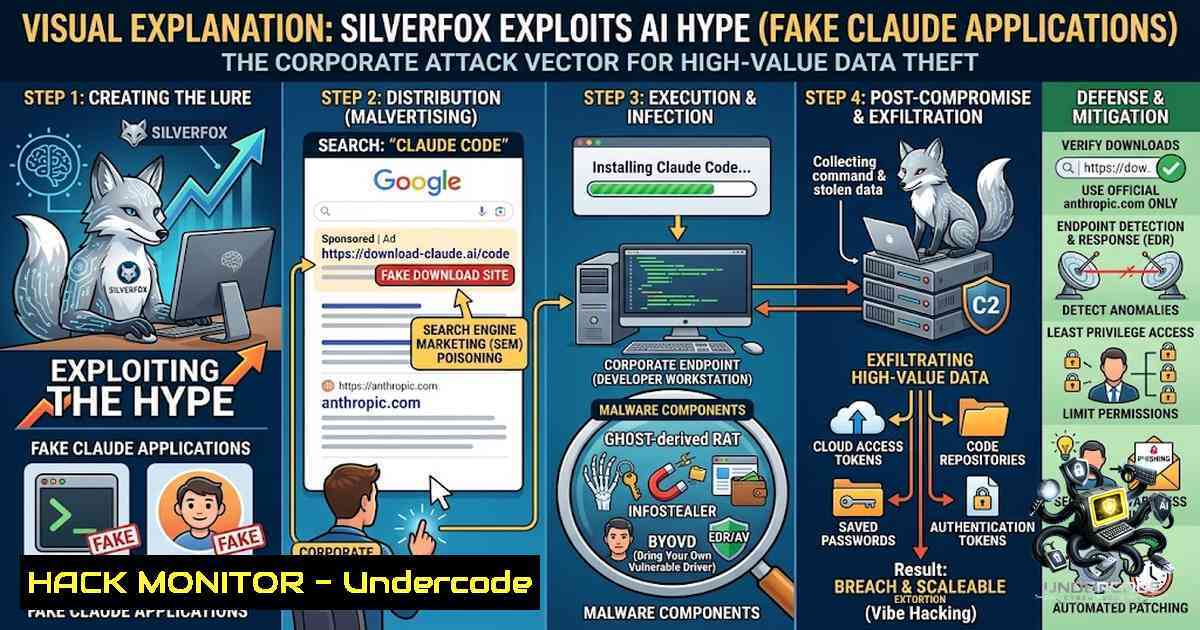
The rapid enterprise adoption of artificial intelligence tools has created a new and dangerous attack surface for organizations worldwide. Cybercriminals are now exploiting this trend by distributing counterfeit AI applications that mimic trusted brands like Claude, transforming employee productivity efforts into potential security breaches. Kaspersky’s Global Research and Analysis Team (GReAT) recently identified the SilverFox advanced persistent threat (APT) group actively targeting companies across the Asia-Pacific region with fake Claude AI applications for Windows, macOS, and Linux. With over 90% of attacks concentrated in Greater China and manufacturing accounting for more than a third of all incidents, this campaign represents a significant evolution in social engineering tactics that leverages brand trust and the urgency of AI adoption.
Learning Objectives:
- Understand the mechanics of the SilverFox fake Claude AI campaign and its implications for enterprise security
- Identify indicators of compromise (IoCs) associated with counterfeit AI applications and phishing lures
- Implement technical controls, including application allowlisting, endpoint monitoring, and Zero Trust architecture, to mitigate Shadow AI risks
You Should Know:
- Understanding the SilverFox Attack Chain: From Phishing to Persistent Access
SilverFox, first identified by Kaspersky researchers in December 2025, employs a multi-pronged approach to infiltrate organizations. The group distributes fake Claude AI applications through three primary vectors: fraudulent websites mimicking official AI vendor pages, phishing emails with malicious attachments, and compromised files shared via social messaging applications.
In one notable campaign between January and February 2026, SilverFox distributed over 1,600 phishing emails disguised as tax audit notifications. These emails instructed recipients to download an archive purportedly containing a “list of tax violations,” which instead triggered a multi-stage malware infection. Once installed, the fake Claude application silently establishes persistence, conducts espionage activities, and exfiltrates sensitive corporate data.
Technical Analysis:
The malware associated with this campaign typically employs the following tactics:
- Persistence mechanisms: Scheduled tasks, registry run keys (Windows), launch agents (macOS), or systemd services (Linux)
- Command and control (C2): Encrypted communications over HTTPS to domains mimicking legitimate AI services
- Data exfiltration: Staged collection of documents, credentials, and browser histories before transmission
Recommended Detection Commands (Linux):
 Check for suspicious scheduled tasks or cron jobs
crontab -l
sudo cat /etc/crontab

Review systemd services for unauthorized entries
sudo systemctl list-units --type=service --all | grep -v "systemd"

Examine recent network connections for suspicious outbound traffic
sudo netstat -tunap | grep ESTABLISHED

Check for unauthorized user accounts or privilege escalation
sudo lastlog | grep -v "Never"
sudo cat /etc/passwd | grep -v "/bin/false" | grep -v "/usr/sbin/nologin"
Windows Detection Commands (PowerShell):
 List scheduled tasks created in the last 30 days
Get-ScheduledTask | Where-Object {$_.Date -gt (Get-Date).AddDays(-30)}

Check for recently modified startup entries
Get-ItemProperty -Path "HKLM:\Software\Microsoft\Windows\CurrentVersion\Run"
Get-ItemProperty -Path "HKCU:\Software\Microsoft\Windows\CurrentVersion\Run"

Review network connections for suspicious processes
netstat -ano | findstr ESTABLISHED
Get-1etTCPConnection | Where-Object {$_.State -eq "Established"}

Examine event logs for anomalous process creation
Get-WinEvent -LogName Security | Where-Object {$_.Id -eq 4688} | Select-Object -First 20
- The SilverFox Targeting Profile: Industries and Geographies at Risk
Kaspersky’s telemetry reveals a clear pattern in SilverFox’s targeting strategy. The Asia-Pacific region bears the brunt of malicious activity, with Greater China representing more than 90% of all attacks and mainland China alone accounting for 71%. In Southeast Asia, Myanmar, Cambodia, and Singapore have emerged as the next highest-risk hotspots.
The group’s sectoral focus is equally revealing. Manufacturing represents the largest target, comprising over one-third of all attacks. IT services, healthcare, and finance are also major targets, reflecting the high-value data and intellectual property these industries possess. The campaign has also extended to industrial, consulting, trade, and transportation sectors across India, Indonesia, South Africa, and Russia.
Risk Assessment Framework:
Organizations in these sectors should conduct a Shadow AI risk assessment using the following methodology:
- Inventory all AI tools in use across the organization, including those installed by employees without IT approval
- Verify the source of each AI application against official vendor distribution channels
- Assess data access permissions for each AI tool, particularly those with access to sensitive corporate information
- Review network egress filtering to detect unauthorized data transfers
Recommended Allowlisting Configuration (Linux – AppArmor):
 Create an AppArmor profile for approved AI applications
sudo aa-genprof /path/to/approved/ai/application

Enforce the profile
sudo aa-enforce /path/to/approved/ai/application

List all enforced profiles
sudo aa-status

Monitor AppArmor denials in system logs
sudo journalctl -f | grep "apparmor="
Windows Application Control (WDAC):
 Create a base policy from a reference system
New-CIPolicy -FilePath "C:\WDAC\BasePolicy.xml" -Level Publisher -Fallback Hash

Convert to binary format
ConvertFrom-CIPolicy -XmlFilePath "C:\WDAC\BasePolicy.xml" -BinaryFilePath "C:\WDAC\BasePolicy.p7b"

Deploy the policy
Set-CIPolicy -FilePath "C:\WDAC\BasePolicy.p7b" -PolicyName "ApprovedAppsPolicy"
- AI as a Double-Edged Sword: Attackers Weaponize Generative AI
Kaspersky warns that AI is not only a target but also a weapon that lowers the cost and technical expertise required to launch sophisticated cyberattacks. The researchers highlighted several alarming developments that illustrate this trend:
JADEPUFFER, described as the first fully LLM-driven ransomware, demonstrates AI making decisions and executing attacks with limited human intervention. In a case disclosed by Sysdig, a malicious AI agent diagnosed a failed attack, changed its approach, and launched another attack in just 31 seconds.
VoidLink, an AI-assisted cloud-1ative malware framework identified in January 2026, exemplifies how generative AI makes sophisticated malware development more accessible to threat actors with limited programming knowledge.
ChatGPhish, an indirect prompt injection technique, hides malicious instructions inside webpages. When users ask an AI assistant to summarize such content, the AI unknowingly relays the malicious instructions or links, effectively turning trusted AI tools into attack vectors.
Defensive Measures:
 Monitor for suspicious outbound traffic to AI-related domains (Linux)
sudo tcpdump -i eth0 -1 'dst port 443' | grep -E "claude|anthropic|openai|chatgpt"

Implement egress filtering with iptables
sudo iptables -A OUTPUT -d 192.168.0.0/16 -j ACCEPT  Allow internal
sudo iptables -A OUTPUT -d 0.0.0.0/0 -j DROP  Block all other outbound
 Then selectively allow approved AI service IPs
Network-Level Protection (Cisco ACL example):
! Block known malicious domains associated with fake AI distribution
ip domain-list block malicious-ai-distribution.com
ip domain-list block fake-claude-download.net
! Implement DNS sinkholing for unauthorized AI domains
ip dns server
ip dns spoofing
4. Building a Comprehensive Shadow AI Defense Strategy
The SilverFox campaign underscores the critical need for organizations to treat AI security as an integral component of their broader cybersecurity strategy. Kaspersky recommends a multi-layered defensive approach:
Application Allowlisting and Control: Deploy strict application control policies that permit only pre-approved AI tools from verified sources. This prevents employees from installing unauthorized software, including counterfeit AI applications.
Endpoint Detection and Response (EDR/XDR): Implement EDR solutions capable of detecting and responding to anomalous process behavior, including unauthorized installation attempts and unusual network connections.
Security Awareness Training: Educate employees about the risks of downloading AI tools from unofficial sources and the importance of verifying software authenticity.
Clear AI Usage Policy: Establish and communicate a formal Shadow AI policy that defines approved AI tools, usage guidelines, and reporting procedures for unauthorized installations.
Implementing EDR Rules (Example – Sysmon Configuration):
<Sysmon schemaversion="4.22">
<!-- Monitor for process creation from unusual locations -->
<EventFiltering>
<ProcessCreate onmatch="exclude">
<Image condition="is">C:\Windows\System32\</Image>
</ProcessCreate>
</EventFiltering>

<!-- Alert on network connections to suspicious domains -->
<EventFiltering>
<NetworkConnect onmatch="include">
<DestinationHostname condition="contains">claude</DestinationHostname>
</NetworkConnect>
</EventFiltering>
</Sysmon>
Linux Auditd Rules for AI Application Monitoring:
 Add audit rules to monitor AI application directories
sudo auditctl -w /opt/claude/ -p wa -k claude-access
sudo auditctl -w /usr/local/bin/ -p wa -k bin-modification

Monitor for execution of unauthorized binaries
sudo auditctl -a always,exit -F arch=b64 -S execve -F path=/tmp/ -k temp-execution

Review audit logs
sudo ausearch -k claude-access
What Undercode Say:
- Key Takeaway 1: The threat is not the AI tool itself but the trust placed in applications simply because they bear a recognizable brand name. Organizations must verify the authenticity of all AI software before installation, regardless of how legitimate it appears.
-
Key Takeaway 2: Shadow AI adoption creates unmanaged security risks that traditional user awareness training alone cannot address. A combination of technical controls—including application allowlisting, endpoint monitoring, and network segmentation—is essential to mitigate this evolving threat vector.
Analysis: The SilverFox campaign represents a watershed moment in the convergence of AI adoption and cyber threats. With over 1,600 malicious emails distributed in a single two-month period and attacks concentrated in high-value sectors like manufacturing and healthcare, the scale and sophistication of this operation demand immediate attention from security teams. The group’s ability to exploit brand trust in Claude, a widely recognized AI platform, demonstrates how attackers are adapting their social engineering techniques to capitalize on the AI gold rush. Moreover, Kaspersky’s warnings about AI-enabled threats like JADEPUFFER, VoidLink, and ChatGPhish highlight a disturbing trend: AI is rapidly becoming both the target and the weapon. As attackers leverage AI to automate decision-making and accelerate every stage of an attack, defenders must respond with the same level of intelligence. Organizations that fail to integrate AI security into their broader cybersecurity strategy risk becoming the next casualty of this evolving threat landscape.
Prediction:
- -1 Accelerated AI-Driven Attacks: As generative AI tools become more accessible, threat actors will increasingly automate attack chains, reducing the time between initial compromise and data exfiltration from days to minutes. The 31-second attack recovery demonstrated by JADEPUFFER is merely the beginning of this trend.
-
-1 Expansion of Brand Impersonation Campaigns: The success of the SilverFox fake Claude campaign will inspire copycat operations targeting other popular AI brands, including ChatGPT, Gemini, and Copilot. Organizations should prepare for a wave of counterfeit AI applications across all major platforms.
-
+1 Evolution of Defensive AI: The SilverFox campaign will accelerate investment in AI-powered threat hunting and detection solutions. Organizations that deploy AI-based detection and response systems will gain a significant advantage in identifying and mitigating AI-enabled attacks.
-
-1 Regulatory Scrutiny on Shadow AI: High-profile incidents like this will prompt regulators to impose stricter requirements on AI usage monitoring and reporting, particularly in highly regulated sectors like healthcare and finance. Organizations should proactively establish Shadow AI policies to avoid compliance penalties.
-
+1 Zero Trust as the New Standard: The campaign’s success in bypassing traditional perimeter defenses will accelerate the adoption of Zero Trust architecture, with organizations implementing stricter identity verification, least-privilege access, and continuous monitoring across all endpoints and networks.
▶️ Related Video (84% Match):
https://www.youtube.com/watch?v=37zJ63CdvPk
🎯Let’s Practice For Free:
🎓 Live Courses & Certifications:
Join Undercode Academy for Verified Certifications
🚀 Request a Custom Project:
Secure, high-velocity infrastructure and disruptive technological engineering. Contact our engineering team for high-tier development and proprietary systems:
[email protected]
💎 Smart Architecture | 🛡️ Secure by Design | ⭐ Trusted by Thousands
IT/Security Reporter URL:
Reported By: https://lnkd.in/p/eptdzq24 – Hackers Feeds
Extra Hub: Undercode MoN
Basic Verification: Pass ✅


