Listen to this Post
Introduction:
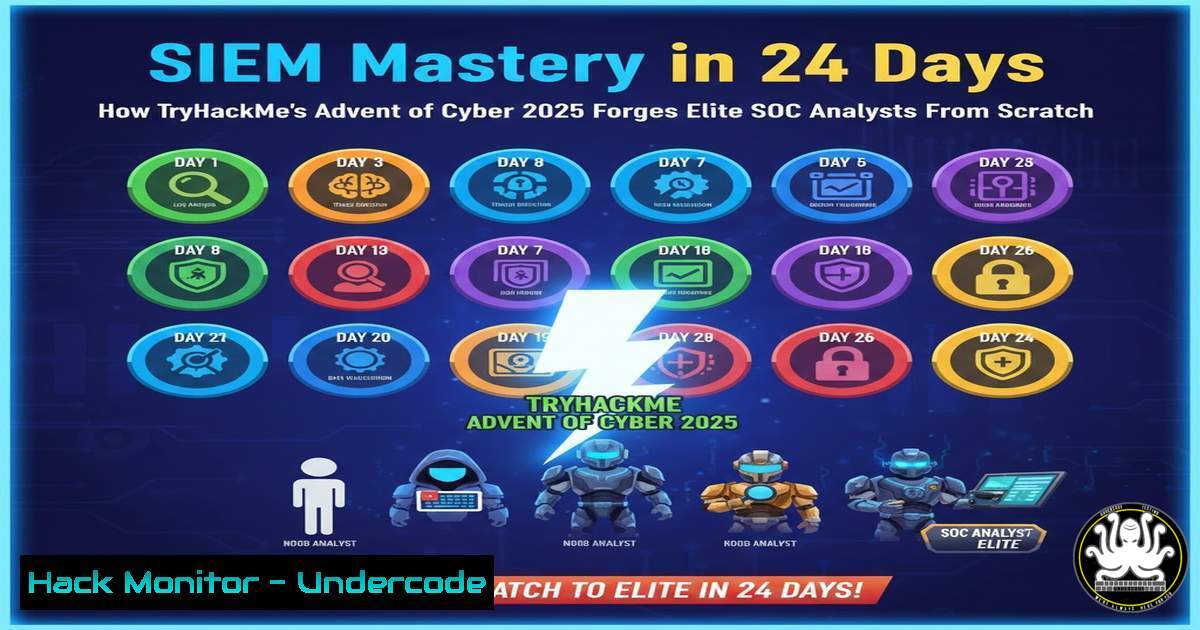
Security Information and Event Management (SIEM) platforms are the central nervous system of a modern Security Operations Center (SOC), aggregating and analyzing log data to detect threats. TryHackMe’s annual “Advent of Cyber” event demystifies this critical technology through guided, hands-on labs, offering a rapid upskilling path for aspiring cybersecurity professionals. This article deconstructs the practical skills gained from challenges like “Splunk Basics,” translating them into a professional learning framework.
Learning Objectives:
- Understand the core function and value proposition of a SIEM in defensive security.
- Gain practical, entry-level proficiency in navigating Splunk and constructing basic searches.
- Learn to apply a threat-hunting mindset to log data for identifying indicators of compromise.
You Should Know:
1. The Foundational Role of SIEM in Cybersecurity
A SIEM (Security Information and Event Management) tool is not just a log collector; it is a correlation engine. It ingests data from endpoints, networks, servers, and applications, normalizes it, and applies rules to identify potentially malicious activity. For a SOC analyst, proficiency in a tool like Splunk, QRadar, or Elastic (ELK Stack) is non-negotiable. It’s the primary interface for incident detection and initial investigation.
Step‑by‑step guide:
The first step is understanding log sources. In a lab environment like TryHackMe, you are typically provided with pre-generated log files. In a real-world scenario, you must ensure syslog, Windows Event Logs, or firewall logs are being forwarded.
– On Linux (Configuring Rsyslog for remote log collection):
 Edit the rsyslog configuration file
sudo nano /etc/rsyslog.conf

Uncomment the following lines to enable UDP log reception (or use TCP @@ for reliability)
module(load="imudp")
input(type="imudp" port="514")

Restart the rsyslog service
sudo systemctl restart rsyslog
– On Windows (Forwarding Event Logs via Group Policy):
Navigate to Computer Configuration > Policies > Administrative Templates > Windows Components > Event Forwarding. Configure the subscription manager to point to your SIEM server’s collector IP.
- Navigating Splunk: From Basic Search to SPL Mastery
Splunk’s Search Processing Language (SPL) is your key to unlocking insights from data. A “Day 3” challenge typically starts with loading a sample data file and running basic searches.
Step‑by‑step guide:
- Upload Data: In Splunk, use the “Add Data” feature to upload a sample log file (e.g.,
web_access.log). - Basic Searching: Start with a raw event search: “ to see everything. Then, refine by source:
source="web_access.log".
3. Using SPL Commands:
stats: Perform statistical operations. `source=”web_access.log” | stats count by client_ip` lists IPs and their request counts.top: Show most common values. `… | top url` reveals the most frequently accessed URLs.search: Filter events. `… | search status=500` finds server errors.table: Format output. `… | table _time, client_ip, status, url` creates a clean report.
- Creating an Alert: From a meaningful search (e.g., detecting brute force:
... | stats count by client_ip | where count > 100), click “Save As” > “Alert”. Set a cron schedule (e.g., every 5 minutes) and trigger actions. -
Threat Hunting with Log Analysis: A Practical Exercise
Threat hunting is a proactive search for adversaries already in your network. Logs are the hunter’s primary evidence. A common exercise is hunting for web shell attacks using web server logs.
Step‑by‑step guide:
Using an Apache `access.log`, look for anomalies:
- Identify Suspicious User-Agents: Known exploit tools and scanners use distinct User-Agent strings.
source="access.log" | stats count by user_agent | sort -count
Look for agents like “sqlmap”, “nikto”, or “Nmap Scripting Engine”.
- Find POST Requests to Unusual Files: Web shells are often uploaded via POST to obscure files.
source="access.log" method=POST | stats count by url
Investigate POST requests to files like
.php,.jsp, or `.asp` in temporary directories. -
Sequence Search for Exploitation: Chain events to see an attack unfold.
source="access.log" client_ip="192.168.1.100" | transaction client_ip startswith=(status=200) endswith=(method=POST)
This groups activity from an IP, showing a successful request followed by a POST, potentially indicating initial access and then payload delivery.
-
Building a SIEM Lab at Home with Open Source Tools
While Splunk offers a free version, building a full lab with open-source tools provides deeper architectural understanding. The ELK Stack (Elasticsearch, Logstash, Kibana) is a powerful alternative.
Step‑by‑step guide:
- Set Up Elasticsearch & Kibana: Use Docker for simplicity.
docker run -d --name elasticsearch -p 9200:9200 -p 9300:9300 -e "discovery.type=single-node" elasticsearch:8.11.0
docker run -d --name kibana --link elasticsearch:elasticsearch -p 5601:5601 kibana:8.11.0
- Configure Logstash: Create a `logstash.conf` pipeline to parse syslog.
input { tcp { port => 5000 type => syslog } } filter { if [bash] == "syslog" { grok { match => { "message" => "%{SYSLOGTIMESTAMP:timestamp} %{SYSLOGHOST:hostname} %{DATA:program}(?:[%{POSINT:pid}])?: %{GREEDYDATA:message}" } } date { match => [ "timestamp", "MMM d HH:mm:ss", "MMM dd HH:mm:ss" ] } } } output { elasticsearch { hosts => ["elasticsearch:9200"] } } - Forward Linux Logs: Send logs from your host to Logstash.
sudo logger -n 127.0.0.1 -P 5000 "Test SIEM Message". -
Visualize in Kibana: Access Kibana at `http://localhost:5601`, create an index pattern, and build dashboards.
-
From Lab to Reality: Key SIEM Use Cases for a Junior Analyst
Hands-on labs build muscle memory for real SOC workflows. Key daily use cases include:
– Brute Force Detection: Alert on multiple failed logins from a single source. SPL: ... | stats count by src_ip | where count > 10.
– Data Exfiltration: Detect large outbound transfers. SPL: ... | stats sum(bytes_out) by dest_ip | where sum_bytes_out > 100000000.
– Unusual Process Execution: In endpoint logs, alert on execution of `powershell.exe` with encoded commands or `certutil.exe` used to download files.
What Undercode Say:
- Democratization of Expertise: Advent of Cyber and platforms like TryHackMe are critically lowering the barrier to entry for cybersecurity. They provide contextually rich, safe environments where theoretical knowledge from certifications (like CompTIA Security+) is transformed into practical, repeatable skill.
- The “Hands-On” Imperative: The post highlights that engagement comes from doing. Passive learning is insufficient in cybersecurity. The future analyst is forged not by reading about Splunk, but by constructing SPL queries to catch a simulated attacker in a holiday-themed story.
The analysis centers on a paradigm shift in security training. Traditional education often leaves a “practicality gap” between theory and job readiness. Interactive cyber ranges bridge this gap efficiently. The poster’s progression—from CompTIA and Google certifications to applied TryHackMe labs—exemplifies the ideal modern learning path: validate foundational knowledge with a cert, then build tacit skill through continuous, guided practice. This approach directly addresses the industry’s talent shortage by creating job-ready candidates faster.
Prediction:
The success of gamified, event-driven learning like Advent of Cyber will accelerate the integration of cyber range technology directly into corporate onboarding and continuous training programs. We will see a rise in “Micro-SOC” simulations as a standard component of security education, reducing the time-to-productivity for junior analysts from months to weeks. Furthermore, the underlying technology of these platforms will evolve to leverage AI not just for generating attacks, but for providing personalized, adaptive learning paths and real-time, intelligent hint systems that mimic a senior mentor, making advanced threat hunting and digital forensics skills accessible to a broader audience sooner.
🎯Let’s Practice For Free:
IT/Security Reporter URL:
Reported By: Malini L – Hackers Feeds
Extra Hub: Undercode MoN
Basic Verification: Pass ✅


