Listen to this Post
Introduction
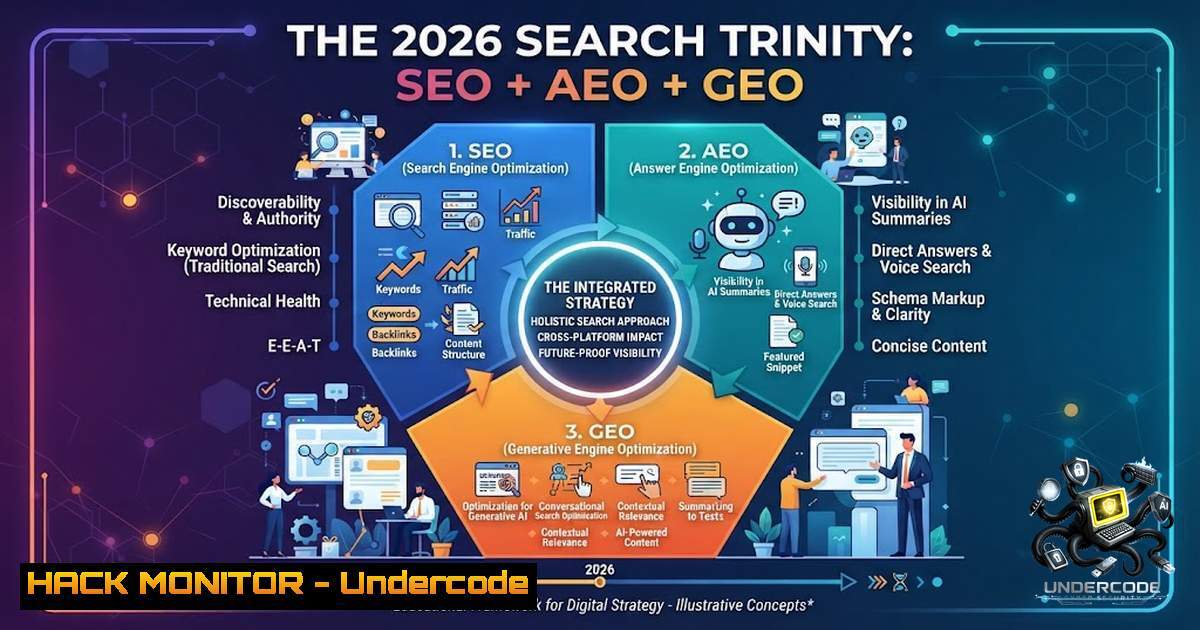
The search landscape has undergone a seismic shift. In 2026, traditional search engine optimization (SEO) alone is no longer sufficient to guarantee visibility. With Gartner projecting a 25% decline in traditional search volume and SparkToro reporting that 58.5% of Google searches now end without a click, the strategy isn’t SEO versus AEO versus GEO—it is SEO + AEO + GEO working in concert. Answer Engine Optimization (AEO) and Generative Engine Optimization (GEO) have emerged as critical layers that determine whether your brand gets cited by AI assistants like ChatGPT, Gemini, and Claude, or vanishes into digital obscurity.
Learning Objectives
- Understand the distinct roles of SEO, AEO, and GEO in the 2026 search ecosystem
- Learn how to structure content for AI extraction and citation
- Master technical implementations including Schema markup, FAQPage architecture, and entity-based optimization
- Develop a unified strategy that compounds visibility across all three search layers
- SEO: The Foundation That Still Matters—But Not Enough
Search Engine Optimization remains the essential, long-term driver of organic traffic. However, the game has changed. In 2026, SEO is about building topical authority and technical excellence, not keyword stuffing. The focus has shifted away from 3,000-word blog posts toward Entity SEO—using Schema markup to help search engines understand exactly what your content means.
What This Means for You:
- Technical health and Core Web Vitals are non-1egotiable
- Content must be organized into comprehensive, interlinked clusters
- Backlinks and domain authority still matter—but they’re table stakes, not differentiators
Why SEO Alone Fails: High competition, slow results, and increasing vulnerability to “zero-click” scenarios mean ranking 1 no longer guarantees traffic.
Technical Implementation: Core Web Vitals Audit
 Linux - Check Core Web Vitals using Lighthouse CLI
npm install -g lighthouse
lighthouse https://yourdomain.com --view --preset=desktop

Monitor server response times
curl -o /dev/null -s -w "Time to First Byte: %{time_starttransfer}s\n" https://yourdomain.com

Check DNS resolution and connection times
dig yourdomain.com +stats
 Windows - Test page speed with PowerShell
Invoke-WebRequest -Uri "https://yourdomain.com" -UseBasicParsing
Measure-Command { Invoke-WebRequest -Uri "https://yourdomain.com" -UseBasicParsing }
2. AEO: Winning the Answer, Not the Click
Answer Engine Optimization focuses on winning direct answers—particularly for voice search and featured snippets, which now make up over 50% of 2026 search queries. AEO is the practice of structuring your content, data, and authority signals so that AI assistants cite and recommend your brand when someone asks a category-level question.
The Core Difference: SEO optimizes for a position in a list of results; AEO optimizes for inclusion in the single answer the model generates. SEO gets you indexed; AEO gets you cited.
AEO Best Practices:
- Answer specific “who, what, when, why” questions immediately (within 40-60 words)
- Use FAQPage schema to appear in conversational AI summaries
- Write in concise, structured blocks with clear entity relationships
- Create question-based content clusters rather than generic blog posts
The AEO Catch: Zero-click answers reduce traffic even when you win. Your goal shifts from driving clicks to building brand recall and citation share.
Technical Implementation: FAQPage Schema for AEO
{
"@context": "https://schema.org",
"@type": "FAQPage",
"mainEntity": [{
"@type": "Question",
"name": "What is the difference between SEO and AEO?",
"acceptedAnswer": {
"@type": "Answer",
"text": "SEO helps your website rank in traditional search results so users find and click your pages. AEO helps your content be extracted as a direct answer by AI tools like Google AI Overviews, ChatGPT, and voice assistants, without the user having to click anything."
}
}]
}
Testing Your Structured Data:
 Validate Schema markup using Google's Rich Results Test
curl -X POST "https://search.google.com/test/rich-results" \
-H "Content-Type: application/json" \
-d '{"url":"https://yourdomain.com/page"}'
3. GEO: The AI Citations Frontier
Generative Engine Optimization is the newest frontier—a method for gaining trust and citations from AI tools such as ChatGPT, Gemini, Perplexity, and Google AI Overviews. GEO focuses specifically on how large language models retrieve, synthesize, and attribute information when they construct responses.
What GEO Rewards:
- Content that is “chunked” into atomic, fact-dense passages instead of long narratives
- High E-E-A-T (Expertise, Experience, Authoritativeness, Trustworthiness)
- Cited sources, statistics, quotations, and authoritative language
- Original research and clear factual statements that a model can lift
The Measurement Challenge: Traditional metrics like click-through rate don’t apply. Success is measured by Citation Share of Voice—how often your brand is referenced in AI-generated responses.
Technical Implementation: Content Chunking for AI Extraction
 Python script to analyze content chunking for GEO readiness
import re
from collections import Counter

def analyze_content_chunking(text):
 Split into atomic fact units (sentences containing factual claims)
sentences = re.split(r'[.!?]+', text)
fact_patterns = [r'\d+%', r'\d+ (million|billion|thousand)', r'according to', r'research shows']

fact_density = []
for sent in sentences:
if any(re.search(p, sent) for p in fact_patterns):
fact_density.append(len(sent.split()))

return {
'total_sentences': len(sentences),
'fact_dense_sentences': len(fact_density),
'avg_fact_length': sum(fact_density)/len(fact_density) if fact_density else 0
}

Example usage
content = "Your article content here..."
print(analyze_content_chunking(content))
- The Unified Strategy: SEO + AEO + GEO as One Practice
A common mistake is treating SEO, AEO, and GEO as separate disciplines. They are not. SEO, AEO, and GEO form a unified practice serving three distinct audiences. The work that earns visibility in an AI answer is the same work that earned visibility in a blue link—what changed is not the discipline, but the surface.
The Layered Approach:
1. SEO builds the technical and authority foundation
- AEO ensures your content is structurally legible and semantically precise for extraction
- GEO positions your brand as a trusted source worthy of citation in AI-generated summaries
Enterprise Reality: AEO carries no backlink-style fallback for structural weakness the way SEO does. If your content isn’t clean enough to extract and cite, no amount of backlinks will save you.
Implementation Checklist
 Unified SEO + AEO + GEO Audit Checklist
technical_seo:
- Core Web Vitals passed
- XML sitemap submitted
- robots.txt configured
- Mobile-friendly verified

content_structure:
- FAQPage schema implemented
- Question-based content clusters created
- Direct answers within 40-60 words
- Entity relationships mapped with Schema

authority_signals:
- Original research published
- Expert quotes and statistics included
- Author bios with E-E-A-T signals
- Backlink profile maintained

measurement:
- Citation tracking implemented
- Brand mention monitoring active
- Traditional SEO analytics in place
- The Zero-Click Reality: Why Traditional Metrics Are Broken
The shift to AI-powered search has fundamentally changed how success is measured. Traditional SEO measures success through keyword rankings, organic click-through rates, domain authority growth, and traffic volume. But in a world where 58.5% of searches end without a click, these metrics tell an incomplete story.
What’s Changed:
- Users now spend more time inside assistant chats
- Follow-up questions get handled through natural language processing
- Multimodal answers mix text, images, and video in the same response
The New Metrics:
- Citation Rate: How often your brand is named in AI responses
- Brand Representation: Your share of voice in AI-generated answers
- Reference Rate: How frequently you’re cited in generative responses
- Schema Markup: The Most Impactful Action for 2026
Implementing structured data is the single most impactful action you can take this year. Large language models rely on Schema markup even more than traditional search engines do. Schema helps AI systems understand your content’s meaning, relationships, and context without ambiguity.
Priority Schema Types for 2026:
- FAQPage and QAPage for direct answers
- HowTo for procedural content
- Product and Offer for e-commerce
- with author and datePublished for news content
- Organization and Person for entity authority
Technical Implementation: Entity SEO with Schema
{
"@context": "https://schema.org",
"@type": "",
"headline": "Your ",
"author": {
"@type": "Person",
"name": "Author Name",
"sameAs": ["https://linkedin.com/in/author", "https://twitter.com/author"]
},
"publisher": {
"@type": "Organization",
"name": "Your Brand",
"logo": {
"@type": "ImageObject",
"url": "https://yourdomain.com/logo.png"
}
},
"datePublished": "2026-07-13",
"dateModified": "2026-07-13",
"mainEntityOfPage": {
"@type": "WebPage",
"@id": "https://yourdomain.com/article"
},
"about": {
"@type": "Thing",
"name": "SEO AEO GEO 2026"
}
}
7. What Undercode Say
- SEO is the foundation, but it’s no longer the full picture. In 2026, building topical authority and technical excellence matters more than keyword density. Your content must be discoverable, indexable, and trusted before AI can even consider citing it.
-
AEO and GEO are not replacements—they are extensions. The strategy is SEO + AEO + GEO, not SEO versus AEO versus GEO. AEO runs on top of SEO, and GEO extends both. You cannot afford to pick one.
Analysis: The 2026 search paradigm represents a fundamental shift from ranking pages to becoming the answer AI delivers. Brands that continue optimizing only for traditional SEO are effectively invisible to a growing segment of their target audience. The winners will be those who treat SEO, AEO, and GEO as a unified practice—building technical foundations, structuring content for extraction, and positioning themselves as authoritative sources worthy of AI citation. The challenge isn’t technical complexity; it’s organizational inertia. Most teams are still playing a 2015 game while the search landscape has moved to 2026.
Prediction
- +1 Brands that adopt a unified SEO + AEO + GEO strategy in 2026 will capture early-mover advantage in AI search channels, establishing themselves as trusted sources before competitors even recognize the shift.
-
-1 Businesses that continue optimizing solely for traditional search will experience accelerating traffic declines as zero-click results and AI Overviews consume an ever-larger share of user attention.
-
+1 The emergence of citation-based metrics will create new opportunities for smaller brands with high-quality, authoritative content to compete against larger competitors with bigger backlink profiles.
-
-1 Enterprise teams that treat AEO as a separate initiative requiring new budgets and separate workflows will waste months on organizational restructuring before addressing the fundamental question: “Is my content clean enough to extract and cite?”
-
+1 Schema markup and structured data expertise will become the most valuable SEO skills in the job market, as LLMs rely on them even more than traditional search engines do.
-
-1 Brands that fail to implement FAQPage schema and question-based content clusters will be systematically excluded from conversational AI summaries, losing visibility in the fastest-growing search channel.
▶️ Related Video (74% Match):
https://www.youtube.com/watch?v=0pI_ATJaF4k
🎯Let’s Practice For Free:
🎓 Live Courses & Certifications:
Join Undercode Academy for Verified Certifications
🚀 Request a Custom Project:
Secure, high-velocity infrastructure and disruptive technological engineering. Contact our engineering team for high-tier development and proprietary systems:
[email protected]
💎 Smart Architecture | 🛡️ Secure by Design | ⭐ Trusted by Thousands
IT/Security Reporter URL:
Reported By: Where Seo – Hackers Feeds
Extra Hub: Undercode MoN
Basic Verification: Pass ✅


