Listen to this Post
Introduction:
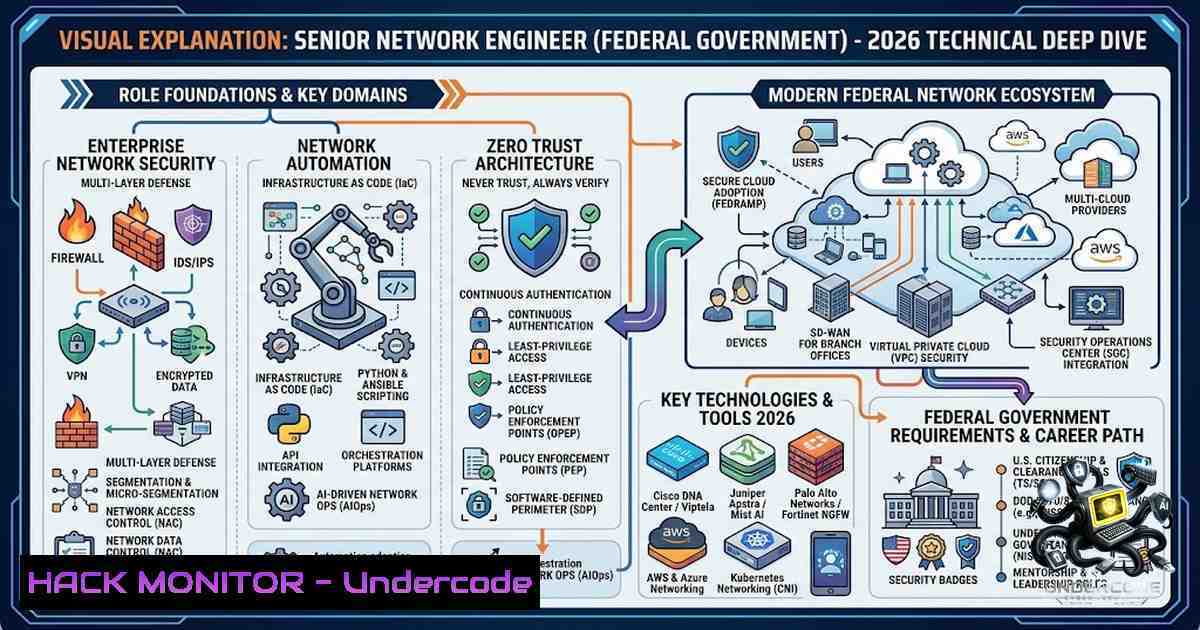
The Australian Federal Government’s ongoing digital transformation has created an urgent demand for Senior Network Engineers who can architect, secure, and automate enterprise-scale infrastructure. IT Alliance Australia is currently seeking qualified professionals for a Canberra-based role, but the technical bar has never been higher. Modern network engineers must master everything from traditional routing protocols to AI-driven automation, Zero Trust security models, and compliance with the Australian Government’s Information Security Manual (ISM) and Protective Security Policy Framework (PSPF). This article provides a comprehensive technical roadmap covering the essential skills, commands, and certifications required to succeed in these high-stakes environments.
Learning Objectives:
- Master enterprise network design and troubleshooting using Cisco, Juniper, and Aruba technologies with a focus on Federal Government security frameworks
- Implement network automation workflows using Python, Ansible, and REST APIs to reduce manual configuration errors
- Apply Zero Trust segmentation and network hardening techniques aligned with ACSC guidance to contain breaches and limit attack surfaces
You Should Know:
1. Core Networking Competencies and Certification Requirements
Federal Government Senior Network Engineer roles demand deep expertise across the entire OSI stack. Essential certifications include CCNA, CCNP, or equivalent qualifications, alongside ITIL Foundation certification. Candidates must demonstrate expert knowledge of routing protocols including BGP, OSPF, and EIGRP, as well as hands-on experience with Cisco data centre technologies like Cisco ACI, Nexus switches, and enterprise-grade routers.
Step-by-Step Guide: Network Protocol Troubleshooting
On Linux systems, verify routing tables and neighbour adjacencies:
 Display the kernel IP routing table
ip route show

Show detailed BGP neighbour status (requires FRR or Quagga)
vtysh -c "show ip bgp summary"

Capture and analyse OSPF neighbour relationships
vtysh -c "show ip ospf neighbor"

Continuous packet capture for advanced troubleshooting
tcpdump -i eth0 -1n -s 0 -w capture.pcap
On Windows systems, use these equivalent commands:
 Display the routing table
route print

View active network connections and listening ports
netstat -ano

Test network path and identify hops
tracert -d 192.168.1.1

Perform a continuous ping test with timestamp logging
ping -t 8.8.8.8 | ForEach-Object {"$(Get-Date) $_"} >> ping_log.txt
2. Network Security Hardening and Compliance
Federal Government environments require strict adherence to the ACSC’s Essential Eight and ISM controls. Network segmentation based on business functions and security zones is critical to containing breaches and limiting impact. Implement defence-in-depth by hardening SSH configurations, deploying Fail2Ban, and configuring cloud firewalls with minimal open ports.
Step-by-Step Guide: SSH Hardening on Linux Servers
 Step 1: Edit the SSH daemon configuration
sudo nano /etc/ssh/sshd_config

Apply these hardening settings:
 PermitRootLogin no
 PasswordAuthentication no
 PubkeyAuthentication yes
 AllowUsers your_username
 MaxAuthTries 3
 ClientAliveInterval 300
 ClientAliveCountMax 2

Step 2: Restart SSH service
sudo systemctl restart sshd

Step 3: Configure Fail2Ban to block brute-force attempts
sudo apt-get install fail2ban -y
sudo systemctl enable fail2ban
sudo systemctl start fail2ban

Step 4: Verify Fail2Ban status
sudo fail2ban-client status sshd
Windows Server Hardening Commands (PowerShell):
 Disable unnecessary services
Set-Service -1ame "Telnet" -StartupType Disabled
Set-Service -1ame "RemoteRegistry" -StartupType Disabled

Configure Windows Firewall with strict inbound rules
New-1etFirewallRule -DisplayName "Block All Inbound Except RDP" -Direction Inbound -Action Block
New-1etFirewallRule -DisplayName "Allow RDP from Specific IP" -Direction Inbound -LocalPort 3389 -Protocol TCP -Action Allow -RemoteAddress "192.168.1.0/24"

Enable Windows Defender Exploit Guard
Set-MpPreference -EnableNetworkProtection Enabled
3. Network Automation and Programmability
The 2026 network engineer must be proficient in Python, REST APIs, Ansible, and Git to automate repetitive tasks and reduce human error. Advanced roles now require building LLM-powered network agents and using MCP servers for intelligent automation workflows. Cisco U. offers dedicated learning paths for AI-powered network management and automation.
Step-by-Step Guide: Python Script for Automated Network Device Backup
!/usr/bin/env python3
"""
Automated backup script for Cisco devices using Netmiko
Requires: pip install netmiko
"""

from netmiko import ConnectHandler
from datetime import datetime
import os

Define device parameters
devices = [
{
'device_type': 'cisco_ios',
'host': '192.168.1.1',
'username': 'admin',
'password': 'secure_password',
'secret': 'enable_secret'
},
 Add additional devices as needed
]

backup_dir = "./network_backups"
os.makedirs(backup_dir, exist_ok=True)

for device in devices:
try:
connection = ConnectHandler(device)
connection.enable()

Capture running configuration
output = connection.send_command("show running-config")

Generate timestamped filename
timestamp = datetime.now().strftime("%Y%m%d_%H%M%S")
filename = f"{backup_dir}/{device['host']}_{timestamp}.cfg"

with open(filename, 'w') as f:
f.write(output)

print(f"✅ Backup successful: {filename}")
connection.disconnect()

except Exception as e:
print(f"❌ Backup failed for {device['host']}: {str(e)}")
4. API Security and Cloud Hardening
Federal Government networks increasingly integrate with cloud services and APIs. Engineers must implement robust API security measures including OAuth 2.0, rate limiting, input validation, and comprehensive logging. Zero Trust principles require continuous verification of every access request, regardless of network location.
Step-by-Step Guide: Implementing API Rate Limiting with Nginx
 /etc/nginx/nginx.conf
http {
 Define rate limiting zone
limit_req_zone $binary_remote_addr zone=api_limit:10m rate=10r/s;

server {
listen 443 ssl;
server_name api.gov.example;

Apply rate limiting to API endpoints
location /api/ {
limit_req zone=api_limit burst=20 nodelay;
limit_req_status 429;

Enforce strict SSL/TLS
ssl_protocols TLSv1.2 TLSv1.3;
ssl_ciphers HIGH:!aNULL:!MD5;

Proxy to backend
proxy_pass http://backend_api;
proxy_set_header X-Real-IP $remote_addr;
proxy_set_header X-Forwarded-For $proxy_add_x_forwarded_for;
}
}
}
Windows Server API Security with IIS:
 Install IIS URL Rewrite module for rate limiting
Install-WindowsFeature -1ame Web-Server, Web-Dyn-Compression, Web-Url-Rewrite

Configure request filtering to block malicious patterns
Add-WebConfigurationProperty -Filter "system.webServer/security/requestFiltering/denyUrlSequences" -1ame "." -Value @{string="/../"}
Add-WebConfigurationProperty -Filter "system.webServer/security/requestFiltering/denyUrlSequences" -1ame "." -Value @{string="/./"}

Enable failed request tracing for security auditing
Set-WebConfigurationProperty -Filter "system.webServer/tracing/traceFailedRequests" -1ame "enabled" -Value "True"
5. Zero Trust Architecture Implementation
Zero Trust is no longer optional for Federal Government networks. Engineers must design networks that assume breach and verify explicitly. This involves micro-segmentation, continuous monitoring, and least-privilege access controls. The ACSC provides specific guidance on implementing network segmentation and segregation to contain compromises.
Step-by-Step Guide: Implementing Network Segmentation with VLANs and ACLs
On Cisco IOS devices:
! Create VLANs for different security zones
vlan 10
name MANAGEMENT
vlan 20
name USER_DATA
vlan 30
name GUEST
vlan 40
name DMZ

! Configure SVI interfaces with access control
interface vlan 10
ip address 10.0.10.1 255.255.255.0
ip access-group MANAGEMENT-ACL in

! Apply strict ACLs between zones
ip access-list extended MANAGEMENT-ACL
permit tcp 10.0.10.0 0.0.0.255 10.0.20.0 0.0.0.255 eq ssh
permit tcp 10.0.10.0 0.0.0.255 10.0.40.0 0.0.0.255 eq https
deny ip any any log
Linux Firewall Configuration with nftables:
 Create nftables configuration for network segmentation
sudo nft add table inet filter
sudo nft add chain inet filter input { type filter hook input priority 0 \; }
sudo nft add chain inet filter forward { type filter hook forward priority 0 \; }

Allow established connections
sudo nft add rule inet filter input ct state established,related accept

Allow SSH from management subnet only
sudo nft add rule inet filter input ip saddr 10.0.10.0/24 tcp dport 22 accept

Drop all other traffic
sudo nft add rule inet filter input drop

Save configuration
sudo nft list ruleset > /etc/nftables.conf
sudo systemctl enable nftables
What Undercode Say:
- Key Takeaway 1: Federal Government network engineering roles demand a rare combination of traditional networking expertise (CCNA/CCNP, routing protocols, Cisco/Juniper/Aruba) and modern security automation skills, making certified professionals highly valuable in the current market.
-
Key Takeaway 2: The shift toward AI-driven network automation and Zero Trust architectures means engineers must continuously upskill—proficiency in Python, Ansible, REST APIs, and security frameworks like the ISM and PSPF is no longer optional but mandatory for career progression.
The intersection of Federal Government security requirements and cutting-edge network automation creates a unique career niche. Engineers who can bridge the gap between traditional route/switch expertise and modern programmable infrastructure will command premium positions. The Canberra market, in particular, offers sustained demand due to the concentration of government agencies and defence contractors. However, the barrier to entry remains high—Australian citizenship and the ability to obtain at least NV1 security clearance are non-1egotiable prerequisites. Organizations like IT Alliance Australia are actively seeking these professionals, and the trend toward long-term contracts with extension options suggests stable, rewarding career paths for those who invest in the right technical certifications and hands-on experience.
Prediction:
- +1 The convergence of AI-powered network automation with Federal Government security mandates will create a new class of “Security Automation Engineers” by 2028, combining DevOps practices with classified network environments.
-
+1 Australian Federal Government agencies will increasingly adopt Zero Trust Network Access (ZTNA) and SASE architectures, driving demand for engineers with expertise in Zscaler, Palo Alto, and similar platforms.
-
-1 The skills gap in network automation and AI integration will widen, potentially delaying government digital transformation initiatives and creating security vulnerabilities in legacy infrastructure.
-
-1 Stricter security clearance requirements and the concentration of roles in Canberra may create geographic talent shortages, limiting the pool of qualified candidates and driving up salary expectations for those who meet all criteria.
▶️ Related Video (62% Match):
https://www.youtube.com/watch?v=4V18cNx_zVQ
🎯Let’s Practice For Free:
🎓 Live Courses & Certifications:
Join Undercode Academy for Verified Certifications
🚀 Request a Custom Project:
Secure, high-velocity infrastructure and disruptive technological engineering. Contact our engineering team for high-tier development and proprietary systems:
[email protected]
💎 Smart Architecture | 🛡️ Secure by Design | ⭐ Trusted by Thousands
IT/Security Reporter URL:
Reported By: Seniornetworkengineer Share – Hackers Feeds
Extra Hub: Undercode MoN
Basic Verification: Pass ✅


