
Listen to this Post
Introduction:
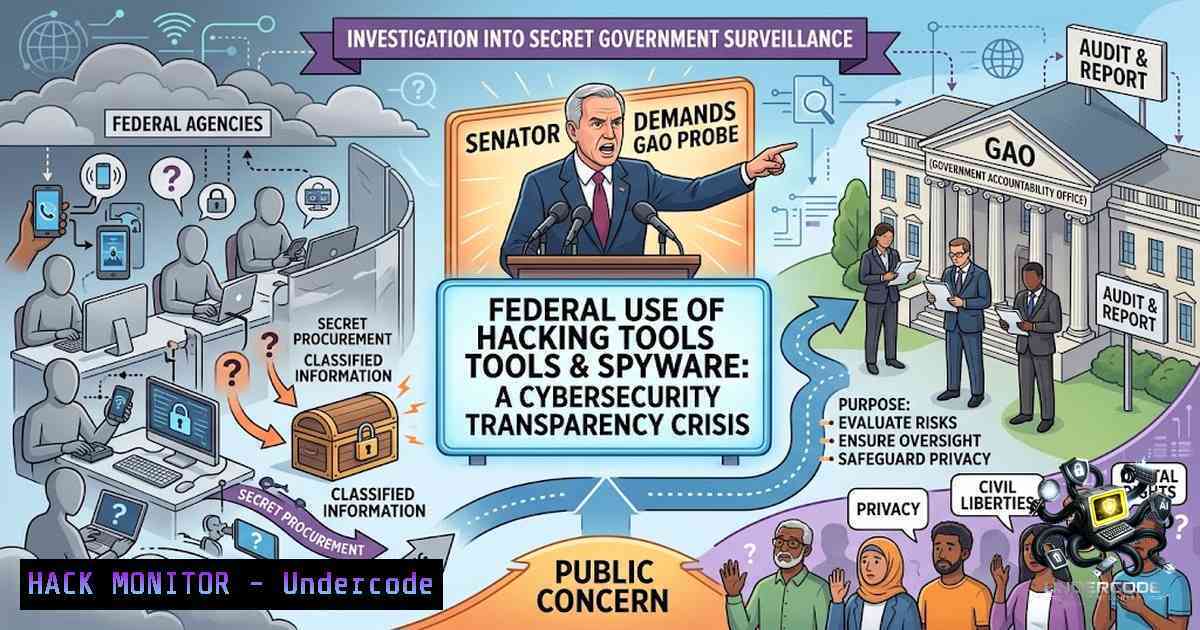
For over 25 years, U.S. federal law enforcement agencies—including the FBI, DEA, Secret Service, and ICE’s Homeland Security Investigations—have employed sophisticated hacking tools and spyware in domestic investigations. Yet unlike wiretaps and pen registers, which require public annual reports, the government has never published comparable transparency data for hacking operations. On August 21, 2026, Senator Ron Wyden and Representative Greg Casar formally requested the Government Accountability Office (GAO) to launch a comprehensive, unclassified review of how these agencies acquire, store, secure, and deploy offensive cyber capabilities against Americans. This demand arrives amid documented cases of tool misuse, dangerous leaks to foreign adversaries, and a multi-administration pattern of ignoring congressional transparency requests.
Learning Objectives & Secrets:
- Objective 1 – Map the Federal Hacking Tool Ecosystem: Understand which agencies (FBI, DEA, ICE/HSI, Secret Service) purchase and deploy commercial and custom-built hacking tools, including zero-day exploits, implants, and spyware.
-
Objective 2 – Audit Procurement, Storage, and Security Controls: Learn how to assess whether agencies submit discovered vulnerabilities to the Vulnerabilities Equities Process (VEP) for responsible disclosure, and evaluate the cybersecurity measures preventing dangerous leaks.
-
Objective 3 – Evaluate Judicial Transparency and Collateral Risk: Discover how agencies inform courts when seeking Rule 41 hacking warrants, and whether they disclose the risk of affecting unknown or innocent targets.
You Should Know:
- The Historical Precedent – From Magic Lantern to Zero-Day Exploits
The earliest documented FBI spyware deployment dates back to 1999. During an investigation into Philadelphia mobster Nicodemo S. Scarfo, federal agents discovered he used Pretty Good Privacy (PGP) to encrypt a critical file. The FBI physically installed a rudimentary keylogger on his computer—a technique classified at the time—to capture his encryption keystrokes and decrypt the evidence. By 2001, the Bureau had developed “Magic Lantern,” a remotely deployable spyware agent.
Fast-forward to today: the government’s hacking arsenal has evolved into multi-million-dollar zero-day exploits. Trenchant—the division of defense contractor L3Harris—employs teams of hackers who dig deep into software from Google, Apple, and others, identifying unknown flaws and turning them into reliable, weaponized exploits. These zero-days can be worth millions of dollars each. The government’s failure to transparently report how often, and for what reasons, these capabilities are deployed against Americans is precisely what Wyden and Casar aim to remedy.
- The Peter Williams Case – A Blueprint for Tool Proliferation Risks
To illustrate the acute dangers of inadequate security around hacking tools, Senator Wyden specifically cited the case of Peter Williams, a former executive at L3Harris. Williams, who was the general manager of Trenchant, had “full access” to the company’s secure networks. Between 2022 and 2025, he stole at least eight zero-day exploit components—intended exclusively for U.S. government and allied use—and sold them to Operation Zero, a Russian exploit broker the U.S. government calls “one of the world’s most nefarious”.
Williams received $1.3 million in cryptocurrency for the theft. Prosecutors stated the stolen tools caused $35 million in losses to L3Harris and could have enabled access to millions of devices worldwide. The exploits ended up being used by Russian spies against Ukraine and by Chinese cybercriminals against cryptocurrency owners. Williams was sentenced to 87 months in prison.
Step‑by‑Step Guide – How to Audit Government Hacking Tool Security (Blue Team / Red Team Perspective):
- Inventory and Classify: Identify all offensive security tools, zero-day exploits, and implants within your organization. Classify by target platform (Windows, Linux, iOS, Android), persistence mechanism, and exfiltration capability.
-
Map Acquisition Chain: Document procurement sources—whether built in-house (like Trenchant) or purchased from commercial vendors (NSO Group, Candiru, etc.). Verify vendor vetting and supply chain security.
-
Implement Isolation and Access Controls: Store hacking tools in air-gapped, segmented environments with strict role-based access. Williams exploited “full access” to download tools to a portable hard drive—enforce least-privilege principles and monitor all data egress.
-
Establish VEP Integration: Ensure any discovered zero-day vulnerability is submitted to the Vulnerabilities Equities Process for review. The VEP determines whether the government should disclose the flaw to vendors for patching or retain it for operational use.
-
Deploy Continuous Monitoring and Auditing: Use SIEM (e.g., Splunk, ELK) with custom alerts for unauthorized access to exploit repositories. Implement file integrity monitoring (FIM) on all systems housing offensive tools.
Linux Command (Audit File Access):
 Monitor all access to /opt/exploit_repo in real-time
auditctl -w /opt/exploit_repo -p rwxa -k exploit_access
 Search audit logs for access events
ausearch -k exploit_access --format raw | aureport -f -i
Windows Command (Audit Object Access via PowerShell):
 Enable advanced audit policy for file access
auditpol /set /subcategory:"File System" /success:enable /failure:enable
 Use Sysmon or Windows Event Forwarding to track access to C:\Tools\Exploits
- Judicial Candor and Rule 41 – The Warrant Transparency Gap
Wyden and Casar’s third request focuses on how agencies inform courts when seeking warrants for hacking operations. Under Rule 41 of the Federal Rules of Criminal Procedure, judges can authorize remote access to computers—even across jurisdictions—but the government must provide sufficient information to evaluate risks.
The lawmakers are concerned that courts may not be fully informed about the collateral risks of these tools, such as the potential to affect unknown or innocent targets. They also question whether agencies disclose when they are using commercially purchased spyware versus custom-built implants, and whether they reveal the origin and testing status of the tools. This lack of judicial transparency, they argue, undermines the constitutional safeguards that should accompany such invasive surveillance.
Step‑by‑Step Guide – How to Audit Judicial Authorization Processes (Compliance / Legal Perspective):
- Review Warrant Applications: Examine all Rule 41 hacking warrants obtained in the last five years. Verify that each application includes a technical description of the tool’s capabilities and potential collateral impact.
-
Assess Risk Disclosure: Determine whether applications disclose the possibility of affecting third-party devices, including encryption bypass risks and data corruption probabilities.
-
Track Authorization vs. Deployment: Compare the scope of judicial authorization against actual deployment logs. Identify any instances where tools were used beyond the court-approved parameters.
-
Implement a Pre‑Deployment Review Board: Establish a cross-functional board (legal, technical, and oversight) to approve each hacking operation before execution, ensuring alignment with the warrant’s scope.
-
Document and Report Anomalies: Create a mandatory reporting mechanism for any deviation from the authorized plan, including unintended access to non-target devices.
-
Internal Misuse and Abuse – The Human Factor
The lawmakers’ first request asks the GAO to investigate documented cases of agents abusing hacking tools and spyware for unauthorized or personal purposes. They highlight “countless documented examples of government employees abusing sensitive surveillance databases and tools for unauthorized personal purposes”—from using surveillance systems to spy on spouses and ex-lovers to unauthorized data queries.
While specific cases of hacking tool abuse may be classified, the pattern of surveillance database misuse is well-documented. The GAO is now tasked with reviewing how such cases are detected, monitored, and punished. This includes evaluating technical controls that should prevent unauthorized access, as well as the oversight protocols that should catch abuse when it occurs.
Linux Command (Monitor Authorized User Activity):
 Track all sudo commands executed by users in the 'security' group
grep "sudo" /var/log/auth.log | grep "security"
 Monitor SSH logins and session activity
last -a | grep -E "still logged in|pts"
Windows Command (Audit User Activity via PowerShell):
 Query security event log for user logon/logoff events (IDs 4624, 4634, 4647)
Get-WinEvent -LogName Security | Where-Object { $_.Id -in 4624,4634,4647 } | Select-Object TimeCreated, Id, Message
 Enable PowerShell script block logging for forensic traceability
Set-ItemProperty -Path "HKLM:\SOFTWARE\Policies\Microsoft\Windows\PowerShell\ScriptBlockLogging" -1ame "EnableScriptBlockLogging" -Value 1
5. Tool Proliferation and Cyber Supply Chain Risks
The GAO is also asked to review how agencies “acquire, store, and secure” hacking tools to avoid dangerous leaks. The Williams case proves that even within a highly classified defense contractor environment, a single insider with sufficient access can exfiltrate millions of dollars worth of zero-days.
Moreover, many tools come from commercial brokers operating in a lightly regulated international market. Some vendors have sold to authoritarian regimes that used the technology against journalists and activists. Although U.S. agencies claim to apply stricter standards, the lack of public detail about procurement contracts makes independent verification difficult.
Step‑by‑Step Guide – How to Secure the Exploit Procurement and Storage Lifecycle:
- Vendor Risk Assessment: Before purchasing any commercial hacking tool, conduct a thorough vendor security audit. Verify the vendor’s own supply chain security, data handling practices, and history of breaches or leaks.
-
Encrypt at Rest and in Transit: All exploit code and implant binaries must be stored with FIPS 140-2 validated encryption. Use hardware security modules (HSMs) for key management.
-
Implement Physical and Logical Segregation: Store offensive tools in physically separate, access-controlled facilities with biometric authentication. Logical segregation via VLANs and firewalls should prevent any cross‑contamination with production or general-purpose networks.
-
Regular Penetration Testing: Conduct red-team exercises specifically targeting the exploit storage environment. Simulate insider threat scenarios—including privileged access abuse—to identify gaps.
-
Establish a Zero‑Trust Architecture: Assume breach. Implement continuous authentication, micro‑segmentation, and real-time anomaly detection across all systems that touch hacking tools.
What Undercode Say:
-
Key Takeaway 1: The lack of transparency around federal hacking operations is not a technical oversight—it is a systemic governance failure that has persisted across multiple administrations. Without public annual reports, there is no accountability for how often, why, or against whom these powerful tools are deployed.
-
Key Takeaway 2: The Peter Williams case demonstrates that the greatest vulnerability is not the tools themselves, but the human and procedural controls around them. A single insider with excessive privileges can cause billions in damage and enable foreign adversaries to weaponize U.S. capabilities against allies and civilians alike.
Analysis: This GAO review, if commissioned, could become a watershed moment for cybersecurity oversight in the United States. It would force federal agencies to publicly justify their acquisition and deployment of offensive cyber capabilities—something they have successfully avoided for over two decades. The request also signals growing bipartisan concern that the balance between national security and civil liberties has tilted too far toward secrecy. However, the true test will be whether the GAO’s unclassified report leads to legislative action, or whether it joins a long list of oversight documents that are quietly shelved. For cybersecurity professionals, this development underscores the urgent need for robust insider threat programs, zero-trust architectures, and transparent vulnerability disclosure processes—not just in government, but across every organization that handles sensitive exploits.
Prediction:
- -1 If the GAO report is classified or heavily redacted, public trust in federal surveillance will further erode, fueling legislative gridlock and potentially driving hacking tool procurement further into the shadows.
-
+1 If the GAO delivers a substantive unclassified report with actionable recommendations, it could catalyze new legislation mandating annual transparency reports for federal hacking operations—setting a global precedent for accountable offensive cyber operations.
-
-1 Commercial spyware vendors may face increased scrutiny and potential export restrictions, which could reduce the availability of legitimate tools for law enforcement while pushing the market further underground.
-
+1 The Williams case and the GAO review may accelerate adoption of zero-trust architectures and insider threat detection across both government and private-sector security teams, improving overall cyber resilience.
-
-1 Foreign adversaries, including Russia and China, will continue to target U.S. exploit developers and contractors, recognizing that stolen zero-days offer asymmetric advantages in cyber warfare and espionage.
▶️ Related Video (72% Match):
https://www.youtube.com/watch?v=15AF2SMETss
🎯Let’s Practice For Free:
🎓 Live Courses & Certifications:
Join Undercode Academy for Verified Certifications
🚀 Request a Custom Project:
Secure, high-velocity infrastructure and disruptive technological engineering. Contact our engineering team for high-tier development and proprietary systems:
[email protected]
💎 Smart Architecture | 🛡️ Secure by Design | ⭐ Trusted by Thousands
IT/Security Reporter URL:
Reported By: https://lnkd.in/p/eXBFbhmk – Hackers Feeds
Extra Hub: Undercode MoN
Basic Verification: Pass ✅


